

Gold Didn’t Moon — It Repriced
Gold didn’t fail or stall after QT ended — it repriced early and is now consolidating at a higher structural level. An updated Pattern Nexus breakdown on gold’s role in the current liquidity regime.
Gold didn’t fail or stall after QT ended — it repriced early and is now consolidating at a higher structural level. An updated Pattern Nexus breakdown on gold’s role in the current liquidity regime.
Jump to a section
Gold did not moon. It matured. With QT now definitively over and light QE already back online through Treasury purchases, gold is no longer responding to tightening or anticipation. It is responding to a new liquidity baseline — one where stabilization, not crisis, defines price behavior.
Executive Summary
Gold did not moon. It matured.
Two months ago, we laid out a simple thesis: gold had already front-run systemic stress before most investors even noticed liquidity was shifting. The expectation that it would explode once QT ended was a misunderstanding of phase dynamics. Gold wasn’t behind. It was early.
Now, the macro backdrop has fully caught up with that thesis. QT is over. Light QE has already returned through roughly $45 billion in Treasury purchases designed to stabilize reserves and collateral conditions. This is no longer a transition in progress — it is a new operating regime.
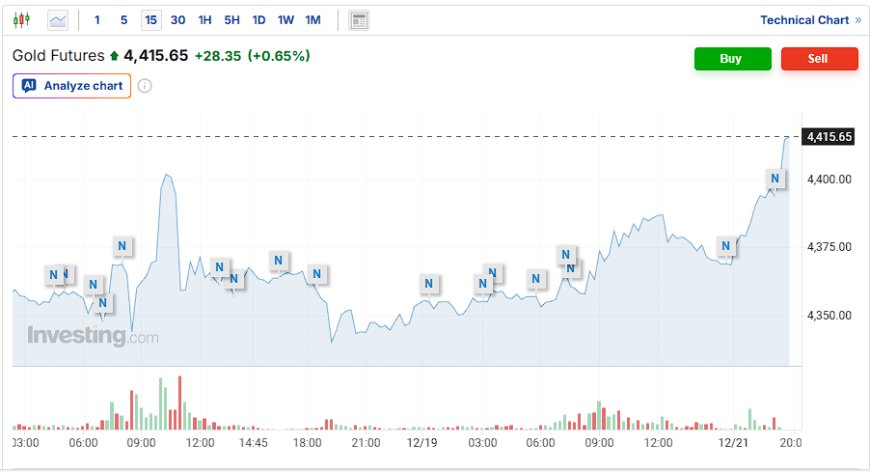
The latest chart action — a steady rise into year-end and a controlled advance through the 4,400 zone — confirms what the Pattern Nexus framework projected. Gold has shifted from a volatility hedge into a liquidity anchor. No blow-off top. No speculative surge. Just quiet confirmation that gold is now embedded inside the system’s baseline architecture.
Gold is not exploding because there is no panic. It is holding altitude because the system is fragile but managed — the precise environment where gold stops behaving like a trade and starts behaving like infrastructure.
Recap: The Original Thesis
When QT ended without ceremony, it validated a core Pattern Nexus premise: liquidity mechanics matter more than narratives. Markets price flows and constraints first. Headlines follow later.
Gold responded before confirmation. By the time the Fed officially halted balance-sheet runoff and Treasury operations began stabilizing reserve levels, gold had already repriced. It was never waiting for an emergency QE announcement. It was responding to the end of liquidity withdrawal itself.
The original thesis was explicit: gold does not moon simply because QT ends. It reprices to reflect the regime shift — then it holds. Explosive upside requires disorder, not normalization.
Gold is an anticipatory asset. It prices regime transitions, not press conferences. That is why it often looks “early” to narrative-driven observers.
Phase Dynamics: Why QT Ending and QE-lite Don’t Produce Moonshots
Many investors still treat QT, QE, and liquidity as binary switches. They are not. They operate through phases.
- Phase 1: QT and withdrawal. Liquidity drains, funding tightens, marginal leverage breaks.
- Phase 2: Anticipation. Forward-looking assets reprice before confirmation.
- Phase 3: Stabilization. QT ends. QE-lite begins. Volatility compresses.
- Phase 4: Disorder or equilibrium. Either the system breaks, or it drifts in managed fragility.
Gold’s sharpest repricing usually happens in Phase 2. By Phase 3 — where we now clearly are — the move is already embedded. Expecting a moonshot here is a category error.
QE-lite does not create panic bids. It prevents panic. That distinction is critical.
What Has Changed — And What Hasn’t
Unchanged
- Systemic fragility remains present.
- The global system remains management-heavy.
- Gold remains a credibility hedge, not a growth asset.
Changed
- QT is definitively over. Balance-sheet contraction is no longer active.
- QE-lite is already in motion. Roughly $45B in Treasury purchases have returned reserves to the system.
- Gold has confirmed a new structural band above 4,400.
This is not excitement. This is acceptance.
Markets are no longer debating whether gold should be here. They are treating this level as normal.
Gold’s Current Structural Behavior
Gold is not acting like a momentum asset.
- Volume is controlled.
- Price discovery is deliberate.
- Pullbacks are shallow and quickly absorbed.
That is not speculative behavior. It is institutional, reserve-driven allocation. Gold is being placed, not chased.
This is what a plateau regime looks like: a market that has repriced and now holds altitude without urgency.
The gold chart is functioning as a liquidity sensor. It is measuring baseline confidence, not fear.
Liquidity Plumbing Update: QT Over, QE-lite Active
This is the most misunderstood part of the current environment.
QE-lite is not emergency stimulus. It is system maintenance. Roughly $45 billion in Treasury purchases are not designed to spark risk-on behavior — they are designed to ensure reserves, collateral, and funding markets remain functional.
- Reserve buffers are being rebuilt.
- Collateral chains are being stabilized.
- Rollover risk is being actively managed.
This kind of liquidity expansion supports higher asset baselines without producing vertical charts. It raises the floor, not the ceiling.
Gold thrives in transition. Once transition completes and stabilization begins, gold’s role shifts from acceleration to anchoring. That is exactly what we are observing.
What’s Bidding Gold Here
There is no single driver. There is a stack.
Structural allocation
Gold remains the only widely accepted non-liability reserve asset. In a world where balance-sheet risk matters, that role strengthens under QE-lite, not weakens.
Managed fragility
QE-lite signals fragility, not strength. The system can function, but only with ongoing intervention. Gold prices that reality.
Absence of speculative excess
The lack of a blow-off is constructive. It implies durability, not exhaustion.
What Would Actually Make Gold Break Out
Gold will not accelerate simply because QE-lite exists. It accelerates when QE-lite fails.
- Funding market seizure
- Sovereign rollover accident
- Currency credibility event
- Major geopolitical commodity disruption
Absent those, gold’s job is to sit where it is and remind the system where risk lives.
What This Means Going Forward
Gold is not supposed to be exciting right now.
QT is over. QE-lite is active. Volatility is suppressed. The system is managed.
Gold holding above 4,400 tells you everything you need to know: the system is stable enough to function, but fragile enough to require permanent support.
That is not a trade. It is a regime marker.
And it has now been confirmed.
PN Lens
Pattern Nexus Lens: When QT ends and QE-lite replaces it, gold does not moon — it anchors. Plateau behavior above prior regime ceilings signals managed fragility, not failure.
FAQ
Is QE-lite bullish for gold?
Yes — structurally. It supports a higher baseline, not a vertical spike.
What would be bearish?
A genuine return to durable equilibrium without intervention. That remains unlikely.
Is gold a trade here?
No. It’s a system signal.
Sources
- Federal Reserve balance sheet data
- U.S. Treasury purchase and rollover data
- Gold spot and futures pricing
- Repo and funding market indicators
Menene Martaninka?
 Kamar
0
Kamar
0
 Karya
0
Karya
0
 Kauna
0
Kauna
0
 Ban dari
0
Ban dari
0
 Wao
0
Wao
0
 Bacin rai
0
Bacin rai
0
 Fushin
0
Fushin
0

Nexus (Christopher)
Founder of Pattern Nexus. I research markets, macro, geopolitics, AI, history, ancient systems, and the patterns most people overlook. I’m also building Market Radar, a trading scanner designed to read pressure, risk, confirmation, and setup quality before ch…
Related research
Gold Didn’t Moon — It Front-Ran Liquidity (Again)
Gold didn’t spike randomly — it front-ran liquidity, real-rate pivots, and QT stress exactly like we’ve been discussing. Here’s the long-te…
7 shared topics, 1 shared asset, same research avenue.
Gold’s Rough Day Doesn’t Change the Bigger Picture: A Natural Correction in a Structural Bull Market
Gold is pulling back to $4,210 after its record-breaking rally above $4,400, but this retracement is part of the natural rhythm of the mark…
5 shared topics, 1 shared asset, same research avenue.
The Liquidity Crunch Nobody’s Talking About: How Repo Stress, Bank Failures, and a “False Surplus” Are Fueling Gold’s Breakout
A hidden liquidity crisis is forming under the surface of global markets. Repo markets are flashing stress, regional banks are reporting fr…
4 shared topics, 1 shared asset.
Sharhu (0)
Security Check
Please complete the captcha to verify you are human.