

Why Hard Work Won’t Save Gen Z in the AI Era
A deep dive into Gary Shilling’s warning that young people will need to work harder in the AI era—and why hustle alone isn’t enough. This long‑form article explores the end of the industrial work ethic, the rise of automation, and the new rules for generational success.

A deep dive into Gary Shilling’s warning that young people will need to work harder in the AI era—and why hustle alone isn’t enough. This long‑form article explores the end of the industrial work ethic, the rise of automation, and the new rules for generational success.
Jump to a section
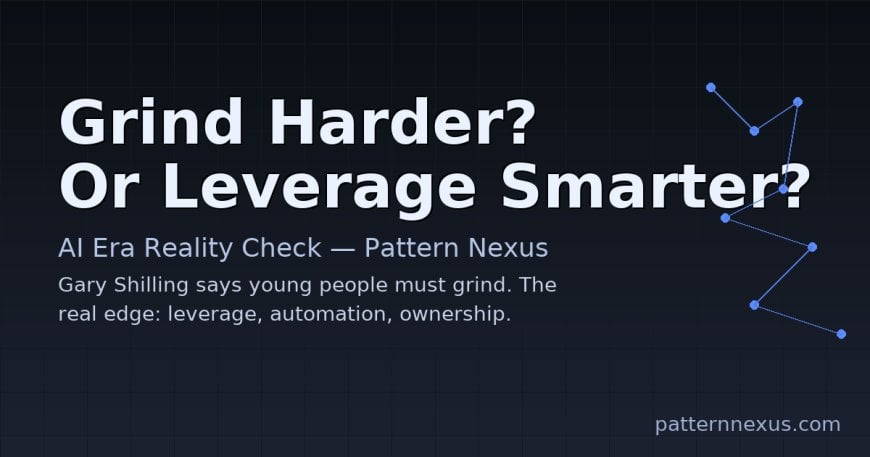
Why Hard Work Won’t Save Gen Z in the AI Era
By Chris @ Pattern Nexus
In late October 2025, veteran economist and forecaster Gary Shilling told Business Insider that young people are “going to have to work a lot harder” to succeed in the artificial-intelligence age and that many will end up worse off than their parents[1]. Shilling—celebrated for predicting both the dot-com crash and the housing bust—warned that AI could displace workers, forcing some into menial jobs and leaving them with limited incomes and purchasing power[2]. He argued that the world doesn’t owe anyone a living and urged young people to hustle, acquire new skills, and find ways to add value or face the prospect of economic stagnation[3].
Shilling’s remarks tap into a broader, anxiety-ridden conversation about how automation and algorithmic systems are transforming the nature of work and wealth. They also expose a tension between the long-held belief that hard work yields prosperity and the emerging reality that ownership of intellectual property, data, and network effects now drives economic gains. This article will unpack Shilling’s warnings, contextualize them within macroeconomic and technological trends, and argue that while hustle remains necessary, it must be coupled with strategic leverage in order to thrive in the AI era.
1. The End of the Industrial Work Ethic
Generations raised in the 20th century were taught that success stemmed from diligent labor, punctuality, and loyalty to institutions. Those values were not arbitrary; they reflected the structure of the industrial economy. Manufacturing and services were labor-intensive. Marginal returns to labor were relatively linear, meaning each hour worked produced a somewhat predictable amount of output. Wages, benefits, and stable career trajectories rewarded perseverance. Home ownership, pensions, and healthcare coverage underpinned the promise of upward mobility.
But as the 21st century has unfolded, the economic landscape has shifted. Productivity growth has increasingly derived from capital and technology rather than labor. Digital platforms, advanced robotics, and AI systems have rendered certain categories of work obsolete, from manufacturing jobs to routine white-collar tasks. The COVID-19 pandemic accelerated automation investments across industries. And while new jobs have emerged—data science, machine-learning engineering, digital content creation—the supply of such roles remains limited relative to the scale of automation.
Shilling encapsulated this shift when he noted that AI will likely displace some workers and leave them “selling hamburgers on the corner”[4]. His imagery evokes a gig-economy future in which those who lack specialized skills may be forced into low-wage service work. More importantly, he highlights that the distribution of economic gains is changing: productivity improvements accrue to those who own or control the machines rather than those who operate them. In other words, the new economy rewards ownership of capital and intellectual property far more than raw effort.
2. Historical Context: From Labor to Leverage
To understand why hard work alone no longer guarantees prosperity, it helps to compare the current era with past technological shifts. During the Industrial Revolution, the mechanization of agriculture and manufacturing displaced craft workers but also created millions of factory jobs. Industrialists needed bodies to operate machines and assemble goods. Although wages were low at first, unions and political reforms eventually improved working conditions. The rise of the 20th-century corporation provided career ladders, pensions, and training.
The Information Age that began in the late 20th century changed this dynamic. Personal computers, the internet, and mobile devices digitized information flows and automated data processing. As intangible assets (software, patents, trademarks, data) became more valuable than tangible ones (factories, machines), firms could scale globally with fewer workers. A single piece of code could serve millions of users at negligible marginal cost. Network effects created winner-take-all markets, where dominant platforms captured outsized profits.
In this environment, the returns to labor became bifurcated. High-skill jobs in software engineering, finance, and design enjoyed rising wages due to scarcity and global demand. Meanwhile, middle-skill roles (clerical, manufacturing, basic accounting) stagnated or disappeared. Many workers turned to gig platforms (ride-hailing, delivery, freelance marketplaces) that provided flexibility but little job security or benefits. Home ownership and retirement savings became increasingly elusive for younger generations.
Shilling warned that young people will need to adapt to the realities of this new world[5]. But what are those realities? They include exponential returns to capital, the dominance of intangible assets, and the diminishing correlation between hours worked and income earned. Productivity is now driven by algorithms and automation; value accrues to those who own the code or the platform rather than those who sell their labor. Thus, “working a lot harder” in the traditional sense may not deliver the wealth that previous generations enjoyed.
3. The Generational Wealth Divide
One reason Shilling’s comments resonated is that many young adults already feel they are falling behind their parents. A growing body of research shows that Millennials and Gen Z have lower net worth, higher student debt, and less access to home ownership than previous cohorts at the same age. A 2024 study by the Federal Reserve concluded that the median net worth of households headed by someone under 35 was 20% lower (in real terms) than it was for Baby Boomers at the same stage of life.
Several factors contribute to this gap:
- Inflated Asset Prices: Low interest rates and quantitative easing have inflated real estate and stock market values. Younger households have difficulty saving for down payments while wealthier, older cohorts benefit from asset appreciation.
- Student Debt: College tuition has outpaced inflation for decades. Many graduates enter the workforce with significant debt burdens that reduce their ability to save.
- Job Polarization: The decline of mid-wage jobs and growth of low-wage service work has compressed the middle class. New entrants often start at lower wages and see slower income growth.
- Pension Erosion: Employer-provided pensions have given way to defined-contribution plans that shift investment risk to individuals. Many Gen Z workers lack retirement plans altogether.
- Housing Costs: In major cities, housing costs have far outpaced wage growth, consuming a disproportionate share of young workers’ incomes.
Given these structural headwinds, the idea that hard work alone will generate wealth seems increasingly improbable. Shilling himself noted that the lives of young people are likely to involve “limited incomes and purchasing power”[6]. Without radical changes—such as improved access to equity ownership, universal basic income, or new forms of collective bargaining—many may indeed end up poorer than their parents.
4. AI’s Impact on the Labor Market
The core of Shilling’s warning concerns the disruptive impact of artificial intelligence on employment. Machine-learning models and robotics are rapidly advancing in tasks once thought uniquely human: natural-language processing, pattern recognition, decision-making, and even creative production. Large language models can write code and compose articles; computer vision systems can inspect parts and drive vehicles. As AI becomes more capable, some jobs will disappear entirely, while others will be radically reconfigured.
The economics of AI exacerbate winner-take-all dynamics. Training large models is expensive, but once created, they can serve millions of users at near-zero marginal cost. Companies that own the most powerful models and data sets can dominate markets, undercutting competitors and capturing economic rents. Workers, by contrast, cannot replicate their output across millions of customers; their time is finite.
Will AI create more jobs than it destroys? Historical evidence suggests that technological revolutions ultimately lead to net job creation—but only after periods of painful adjustment. The difference now is the pace of change and the scope of tasks AI can perform. To remain relevant, human workers must complement AI rather than compete with it. That means developing skills in areas such as:
- AI Literacy: Understanding how machine-learning models work, their limitations, and how to use them effectively.
- Complex Problem-Solving: Applying domain expertise to interpret outputs and make ethical judgments.
- Interdisciplinary Thinking: Combining insights from technical, social, and creative fields.
- Network Building: Cultivating professional relationships and communities that share information and resources.
Merely working longer hours will not provide these advantages. Instead, individuals must invest time in education, continuous learning, and building leverage—the ability to achieve outsized outcomes from small inputs. Leverage comes from owning code, data, or distribution channels; from building networks and audiences; and from automating tasks so that one’s time is multiplied by machines.
5. Hustle vs. Leverage: Shifting the Success Paradigm
Shilling urges young people to “hustle” and “add value”[7], but the meaning of hustle has evolved. In the gig-economy era, hustle has come to signify working multiple jobs or side gigs to make ends meet. Yet this kind of hustle can become self-defeating if it doesn’t generate capital ownership or compounding returns. A driver who completes more rides may earn extra cash today, but their earnings don’t scale; they are trading time for money at a fixed rate.
True leverage requires building or acquiring assets that generate revenue without constant labor input. This can include:
- Software and Automation: Writing code or developing tools that others pay to use. Once built, software scales with minimal ongoing effort.
- Content and Audience Building: Creating educational materials, podcasts, or community platforms that attract subscribers or advertisers.
- Equity Ownership: Taking equity stakes in startups, cooperatives, or decentralized autonomous organizations (DAOs) that could appreciate over time.
- Network Effects: Growing communities or user bases that become more valuable as more people join, thus increasing bargaining power.
- Platforms and Marketplaces: Operating marketplaces that match buyers and sellers or host transactions, collecting fees at scale.
These strategies align with the economic logic of the AI era: they harness technology’s scaling properties rather than simply working harder within a linear framework. Entrepreneurs and creators who own code or distribution stand to benefit from AI’s productivity gains; those who supply labor to automated systems risk being commodified.
6. Adapting Education and Policy
Individuals can take steps to prepare for the AI era, but systemic changes are also required. Shilling emphasizes personal responsibility—“The world does not owe any of us a living”[8]—but policymakers and educators must also ensure that the next generation has access to the tools and knowledge necessary to succeed.
Education. Traditional curricula often lag behind technological change. Schools need to integrate AI literacy, data science, and critical thinking across disciplines. Entrepreneurial education should teach students how to build products, manage intellectual property, and participate in digital economies. Apprenticeships and project-based learning can provide hands-on experience with emerging technologies.
Lifelong Learning. Rapid technological change necessitates continuous skills upgrades. Governments and employers can support workers by subsidizing training, offering micro-credentialing, and providing on-the-job upskilling. Lifelong learning should be accessible and affordable, recognizing that careers may span multiple industries and skill sets.
Social Safety Nets. As automation displaces jobs, social safety nets will play a critical role in smoothing transitions and preventing poverty. Proposals such as universal basic income (UBI), negative income taxes, and portable benefits aim to decouple survival from employment. While Shilling suggests that limited incomes and purchasing power may be inevitable[9], targeted social programs could mitigate the worst impacts.
Ownership Innovation. New economic models—cooperatives, DAOs, community land trusts—allow participants to share in the gains of collective endeavors. Policy frameworks that encourage employee ownership, platform cooperatives, and decentralization could democratize the benefits of AI. These models can help individuals move from pure laborers to partial owners of productive assets.
7. Reframing Success: Purpose and Well-Being
Another dimension often overlooked in conversations about generational success is well-being. The 20th-century work ethic prioritized economic output over personal fulfillment, leading many to equate long hours with virtue. However, surveys show that Gen Z values work–life balance, mental health, and social impact as much as or more than material wealth. Rather than simply striving to replicate their parents’ economic status, many young people aspire to meaningful work, flexible schedules, and sustainable lifestyles.
Shilling’s claim that working leads to longevity[10]—he remains active at age 88 and attributes his vitality to continuing his work—suggests that purposeful engagement can indeed prolong life and provide satisfaction. Yet purpose does not necessarily mean grinding for an employer; it can come from creative pursuits, community building, or projects that align with one’s values. In the AI era, where machines take over routine tasks, humans may have more freedom to focus on what makes us uniquely human: empathy, storytelling, problem-solving, and art.
If we frame success not solely in terms of out-earning our parents but in terms of building meaningful, sustainable lives, then the generational wealth gap becomes less threatening. Policies that ensure basic economic security can enable people to pursue purpose. And by leveraging AI to automate drudgery, we can free up time for higher-order activities.
8. Debunking Myths About Gen Z Laziness
Shilling implied that some young people are not convinced they need to dig in and work[11], hinting at a stereotype of lazy or entitled youth. This perception has surfaced repeatedly across generations—Boomers were once derided by their elders as lazy hippies—but may not reflect reality. In fact, Gen Z students and workers often juggle multiple responsibilities: part-time jobs, side hustles, volunteer work, and social activism. They face precarious housing, climate anxiety, and political polarization.
Research by the Stanford Center on Poverty and Inequality shows that young people are working similar or greater hours compared with prior cohorts at the same age. The difference lies in compensation and stability. The gig economy lacks benefits and career progression; entry-level salaries have not kept pace with living costs. Accusing Gen Z of laziness ignores the structural barriers they face.
Moreover, Gen Z’s skepticism about traditional work may reflect rational adaptation. When wages stagnate, costs rise, and automation threatens job security, it is logical to seek alternative paths: gig work to gain flexibility, entrepreneurship to capture upside, activism to change policies, or creative pursuits that provide fulfillment outside of the labor market. Questioning the value of “grinding” in a broken system is not laziness; it is critical thinking.
9. The Power of Collective Action
While individual adaptation is essential, collective action remains a potent force for shaping the future of work. History shows that organized labor movements, civil rights campaigns, and social activism have secured rights and benefits that individual hustle could not. In the AI era, new forms of collective action may involve:
- Data Cooperatives: Communities pooling their data and negotiating collectively with platforms for fair compensation.
- Platform Worker Unions: Gig workers organizing to demand fair wages, benefits, and algorithm transparency.
- Policy Advocacy: Movements pushing for regulation of AI and corporate power, antitrust enforcement, and worker-ownership incentives.
- Community Wealth Building: Local initiatives like community land trusts, credit unions, and worker-owned businesses.
These collective strategies recognize that structural problems require structural solutions. They also reflect a shift from the individualism often celebrated in tech culture toward a recognition of interdependence. In a world where digital platforms shape our lives, collective bargaining can help ensure that the benefits of AI are widely shared rather than concentrated in a few corporate hands.
10. Conclusions: A Nuanced Take on Shilling’s Warning
Gary Shilling’s admonition that young people must work harder in the AI era contains both truth and blind spots. It is true that complacency is dangerous in a fast-changing economy. Continuous learning, adaptability, and initiative are essential. It is also true that many jobs will disappear and that those without specialized skills may struggle to maintain their living standards. Shilling’s emphasis on hustle and value creation highlights important personal responsibilities.
However, Shilling’s focus on hard work overlooks the structural changes that have decoupled labor from prosperity. Simply working longer hours cannot overcome the fact that AI and automation generate exponential returns for asset owners. Without ownership or leverage, hustle becomes a treadmill. A more complete strategy for Gen Z involves building and acquiring assets, creating or participating in networks, and leveraging technology to amplify one’s efforts.
Policy makers, educators, and communities have roles to play as well. Preparing young people for the AI era requires investing in education, redesigning social safety nets, and promoting inclusive ownership models. It also demands a cultural shift away from equating long hours with moral virtue and toward valuing well-being, creativity, and sustainability.
Ultimately, the AI revolution is not just an economic transformation; it is a societal one. If we embrace automation as a tool to reduce drudgery and free humans to pursue higher-order pursuits, we can craft a future where both individuals and communities flourish. But this will not happen automatically. It will require both individual adaptation and collective action—hustle and leverage, purpose and policy. For Gen Z, the challenge is not to grind harder in a broken system; it is to help design a new one.
Sources
- IndexBox — “Young People Must Work Harder in AI Era, May Be Worse Off Than Parents, Forecaster Warns.” (summary of BI interview). Link ↩
- IndexBox — on displacement and limited purchasing power. Link ↩
- IndexBox — on “the world does not owe any of us a living” and the need to hustle. Link ↩
- IndexBox — “selling hamburgers on the corner.” Link ↩
- IndexBox — on adapting to new realities. Link ↩
- IndexBox — “limited incomes and purchasing power.” Link ↩
- IndexBox — “hustle” and “add value.” Link ↩
- IndexBox — “The world does not owe any of us a living.” Link ↩
- IndexBox — on limited purchasing power inevitability. Link ↩
- IndexBox — Shilling on working and longevity. Link ↩
- IndexBox — young people “don’t seem all that convinced that they’ve got to really dig in.” Link ↩
- Business Insider — “A legendary economist says Gen Z will have to work a lot harder to survive the AI era — and may end up poorer than their parents.” Link
- Federal Reserve studies and macroeconomic analyses on generational wealth, job polarization, and productivity growth (background context).
- Historical analyses of automation, AI development, and future-of-work trends (background context).
This article is part of the Pattern Nexus series on macroeconomics, technology, and societal change. For shorter versions of these insights, check out our social posts linked above.
Menene Martaninka?
 Kamar
0
Kamar
0
 Karya
0
Karya
0
 Kauna
0
Kauna
0
 Ban dari
0
Ban dari
0
 Wao
0
Wao
0
 Bacin rai
0
Bacin rai
0
 Fushin
0
Fushin
0

Pattern
Related research
The Two- (or Three-) Speed Economy: Automation Is Fracturing Growth — Why MMT-Style Tools Become Inevitable
Inflation cools, rents slip, unemployment edges up—yet productivity rises. Automation is splitting the economy into winners and the automat…
3 shared topics.
Why Artificial Intelligence needs an ethical approach.
Originally written by Christopher Grenke in 2022, this paper examines artificial intelligence, trust, ethics, human values, algorithmic bia…
2 shared topics, same research avenue.
The 2026 System Pressure Poll: Where Are America and the World Actually Going?
This is not another left-versus-right approval poll. The Pattern Nexus System Pressure Poll examines the deeper structures shaping curre…
2 shared topics, same research avenue.
Time Isn’t Real, It’s a Coordination Layer: Why the World Still Pretends Time Zones Are Natural
2 shared topics, same research avenue.
Alone Together: The Dual Impact of the Internet and AI
From AOL chat rooms to artificial intelligence, technology has redefined connection and isolation. The evolution of the internet reshaped s…
2 shared topics, same research avenue.
The World I’ve Been Mapping Is Taking Shape
I connect the developments now taking shape across AI infrastructure, private power, critical minerals, the Iran energy shock, digital doll…
2 shared topics.
Sharhu (0)
Security Check
Please complete the captcha to verify you are human.