
Signal in the System: USS Gerald R. Ford Deployment and the Next Phase of U.S. Power Consolidation
The U.S. Navy’s Gerald R. Ford carrier deployment near Venezuela isn’t about drug interdiction — it’s the next signal in a global realignment. From digital money to military logistics, this move marks the convergence of economic, narrative, and kinetic power inside the Pattern Nexus system.

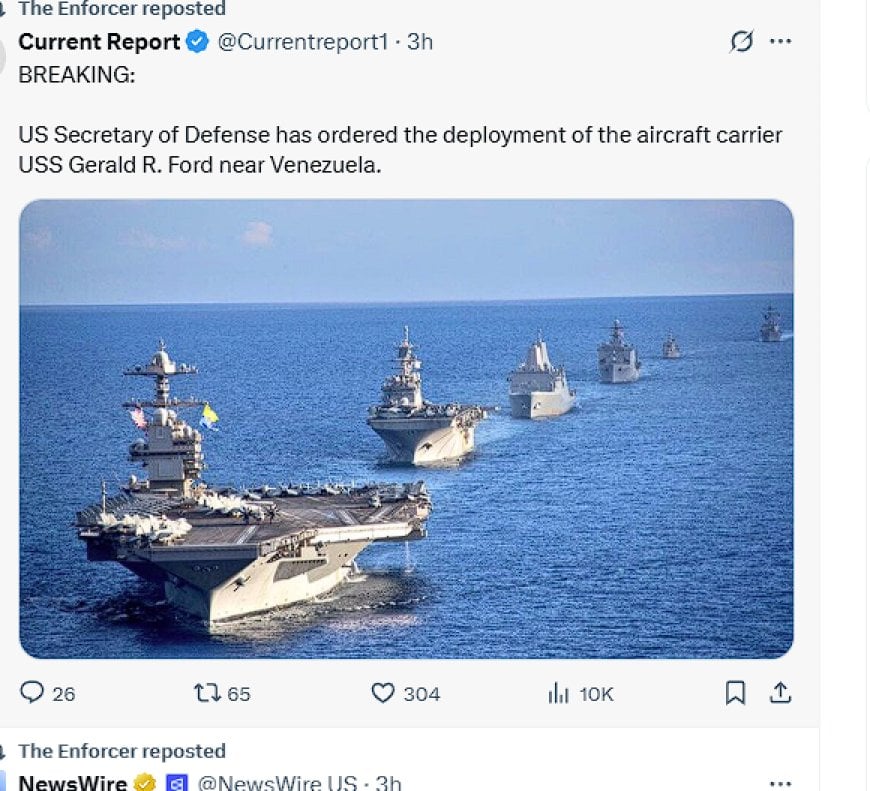
Signal in the System: The Ford Deployment and the Next Phase of U.S. Power Consolidation
Published October 24, 2025 | by Pattern Nexus
The recent deployment order sending the USS Gerald R. Ford (CVN-78) to the Southern Command (SOUTHCOM) theater — officially to conduct counter-narcotics operations — marks more than a military maneuver. It represents a visible node in the deeper systemic realignment of 2025. This is not an isolated act; it is the continuation of a pattern we have been tracking for months through Consolidating Power: The Global Carrier Pattern and the Caribbean Surge and The Signal, Not the Show.
The System Repositions
When the United States deploys its most advanced carrier group toward Venezuela, it is not reacting — it is pre-positioning. Across all systems — economic, digital, and military — decentralization has peaked and consolidation has begun. The Caribbean, once a maritime backwater of Cold War logistics, has become the epicenter of multi-domain leverage once again. Its ports, airfields, and undersea communication routes are now as strategically critical as any oil field or stock exchange.
In Caribbean Surge: From Sea Strikes to Land Options, we outlined how U.S. SOUTHCOM quietly expanded interoperability between naval, amphibious, and intelligence assets. The Ford’s movement completes that triad — the kinetic backbone behind an emerging hemispheric network designed for rapid projection, not long-term occupation. It’s the architecture of flexibility: fast deployments, data-linked targeting, and immediate escalation capacity.
Corridors and Leverage
As detailed in SOUTHCOM’s Caribbean Buildup, the key to control in this new era isn’t territory — it’s corridors. Whoever dominates the pathways of trade, energy, and data flow dictates the shape of global leverage. The Caribbean serves as a pressure valve between the Atlantic, Pacific, and emerging Arctic lanes. Every vessel, satellite, and data relay through this region forms part of the same feedback system of control.
The Ford’s arrival in this theater reinforces the U.S. objective to secure the western hemisphere’s connective tissue ahead of an impending economic inflection point. When liquidity contracts, governments reassert physical control over the arteries that sustain their economies. In that context, this deployment isn’t about “drug interdiction” — it’s about system integrity.
Monetary and Kinetic Convergence
In Global Geopolitics Update 2025, we connected shifts in U.S. foreign policy with the simultaneous rollout of new digital-monetary systems. The Ford’s deployment aligns perfectly with that timeline. The U.S. Treasury is experimenting with blockchain rails for tokenized Treasuries while the Federal Reserve manages the liquidity drain of quantitative tightening. Simultaneously, defense assets are being redistributed to ensure strategic mobility and responsiveness to any financial or geopolitical contingency.
This is the convergence point — monetary, informational, and military systems synchronizing. The world’s reserve currency, its dominant naval force, and its digital infrastructure are being recalibrated together. It is no longer about separate domains; it’s one continuous operating environment. The Ford’s movement signals that coordination explicitly — a visual expression of systemic unity.
The Narrative Layer
As analyzed in The Regime Change Question, narrative framing often precedes kinetic escalation. “Counter-narcotics” has become the new “peacekeeping.” Every pivot of power needs a palatable pretext, and this is no exception. By using law enforcement language, Washington transforms strategic positioning into a narrative of humanitarian security — a playbook refined over decades of global operations.
This is why each phase — carrier deployments, bomber demonstrations, special operations staging — appears independent in mainstream coverage but forms a coherent chain in strategic reality. The pattern is coherence disguised as coincidence.
The Compression of Time
We’ve entered a stage where time-to-action is the ultimate currency. Once a strike group is positioned, decision windows collapse. The Ford’s proximity to Venezuela and Colombia means the U.S. can shift from deterrence to engagement within hours. This compression reduces cost, raises leverage, and amplifies deterrence signals across every theater — from the Caribbean to the Indo-Pacific.
This temporal compression mirrors the behavior of modern financial systems: high-frequency trades, instant settlement, and automated liquidity swaps. Control the tempo — and you control the system. The Ford’s deployment is a kinetic representation of that same principle.
The Broader Systemic Alignment
Each of the following elements is unfolding in synchrony — visible evidence that the system is adjusting as one machine:
- Carrier realignments across the Caribbean, Arabian Sea, and Pacific basins.
- Gold’s breakout as a collateral revaluation signal in global liquidity cycles.
- Tokenized debt instruments gaining traction within regulated financial markets.
- Central banks pivoting from interest-rate signaling to balance-sheet orchestration.
- Defense posture reforms integrating AI-driven logistics and autonomous targeting frameworks.
These are not isolated developments. They are synchronized adjustments of a single global architecture. The Ford’s movement is simply the physical proof of a transition already well underway — a reordering of how power, capital, and information interact.
Signal, Not the Show
As noted in The Signal, Not the Show, modern power projection no longer relies on direct confrontation. The movement itself is the message. Every deployment, exercise, or “counter-operation” is a data point in the information field — a signal to adversaries, markets, and allies alike. The Ford’s relocation communicates that the next phase of global restructuring will not remain confined to balance sheets or currency regimes; it will extend into physical space.
When monetary systems evolve, power follows the current — both digital and oceanic.
This deployment isn’t about Venezuela alone. It’s about the structure of a world where energy, data, and liquidity all flow through militarized pipelines of control. The Ford’s course is the system’s pulse — the rhythm of consolidation revealing itself in real time.
Where This Is Heading — The Return of the Monroe Doctrine
The trajectory is clear: the United States is re-establishing hemispheric dominance under a modernized version of the Monroe Doctrine — not declared through speeches, but demonstrated through posture. The Ford’s deployment, combined with the layered SOUTHCOM build-up we’ve documented across the last year, represents the practical re-assertion of “the Americas for America” — a twenty-first-century interpretation centered not on ideology, but on infrastructure control.
This new Monroeism isn’t about keeping European empires out; it’s about keeping multipolar influence contained. China’s port acquisitions, Russia’s technical assistance programs, Iran’s logistics nodes — all have quietly expanded into Latin America through economic corridors and energy contracts. The Ford’s movement southward is a signal that Washington intends to re-draw those boundaries. Instead of proclamations, the message is conveyed through positioning: carrier groups, security compacts, and synchronized economic policy.
In this model, hemispheric stability is measured through network sovereignty — who controls the data cables, who directs trade logistics, and who owns the digital infrastructure beneath it all. The U.S. is no longer projecting democracy; it’s projecting infrastructure dominance. The Caribbean and northern South America have become the pilot zone for this reintegration — a proving ground for what a post-globalized order looks like when regional hegemony is re-asserted under the language of “counter-illicit activity” and “supply-chain security.”
Expect to see this pattern deepen: joint-training “humanitarian” missions in Central America, expanded naval exercises in the Gulf, and increased investment flows tied to digital-currency partnerships that keep capital inside the hemisphere. These aren’t disparate actions — they’re the administrative layers of a new hemispheric order forming quietly beneath the noise of daily politics.
In essence, the United States is not returning to the old Monroe Doctrine — it’s remonetizing it. Power in the Western Hemisphere is being collateralized through liquidity, logistics, and law — a triad that fuses finance and force into one strategic instrument. The Ford isn’t just a warship; it’s a declaration that the Western Hemisphere’s systems — monetary, digital, and physical — will be realigned before the next cycle resets.
Vad är din reaktion?
 Gilla
0
Gilla
0
 Ogilla
0
Ogilla
0
 Kärlek
0
Kärlek
0
 Rolig
0
Rolig
0
 Wow
0
Wow
0
 Ledsen
0
Ledsen
0
 Arg
0
Arg
0
















Kommentarer (0)