
Orderly Stress: Why Repo Stability Is Masking Deeper Collateral Strain
Repo markets remain orderly even as settlement fails and benchmark collateral strain emerge. This analysis explains why stable SOFR, modest ON RRP and MBS repo usage, and limited Fed operations can coexist with deeper stress in collateral mobility and dealer balance sheets.
Orderly Stress: How a Stable Repo Market Is Masking a Deeper Collateral Constraint
The repo market is not panicking — but it is not loose, healthy, or unconstrained either. Stable rates, muted Fed operations, and contained usage volumes coexist with rising settlement fails and benchmark collateral scarcity. This is not calm. It is orderly stress — a regime where the system appears functional on the surface while binding tightly underneath.
Summary
Core conclusion: Repo markets are functioning, but only because stress is being absorbed through balance-sheet rationing, collateral segmentation, and settlement failure — not because liquidity is abundant.
A system can remain price-stable while becoming mechanically brittle. That is what we are observing now.
- ON RRP usage around ~$20B reflects a pressure valve, not excess liquidity.
- MBS repo usage around ~$14–15B reflects balance-sheet strain, not confidence.
- SOFR, TGCR, and BGCR remain inside policy bounds.
- Meanwhile, settlement fails in the on-the-run 10-year Treasury have surged to levels not seen since 2017.
This configuration defines orderly stress: a regime where the system avoids visible disorder by quietly restricting motion.
What Repo Actually Looks Like Right Now
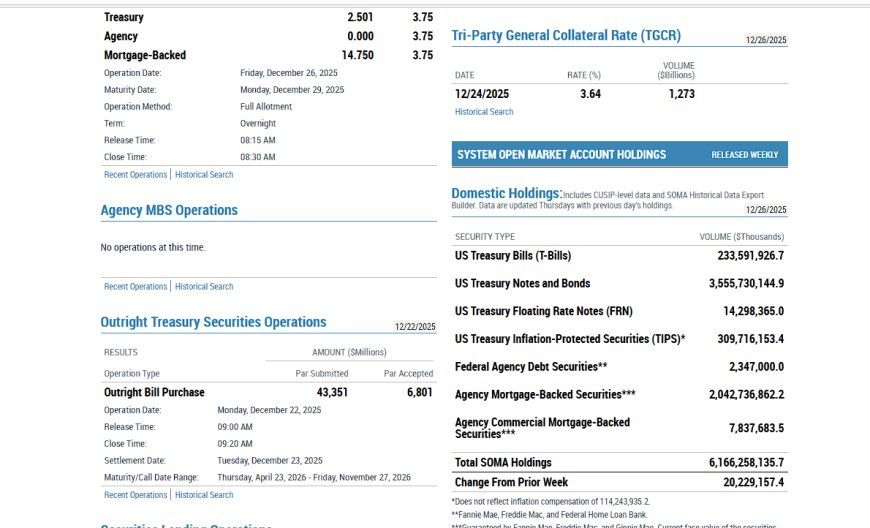
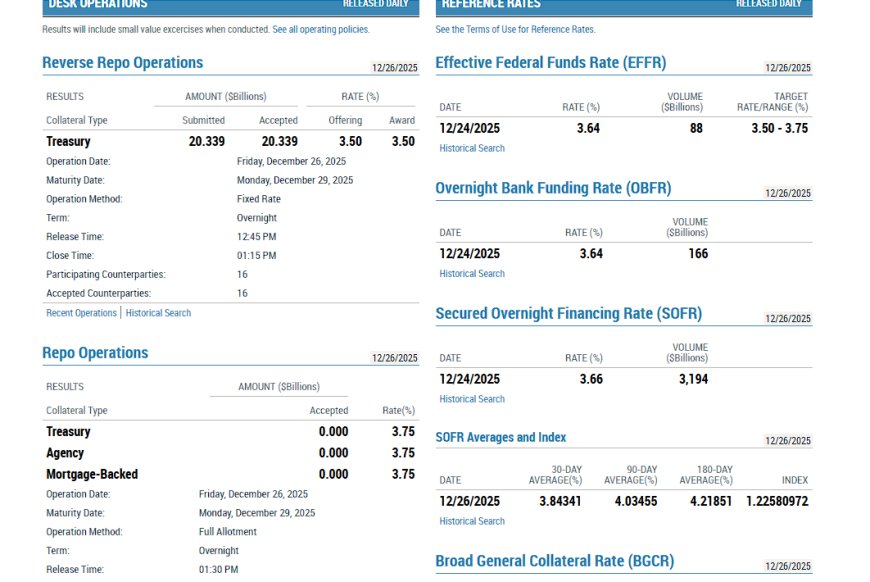
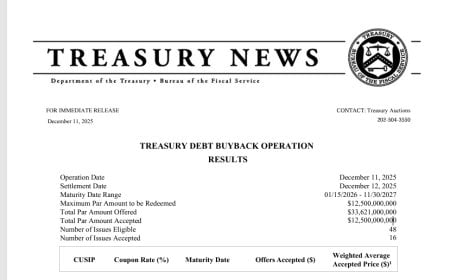
As of December 26, Fed Desk Operations show the following:
- Treasury ON RRP: ~$20B accepted
- MBS repo usage: ~$14–15B
- GC repo operations: 0 accepted
- SOFR: ~3.66%
- TGCR: ~3.64%
These numbers are not trivial — but neither are they indicative of generalized funding panic.
Funding is available. Rates are anchored. Cash is not scarce.
This is the critical nuance: Availability of funding does not imply availability of balance-sheet intermediation or collateral mobility.
Repo is doing what it is designed to do in this regime: price money efficiently while forcing the system to self-discipline elsewhere.
Why “Calm” Is a Misdiagnosis
Describing this environment as “calm” is analytically wrong.
A more accurate description is:
- Orderly: Prices remain inside policy corridors.
- Constrained: Dealer balance sheets are rationed.
- Segmented: Not all collateral clears equally.
Correct framing: The system is stable because it is restricting behavior — not because stress is absent.
In control-system terms, this is not equilibrium. It is damping.
The system is suppressing volatility by limiting throughput.
Funding Stress vs Collateral Stress
This is the distinction most commentary misses.
Repo markets price funding stress. Settlement systems reveal collateral stress.
Right now:
- Funding is available at known prices.
- General collateral trades normally.
- Specific benchmark collateral is intermittently unavailable.
That allows repo to remain orderly while delivery fails spike elsewhere.
Key system insight: A market can fund itself smoothly while failing to deliver the instruments it actually needs.
This is not a contradiction. It is a segmentation outcome.
Why This Is Not 2019 or 2020
| Metric | 2019 Repo Shock | March 2020 Crisis | Current Regime |
|---|---|---|---|
| Repo Rates | 8–10% spikes | Dislocated, volatile | Anchored |
| Fed Repo Usage | $75–100B daily | Hundreds of billions | Minimal |
| ON RRP | Irrelevant | Not primary tool | Low, active buffer |
| Dealer Balance Sheets | Overwhelmed | Frozen | Tight, rationed |
| Settlement Fails | Secondary signal | Explosive | Localized but sharp |
| Failure Mode | Funding shortage | Liquidity + credit | Collateral mobility constraint |
Conclusion: This is a different failure mode — quieter, more technical, and easier to misread.
Where the Stress Is Actually Showing Up
The real stress signal is not in repo rates.
It is in settlement.
The spike in fails in the on-the-run 10-year Treasury required none of the following:
- No funding panic
- No rate shock
- No loss of confidence
It required only:
- High benchmark demand
- Limited dealer-held float
- Stretched collateral reuse chains
Repo stayed orderly because money was available. Settlement failed because the bond was not.
PatternX System Interpretation
PatternX framing: Orderly stress is more dangerous than visible panic because it allows constraints to accumulate without triggering corrective response.
This regime reflects:
- Finite dealer intermediation capacity
- High dependence on collateral velocity
- Benchmark concentration effects
- Policy tools optimized for funding stress, not delivery stress
The system is not unstable.
It is inflexible.
What Comes Next
In an orderly-stress regime, resolution does not arrive through explosion.
It arrives through:
- Repeated settlement disruptions
- Migration of scarcity across benchmarks
- Quiet policy adjustments framed as “technical”
- Balance-sheet re-pricing rather than rate repricing
Final takeaway: Repo stability does not negate stress. It tells you the system is choosing where to place it.
Яка ваша реакція?
 Подобається
0
Подобається
0
 Неподобання
0
Неподобання
0
 Любов
0
Любов
0
 Смішно
0
Смішно
0
 Ух ти
0
Ух ти
0
 Сумно
0
Сумно
0
 Злий
0
Злий
0

Founder of Pattern Nexus. I research markets, macro, geopolitics, AI, history, ancient systems, and the patterns most people overlook. I’m also building Market Radar, a trading scanner designed to read pressure, risk, confirmation, and setup quality before chasing a move. Pattern Nexus is where I connect the dots between data, history, technology, and the bigger system playing out around us.















Коментарі (0)