
QT Is Over: The System Just Crossed Its Reserve Floor
The liquidity cycle has flipped. QT exhausted the reserve buffer, pushing the system into structural limits the Fed can’t ignore. This isn’t a debate — it’s a regime shift. From banking reserves to tokenized collateral, here’s what comes next.
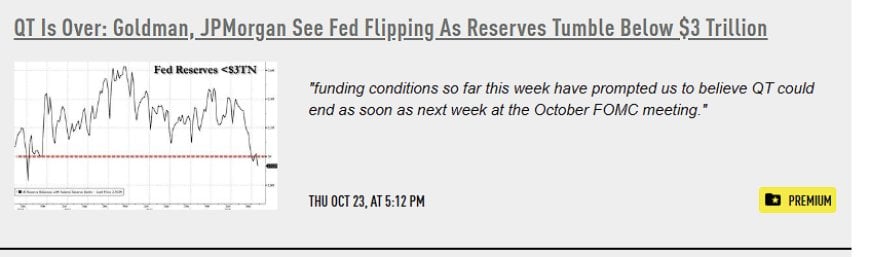
QT Is Over: The System Just Crossed Its Reserve Floor
Published October 23, 2025 | by Pattern Nexus
We just crossed the line I’ve been mapping for months. Not the line pundits argue about on TV. The system line — where quantitative tightening (QT) runs into the hard limits of banking reserves, collateral availability, and market plumbing. When that floor is hit, the game board changes. It’s not a “maybe.” It’s a structural constraint on how far policymakers can drain liquidity before something breaks that they actually care about.
If you’ve been following my work, you know this turn has been telegraphed: falling excess reserves, collapsing usage of easy buffers, stress rippling through funding channels, and a policy backdrop that can’t afford a real accident heading into an election-heavy world and a deglobalized commodity map. The net: QT has exhausted the true buffer. The next phase is stabilization, then quiet re-liquefication — call it “QE in practice,” whatever the branding.
The Reserve Floor Problem (Why QT Can’t Be Infinite)
Central banks like to suggest QT is a dial they can turn smoothly. Reality is jagged. Below a certain system-wide reserve level, funding markets become nonlinear: repo specialists get twitchy, dealers hoard the “right” collateral, and banks start prioritizing optionality over intermediation. You don’t see this in one neat headline; you see it in behavior — bid/offer dynamics, term premia, bill richness, and how fast stress transmits when a surprise hits.
At that floor, every marginal dollar drained from the system starts pulling connective tissue, not fat. That’s when policymakers change posture — sometimes publicly (rate guidance), more often mechanically (operations, pace adjustments, composition). We’re there.
How This Shows Up in Markets
- Rates & Term Structure: Front-end policy can still move, but the bias shifts toward accommodation via plumbing — slower balance sheet run-off, altered reinvestments, or facilities doing quiet heavy lifting.
- Credit Rationing & Risk: Lenders get selective. Spreads stop tightening on good news, widen quickly on bad news. Funding windows feel shorter; issuance timing matters more.
- Collateral Scarcity vs. Cash Scarcity: The dance flips back and forth. When reserves are scarce, “pristine” collateral levitates. That can make duration feel safe… until it doesn’t.
- Gold & Hard Assets: Not a religion — a mirror. When the system hints at re-liquefication, the pricing mirror tilts. Hard assets sniff first.
Policy: What Shifts Next (Label It However You Want)
Policymakers won’t hold a parade and announce “QT is over.” They’ll talk “prudence” and “stability,” then do the work. Expect one or more of the following:
- Slower QT Pace: The most frictionless lever. Let runoff decelerate without admitting defeat.
- Targeted Reinvestment Tweaks: Subtle changes in duration and composition to ease specific pressure points.
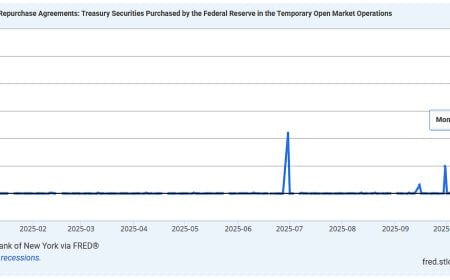
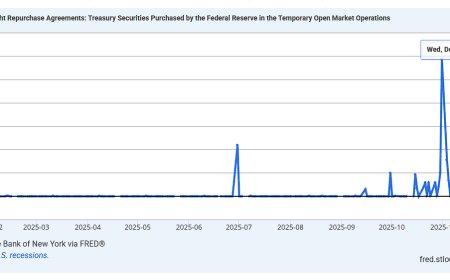
- Facility Usage as a Relief Valve: Periodic operations to cushion funding, keeping optics calm.
- Forward-Guidance as Camouflage: Talk “data dependence,” act to protect pipes. Optics matter.
The point isn’t what they say. It’s what the machine does. The machine is already turning.
Beyond Markets: Liquidity as Infrastructure for a Digitized Economy
Liquidity isn’t just about stocks and bonds. It’s the operating system for the next rails: tokenized treasuries, real-time settlement, programmable collateral, and a data-native dollar. A world shifting to 24/7 markets, streaming payments, AI-driven logistics, and machine-to-machine commerce can’t run on brittle, starved liquidity. That’s why each tightening cycle ends the same way: with a reluctant admission that the base layer must be funded if you want the future to actually boot.
What I’m Watching (Signals, Not Noise)
- Balance-Sheet Mechanics: Pace and composition of runoff vs. reinvestment; any “temporary” ops that look suspiciously permanent.
- Front-End Funding: Repo/term dynamics, bill richness, and dealer balance-sheet telltales.
- Collateral Behavior: On-the-run vs. off-the-run spreads; specialness in specific maturities.
- Cross-Asset Confirmations: Gold/hard assets, long duration’s reaction function, credit curve kinks.
- Policy Language vs. Plumbing: Dissonance between the press conference and what the pipes actually do.
Execution Mindset (Not Financial Advice)
This is a regime inflection, not a one-day trade. Positioning should respect higher path-dependency: liquidity windows open/close faster, dispersion increases, and headline shocks matter less than plumbing shifts. Survival is sizing; edge is timing; conviction is earned by reading the pipes, not the pundits.
Key Takeaways
- QT exhausted the real buffer; the system hit (or is skimming) its reserve floor.
- Policy will pivot in practice before it admits it in words.
- Re-liquefication supports the rails of a digitized, tokenized economy.
- Watch plumbing, not press releases.
Related Posts (Pattern Nexus)
- Fed’s October Pivot: Liquidity Cycles, Digital Dollar Frontier
- The Calm Before the Liquidity Storm: QE 2026 in Motion
- Daily Recap (Oct 22, 2025): Markets Brace for a Data-Blind Fed
- The Calm Before the Liquidity Storm
- Fed, MBS & Repo Operations: QE2026 and the Liquidity Cycle
- Era of Easy Money Ends — How Declining Liquidity Is Shaping Markets
Яка ваша реакція?
 Подобається
0
Подобається
0
 Неподобання
0
Неподобання
0
 Любов
0
Любов
0
 Смішно
0
Смішно
0
 Ух ти
0
Ух ти
0
 Сумно
0
Сумно
0
 Злий
0
Злий
0

Founder of Pattern Nexus. I research markets, macro, geopolitics, AI, history, ancient systems, and the patterns most people overlook. I’m also building Market Radar, a trading scanner designed to read pressure, risk, confirmation, and setup quality before chasing a move. Pattern Nexus is where I connect the dots between data, history, technology, and the bigger system playing out around us.















Коментарі (0)