
Unwinding the Yen Carry Trade: The $20 Trillion Question and the Coming Dollar Shockwave
The yen carry trade is the hidden leverage machine behind decades of global liquidity. Now, as Japan exits negative rates, up to $20 trillion in leveraged positions risk unwinding — triggering forced liquidations, global volatility, and a potential dollar spike driven by repatriation flows. This article explores how the unwind works, why it matters, and how dedollarization narratives collide with the coming dollar squeeze.

Unwinding the Yen Carry Trade: What it means for the Dollar and Global Markets
Are They Going to Raise Rates Again?
As of late-2025, markets remain focused on whether the Bank of Japan will raise rates again. The BoJ paused after its initial normalization move, but policymakers have repeatedly indicated that further adjustment depends on evidence of sustainable, wage-driven inflation. Japan’s October labor and earnings data showed continued wage growth momentum, keeping the possibility of another 25 bps hike alive.
Economists and traders widely expect at least one additional hike, potentially as soon as the December meeting, if wage-settlement trends hold. However, the path is likely to remain gradual, with the BoJ prioritizing stability and avoiding another shock to global funding markets.
Importantly, the BoJ is signaling a slower pace than markets initially priced in, which has contributed to the yen’s volatility. Every hesitation from the BoJ to accelerate tightening has opened the door for renewed yen weakness — and renewed carry activity — even as structural inflation signals firm up. In short: Japan is not done yet, but the tightening slope is shallow, and timing is data-dependent.
The implication for global markets is clear: every BoJ policy meeting now matters. A quicker path could trigger another wave of carry unwind pressure; a slower one encourages re-leveraging. Investors should expect policy-driven volatility in USDJPY, Japanese equities, and global liquidity conditions into 2026.
The yen carry trade has long been a quiet engine of global liquidity. By borrowing at near‑zero Japanese interest rates and investing the proceeds in higher‑yielding assets overseas, investors have created a vast network of leveraged positions. When the Japanese yen suddenly strengthens, those positions become vulnerable, forcing traders to repay yen loans and sell their foreign assets. In August 2024 the world got a taste of what a disorderly unwind looks like: a surprise rate hike by the Bank of Japan sent the yen soaring and triggered sharp declines in technology stocks and other risk assets.
To understand the stakes, this article explores how the carry trade works, how large it really is, how an unwind reverberates through global markets and the U.S. dollar, and why sensational figures—such as claims that unwinding could amount to US$20 trillion—don’t hold up to scrutiny. We also examine how the dollar’s role in the global system is evolving and whether a shift away from the greenback could cause repatriated dollars to strengthen it.
Late-2025 update: The August 2024 shock didn’t end the carry era—it reset it. Through 2025 the BoJ stayed cautious and data-dependent, the yen whipsawed as markets repeatedly mis-timed normalization, and speculative yen shorts quietly rebuilt when differentials persisted. In the U.S., money-market buffers thinned as reverse-repo usage fell toward zero while QT approached its practical limits. A rare split in safe-haven flows emerged: the dollar stayed firm even as gold notched fresh highs—classic stress-regime behavior that signals a more fragile global liquidity backdrop.

Understanding the Yen Carry Trade
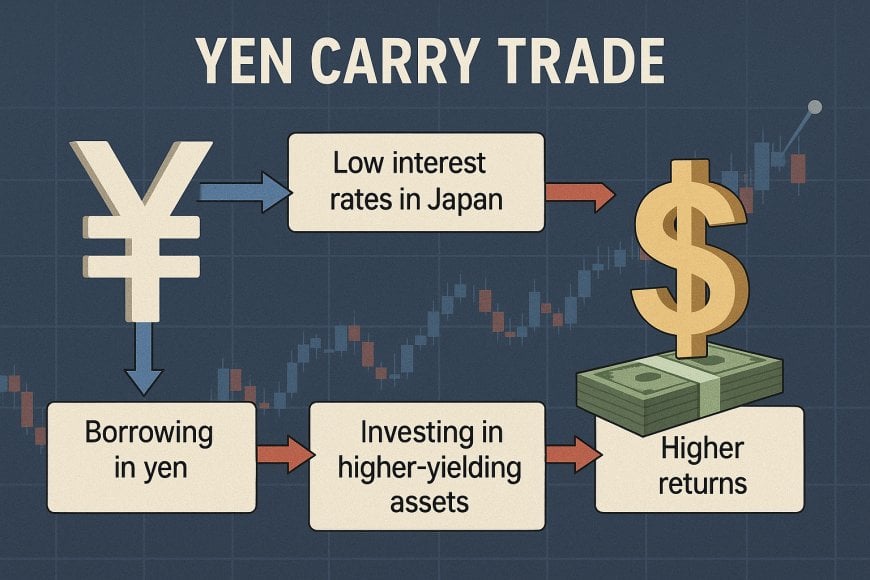
A carry trade is an investment strategy that borrows in a low‑interest‑rate currency and invests in higher‑yielding assets denominated in another currency. Japan’s ultra‑loose monetary policy made the yen the cheapest funding currency for decades. Investors could borrow yen at near‑zero cost and purchase U.S. stocks, Treasury bonds or other higher‑yielding securities, capturing the interest‑rate differential. Because the trade is often leveraged and uses derivatives such as forwards and futures, a small movement in the yen can erase months of returns.
In practice, carry trades exploit a persistent anomaly known as the forward premium puzzle: currencies with higher interest rates tend to appreciate rather than depreciate in the short term, making it profitable to borrow low‑yielding currencies. During the 2020s the yen carry trade became particularly popular because the Federal Reserve raised rates aggressively while the Bank of Japan (BoJ) kept rates near zero. By July 2024 speculators were heavily short the yen while holding large positions in U.S. technology stocks and other risk assets.
Sizing the Carry Trade: Separating Myth from Reality
Measuring the yen carry trade is notoriously difficult because it spans bank loans, bond investments and derivatives. Sensational figures—particularly the widely repeated assertion that a yen carry trade unwind could reach US$20 trillion—often arise from misinterpretations. In reality, most credible estimates are much lower:
- The Bank for International Settlements (BIS) estimated that total FX carry‑trade exposures heading into the August 2024 turmoil were roughly ¥40 trillion (about US$250 billion)—far below trillions of dollars.
- Reuters noted that short‑term external loans by Japanese banks (a narrow proxy for the trade) were about US$350 billion and that Japan’s foreign portfolio investments abroad totaled ¥666.86 trillion (~US$4.5 trillion), most of which are long‑term investments rather than leveraged carry trades.
- ING’s analysis of cross‑border yen lending showed that Japanese banks had about ¥157 trillion (US$1 trillion) in foreign yen loans to non‑banks, while their total yen‑denominated cross‑border claims were ¥328 trillion (US$2.2 trillion). These figures include legitimate trade and investment financing and therefore likely overstate speculative carry trades.
- The ASEAN+3 Macroeconomic Research Office (AMRO) reported that yen‑denominated loans to non‑bank borrowers rose to about ¥41 trillion by mid‑2024 and that yen claims to offshore financial centers totaled roughly US$579 billion.
- Analyst Jeffrey Kleintop used BIS data to estimate that foreign lending in yen totaled about US$1 trillion (145 trillion yen) as of March 2024, suggesting that any medium‑term unwind would be measured in hundreds of billions, not tens of trillions.
- The Financial Study Association Groningen noted that Japanese banks’ foreign lending reached US$1 trillion and that Japan’s net international investment position was ¥487 trillion (~US$3.3 trillion). However, most of these overseas investments are long‑term holdings by banks, pensions and insurance companies rather than leveraged carry trades.
- Back in 2007, Japan’s top financial diplomat guessed that the carry trade involved 10–20 trillion yen (US$85–170 billion)—a far cry from the US$20 trillion figure often circulated today.
- A widely circulated claim from a civil service study guide that the carry trade is “over US$20 trillion” appears to conflate Japan’s total foreign investments with leveraged carry trades and has no primary source to back it up.
These estimates suggest that the yen carry trade, while sizeable, is likely in the hundreds of billions to perhaps a couple of trillion dollars—not the tens of trillions implied by sensational headlines.
The 2024 Unwind and Market Impact
The turning point came on 31 July 2024 when the BoJ surprised markets by raising its policy rate to 0.25%—its first significant hike since the financial crisis. At the same time, a weak U.S. jobs report and hawkish BoJ guidance combined to drive the yen about 14 % higher versus the dollar. Speculative positioning flipped overnight: futures contracts betting against the yen were cut in half within days and were nearly flat by early August.
The sharp appreciation of the yen forced investors to unwind leveraged trades. Because many carry trades were used to fund long positions in U.S. technology stocks, the Nasdaq‑100 index tumbled about 13 %. Margin calls triggered a vicious cycle as traders sold dollars and bought back yen, which further strengthened the yen and pressured global equities. The S&P 500 fell 3 % and Japan’s Nikkei slumped more than 12 %, its steepest one‑day drop since 1987.
Jeffrey Kleintop describes this sequence as a “broad‑based margin call” where forced selling cascaded across asset classes. The International Monetary Fund noted that the unwinding of leveraged yen carry trades spurred sell‑offs in stock markets and highlighted how quickly risk‑off episodes can amplify volatility. The episode also underscored how interconnected global markets have become: a domestic policy shift in Japan caused ripple effects from Tokyo to New York.
The Yen Carry Reset (Q4 2024 → 2025)
Post-shock, carry didn’t vanish—it migrated. As the BoJ emphasized gradualism and optionality, rate differentials remained wide enough for leveraged funding in yen to re-form in new pockets and structures. Periods of yen strength forced tactical de-risking, but disappointing tightening cadence saw the yen weaken again, inviting re-engagement. Japanese pensions and insurers adjusted at the margin rather than executing a wholesale pull-home, and corporate Japan continued to deploy capital abroad when hedged returns cleared internal hurdles. The net effect: a reset from “crowded and complacent” to “rotating and more tactical,” with positioning flipping faster around policy events.
2025 Funding & Safe-Haven Dynamics
With front-end buffers thinner, marginal stress shows up more quickly in dollar funding spreads and basis. Treasury bill supply and reserve dynamics now transmit into risk appetite with less cushion than in 2023–2024. That matters for a yen-carry unwind: forced deleveraging can hit when dollars are already in demand for settlement and margin, supporting the dollar even as risk sells off.
Meanwhile, safe-haven flows have bifurcated. The dollar retains its settlement primacy, but gold is claiming a larger share of “trust insurance.” Seeing both bid at once is a hallmark of regimes where policy and geopolitical shocks arrive more frequently. In practice, this mix dampens the odds of a one-way dollar collapse even if some repatriation occurs, while keeping tail risks alive for assets that benefited most from cheap yen funding.
Implications for the Dollar and Global Markets
The yen carry trade matters for the U.S. dollar because borrowed yen often fund purchases of U.S. assets. When Japanese investors repatriate funds, they sell U.S. stocks and bonds, putting upward pressure on U.S. yields. The Schwab Center for Financial Research observed that if Japanese yields continue rising, banks, pensions and insurance companies may gradually bring money home, potentially nudging U.S. yields highe. However, Schwab analysts also noted that positioning has shifted: speculators are now long the yen and repatriation is likely to be slow, reducing the risk of sudden forced selling.
Currency dynamics also come into play. During risk‑off episodes investors around the world scramble for dollars to settle obligations. After the 2008 crisis, arbitrage limits segmented on‑shore and off‑shore dollar markets; in times of stress it becomes difficult for foreign borrowers to obtain dollars, causing covered interest parity deviations to widen. The Dallas Fed explains that this shortage forces borrowers to buy dollars on the spot market, pushing the dollar up. In other words, a carry‑trade unwind can paradoxically strengthen the dollar as investors rush to convert assets into the currency they need to repay dollar‑denominated liabilities.
The August 2024 episode therefore offers two lessons. First, yen strength can cause a sell‑off in U.S. risk assets when carry trades are crowded. Second, during times of market stress, the dollar often appreciates because it remains the world’s default funding currency—even when the stress originates from Japan.
Future Scenarios & Myth‑busting
Given the size of Japan’s external assets—banks, pensions and insurance companies hold trillions of dollars in overseas stocks and bonds—the unwind of the yen carry trade could continue to play out over months or years. However, the idea that a full unwind would amount to US$20 trillion is unsupported. Most credible estimates of speculative carry trades are between US$250 billion and US$1–2 trillion. Even if all yen‑denominated loans were repaid simultaneously, it would still be an order of magnitude smaller than global financial markets.
Markets have already adjusted. Speculators are now net long the yen, reflecting expectations of further BoJ tightening. Japanese institutions may repatriate some funds as domestic yields rise, but they are more likely to do so gradually. If volatility spikes again, the BoJ and Japan’s Ministry of Finance have tools—such as slowing quantitative tightening or cutting bond issuance—that can ease pressure. Therefore, a repeat of the August 2024 chaos is possible but not inevitable.
Dollar’s Global Role & De‑dollarization Pressure
The U.S. dollar remains the central pillar of the international monetary system. According to the Federal Reserve’s 2025 report, the dollar accounted for about 58 % of disclosed global foreign‑exchange reserves in 2024—down from 72 % in 2001 but essentially unchanged since 2022. The euro’s share was around 20 % and the yen’s share 6 %. The report also noted that the share of gold in reserves has increased mainly because of rising gold prices rather than a sharp reduction in dollar holdings. Foreign investors held roughly US$9 trillion of marketable U.S. Treasury securities as of early 2025.
Chatham House observes that the dollar still plays a dominant role in trade settlement and cross‑border finance. While the share of U.S. government debt held by foreigners has fallen from about 50 % in 2014 to a third by 2025, private investors rather than central banks have been the main drivers of recent inflows. This underscores a key point: the dollar’s strength is rooted less in its role as a reserve asset and more in the attractiveness of U.S. economic growth and high yields. Despite talk of “de‑dollarization,” Reuters reported in 2025 that foreign central banks continued to purchase U.S. Treasuries, and there was no evidence of an abrupt rotation away from dollar assets.
The slow erosion of the dollar’s share in reserves reflects diversification rather than a wholesale shift. At the same time, investors are allocating more to gold and smaller currencies. These trends could reduce the dollar’s “exorbitant privilege” over decades but are unlikely to cause a sudden collapse.
Could Repatriated Dollars Boost the Dollar?
A popular argument holds that if foreign holders of dollars and dollar‑denominated assets reduce their exposure, those dollars will “come home” to the United States and thereby increase the value of the dollar. Reality is more nuanced. When international investors sell U.S. assets and repatriate proceeds into their home currencies, they are effectively selling dollars, which tends to weaken the dollar by reducing demand. For example, analysts at Schroders noted that if U.S. growth falters and inflation stays high, international investors may repatriate assets to domestic markets, reducing demand for the dollar. In that scenario, other defensive assets such as gold could take market share from the dollar.
However, repatriation does not happen in a vacuum. Global risk‑off episodes—like the August 2024 carry‑trade unwind—often prompt flight‑to‑safety flows into dollars. Covered interest parity deviations and segmented dollar markets can produce shortages that drive the dollar higher. Thus, repatriation flows might coincide with safe‑haven demand, with opposing effects on the exchange rate.
Moreover, dollars held abroad are largely the liabilities of U.S. banks and Treasury securities; when foreign holders sell these assets, domestic investors may buy them. The net effect on domestic liquidity and exchange rates depends on monetary policy, interest‑rate differentials, and investor sentiment. There is little empirical evidence that repatriated dollars would automatically strengthen the currency. On balance, a gradual diversification away from the dollar is more likely to modestly reduce its value over time than to trigger a dramatic appreciation.
Conclusion
The yen carry trade illustrates how financial innovations can create hidden vulnerabilities. Because the trade involves borrowing cheaply in yen to invest abroad, sudden shifts in interest rates or exchange rates can force investors to unwind positions and create turbulence across global markets. The August 2024 episode shows how such an unwind can spill into U.S. technology stocks and prompt safe‑haven flows into the dollar.
Yet the size of the carry trade is often exaggerated. Credible estimates suggest exposures in the hundreds of billions rather than tens of trillions, and Japanese institutions are likely to repatriate capital gradually. Meanwhile, the U.S. dollar remains the world’s primary reserve currency despite a slow decline in its share of official reserves. De‑dollarization is a gradual, multi‑decade process, and there is scant evidence that repatriated dollars would cause a sudden surge in the currency’s value.
For investors, the key takeaway is risk management. Monitor interest‑rate differentials, central‑bank policies and positioning in currency and equity markets. Diversify exposure across currencies and asset classes, and be cautious about narratives that promise outsized movements without credible data. The yen carry trade’s unwind may be unsettling, but understanding its true scale and mechanics helps keep it in perspective.
Яка ваша реакція?
 Подобається
0
Подобається
0
 Неподобання
0
Неподобання
0
 Любов
0
Любов
0
 Смішно
0
Смішно
0
 Ух ти
0
Ух ти
0
 Сумно
0
Сумно
0
 Злий
0
Злий
0

Founder of Pattern Nexus. I research markets, macro, geopolitics, AI, history, ancient systems, and the patterns most people overlook. I’m also building Market Radar, a trading scanner designed to read pressure, risk, confirmation, and setup quality before chasing a move. Pattern Nexus is where I connect the dots between data, history, technology, and the bigger system playing out around us.


















Коментарі (0)