
Chiến dịch Venezuela: Maduro bị bắt, Caracas bị tấn công, và Mỹ tuyên bố kiểm soát tạm thời
Mỹ đã thực hiện một cuộc tấn công quy mô lớn ở Venezuela và tuyên bố đã bắt giữ Nicolás Maduro và Cilia Flores, chuyển họ sang quyền quản lý của Mỹ để truy tố. Báo cáo Pattern Nexus này tổng hợp các chi tiết đã được xác minh, các tuyên bố trích dẫn của Trump, các tuyên bố về hoạt động, các điểm yếu pháp lý và các tác động chiến lược về dầu mỏ và bán cầu.
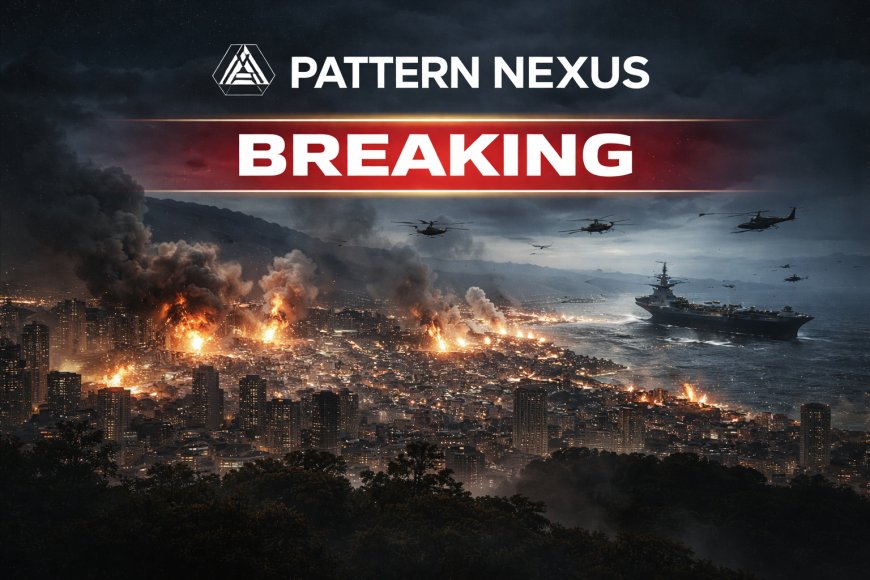
A sitting head of state removed in a U.S.-directed raid, moved to American custody, and framed as a narco-terror prosecution. This is a sovereignty shock, an oil lever, and a hemisphere doctrine test rolled into one event.
What We Know Right Now
- The U.S. carried out a “large-scale strike” in Venezuela early January 3, 2026, with explosions and aircraft activity reported in and around Caracas.
- President Trump publicly claimed U.S. forces captured Nicolás Maduro and also took Maduro’s wife, Cilia Flores, into custody.
- AP reporting states Maduro and Flores were removed from Ft. Tiuna (a major military base complex in Caracas) and transported to U.S. custody aboard a U.S. warship.
- Trump stated the U.S. will “run” Venezuela temporarily until a transition is arranged, explicitly rejecting the risk of a simple internal successor replicating the prior regime dynamics.
- The U.S. prosecution pathway is framed as narco-terror / drug kingpin accountability, with reporting indicating a new indictment and intent to prosecute in New York.
- The legal basis is contested: significant reporting emphasizes the absence of explicit congressional authorization and the international-law sovereignty questions the operation triggers.
Pattern Nexus note: in breaking events like this, early claims tend to be clean and absolute while independent verification lags. The correct approach is not “believe nothing,” it is “separate confirmed facts, attributed claims, and open unknowns.” This report does that.
Trump Quote Tape (Verified)
On U.S. control of Venezuela (temporary governance claim):
“We’re going to run the country until such time as we can do a safe, proper and judicious transition.”
On rejecting a Maduro successor structure:
“We don’t want to be involved with having somebody else get in, and we have the same situation that we had for the last long period of years.”
On the operation’s stated military outcome (capture framing):
“[A] large scale strike [was] successfully carried out…”
“[U.S. forces] successfully captured Maduro in the dead of night.”
On the stated political objective (values framing):
“We want peace, liberty and justice for the great people of Venezuela.”
On oil involvement (resource/economic surface):
The U.S. will be “very strongly involved” in Venezuela’s oil industry.
Important: The quote block above is restricted to language directly reported by major outlets in their live coverage and writeups. Any circulating lines beyond this set should be treated as unverified until a transcript, video, or primary-source record is published.
Operational Claims and Reported Mechanics
What is being reported
- Timing: Pre-dawn strike/raid window on January 3, 2026, with Caracas reporting explosions and low-flying aircraft.
- Target environment: Caracas and regime-linked nodes, with AP specifically reporting removal from Ft. Tiuna.
- Force posture (attribution): Reporting references elite U.S. special operations involvement. Some coverage describes Delta Force participation, but granular order-of-battle confirmation is still limited in public reporting.
What remains unknown (as of publication)
- Exact target list and battle damage assessment (what was hit, what was neutralized, and what is exaggerated).
- Casualty totals and civilian impact beyond early reports indicating casualties in the Caracas area.
- Command-and-control continuity inside Venezuela: who controls which units, and whether the security state fractures, consolidates, or splinters into competing centers.
Why this matters: The operational mechanics are not trivia. They determine whether this was a surgical “snatch” framed as law enforcement plus special operations, or a broader kinetic intervention that creates longer-duration occupation dynamics.
Custody, Transport, and Prosecution Path
AP reporting indicates Maduro and Flores were moved to U.S. custody and transported on a U.S. warship, with Trump publicly stating they will face prosecution in New York. That matters because it signals the administration is not framing this as a negotiation chip. It is framing it as a judicial end-state: indictment, trial venue, and incarceration pathway.
What the prosecution framing does strategically
- Re-labels the action: “War/attack” becomes “capture/indictment/enforcement,” even if the kinetic reality looks like a strike package.
- Constrains bargaining: Once “New York prosecution” is the declared destination, back-channel exile deals become politically harder.
- Signals deterrence: The implied message is that heads of state can be treated like transnational criminal targets if Washington can justify it under narco-terror / cartel frameworks.
The Legal Fault Line
The immediate controversy is predictable and structural: a unilateral strike inside a sovereign country, removal of a sitting leader, and a declared temporary governance role. That is a direct collision with both U.S. domestic war-powers norms and international sovereignty frameworks.
Domestic (U.S.) issues being raised in reporting
- Congressional authorization: Major reporting emphasizes the absence of explicit congressional authorization for military action in Venezuela.
- Precedent risk: If this is normalized as an “anti-narco” template, the executive branch gains a broad intervention lever that bypasses legislative constraints.
International-law issues
- Sovereignty and use of force: Any cross-border strike absent host-nation consent triggers immediate U.N. Charter and customary-law debate.
- Recognition problem: If Washington claims “temporary governance,” the world has to decide whether this is occupation, trusteeship language, or transitional administration by force.
Pattern Nexus read: This will not be litigated only in courts. It will be litigated through alliances, sanctions, trade, energy flows, and whether regional states quietly cooperate or quietly obstruct.
Oil, Infrastructure, and the Real Incentive Surface
Trump’s stated intent to be “very strongly involved” in Venezuela’s oil industry is not a footnote. Venezuela’s oil is not only barrels, it is leverage: infrastructure contracts, export routing, refining compatibility, and downstream alignment.
What “strongly involved” can mean in practice
- Security overlay on critical assets: Ports, pipelines, terminals, and key producing fields become strategic nodes.
- Reconstruction contracts: Infrastructure spend is the bridge between “military action” and “economic normalization,” and it becomes the patronage system for a new governing coalition.
- Export reorientation: Control over the marginal barrel changes counterparties, payment rails, and sanction architecture.
If the U.S. is serious about transition governance, oil is the funding mechanism. Without a credible funding mechanism, “transition governance” becomes indefinite security management.
Second-Order Risks: Fragmentation, Blowback, and Precedent
Venezuela internal fragmentation risk
- Security services and military loyalty splits: If command cohesion breaks, you get parallel authorities, localized violence, and competing claims to legitimacy.
- Street legitimacy contest: Even if Maduro is removed, the regime network (party apparatus, patronage, militias) may persist as an insurgent political structure.
Regional spillover
- Refugee flow acceleration: Shocks produce movement. Neighboring states face humanitarian and security pressures.
- Proxy responses: States aligned with Maduro may respond asymmetrically: cyber, sabotage, maritime incidents, or clandestine support to resistance networks.
Global precedent
- “Leader snatch” normalization: If one major power does it, others will cite it.
- Doctrine reset messaging: Even limited strikes can be used as proof that hemispheric “red lines” are being reasserted by force, not diplomacy.
Pattern Nexus Lens
1) This is a sovereignty shock packaged as a law-enforcement story. The prosecution framing is not incidental. It is the political bridge that lets a kinetic action be narrated as “justice” instead of “war.”
2) “We’re going to run the country” is an occupation-adjacent statement. Even if intended as temporary, the operational reality creates governance liabilities: security, continuity of services, legitimacy, and funding. Oil becomes the only scalable funding surface.
3) The oil line is the tell. When leaders start talking about being “very strongly involved” in oil, it is a signal that control of the economic engine is part of the intended stabilization architecture.
4) The doctrine test is bigger than Venezuela. If this holds without major international penalty, it widens the Overton window for future cross-border “anti-cartel / anti-narco / anti-terror” operations against state actors.
This is not a “headline event.” It is a structural precedent event. The next 30 days are about whether the world treats it as a one-off exception or the opening move of a new enforcement doctrine in the Americas.
FAQ
Is Maduro’s capture independently confirmed?
Major outlets report the U.S. claim as true and AP reporting describes custody and transport details. Independent verification from Venezuelan institutions is not the standard here because the state itself is the target; the best confirmation vector is multi-source alignment across reputable outlets plus custody/prosecution actions that follow.
Does “run the country” mean annexation?
Not as stated. It is framed as temporary administration pending a “safe, proper and judicious transition.” The real question is duration. Temporary governance statements frequently become longer-duration security presences if legitimacy and funding are not solved quickly.
Why is oil central to this?
Oil is Venezuela’s economic engine and the only scalable source of funding for stabilization. If the U.S. is “strongly involved,” it implies security, contracts, export alignment, and control over the cashflow that underwrites the transition structure.
What should observers watch next?
Look for: confirmed prosecution filings and venue specifics, who is recognized as interim authority, whether Venezuelan command structures unify or fracture, any sustained U.S. presence around critical infrastructure, and immediate reactions from key regional powers.
Sources
- CBS News (Live Updates): U.S. strikes Venezuela; Trump: “We’re going to run the country…”
- Associated Press: U.S. captures Venezuela’s leader and his wife; plans to prosecute them
- Associated Press (What We Know): Summary of strike, capture claims, and implications
- AP Live: Trump says Maduro and his wife will face prosecution in New York
- Reuters: Trump says U.S. captured Venezuela President Maduro after “large-scale” strike
- The Guardian: Trump says U.S. will be “very strongly involved” in Venezuela’s oil industry
Phản Ứng Của Bạn Là Gì?
 Thích
0
Thích
0
 Không Thích
0
Không Thích
0
 Yêu
0
Yêu
0
 Hài hước
0
Hài hước
0
 Wow
0
Wow
0
 Buồn
0
Buồn
0
 Giận dữ
0
Giận dữ
0

Founder of Pattern Nexus. I research markets, macro, geopolitics, AI, history, ancient systems, and the patterns most people overlook. I’m also building Market Radar, a trading scanner designed to read pressure, risk, confirmation, and setup quality before chasing a move. Pattern Nexus is where I connect the dots between data, history, technology, and the bigger system playing out around us.







Các bình luận (0)