
The $550 Billion Pivot: How the U.S.–Japan Alliance Is Re-Wiring Global Power
The U.S. and Japan have unveiled a historic $550 billion trade and investment framework linking critical minerals, nuclear energy, and AI infrastructure — a deal that redefines global economic and geopolitical balance as the Pacific alliance enters a “new golden age.

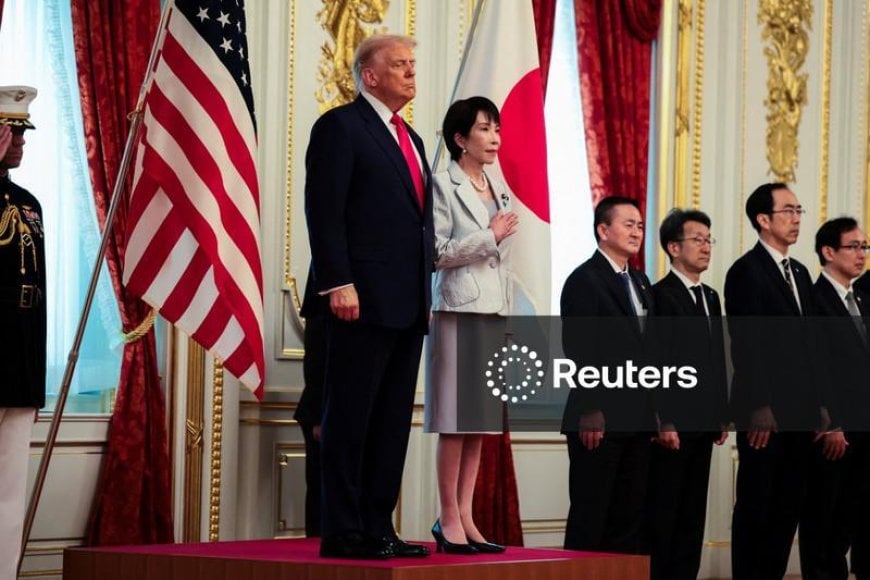
Source: Reuters / Bloomberg / The Guardian (October 28, 2025)
The $550 Billion Pivot: How the U.S.–Japan Alliance Is Re-Wiring Global Power
By Chris @ Pattern Nexus | October 28 2025
On October 28 in Tokyo, U.S. President Donald Trump and Japan’s new Prime Minister Sanae Takaichi signed one of the most consequential economic agreements in decades — a sweeping trade and investment framework that fuses critical-mineral security, next-generation nuclear power, and a $550 billion Japanese investment package into the U.S. economy.
Rare Earths and Critical Minerals: Breaking China’s Stranglehold
The deal’s first pillar focuses on securing supply chains for rare earths — essential inputs for EVs, semiconductors, defense systems, and the digital infrastructure powering AI. China currently processes over 90 percent of global supply, making this coordination between Washington and Tokyo a direct counterweight. Both governments will fund mining, refining, and stockpiling initiatives while inviting allied participation to diversify global markets. [Reuters]
Nuclear and Energy Security: Exporting the Future
The second pillar revives Japan’s nuclear export ambitions and dovetails with U.S. energy-security goals. Japanese firms such as Mitsubishi Heavy Industries and Toshiba will collaborate with GE Vernova on advanced AP1000 and Small Modular Reactors (SMRs), positioning both nations at the forefront of nuclear innovation. [Reuters]
The Investment Floodgate: $550 Billion in Motion
Japan’s Ministry of Economy, Trade and Industry identified flagship projects under a joint $550 billion investment program — spanning AI infrastructure, energy storage, power generation, and critical minerals. SoftBank, Mitsubishi, GE Vernova, and Toshiba are among the early participants. [Reuters] [Bloomberg]
Pattern Nexus Perspective: The Macro Implication
This isn’t just trade — it’s a strategic realignment. The U.S.–Japan partnership is anchoring a new industrial core in the Pacific, one that redirects global capital flows and fractures China’s monopoly over key technologies. It signals a macro pattern I’ve been tracking for months: the convergence of geopolitical security, technological self-sufficiency, and liquidity deployment into hard assets and energy systems.
In my broader framework on Pattern Nexus, this fits squarely into the “Systems & Patterns” category — the transition from financial dominance to resource and infrastructure dominance. We’re seeing a feedback loop of capital redistribution that links monetary policy, energy security, and technological sovereignty into a single global mechanism. It’s a shift from virtual liquidity to tangible control points — rare earths, reactors, and data centers becoming the new pillars of monetary and political power.
Geopolitical Ripples and the Emerging Bloc Order
China and Russia have both tightened control over commodity flows and export routes since 2022. The U.S.–Japan move is a counterweight designed to secure access to strategic inputs while building a network that extends through Southeast Asia, Australia, and North America. It’s a “soft NATO” for supply chains — one that could eventually merge with AUKUS-level defense coordination. [Guardian]
Macro Convergence and Gold’s Role
As I’ve noted in previous Pattern Nexus analyses (The Calm Before the Liquidity Storm and The Digital Dollar Frontier), global monetary flows are rotating toward tangible assets. The $550 billion commitment represents more than foreign direct investment — it’s a monetary migration into physical production, infrastructure, and energy independence. Gold, energy, and industrial capacity are emerging as hedges against the debt super-cycle and the digitization of currency control.
What Comes Next
Expect follow-through in 2026 with joint funding for critical-mineral refineries, U.S. nuclear plant revivals, and Japanese capital entering AI and semiconductor infrastructure. This agreement is the economic arm of a larger pattern — the realignment of industrial power toward a Pacific axis as the world transitions from financial expansion to material consolidation.
Sources & References
- Reuters – US, Japan leaders ink rare earths and nuclear tie-ups (Oct 28 2025)
- Bloomberg – Japan Names First Projects in $550 Billion US Investment Fund (Oct 28 2025)
- Reuters – SoftBank and GE Vernova Among Firms Interested in Deal (Oct 28 2025)
- The Guardian – Takaichi Promises Golden Age in Relations (Oct 28 2025)
Hashtags: #USJapanDeal, #Trade, #Investment, #PatternNexus, #RareEarths, #NuclearPower, #EnergySecurity, #AIInfrastructure, #GlobalEconomy, #Trump, #Takaichi, #SoftBank, #Mitsubishi, #GEVernova, #CriticalMinerals, #SystemsAndPatterns
Qual è la tua reazione?
 Mi piace
0
Mi piace
0
 Non mi piace
0
Non mi piace
0
 Amore
0
Amore
0
 Divertente
0
Divertente
0
 Wow
0
Wow
0
 Triste
0
Triste
0
 Arrabbiato
0
Arrabbiato
0










Commenti (0)