
Only Five Real Countries? Mapping De Facto Sovereignty in a 196-Flag World
On paper there are almost 200 sovereign states. In practice, a handful of “real countries” write the rules while everyone else lives inside their system. This Pattern Nexus long-form builds a sovereignty scorecard—money, guns, energy, chips, story, and institutions—to sort the U.S., China, Russia, UK, and France from near-poles like India, Iran, and Saudi Arabia, and from the client states and hedgers that orbit them.
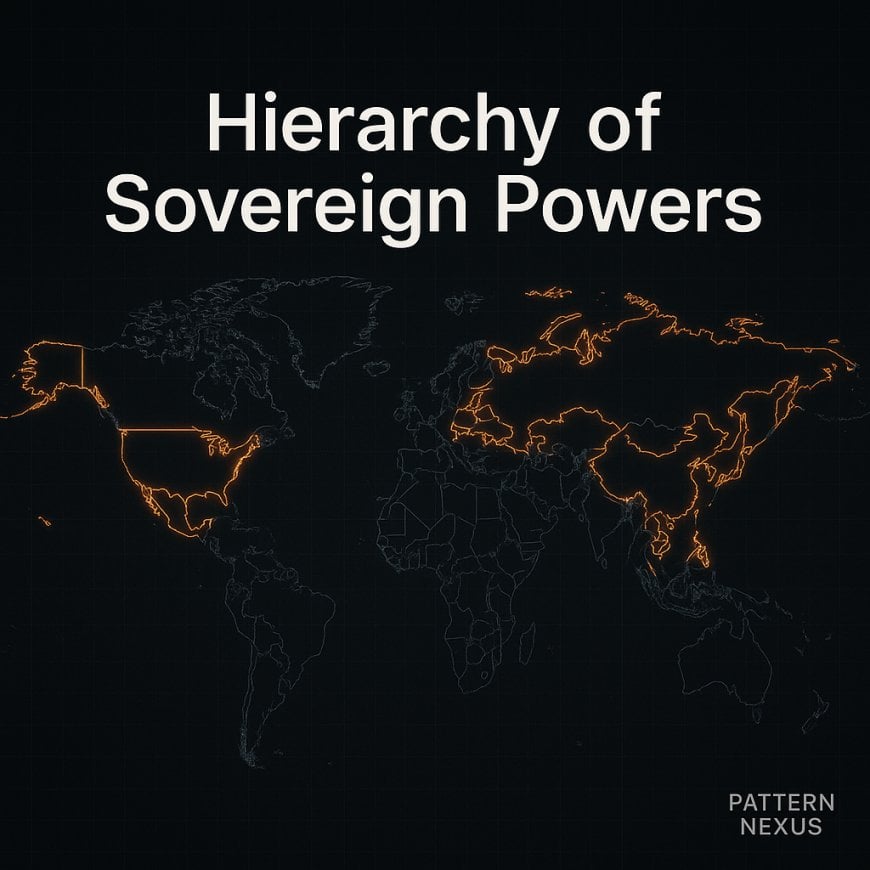
196 Flags, Five Real Countries
The world loves the story of “almost 200 countries.” The big wall map in every classroom is covered in equal-sized boxes, each flag gets the same sized plate at the United Nations, and every leader delivers the same time-boxed speech once a year.
But if you step back and look at how money, security, energy, and information actually move, the picture is much harsher. Most “countries” are not independent decision centers. They are nodes inside someone else’s system. Their currencies are soft-pegged to someone else’s. Their armies are backstopped by someone else’s. Their elites hold their savings in someone else’s assets and send their kids to someone else’s universities.
From that plumbing-first perspective, you can make a very controversial claim: there are roughly five fully consequential countries on Earth: the United States, China, Russia, the United Kingdom, and France.
A second ring of “almost countries” sits just below that tier: India, Iran, North Korea, maybe Saudi Arabia someday. They are not system-makers, but they are structurally disobedient. You cannot just sanction or bomb them without the entire region and parts of the system rebalancing around the shock.
Everyone else lives somewhere on a spectrum from strong client to hedging middle power. They can posture, hedge, and bargain, but they are ultimately constrained by a handful of monetary, military, and institutional poles. Many of the flags you see on that classroom map are, functionally, franchisees of a larger geopolitical parent company.
This article builds a framework to make that uncomfortable statement testable instead of just edgy. We are going to define what “real independence” actually means, score countries across a small number of concrete axes, and show how the map of 196 states collapses into a few true system-makers, a band of near-poles, a messy middle of hedgers, and a long tail of clients and protectorates.
De jure sovereignty vs de facto power
International law is built on the idea of de jure sovereignty: a defined territory, a government, a population, and the ability to enter into relations with other states. On that legal checklist, Iceland and India both qualify as “states.” They have seats, flags, and signatures.
De facto sovereignty is different. It asks a harder question:
If this state defied the system on something that really mattered to the system, could it survive the pushback mostly on its own?
That is not a moral question. It is a balance-sheet and plumbing question. Behind the scenes, the world is wired through:
- Reserve-currency balance sheets and cross-border payment rails
- Defense guarantees and overseas bases
- Fuel and food supply chains, pipelines, and sea lanes
- Tech stacks, IP owners, and standards bodies
- Media platforms, language hierarchies, and cultural exports
- Clubs with vetoes and quotas: the UN Security Council, IMF, G7, G20, and so on
On those dimensions, a microstate that uses someone else’s currency and outsources its defense is not equivalent to a state that issues the reserve asset, controls the sanctions switchboard, and hosts the platforms where the rest of the planet argues about reality.
The entire point of this framework is to separate those two layers. The map of flags and anthems is one layer. The map of monetary, military, and narrative gravity is another. our intuition that “most countries are puppet states” is, in practice, a rough recognition of that second map.
The six axes of real power
To turn this into something more rigorous than “vibes,” we define six axes of de facto sovereignty. A state is genuinely independent only if it is strong in most of these at the same time.
1. Monetary and financial sovereignty
- Does the state issue a currency that other countries willingly hold as a store of value or use in trade?
- Can it borrow abroad in its own currency, or is it trapped borrowing in dollars and euros?
- Is it the one imposing sanctions, or is it vulnerable to being unplugged from the dominant financial rails?
- Is its central bank essentially autonomous, or living under IMF conditionality, hard pegs, and external guardianship?
In this lens, the United States sits at the top. The dollar and U.S. Treasuries are the main reserve asset and funding vehicle of the system. A large share of global trade, commodities, and cross-border credit is invoiced and settled in dollars. Everyone else’s balance sheet is, directly or indirectly, denominated against that fact.
2. Security and war-making autonomy
- Does the state have a credible nuclear deterrent and an independent command chain?
- Can it build its own advanced weapons, or is it dependent on imports from one or two suppliers?
- Can it fight a major regional war without collapsing financially or logistically in months?
- Are there foreign troops permanently on its soil with de facto veto power over its choices?
Rough rule: if your existence depends on an American, Russian, or French security guarantee, you are not a fully autonomous actor. You are a protected node inside someone else’s defense perimeter.
3. Energy and food base
- Can the state feed itself in a crisis without foreign grain?
- Does it have either its own energy base (oil, gas, uranium, hydro, renewables) or diversified import access that can survive blockades and sanctions?
- Does it control its critical infrastructure: ports, pipelines, refineries, grid, and rail?
Russia scores extremely high here. Japan, by contrast, is a top-tier industrial power that lives and dies on imported energy and food. That asymmetry is exactly what this axis is meant to surface.
4. Industrial and technological stack
- Can the country design and build critical hardware: chips, aircraft, satellites, submarines, heavy machinery?
- Does it have an internal R&D ecosystem of universities, labs, and firms that push the frontier?
- Is it in control of key standards and IP, or just an assembly node for someone else’s design?
The United States and China dominate this, with Europe and Japan as high-end but more constrained stacks. Most of the world simply imports their output.
5. Information and narrative power
- Is the country’s language used as a global working language?
- Does it export films, music, apps, and platforms that other societies consume by default?
- Can it run information campaigns abroad that actually move public opinion?
This is where the Anglosphere’s structural advantage screams off the chart. English, Hollywood, and American platforms mean most people experience international events through a U.S.-tilted lens, even when they think they are “neutral.”
6. Institutional and diplomatic leverage
- Does the state have a standing veto in any system-defining club?
- Can it convene coalitions on sanctions, interventions, trade regimes, or climate policy?
- Is its capital a default hub for summits, negotiations, and arbitrations?
Permanent Security Council seats, outsize voting weights at the IMF and World Bank, leadership in NATO, the G7, the G20, or alternative blocs like BRICS or the Shanghai Cooperation Organization all live here.
Working definition: a “real country” is one that, if you cut it out of the system or brought it into full confrontation, would force the system to reorganize around that shock.
The sovereignty scorecard
To make this concrete, we build a simple 0–5 scorecard on each axis:
- 0–1: very weak or dependent
- 2–3: mixed, hedging, or partially autonomous
- 4–5: strong and largely autonomous
Add the six numbers up and you get a sovereignty score:
- 23–30: System-Maker (Core Pole)
- 16–22: Near-Pole or Regional Great Power
- 9–15: Hedger, Swing State, or Strong Client
- 0–8: Client, Protectorate, or Fragile State
This is not about false precision. It is about having a consistent way to say: “Japan is a tech and financial giant but strategically semi-sovereign” or “Saudi Arabia is energy-rich but militarily and technologically dependent.”
Below is a compressed scorecard for the states that matter most to our “five real countries” thesis and to the rest of the map.
| Country | Money | Security | Energy/Food | Industry/Tech | Narrative | Institutions | Total | Category |
|---|---|---|---|---|---|---|---|---|
| NORTH AMERICA | ||||||||
| United States | 5 | 5 | 5 | 5 | 5 | 5 | 30 | System-Maker |
| Canada | 4 | 3 | 5 | 3 | 4 | 5 | 24 | High-Autonomy Client of U.S. |
| Mexico | 3 | 2 | 3 | 3 | 3 | 3 | 17 | Regional Hedger |
| Cuba | 1 | 2 | 3 | 1 | 2 | 1 | 10 | Isolated Client of Russia/China |
| Dominican Republic | 2 | 1 | 2 | 1 | 2 | 2 | 10 | U.S.-Aligned Client |
| Haiti | 0 | 0 | 1 | 0 | 1 | 0 | 2 | Fragile State |
| Guatemala | 2 | 1 | 2 | 1 | 1 | 1 | 8 | U.S.-Dependent |
| Honduras | 1 | 1 | 2 | 1 | 1 | 1 | 7 | Client State |
| El Salvador | 1 | 1 | 2 | 1 | 2 | 1 | 8 | U.S.-Dollarized Client |
| Nicaragua | 1 | 1 | 2 | 1 | 1 | 1 | 7 | China/Russia-Leaning Client |
| Belize | 1 | 0 | 2 | 0 | 1 | 1 | 5 | Small U.S.-Dependent |
| Jamaica | 1 | 0 | 2 | 1 | 2 | 1 | 7 | U.S./UK-Aligned Client |
| Trinidad & Tobago | 2 | 1 | 3 | 1 | 2 | 1 | 10 | Energy-Based Client |
| Barbados | 2 | 0 | 2 | 1 | 2 | 2 | 9 | Soft-Power Leaning Client |
| SOUTH AMERICA | ||||||||
| Brazil | 3 | 2 | 5 | 3 | 4 | 4 | 21 | Resource Hedger |
| Argentina | 1 | 1 | 3 | 2 | 2 | 2 | 11 | Economic Fragile Hedger |
| Chile | 3 | 1 | 3 | 2 | 2 | 2 | 13 | Mid-Tier Hedger |
| Colombia | 2 | 2 | 2 | 2 | 2 | 2 | 12 | U.S.-Integrated Hedger |
| Peru | 2 | 1 | 3 | 1 | 1 | 1 | 9 | Commodity Client |
| Ecuador | 1 | 1 | 3 | 1 | 1 | 1 | 8 | Dollarized U.S. Client |
| Bolivia | 1 | 1 | 3 | 1 | 1 | 1 | 8 | Resource-Dependent Client |
| Paraguay | 1 | 1 | 3 | 1 | 1 | 1 | 8 | Low-Autonomy Client |
| Uruguay | 2 | 1 | 3 | 2 | 2 | 2 | 12 | Stable Regional Hedger |
| Venezuela | 0 | 2 | 5 | 1 | 1 | 1 | 10 | Isolated Resource Client of Russia/China |
| EUROPE | ||||||||
| United Kingdom | 4 | 4 | 2 | 4 | 5 | 5 | 24 | Atlantic Pole inside U.S. system |
| France | 4 | 4 | 3 | 4 | 4 | 5 | 24 | Continental Pole inside U.S. system |
| Germany | 4 | 3 | 3 | 5 | 3 | 5 | 23 | Industrial Near-Pole inside EU/U.S. |
| Italy | 3 | 2 | 2 | 3 | 3 | 3 | 16 | Mid-Tier EU Client |
| Spain | 3 | 2 | 3 | 3 | 3 | 3 | 17 | EU Client |
| Portugal | 3 | 1 | 3 | 2 | 2 | 3 | 14 | EU Client |
| Netherlands | 4 | 2 | 2 | 5 | 3 | 5 | 21 | High-Industry EU Client |
| Belgium | 3 | 1 | 2 | 3 | 3 | 5 | 17 | EU Institutional Hub |
| Sweden | 4 | 2 | 3 | 5 | 4 | 5 | 23 | Northern Industrial Pole (U.S.-aligned) |
| Norway | 4 | 2 | 5 | 3 | 4 | 5 | 23 | Energy Near-Pole |
| Denmark | 3 | 2 | 2 | 4 | 3 | 5 | 19 | NATO/EU Client |
| Finland | 3 | 2 | 3 | 4 | 4 | 5 | 21 | Northern Security Hedger (U.S.-aligned) |
| Poland | 3 | 3 | 3 | 3 | 3 | 4 | 19 | Frontline U.S. Security Client |
| Ukraine | 1 | 1 | 3 | 2 | 3 | 2 | 12 | U.S./EU Security Client |
| Romania | 2 | 2 | 3 | 2 | 2 | 3 | 14 | NATO Client |
| Czech Republic | 3 | 2 | 2 | 3 | 3 | 3 | 16 | EU Mid-Tier Client |
| Austria | 4 | 1 | 3 | 3 | 3 | 4 | 18 | Neutral Hedger (EU-aligned) |
| Switzerland | 5 | 2 | 3 | 4 | 5 | 5 | 24 | Financial Micro-Pole (Neutral) |
| Greece | 2 | 2 | 3 | 2 | 3 | 3 | 15 | NATO/EU Client |
| Hungary | 2 | 2 | 3 | 2 | 2 | 3 | 14 | Dual-Aligned Hedger |
| Serbia | 1 | 1 | 3 | 1 | 2 | 2 | 10 | Russia-Leaning Balkan Hedger |
| Croatia | 2 | 1 | 3 | 2 | 2 | 2 | 12 | EU/NATO Client |
| Bulgaria | 2 | 1 | 3 | 2 | 2 | 2 | 12 | EU/NATO Client |
| Slovakia | 2 | 1 | 3 | 2 | 2 | 2 | 12 | EU Client |
| Slovenia | 3 | 1 | 3 | 2 | 2 | 3 | 14 | Small EU Hedger |
| Ireland | 4 | 1 | 3 | 4 | 4 | 5 | 21 | Hyper-Globalized U.S.-Aligned Client |
| Iceland | 3 | 1 | 5 | 1 | 3 | 3 | 16 | Small NATO Client |
| Albania | 1 | 1 | 2 | 1 | 2 | 2 | 9 | NATO Client |
| North Macedonia | 1 | 1 | 2 | 1 | 2 | 2 | 9 | NATO Client |
| Bosnia & Herzegovina | 1 | 1 | 2 | 1 | 2 | 1 | 8 | Fragmented Client State |
| Montenegro | 1 | 1 | 2 | 1 | 2 | 2 | 9 | NATO Client |
| MIDDLE EAST & NORTH AFRICA (MENA) | ||||||||
| Saudi Arabia | 3 | 3 | 5 | 2 | 3 | 3 | 19 | Energy Near-Pole, U.S. Security Client |
| Iran | 1 | 4 | 4 | 2 | 2 | 2 | 15 | Regional Rebel / Sanctioned Pole |
| Turkey | 3 | 4 | 3 | 3 | 3 | 4 | 20 | Eurasian Swing State |
| Israel | 4 | 4 | 2 | 5 | 4 | 5 | 24 | High-Tech U.S.-Backed Near-Pole |
| Egypt | 1 | 2 | 3 | 1 | 2 | 2 | 11 | Strategic U.S.-Aligned Client |
| UAE | 3 | 2 | 4 | 3 | 4 | 4 | 20 | High-Autonomy Petrostate Hedger |
| Qatar | 3 | 2 | 5 | 3 | 4 | 3 | 20 | Energy Micro-Pole / Hedger |
| Kuwait | 3 | 2 | 5 | 2 | 3 | 3 | 18 | U.S.-Protected Petrostate |
| Bahrain | 2 | 1 | 3 | 2 | 3 | 3 | 14 | Small U.S.-Security Client |
| Oman | 2 | 1 | 4 | 2 | 2 | 2 | 13 | Neutral Gulf Hedger |
| Iraq | 1 | 1 | 5 | 1 | 1 | 1 | 10 | Fragmented Energy Client |
| Syria | 0 | 1 | 2 | 0 | 1 | 0 | 4 | Russian/Iranian Client State |
| Jordan | 1 | 1 | 2 | 1 | 2 | 2 | 9 | U.S.-Security Client |
| Lebanon | 0 | 1 | 2 | 1 | 2 | 1 | 7 | Failed Financial State / Iran-Influenced |
| Morocco | 2 | 1 | 3 | 2 | 2 | 3 | 13 | U.S.-Aligned Regional Hedger |
| Algeria | 1 | 2 | 5 | 2 | 2 | 2 | 14 | Energy-Based Hedger (Russia-Leaning) |
| Tunisia | 1 | 1 | 2 | 1 | 2 | 2 | 9 | Weak Mediterranean Hedger |
| Libya | 0 | 1 | 5 | 0 | 1 | 0 | 7 | Fragmented Energy Client |
| Yemen | 0 | 0 | 2 | 0 | 1 | 0 | 3 | Failed State |
| SUB-SAHARAN AFRICA | ||||||||
| Nigeria | 1 | 1 | 5 | 2 | 2 | 2 | 13 | Resource Giant, Internally Fragmented |
| South Africa | 3 | 2 | 3 | 3 | 3 | 3 | 17 | Regional Near-Pole / BRICS Hedger |
| Ethiopia | 1 | 2 | 3 | 1 | 1 | 1 | 9 | Regional Power, Weak Institutions |
| Kenya | 2 | 1 | 2 | 2 | 2 | 2 | 11 | East African Hedger |
| Uganda | 1 | 1 | 3 | 1 | 1 | 1 | 8 | China-Leaning Client |
| Tanzania | 1 | 1 | 3 | 1 | 1 | 1 | 8 | China-Integrated Client |
| Ghana | 1 | 1 | 3 | 1 | 2 | 1 | 9 | West African Commodity Client |
| Ivory Coast | 1 | 1 | 3 | 1 | 2 | 1 | 9 | Francophone Client State |
| Senegal | 1 | 1 | 3 | 1 | 2 | 1 | 9 | West African Client |
| Angola | 1 | 2 | 5 | 1 | 1 | 1 | 11 | Energy Client (China-Leaning) |
| Mozambique | 0 | 1 | 4 | 0 | 1 | 0 | 6 | Resource-Dependent Fragile State |
| Zambia | 1 | 1 | 4 | 1 | 1 | 1 | 9 | China-Integrated Resource Client |
| Zimbabwe | 0 | 1 | 3 | 0 | 1 | 0 | 5 | Collapsed State, China-Reliant |
| Democratic Republic of the Congo (DRC) | 0 | 1 | 5 | 1 | 1 | 0 | 8 | Resource Colony of China |
| Sudan | 0 | 1 | 3 | 0 | 1 | 0 | 5 | Failed State |
| South Sudan | 0 | 1 | 4 | 0 | 1 | 0 | 6 | Failed Petrostate |
| Cameroon | 1 | 1 | 3 | 1 | 1 | 1 | 8 | Francophone Client |
| Chad | 0 | 1 | 3 | 0 | 1 | 0 | 5 | French-Security Client |
| Niger | 0 | 1 | 3 | 0 | 1 | 0 | 5 | Resource Client (now Russia-Leaning) |
| Mali | 0 | 1 | 3 | 0 | 1 | 0 | 5 | Russian-Aligned Military Junta |
| Eritrea | 0 | 1 | 2 | 0 | 1 | 0 | 4 | Isolated Dictatorship |
| Somalia | 0 | 0 | 2 | 0 | 1 | 0 | 3 | Failed State (External Security Dependency) |
| Rwanda | 1 | 2 | 2 | 1 | 2 | 1 | 9 | Authoritarian Hedger |
| Burkina Faso | 0 | 1 | 2 | 0 | 1 | 0 | 4 | Junta / Russian-Influenced |
| Gabon | 1 | 1 | 4 | 1 | 1 | 1 | 9 | Resource Client (France/China) |
| Republic of the Congo | 0 | 1 | 4 | 0 | 1 | 0 | 6 | Oil Client State |
| Namibia | 2 | 1 | 4 | 1 | 2 | 2 | 12 | Resource Hedger |
| Botswana | 2 | 1 | 3 | 1 | 3 | 2 | 12 | Stable Mineral Hedger |
| Madagascar | 0 | 1 | 3 | 0 | 1 | 0 | 5 | Weak Island Client |
| ASIA & OCEANIA | ||||||||
| China | 4 | 4 | 4 | 4 | 3 | 4 | 23 | Emerging System-Maker |
| India | 3 | 4 | 3 | 3 | 3 | 4 | 20 | Near-Pole / Structural Hedger |
| Japan | 4 | 3 | 2 | 4 | 4 | 4 | 21 | Rich Semi-Sovereign Client |
| South Korea | 4 | 3 | 2 | 5 | 4 | 4 | 22 | Tech Near-Pole under U.S. Shield |
| North Korea | 0 | 4 | 2 | 1 | 1 | 1 | 9 | Deterrent Micro-State |
| Pakistan | 1 | 3 | 2 | 1 | 2 | 2 | 11 | Nuclear Hedger (China-Leaning) |
| Bangladesh | 1 | 1 | 2 | 1 | 2 | 1 | 8 | Crowded Industrial Client |
| Indonesia | 2 | 2 | 4 | 2 | 2 | 2 | 14 | Resource Hedger / Swing State |
| Malaysia | 2 | 2 | 3 | 2 | 2 | 2 | 13 | ASEAN Hedger |
| Vietnam | 2 | 2 | 3 | 2 | 2 | 2 | 13 | Anti-China Hedger |
| Philippines | 1 | 2 | 3 | 1 | 2 | 2 | 11 | U.S. Maritime Client |
| Thailand | 2 | 2 | 3 | 2 | 2 | 2 | 13 | Dual-Aligned Hedger |
| Myanmar | 0 | 1 | 3 | 0 | 1 | 0 | 5 | Military Junta (China-Leaning) |
| Singapore | 5 | 2 | 2 | 5 | 5 | 5 | 24 | Financial Metropole / Strategic Hedger |
| Australia | 3 | 2 | 5 | 3 | 4 | 3 | 20 | High-Tier Hedger / U.S. Security Client |
| New Zealand | 3 | 1 | 4 | 2 | 3 | 3 | 16 | Pacific Hedger (U.S.-Aligned) |
| Papua New Guinea | 0 | 1 | 4 | 0 | 1 | 1 | 7 | Resource Client |
| Sri Lanka | 0 | 1 | 3 | 1 | 2 | 1 | 8 | Debt-Trap Client (China-Leaning) |
| Nepal | 0 | 1 | 2 | 0 | 2 | 1 | 6 | India/China Buffer Client |
| Mongolia | 1 | 1 | 4 | 1 | 2 | 2 | 11 | Resource Hedger (China/Russia) |
| Kazakhstan | 2 | 2 | 5 | 2 | 2 | 2 | 15 | Multi-Vector Resource Hedger |
| Uzbekistan | 1 | 2 | 3 | 1 | 1 | 1 | 9 | Central Asian Hedger |
| Turkmenistan | 0 | 1 | 5 | 0 | 1 | 0 | 7 | Energy Client of China |
| Kyrgyzstan | 0 | 1 | 2 | 0 | 1 | 1 | 5 | Russia/China Client |
| Tajikistan | 0 | 1 | 2 | 0 | 1 | 1 | 5 | Security Client (Russia/China) |
You can quibble a point here or there. That is fine. The important thing is the shape of the profile. The United States is saturated across every axis. China is right behind but weaker on money and narrative. Russia is a military and resource giant with a structurally weak financial and soft-power position. The UK and France are deeply integrated into the U.S. system but still carry their own nuclear and institutional weight. India is the only plausible future “sixth” pole if it can fix money, industry, and energy at the same time.
The “five real countries” in detail
The United States: system of systems
The United States is not just a country. It is the anchor of the entire modern dollar order. Its Treasury market is the world’s main collateral pool. Its banks, payment networks, and compliance rules define what “legal” money movement means for everyone else. Most global trade and reserves settle through its currency.
Militarily, it is still operating on a different plane: global basing, blue-water navy, nuclear triad, power projection on every continent, and the largest arms industry on the planet. Culturally, it sits at the top of nearly every soft-power index, fueled by English, Hollywood, music, and American platforms. Institutionally, it has a veto and agenda-setting role everywhere that matters.
If you imagine the whole system as a set of concentric shells, the United States is the inner core where rules are written, code is deployed, and standards are set.
China: parallel industrial empire
China is the only state that has vertically integrated enough population, industry, and growing financial infrastructure to challenge the system core in the long run. It is the world’s workshop, a major tech manufacturer, a nuclear power, and an architect of its own parallel rails: alternative payment systems, its own development banks, Belt-and-Road infrastructure, and a growing share of commodity flows.
But it still runs on someone else’s operating system in key ways. It remains dependent on imported energy, vulnerable to chokepoints like straits and semiconductor supply, and its currency, while rising, is still a small minority of global reserves and trade invoicing. Its narrative power is real in its region but thin globally.
In this framework, China is the one plausible alternative core being built in real time, but it is not yet in the same structural position as the United States.
Russia: energy, nukes, and veto
Russia is what happens when you max out security and resources but neglect money and soft power. It has the largest nuclear arsenal on Earth, a complete arms industry, and a resource base that can fuel and feed itself and half its neighborhood. Its ability to shock the system by turning off gas, threatening grain exports, or escalating military conflict is baked into the current architecture.
At the same time, its currency is marginal, its financial links to the West have been deliberately cut, and its international image has deteriorated sharply. It has a Security Council veto and a network of clients and partners, but it is more “spoiler pole” than system architect.
United Kingdom and France: Atlantic anchors
The UK and France are the awkward cases that confirm our thesis. By structural capability, they are absolutely “real countries”:
- They both have nuclear deterrents and can project power abroad.
- They both have deep capital markets and currencies that still function as secondary reserves.
- They both sit on the Security Council with vetoes and formal leadership roles in NATO and the EU ecosystem.
At the same time, their de facto freedom of movement is bounded by the U.S.-led system they helped design. Their currencies live downstream of the dollar. Their defense doctrines are embedded in alliance structures. Their banks are wired through dollar rails and U.S. regulatory reach. They are poles inside the American empire more than fully separate civilizations.
That is why the “five real countries” framing works conceptually even if, technically, you might demote one or two to “near-poles.” The system-defining set is small, Western-heavy, and heavily dollar-centric.
Near-poles and structural rebels
Below the big five sits a ring of states that are too powerful, too stubborn, or too strategically placed to be treated like ordinary clients. They cannot design the whole system, but they can veto chunks of their region and punch far above their GDP weight.
India: the only plausible “sixth country”
India has almost everything you would want in a future pole: population, demographics, a nuclear arsenal, a growing navy, a robust agricultural base, and an increasingly competent tech and space sector. It plays everyone against everyone: buying Russian energy, courting U.S. investment, co-founding BRICS, joining the Quad, and keeping its own strategic ambiguity alive.
Its weak points are clear. The rupee is not a reserve currency. Its industrial base is uneven. It is heavily dependent on energy imports. Its internal infrastructure and institutional quality are inconsistent. But in terms of trajectory, if any state can move from ring two to ring one over the next few decades, it is India.
Iran: sanctions-hardened regional pole
Iran is structurally lopsided. Its financial system is constrained by sanctions. Its currency is weak. Its economy is smaller than it could be. Yet it has built a dense web of influence through missile programs, drones, militias, and ideological networks across the Middle East, while maintaining a decent degree of food and energy self-reliance.
It cannot rewrite global rules, but it can absolutely veto U.S. and Gulf preferences in its immediate region and impose serious costs on any attempt to coerce it. In sovereignty terms, it is a regional rebel country: not fully independent, but impossible to domesticate.
North Korea: tiny, broke, but nuclear
North Korea fails nearly every axis. Its economy is tiny and distorted. Its people are poor. It has almost no financial or institutional leverage. But it has nuclear weapons, missiles, and conventional artillery aimed at one of the world’s most important industrial clusters.
That makes it a paradoxical edge case. It is not a “real country” in our systemic sense, but it has a kind of negative sovereignty: the ability to impose unacceptable costs on everyone else if pushed too far. It is a reminder that in this map, deterrent micro-states occupy their own strange niche.
Saudi Arabia: energy near-pole on a security leash
Saudi Arabia is closer to a pole in the energy and financial sense than people realize. Its combination of oil output, spare capacity, and sovereign wealth makes it a crucial valve in the current arrangement. It can move prices, redirect flows, and fund projects and partners across multiple blocs.
But it is a consumer of security and technology, not a producer. Its army runs on foreign hardware. Its elite protection depends on external patrons. Its future economic strategy is to import a civilization in the form of engineers, firms, and platforms. If a real war broke out that threatened the regime, it would still look to Washington and, increasingly, to Beijing as guarantors.
Saudi Arabia is a perfect example of a state that feels like a country but behaves like an especially powerful franchise of the wider system.
How the rest of the world clusters
Once you have the axes, you do not need to hand-score 196 countries for the article itself. You can group them into patterns that keep showing up in the data and in how crises actually play out.
Dollar-aligned clients
These are states whose money, banks, and security are wired into the dollar empire. They include:
- Most NATO members outside the UK and France
- Japan, South Korea, Australia, New Zealand
- Large chunks of Latin America
- Many Middle Eastern monarchies
Their currencies are often float-in-name-only or pegged. Their reserves are overwhelmingly in dollars and euros. Their debt is priced off U.S. rates. Their armies train with, buy from, and interoperate with U.S. forces. In a real showdown, almost all of them align with Washington, because their survival is wired that way.
China-linked development clients
On the other side you have states whose infrastructure, debt sustainability, or commodity income depends heavily on China:
- Parts of Southeast Asia and Central Asia
- Many African states that took Belt-and-Road loans
- Commodity exporters that rely on Chinese demand
These countries are not “colonies,” but their growth paths and fiscal survival are strongly correlated with decisions in Beijing. They have swapped one form of dependency (Western aid and conditionality) for another form (Chinese credit and commodity bargaining).
Hedgers and swing states
Then there is the middle class of geopolitics: states too big and complex to be simple clients, too constrained to become poles. They include:
- Turkey, Brazil, Mexico, Indonesia, South Africa, Nigeria
- Israel, Australia, South Korea, the Gulf states
They try to arbitrage great-power competition. They sign defense deals with one bloc and trade deals with another. They buy weapons and tech from multiple suppliers. They vote one way on one resolution and another way on the next.
Hedger states have sovereignty in a narrow band: they cannot write global rules, but they can stall them, reroute them, or extract concessions for going along.
Fragile and captured states
At the bottom of the sovereignty ladder are states whose core decisions are effectively outsourced, because they have to be:
- States that use another country’s currency or a currency board by necessity
- States under long-running IMF or donor supervision
- States with no standing army that rely on treaties for defense
- States whose budgets are dominated by aid or remittances
Many small island states, microstates in Europe, and low-income states in Africa sit here. Their leaders have room to maneuver on domestic patronage and rhetoric, but not on the big levers. Their sovereignty is real in law, constrained in practice.
The dollar hierarchy and modern puppethood
All of this sits on top of the money hierarchy that underwrites it. At the top are the issuers of assets everyone else must hold to transact and save. Below that are states that must hold and manage those assets. At the bottom are states whose own money is not trusted by anyone outside their borders.
In that structure, “puppet state” is not just an insult. It is shorthand for a set of hard constraints:
- Your central bank’s balance sheet is mostly someone else’s liabilities.
- Your banks settle international payments in someone else’s currency.
- Your government borrows in someone else’s unit and rolls that debt on someone else’s terms.
- Your elites keep their savings and their children in someone else’s jurisdiction.
When we say “Japan is a semi-sovereign mega-client,” it is not because it lacks engineers or factories. It is because its strategic ceiling is set by Washington’s willingness to extend the nuclear umbrella and keep the dollar and U.S. Navy backstopping its energy and trade routes.
The world does not have 196 independent sovereign actors. It has a handful of true system-makers, dozens of plugged-in clients and hedgers, and a long tail of flags printed on the same collateral.
Why this map matters for 2026–2035
The next decade is not happening in a vacuum. It is landing on top of:
- A maturing dollar-centric system with its own internal liquidity cycles
- An AI and energy build-out that demands enormous capital and grid investment
- Demographic shifts that weaken some regions and concentrate demand in others
- Escalating geopolitical friction in Europe, the Western Pacific, and the Middle East
In that world, what matters is not how many flags exist, but which jurisdictions can:
- Issue collateral the rest of the system must hold
- Guarantee security for whole regions
- Control chokepoints in energy, food, and data
- Set standards in compute, networks, and digital rails
- Shape the story everyone else tells themselves about what is happening
If you treat every country as an equal node, the future looks like chaos. If you compress the map down to the five real countries, the near-poles, and the hedgers, you get a much clearer sense of where the real decision nodes are and where shocks will actually originate.
FAQ and objections
“Isn’t this insultingly dismissive of small countries?”
It is blunt, but it is not about worth or dignity. Every state matters morally. Every culture matters. This framework is simply about who can move the plumbing without asking permission. Many small states have been extremely successful at trading formal sovereignty for stability, aid, and access. That is a rational choice. It just is not the same thing as being a pole.
“What about the European Union? Isn’t that a ‘real country’?”
As a bloc, the EU is absolutely a major pole. It has a reserve currency, a huge market, industrial depth, and a lot of soft power. But it is still an incomplete federation with fragmented fiscal policy and layered security dependence on the United States. This article is deliberately looking at states, not blocs. If you treat the EU as one actor, our “five countries” expands to “three systems”: the dollar-Atlantic system, the Chinese system, and everyone else.
“Isn’t this outdated in a multipolar world?”
The world is multipolar compared to the peak of unipolarity, but it is not flat. The distribution of veto power, reserve issuance, platforms, and bases is still extremely skewed. A decade from now, the shape may change if India, China, and a coalition of hedger states can build real alternative rails. But right now, the hierarchy is still very real.
“What about regional organizations and issue-specific coalitions?”
Organizations like ASEAN, the African Union, or OPEC can absolutely punch above their weight on narrow issues. Small states can also pool their voices, for example on climate. But when it comes to the binding constraints of money, security guarantees, and collateral, most of them are still downstream of decisions taken in Washington, Beijing, Brussels, London, Paris, or Moscow.
“Is ‘puppet’ the right word?”
Probably not in the strict sense. “Client,” “protectorate,” or “system-dependent node” are more accurate and less loaded. “Puppet” is useful as a rhetorical shock: a reminder that formal sovereignty can hide very tight constraints. Local elites often choose that position, because it protects their rents and their physical safety. The article’s goal is to name those structures, not to erase local agency.
Sources
Key data and rankings referenced in this framework are drawn from the following external sources:
- IMF – Currency Composition of Official Foreign Exchange Reserves (COFER)
- IMF – US Dollar’s share of foreign reserves is little changed (2025)
- SIPRI – Trends in World Military Expenditure 2024
- SIPRI – Global military expenditure press release 2025
- SIPRI – Top 100 Arms Producers revenues 2024
- Brand Finance – Global Soft Power Index 2024
- Brand Finance – USA and UK ranked top nation brands, China third
- Wikipedia – List of sovereign states without armed forces
- Wikipedia – Reserve currency overview
آپ کا ردعمل کیا ہے؟
 پسند کریں
0
پسند کریں
0
 نہ پسند
0
نہ پسند
0
 محبت
0
محبت
0
 مزاحیہ
0
مزاحیہ
0
 واہ
0
واہ
0
 اداس
0
اداس
0
 غصہ
0
غصہ
0

Founder of Pattern Nexus. I research markets, macro, geopolitics, AI, history, ancient systems, and the patterns most people overlook. I’m also building Market Radar, a trading scanner designed to read pressure, risk, confirmation, and setup quality before chasing a move. Pattern Nexus is where I connect the dots between data, history, technology, and the bigger system playing out around us.



تبصرے (0)