
Ukraine Is the Fault Line: NATO Expansion, Dollar Custody Warfare, and Russia’s Forced Pivot to China
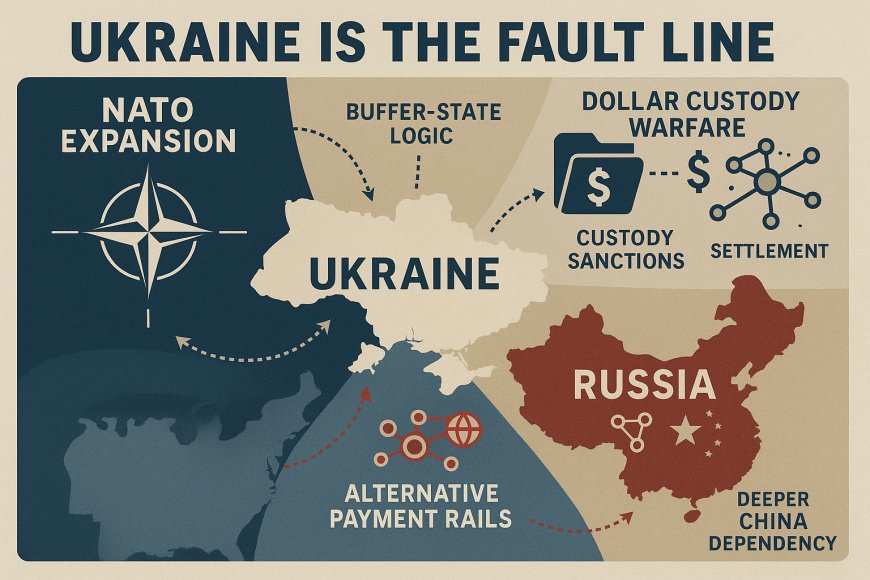
Ukraine is not a regional war. It is the convergence point where NATO’s post-1991 security architecture, the U.S.-led financial control stack (custody, sanctions, settlement), and Russia’s failed integration into the Western order collided. This deep-dive traces the chain from 1990 assurances and NATO expansion through 2008 Bucharest, 2014–2021 freeze failures, the 2022 system shift, and today’s locked endgame. The core mechanism is precedent: territory, security guarantees, sanctions sequencing, and reserve legitimacy must all unwind together or nothing settles. This is the war behind the headlines: buffers, balance sheets, payment rails, collateral, energy, and credibility.
Published: December 15, 2025
By: Pattern Nexus
Ukraine is not a “regional war,” a morality play, or a temporary headline loop. It is the intersection point where three post–Cold War systems finally failed at the same time: (1) Europe’s security architecture, (2) the U.S.-led financial control stack (custody, settlement, sanctions, collateral), and (3) Russia’s attempted integration into the Western order without becoming a subordinate state. Once those layers locked together, the war stopped being a dispute and became a system test. That is why compromise keeps failing. That is why the battlefield moves slowly but the strategic consequences compound fast.
Executive Summary
Core thesis: This war persists because it is now a multi-institution bargain failure. NATO’s open-door logic collides with Russia’s buffer-state logic, and both sit on top of weaponized financial plumbing (custody, settlement, sanctions, collateral). Once the war crossed into reserve immobilization and industrialized aid, “compromise” stopped being about land and started being about precedent and credibility.
The public debate is usually forced into one-axis narratives. Either “Ukraine defending sovereignty” or “Russia reacting to NATO expansion.” Both contain real components. Neither explains why the conflict resists settlement even when the casualty math and exhaustion cycles suggest a negotiated endpoint should emerge.
The correct frame is a system frame. In system terms, Ukraine is the hinge between two security architectures and two capital architectures. The military front line is one layer. The custody-and-settlement front line is the other. The war is not just about whether borders change. It is about whether the post-1991 operating system can enforce outcomes without reintroducing explicit spheres of influence, and whether Russia can survive exclusion from the Western financial core without permanently subordinating itself to China.
Key asymmetry: Russia is fighting for strategic depth, deterrence credibility, and regime survivability under financial siege. The U.S. is managing escalation risk and alliance cohesion while simultaneously stress-testing (and demonstrating) the coercive capacity of the dollar-led stack. Europe is not “the main character” here; Europe is the battlefield-adjacent balance sheet and industrial perimeter where the shock is absorbed, the procurement is scaled, and the legal custody nodes sit.
As of mid-December 2025, peace talks are active and openly strained, with reporting indicating U.S. negotiators pressing Ukraine on Donetsk-related territorial realities and Ukraine’s public remaining resistant to major concessions absent credible security guarantees. The negotiation posture matters because it exposes the real constraint: any settlement has to unwind battlefield lines, security guarantees, sanctions sequencing, and frozen-asset legitimacy in one package, not four separate press conferences.
The Pattern Nexus Baseline: How We Analyze This
Pattern Nexus does not analyze wars as morality stories. Wars are control-system failures. They happen when incentive structures, credibility constraints, and feedback loops stop aligning across multiple layers at once.
In this framework, the Ukraine conflict is a simultaneous failure in:
- Security architecture: alliance commitments, buffer zones, escalation thresholds, deterrence credibility
- Capital architecture: custody, settlement rails, correspondent banking, collateral chains, sanctions enforcement
- Industrial architecture: energy flows, defense production, supply chains, workforce and logistics
- Domestic legitimacy: the political cost of compromise inside Russia, Ukraine, the U.S., and key European states
Critical reminder: You can be “right” on law, “right” on morality, and still lose the system outcome if the other side is solving a different optimization problem. Russia’s optimization problem is strategic depth and survivability. The West’s optimization problem is credibility, alliance cohesion, and the enforceability of the rules-based perimeter. Those are incompatible unless you build a new equilibrium.
What This War Is Actually About
Strip the slogans away and you get three interacting objectives:
- Russia: prevent a hostile military alignment from sitting directly on its western approach, preserve deterrence credibility, and force recognition of a security perimeter it can live with
- United States: preserve alliance credibility, deter revision by force, manage escalation, and demonstrate that dollar-led coercion (sanctions, custody, reserve immobilization) is still decisive
- Ukraine: survive as a sovereign state and avoid becoming a permanently dismembered, permanently unsecured buffer with no credible guarantees
Europe is not the “reason” for the war. Europe is the system layer where the aftershocks are absorbed: energy substitution, defense rearmament, refugee flows, and—most importantly—custody infrastructure. Europe sits on the legal and financial nodes that make reserve immobilization possible at scale. That alone ensures Europe is structurally entangled.
Translation: The battlefield is a map. The real war is about who sets the constraints on the map. Once the West made reserves and custody part of the battlefield, this stopped being “Ukraine vs Russia” and became “system vs system.”
The Post–Cold War “Deal” That Was Never Written Down
The Soviet collapse produced a vacuum faster than formal treaties could fill it. What replaced formal structure was a blend of: assurances, expectations, handshake diplomacy, “understandings,” and strategic ambiguity.
From the Western legal frame, those were not binding commitments restricting future alliance choices. From the Russian strategic frame, those were the implied price of a peaceful geopolitical retreat and a non-catastrophic security perimeter after the Soviet drawdown.
That ambiguity can function only while one side is weak and the other side is disciplined. The moment Russia regained internal stability and the West’s expansion logic kept running, ambiguity became intolerable. Not because Russia is uniquely irrational, but because buffer-state logic is the default language of great powers. The West attempted to operate Europe like an institutional market. Russia kept treating Europe like a threat geography.
Pattern failure: You cannot run a power-balance continent on implied understandings indefinitely. Eventually, someone tests the boundary. When the boundary is tested, the argument stops being “what was said” and becomes “what can be enforced.”
Timeline: 1989–2025 (The Chain, Not the Headlines)
This is the long chain that matters. Not the daily map updates. Not the Twitter outrage cycles. The chain.
- 1989–1991: German reunification negotiations, Soviet withdrawal, and a cascade of Western assurances interpreted in Moscow as constraints on NATO’s eastward posture
- 1994: Partnership-for-Peace framework expands cooperation pathways; Ukraine signs the Budapest Memorandum and gives up inherited nuclear capability for security assurances, not a binding defense guarantee
- 1997: NATO–Russia Founding Act attempts to create a cooperative security relationship and consultation mechanism
- 1999–2004: major NATO enlargement rounds reshape the eastern security map; Kosovo and other events harden Russian suspicion about Western intervention norms
- 2004–2005: Ukraine’s Orange Revolution era deepens Moscow’s perception that political alignment is being contested inside the post-Soviet space
- 2008: Bucharest declaration states Ukraine and Georgia “will become members of NATO” without a timeline, creating a permanent forward option with no expiry clause
- 2014: Maidan aftermath, Crimea annexation, Donbas war begins; sanctions era hardens; Ukraine’s alignment accelerates; Russia’s “buffer” red lines harden
- 2015: Minsk II endorsed by the UN Security Council; implementation fails; the “freeze” strategy degrades into a slow-burn pre-war
- Dec 2021: Russia publishes draft “security guarantees” demands aimed at NATO posture and Ukraine’s alignment path
- Feb 2022: invasion begins; the conflict escalates into a full system conflict: sanctions, reserve immobilization, energy rerouting, defense industrial scaling
- 2022–2025: war becomes institutionalized; custody becomes weaponized; alternative messaging and payment rails accelerate; U.S.-led peace efforts surface with high friction around territorial realities and security guarantees
Pattern Nexus point: Once you pass 2022, the war is no longer primarily about what Ukraine wants or what Russia wants. It becomes about what the system can allow without breaking credibility. That is why it drags. That is why it keeps expanding sideways into finance, energy, and industrial policy.
“Not One Inch”: Assurances vs Treaties vs Expectations
The “not one inch” issue is not a trivia argument. It is the seed crystal of mistrust. There is documented evidence that Western officials discussed NATO’s eastward posture during German reunification negotiations in ways Soviet leadership interpreted as meaningful constraints.
Here is the structural truth: two things can be true at the same time.
- True: assurances and expectations were communicated at high levels in 1990–1991 that Moscow interpreted as constraints on NATO’s eastward movement
- Also true: those assurances were not codified as a binding treaty permanently prohibiting NATO enlargement across all future contexts
Why this matters now: Russia uses the assurance story as a legitimacy claim (“we were lied to”). NATO uses the treaty story as a sovereignty claim (“no outside veto”). That is not just a factual dispute. It is a dispute over what “commitment” means when an empire is collapsing and everyone is improvising the new map.
If you refuse to acknowledge the assurance layer, you cannot explain Russia’s long-term psychology. If you refuse to acknowledge the treaty layer, you cannot explain NATO’s doctrine. The war sits inside that collision.
NATO Expansion as a Control Variable
NATO expansion is usually debated as morality or law. In system terms, it is a control variable that changes: reaction time, forward basing potential, escalation thresholds, and crisis stability.
Every eastward shift compresses Russia’s perceived strategic depth. This compression is not linear. It compounds because it affects warning time, redundancy options, and the number of “buffer decisions” available during a crisis.
Control-system translation: Great powers treat buffer distance the way banks treat collateral coverage. The less coverage you have, the more you react violently to volatility. It’s not “moral.” It’s tail-risk management.
From Moscow’s frame, Ukraine was not “another expansion.” It was the final buffer on the western approach. From NATO’s frame, Ukraine was an aspirant sovereignty issue. Those frames are incompatible unless someone explicitly concedes the principle of spheres of influence—which NATO cannot do publicly without breaking its own doctrine.
Ukraine as Buffer-Hinge: Geography as Destiny
Ukraine sits on the geographic hinge between continental Europe and the Eurasian interior. That sounds poetic until you translate it into operational reality: Black Sea access, land corridors, logistics depth, and the shape of Eastern Europe’s risk perimeter.
This is why simplistic “Ukraine is a prize because it’s rich” explanations are incomplete. Resources matter. But geography sets the baseline.
Misunderstanding that keeps repeating: treating Ukraine purely as a “sovereign choice” problem ignores that buffer states exist because distance matters. The sovereign choice layer is real. The buffer layer is also real. Ignoring either is how you end up shocked when the system breaks.
Russia’s Integration Attempt: Trade, Capital, and the “Join the West” Phase
One of the most misrepresented elements in mainstream coverage is Russia’s long arc after the Soviet collapse: the recurring attempt to integrate with the West on terms that preserved status and security autonomy.
Russia’s post-1991 path was not a straight line toward permanent hostility. It was: economic integration attempts, European energy trade deepening, Western capital access, and periodic security cooperation—paired with deep resentment as NATO moved east, intervention norms changed, and Russian elites saw “integration” as conditional submission rather than partnership.
The energy trade relationship matters because it created a hybrid dependency: Europe depended on Russian energy flows, Russia depended on European demand and payment stability, and both depended on predictable settlement and banking access. That integration created the illusion that security could be managed through commerce. It bought time. It did not resolve the underlying buffer dispute.
Pattern Nexus point: Russia’s long-term objective was not isolation. It was integration with leverage. The moment sanctions and reserve immobilization made “integration” feel like a trapdoor, Russia’s optimization problem shifted: survive without the West, even if that forces dependence on China.
2008 Bucharest: The Clause That Never Expired
The 2008 Bucharest declaration is the structural inflection point because it created a permanent forward option: Ukraine “will become” a NATO member, but without a timeline.
That single clause functions like a perpetual-motion conflict generator:
- It signals intent without specifying execution, creating an open-ended promise
- It incentivizes Russia to prevent the future outcome by shaping facts on the ground now
- It incentivizes Ukraine to deepen alignment because a promise exists even if a path does not
- It forces NATO internal ambiguity, because the promise exists even when consensus does not
Translation: Bucharest turned Ukraine into a forward option contract. Russia decided it had to expire the contract. NATO decided it could not cancel the contract without breaking the credibility of its doctrine.
2014–2021: Crimea, Donbas, Minsk, and the Failure of the Freeze Model
After 2014, Europe tried the standard post-Soviet conflict management template: ceasefire, monitoring, political settlement, and time. That is the “freeze” model.
The freeze model works only when time reduces incentives to fight. In Ukraine, time increased incentives: alignment accelerated, military posture hardened, sanctions normalized, and Russia’s perceived window to shape the outcome narrowed.
Minsk II mattered because it was an attempt to bridge the legitimacy gap through a structured sequence. It failed because the sequence required political concessions under conditions where domestic legitimacy punished compromise. And because external guarantors could not force compliance without escalating.
Why Minsk failure is structural: it treated sovereignty and territorial control as paper-negotiable while armed actors treated the outcome as existential. When existential stakes collide with procedural agreements, the procedures become theater.
Dec 2021 Demands, Feb 2022 Invasion: The Hard-Line Turn
In December 2021, Russia published draft security proposals aimed directly at NATO posture and the Ukraine alignment question. That was the formal moment where Russia signaled it was done with ambiguity. The demands were not designed as polite diplomacy. They were designed as an ultimatum framework.
When the demands were not accepted, the invasion followed. The invasion itself is often treated as a discrete event. In this framework, it is a phase change: the system moved from contested alignment to kinetic enforcement.
System translation: Once a great power concludes that the future state of a buffer will become intolerable, it either accepts the intolerable state or acts early to prevent it. That “act early” logic is what makes the conflict so difficult to settle after the fact.
2022–2025: When the War Became a System
The war crossed a threshold in 2022. It became institutionalized. Not “supported.” Operationalized.
Institutionalized means:
- multi-year procurement plans and industrial scaling
- training pipelines and intelligence integration
- recurring budget-support mechanisms and macro stabilization for Ukraine
- sanctions enforcement regimes and compliance infrastructure
- energy substitution and new long-duration supply contracts
- legal structures around immobilized sovereign reserves
Institutionalization trap: once ministries, parliaments, procurement offices, central banks, and custody nodes build recurring processes around a conflict, “ending it” is not one decision. It’s coordinated unwinding across bureaucracies with different incentives and different political risk exposures.
This is why you can have “peace talks” and still have a war that behaves like a permanent system. The system has momentum. The system has stakeholders. The system has sunk-cost politics.
Territory, “Referendums,” and the Reality Layer
The territorial dispute is not a clean map-line negotiation. It is a multi-layer governance dispute: identity, language, security control, economic integration, and which legal system sets daily life.
Russia ran “referendums” in occupied regions and declared annexations. The prevailing international legal position rejects those votes as illegitimate under occupation conditions. At the same time, it is also true that populations in contested regions can contain genuine mixed identities, survival preferences, and long-standing grievances.
Two realities can exist: (1) wartime referendums under occupation are widely rejected as illegitimate, and (2) local populations are not always a single uniform political block. If you collapse either side into propaganda, you lose the ability to model the settlement problem.
The real settlement question is not “who voted.” It is: who controls security, who guarantees the line, what happens to displaced populations, and what enforcement mechanism prevents a restart in 2–5 years. Without enforcement, the map is just a pause button.
What Russia Wants (Stated) vs What Russia Needs (Structural)
Russia’s stated demands tend to cluster around posture: no Ukrainian NATO membership, limits on Western military infrastructure near Russia, and a renegotiated European security framework that recognizes Russian red lines.
But Russia’s structural needs are the deeper driver:
- Strategic depth: warning time, reduced forward threat, buffer predictability
- Regime survivability: war outcomes and sanctions outcomes feed internal legitimacy and elite cohesion
- Financial access: not because Russia “loves the West,” but because the West still controls the deepest liquidity pools, the settlement trust stack, and the legal-custody layer that makes sovereign finance cheaper and trade smoother
The SWIFT misconception: SWIFT is messaging, not the entire money system. The real power is correspondent banking, clearing, custody, repo/collateral plumbing, and legal reach. You can build alternative rails, but global finance is not just a network. It’s a trust stack.
Our framework point is correct: Russia does not want to become China’s junior partner. But when the West closes the deepest pools of capital and settlement, Russia’s counterparties narrow. Narrow counterparties force dependency. Dependency is not ideology. It is network economics.
What the United States Is Really Managing
The United States is not “managing Ukraine.” The United States is managing: escalation risk, alliance cohesion, and the credibility of the Western enforcement stack.
In this framework, U.S. objectives operate on two layers:
- Security layer: deter further revision by force, preserve NATO credibility, avoid direct NATO–Russia war while sustaining Ukraine
- System layer: demonstrate that dollar-led coercion still works, keep Europe anchored to U.S.-aligned security and intelligence infrastructure, and prevent a Russia–Europe reintegration that would reduce U.S. leverage over the European perimeter
“Playing both sides” (clean version): The U.S. can simultaneously support Ukraine’s war effort and also shape European dependency structures: energy sourcing, defense procurement, intelligence integration, and financial alignment. That is not a conspiracy. That is what an empire does inside an alliance network.
Administration differences change tactics, tone, and sequencing. They do not erase the deeper continuity: NATO doctrine still exists, sanctions architecture still exists, and the credibility cost of “losing” after weaponizing custody is enormous. That is why even when the rhetoric changes, the system remains directionally consistent.
The 2025 peace-talk posture illustrates this: pressure toward territorial realism on one side, insistence on security guarantees and legitimacy on the other. The U.S. is trying to stop the open-ended burn without collapsing credibility. That is the tightrope.
Europe’s Role Without Turning This Into “Europe Part 1–5”
You do not need a Europe series to understand Europe’s function here. Europe’s function is structural:
- Absorber: refugees, energy shocks, industrial costs, domestic political fragmentation
- Procurement perimeter: defense rearmament, ammunition scaling, long-cycle industrial capacity
- Custody node: where immobilized reserves sit and where legal structures are built to monetize windfall profits and back loans
- Credibility perimeter: Europe cannot normalize border change by force without making itself permanently more expensive and insecure
Europe’s hidden constraint: Europe can talk sovereignty all day, but it cannot escape the reality that its energy, defense, and financial architecture became more dependent on U.S. coordination after 2022. Dependency becomes leverage. Leverage becomes alignment. Alignment becomes the default outcome.
That is the “Europe is being played” layer in Our framework. It does not require cartoon villainy. It requires incentives. When Europe’s defense posture and energy sourcing are restructured under crisis, Europe loses degrees of freedom. And the actor with the most degrees of freedom in that system is still Washington.
Ukraine’s Resources and Industrial Position: Prize, Not Cartoon
The “resources” narrative is real but often presented badly. Ukraine’s value is a blend of: agricultural capacity, industrial base legacy, transit corridors, and meaningful deposits of critical raw materials.
But the key limiter is also real: deposits are not production. Production is capex, security, permitting, infrastructure, time, and stable governance. War turns “resource wealth” into “resource map potential.”
Pattern Nexus translation: resources matter less as immediate loot and more as long-run capital-structure capture. Whoever finances the rebuild, structures the ownership. Whoever structures the ownership, structures alignment. That is why “reconstruction” is a strategic weapon.
This is also why the conversation keeps circling minerals. It is not just extraction. It is tie-down: binding Ukraine to Western capital markets, legal norms, and custody frameworks for decades.
Money Layer: SWIFT, Euroclear, Sanctions, Collateral, Shadow Banking
Here is the most important Pattern Nexus sentence in this entire article: the decisive weapon in modern geopolitics is custody.
The dollar system is not “a currency.” It is a stack:
- correspondent banking access
- clearing and settlement infrastructure
- legal jurisdiction reach and compliance enforcement
- custody nodes and central securities depositories
- collateral chains (repo, securities lending, rehypothecation)
- shadow-banking money creation via collateralized credit
- messaging rails (SWIFT as a layer, not the whole stack)
Shadow-banking angle: a large share of global “money” is collateralized credit moving through non-bank channels. When a sovereign loses settlement access and reserve safety, it does not just lose “trade convenience.” It loses collateral credibility, counterparties, and cost-of-capital optionality across the entire system.
The reserve immobilization and the shift toward using profits from immobilized assets to finance loans is a historic threshold. It changes the perceived neutrality of “reserves” held inside Western custody. That has two simultaneous effects:
- Short-term: increases Western coercive power
- Long-term: increases incentives for non-Western states to diversify custody and build redundancy rails
Sanctions plus custody weaponization is why BRICS payment-rail experimentation accelerates. Not because BRICS is magical. Because risk management is mandatory once the world sees what custody power can do.
Reserve-era consequence: every time the West proves reserves can be immobilized and monetized, it strengthens near-term leverage and weakens long-run “political neutrality” trust. The system does not need to collapse for fragmentation to become rational.
China, BRICS, and Forced Monetary Fragmentation
Russia’s strategic nightmare is dependency on China. But sanctions and settlement restriction force Russia to route trade and finance through the next available pools willing to clear transactions. That is not ideology. It is network economics.
Alternative messaging and payment systems exist and are growing, including Russia’s SPFS and China’s CIPS, alongside regional and bilateral settlement arrangements. These alternatives do not instantly replace Western depth. But they do create redundancy.
BRICS as “eventuality” (Our frame, cleaned up): BRICS is less an anti-West religion and more a hedging response to demonstrated Western reach. When custody becomes a weapon, custody diversification becomes policy. Even if the alternatives are inferior, redundancy becomes survival math.
The endpoint is not “the end of the dollar.” The endpoint is fragmentation: more bilateral invoicing, more local-currency settlement, more commodity-linked deals, more parallel rails, more friction cost. The world becomes more expensive and less efficient, but also less singularly controllable.
Why Compromise Fails: The Precedent Trap
This is where most analysts fail: they treat compromise like a single variable called “territory.” In reality, compromise is blocked by a precedent trap across four layers:
- Territory: control lines, displaced populations, governance, enforcement
- Security guarantees: NATO membership vs NATO-like guarantees vs bilateral guarantees vs neutrality constraints
- Sanctions and reserves: sequencing, relief triggers, asset legitimacy, custody precedent
- Domestic legitimacy: leaders and elites cannot “sell” an outcome that looks like surrender or humiliation
The trap: Russia cannot accept a settlement that leaves Ukraine as a forward military option. Ukraine cannot accept a settlement that leaves it permanently unsecured and dismembered. The West cannot accept a settlement that makes custody weaponization look like it failed. Everyone is negotiating against their own credibility constraints.
That is why “unwillingness to compromise” is not a personality flaw. It is structural. If your side believes the other side will re-open the war later, any “deal” is just a ceasefire that banks time. And if the deal banks time, the only rational play is to secure the strongest enforcement position before signing.
Endgames: What a “Deal” Looks Like in System Terms
A settlement is not a paragraph. It is a package with sequencing. If you cannot specify sequencing, you do not have a deal. You have a press conference.
A real system deal would need to define:
- Line and enforcement: current lines, demilitarized zones, monitors, and what happens if violations occur
- Security architecture: what Ukraine gets that is credible enough to prevent re-invasion, without triggering Russia’s red-line perception of forward basing
- Sanctions sequencing: which sanctions lift, when, tied to what compliance triggers
- Frozen assets regime: escrow, windfall profits, ownership, reparations logic, and legal risk containment
- Reconstruction structure: who finances what, how corruption risk is constrained, and how ownership and repayment align incentives
The ugly truth: every component above has to be “good enough” simultaneously. If one component fails, the deal collapses or becomes a temporary pause. That is why this is hard. Not because people are dumb. Because the system is interlocked.
The 2025 negotiation posture being reported—pressure on territorial realism paired with demands for meaningful guarantees—fits the exact shape of this interlock. It is not a “new” problem. It is the same problem finally being spoken aloud.
Pattern Nexus Lens
This conflict is a stress test of the post-1991 operating system. It tests NATO credibility, the enforceability of the rules-based perimeter, Russia’s survivability under financial siege, and China’s capacity to offer parallel rails without inheriting Russia’s sanction burden.
The mainstream question is “who is right.” The system question is:
- What does each bloc need to remain internally stable?
- What tools do they have to enforce those needs?
- What second-order effects do those tools create?
- Which layer breaks first: battlefield endurance, domestic legitimacy, industrial capacity, or financial trust?
The uncomfortable conclusion is that the war is now entangled with the credibility of the Western financial coercion model. If Russia is seen to “win” after reserve immobilization and sanctions, coercion credibility weakens. If the West escalates custody power too far, reserve neutrality credibility weakens. Either way, fragmentation accelerates.
Final translation: The world that emerges from this will be more redundant, more expensive, and more segmented. That is not because the dollar disappears. It is because weaponized custody forces rational hedging behavior.
FAQ
Was NATO expansion “promised not to happen”?
There is documented evidence of assurances and discussions in 1990–1991 that Soviet leadership interpreted as meaningful constraints on NATO’s eastward posture. The dispute is about scope, binding status, and whether those assurances applied beyond the German reunification context into a permanent prohibition on enlargement. That dispute is structural because it reflects two different definitions of commitment: legal treaty vs strategic expectation.
Did Ukraine receive binding guarantees for giving up nuclear weapons?
The Budapest Memorandum provided security assurances and consultation commitments, not an Article 5-style defense guarantee. That gap matters because it shaped Ukraine’s long-run security demand: “assurances” are not enforceable deterrence.
Is SWIFT “the weapon”?
SWIFT is messaging. The weapon is the broader stack: correspondent banking, clearing, custody, and legal reach. SWIFT removal is a visible symbol. Custody and settlement restriction is the deeper choke.
Are the “referendums” decisive?
They are decisive as propaganda and as claimed legitimacy. They are not decisive as a clean settlement mechanism under occupation conditions. The settlement problem is enforcement: security control, displaced populations, guarantees, and the risk of restart.
Is Europe fighting for Ukraine’s resources?
Resources are part of the strategic calculus, but not the core driver. The core driver is security architecture credibility and the cost of normalizing border change by force. Resources matter more in the reconstruction and ownership layer: whoever finances the rebuild shapes long-run alignment.
Is BRICS “anti-West” or “forced hedge”?
In this framework, it is primarily a hedge response to demonstrated access risk. When reserves and custody become political variables, diversification becomes rational policy even if it increases friction and cost.
Sources (Hyperlinks)
NATO Expansion: “What Gorbachev Heard” (National Security Archive)
https://nsarchive.gwu.edu/briefing-book/russia-programs/2017-12-12/nato-expansion-what-gorbachev-heard-western-leaders-early
Baker–Gorbachev Memorandum of Conversation (National Security Archive document page)
https://nsarchive.gwu.edu/document/16116-document-05-memorandum-conversation-between
NATO Bucharest Summit Declaration (2008) (Official NATO text)
https://www.nato.int/en/about-us/official-texts-and-resources/official-texts/2008/04/03/bucharest-summit-declaration
NATO–Russia Founding Act (1997) (Official NATO text)
https://www.nato.int/en/about-us/official-texts-and-resources/official-texts/1997/05/27/founding-act
Partnership for Peace (PfP) programme (NATO topic page)
https://www.nato.int/en/what-we-do/partnerships-and-cooperation/partnership-for-peace-programme
Budapest Memorandum (UN document PDF hosted via Security Council Report)
https://www.securitycouncilreport.org/atf/cf/%7B65BFCF9B-6D27-4E9C-8CD3-CF6E4FF96FF9%7D/s_1994_1399.pdf
UN Security Council Resolution 2202 (2015) endorsing Minsk Package of Measures (PDF)
https://www.securitycouncilreport.org/atf/cf/%7B65BFCF9B-6D27-4E9C-8CD3-CF6E4FF96FF9%7D/s_res_2202.pdf
UN General Assembly Resolution ES-11/4 (attempted annexations / territorial integrity)
https://docs.un.org/en/A/RES/ES-11/4
Russia MFA draft “security guarantees” treaty text (Dec 17, 2021) (MID.RU)
https://mid.ru/ru/foreign_policy/rso/nato/1790818/?lang=en
Russia MFA press release on draft security documents (Dec 17, 2021) (MID.RU)
https://www.mid.ru/en/foreign_policy/news/1790809/
EU Commission press release: EU excludes key Russian banks from SWIFT (Mar 1, 2022)
https://ec.europa.eu/commission/presscorner/detail/en/ip_22_1484
SWIFT community update on disconnections (March 2022)
https://www.swift.com/news-events/news/message-swift-community
U.S. Treasury / OFAC alert on SPFS sanctions risk (Nov 21, 2024) (PDF)
https://ofac.treasury.gov/media/933656/download?inline=
Bank of Russia: SPFS description (official page)
https://www.cbr.ru/eng/development/mcirabis/fin_msg_transfer_system/
CIPS (Cross-border Interbank Payment System) official introduction
https://www.cips.com.cn/en/about_us/about_cips/introduction/index.html
Eurostat: EU trade with Russia (gas share changes through 2025)
https://ec.europa.eu/eurostat/statistics-explained/index.php?title=EU_trade_with_Russia_-_latest_developments
Council of the EU infographic: where EU gas comes from (pipeline + LNG)
https://www.consilium.europa.eu/en/infographics/where-does-the-eu-s-gas-come-from/
European Parliament (Think Tank): rare earths / critical raw materials in Ukraine (2025)
https://www.europarl.europa.eu/RegData/etudes/ATAG/2025/765789/EPRS_ATA%282025%29765789_EN.pdf
IMF press release (Nov 26, 2025): Ukraine financing gap framing (2026–2029)
https://www.imf.org/en/news/articles/2025/11/26/pr-25399-ukraine-agreement-on-new-us-8-point-1-bil-48mo-eff-arrangement
Reuters (Dec 14–15, 2025): Berlin peace talks reporting and Donetsk pressure framing
https://www.reuters.com/world/europe/ukraine-us-peace-talks-berlin-end-resume-monday-zelenskiy-adviser-says-2025-12-14/
https://www.reuters.com/world/europe/ukraine-peace-talks-stretch-into-second-day-start-pivotal-week-europe-2025-12-15/
Reuters (Dec 15, 2025): polling on Ukrainian concession preferences
https://www.reuters.com/world/europe/vast-majority-ukrainians-reject-major-peace-concessions-poll-finds-2025-12-15/
Reuters (Dec 15, 2025): Russia CB lawsuit vs Euroclear and EU frozen-asset policy evolution
https://www.reuters.com/business/russias-central-bank-seeks-230-billion-damages-belgiums-euroclear-moscow-court-2025-12-15/
Reuters (Dec 15, 2025): U.S.–EU methane rule dispute illustrating post-2022 energy leverage dynamics
https://www.reuters.com/business/energy/us-demands-eu-exempt-its-gas-methane-emissions-law-document-shows-2025-12-15/
Brookings (Dec 2021): analysis of Russia’s draft agreements posture
https://www.brookings.edu/articles/russias-draft-agreements-with-nato-and-the-united-states-intended-for-rejection/
CSIS: sanctions, SWIFT, and CIPS overview framing
https://www.csis.org/analysis/sanctions-swift-and-chinas-cross-border-interbank-payments-system
آپ کا ردعمل کیا ہے؟
 پسند کریں
0
پسند کریں
0
 نہ پسند
0
نہ پسند
0
 محبت
0
محبت
0
 مزاحیہ
0
مزاحیہ
0
 واہ
0
واہ
0
 اداس
0
اداس
0
 غصہ
0
غصہ
0

Founder of Pattern Nexus. I research markets, macro, geopolitics, AI, history, ancient systems, and the patterns most people overlook. I’m also building Market Radar, a trading scanner designed to read pressure, risk, confirmation, and setup quality before chasing a move. Pattern Nexus is where I connect the dots between data, history, technology, and the bigger system playing out around us.
















تبصرے (0)