
Quyền lực Thuật toán: Hệ thống Chấm điểm, Mô hình Rủi ro và Quyền phủ quyết Vô hình
Quyền lực thuật toán là lớp quản trị mới. Hệ thống chấm điểm và mô hình rủi ro hiện nay quyết định tính đủ điều kiện, khả năng hiển thị, giá cả và quyền truy cập—thực hiện việc thi hành mềm thông qua việc hạn chế, ngăn chặn và quyền phủ quyết vô hình trên toàn bộ tài chính, nền tảng và các tổ chức.
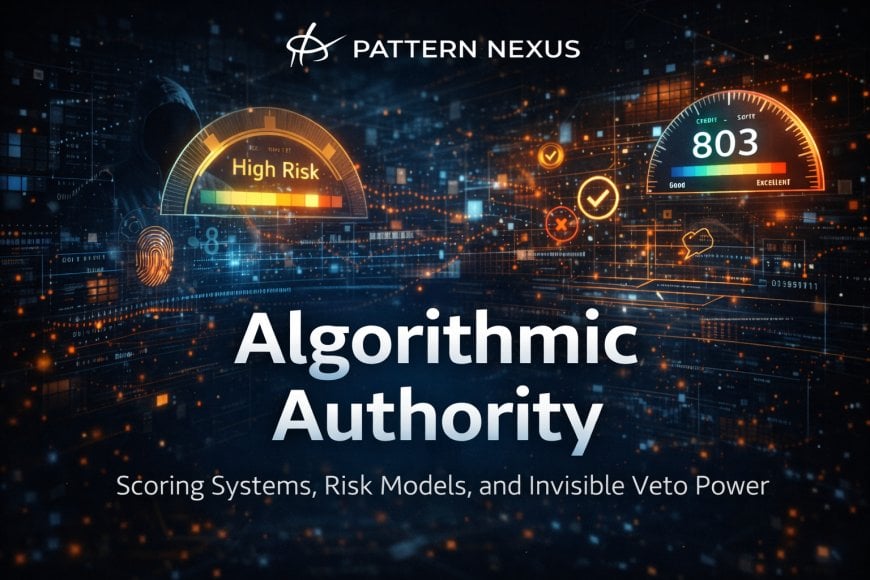


Algorithmic authority is not “AI controlling people.” It’s institutions using models to translate uncertainty into eligibility rules.
The most scalable censorship is not deletion. It’s throttling: reduced reach, denied eligibility, higher friction, and silent exclusion.
When prediction becomes accurate enough, governance shifts from punishing violations to preventing risk.
Authority Without Decree
The control-systems era does not remove law. It bypasses law. The most important decisions in modern life increasingly occur upstream of courts, legislatures, and visible enforcement. Access is granted or denied by systems that look technical: underwriting, fraud detection, recommender ranking, trust tiers, compliance screening, and risk scoring.
This is the rise of algorithmic authority: governance expressed as eligibility logic. The system does not need to accuse. It does not need to prove wrongdoing. It only needs to decide whether participation is acceptable.
Traditional authority is explicit: rules, enforcement events, appeals. Algorithmic authority is environmental: scores, thresholds, throttles, eligibility lanes. The first governs by commands. The second governs by conditions.
The previous chapters built the infrastructure that makes algorithmic authority inevitable:
- Money became software and rails became permissioned access.
- Standards turned compatibility into a gate.
- Energy made uptime a constraint with hard failure modes.
- Compute became a controllable throughput resource.
- Data gravity fused identity to behavior and made prediction scalable.
- Compliance stacks turned risk management into soft enforcement.
Algorithmic authority is the decision layer sitting on top of that machine. It converts measurement into action: who gets approved, who gets downgraded, who gets watched, who gets excluded, and who never knows why.
The most important conceptual shift is simple: legality is binary; risk is continuous. A legal system can say “yes” or “no.” A risk system can say “yes, but,” “yes, with friction,” “yes, but expensive,” “yes, but limited,” or “no, quietly.”
Scoring Systems as a Permission Layer
A “score” is not just a number. It is a routing decision. Scores place people and organizations into lanes, and lanes determine what is possible.
A useful way to see this is to stop thinking about scoring as evaluation and start thinking about scoring as access control.
Scores route participants into lanes. Lanes define approval probability, cost, friction, monitoring intensity, and failure thresholds. The lane is the real outcome. The score is just the handle.
Scores exist everywhere:
- Finance: creditworthiness, underwriting, default probability, affordability, collateral quality.
- Payments: chargeback risk, merchant category monitoring, fraud likelihood, reserve requirements.
- Insurance: risk pricing, coverage denial, exclusions, renewal decisions.
- Platforms: trust and safety tiers, ad account quality, creator eligibility, seller reputations.
- Employment: screening models, background scoring, productivity signals, retention risk.
- Security: identity confidence, anomaly detection, access privileges.
- Compliance: KYC level, AML monitoring intensity, sanctions proximity, “de-risking” likelihood.
The system doesn’t need to coordinate these domains explicitly. They converge because each domain is responding to the same incentives: reduce uncertainty, avoid losses, and reduce liability.
The hidden merger: scoring + compliance
When scoring fuses with compliance, the system becomes far more than “risk management.” It becomes a governance layer because it gains moral and legal justification. Fraud and AML systems are allowed to be opaque. They are allowed to prioritize false positives. They are allowed to deny service instantly. Once that norm exists, it migrates into adjacent decision layers.
This is how “defensible” scoring becomes “unappealable” scoring. The institution can always say the same sentence: risk and compliance requirements prevent disclosure.
Personalization: the silent shift from uniform rules to individualized reality
In older systems, rules were uniform: the same rule applied to everyone. In score-governed systems, reality becomes individualized: different limits, different friction, different pricing, different visibility. Two people can live in the same city and experience completely different system behavior, because the system is responding to different predictions.
This is why algorithmic authority feels invisible. It is not a public decree. It is a private environment.
Invisible Veto Power: Throttles, Friction, and Preemption
Algorithmic authority is most effectively understood as veto power. Not the dramatic veto of politics, but the operational veto of systems: the ability to quietly stop something from functioning at scale.
The modern veto rarely looks like “no.” It looks like throttling.
Bans are loud, legally contestable, and politically costly. Throttles are quiet, tunable, deniable, and continuous. Control systems prefer continuous control.
Throttles come in four primary forms:
- Visibility throttles: ranking changes, reach suppression, discoverability collapse.
- Eligibility throttles: monetization denial, advertising restrictions, feature lockouts.
- Friction throttles: delays, “manual review,” extra verification, repeated holds.
- Pricing throttles: higher rates, worse terms, lower limits, individualized premiums.
The political brilliance of throttles is that they can be framed as “neutral” optimization: fraud prevention, safety, compliance, user experience, market integrity. The result is the same either way: the system decides whose throughput is allowed to remain high.
Preemption replaces due process
Due process is a legal ideal built for a world of slow events and visible enforcement. Preemptive governance is built for a world where systems cannot tolerate unknown risk. If the model predicts a higher probability of loss, violation, or instability, the system acts before the event.
This is governance by probability. It does not require proof. It requires a threshold.
In algorithmic authority, the effective “law” is the eligibility threshold. Cross the threshold and the environment changes. Often permanently, and often invisibly.
The deniability loop
When questioned, algorithmic systems create a chain of deflection. The platform cites policy. Policy cites the model. The model cites risk. Risk cites compliance. Compliance cites regulation. Regulation cites national security or consumer protection. Nobody “made a decision.” The system did.
This is the essence of algorithmic authority: distributed enforcement with no clear decision-maker.
The Model Supply Chain: Data → Score → Decision → Feedback
Models are not one-off tools. They are production systems. They operate as a supply chain:
- data is collected and fused
- features are engineered into signals
- models produce scores
- scores produce decisions
- decisions change behavior
- behavior generates new data
Measurement creates prediction. Prediction creates eligibility. Eligibility creates constraint. Constraint reshapes behavior. Behavior strengthens measurement.
This loop creates two realities:
- Institution reality: the system is optimizing outcomes and reducing risk.
- Human reality: the system is arbitrary, opaque, and unappealable.
Feedback and self-fulfilling outcomes
When models drive access decisions, they can become self-reinforcing. If a model predicts risk and applies friction, it changes the person’s behavior under friction. That new behavior can then be interpreted as confirmation of risk. The model becomes both observer and author of the outcome.
Cross-domain fusion: where authority becomes totalizing
The control-systems risk is not “a model exists.” The risk is that models fuse across domains. A downgrade in one system cascades into others: bank access affects business viability, business viability affects credit, credit affects insurance, insurance affects licensing, licensing affects platform eligibility, platform eligibility affects income, income affects everything else.
When domains fuse, exclusion becomes systemic. That is what turns scoring into authority.
Compute and energy as the enforcement substrate
Real-time scoring requires compute, and compute requires energy. As compute becomes more centralized and more expensive, the ability to run high-grade models becomes a structural advantage for incumbents and states that control the compute stack. This links Part V and Part IV directly into algorithmic authority. The decision layer is only as powerful as the throughput behind it.
Regulatory Reality and the New Legibility Wars
As of 2024–2025, regulators increasingly treat algorithmic decision systems as governance infrastructure. The shift is visible in three overlapping regimes: AI governance, platform governance, and data security governance. The common theme is legibility: forcing systems that shape outcomes to become explainable, auditable, and accountable.
AI governance: risk-based regulation of decision systems
Europe’s AI Act (Regulation (EU) 2024/1689) formalizes a risk-based framework that treats certain AI uses as high-impact governance concerns. It defines prohibited practices and imposes obligations on systems considered “high-risk.” The intent is not to ban AI broadly; it is to constrain decision systems that can materially affect rights, access, and outcomes.
Platform governance: recommender systems as authority systems
The Digital Services Act (Regulation (EU) 2022/2065) reflects the realization that ranking and recommendation systems govern public attention. Article 27 addresses recommender system transparency by requiring that main parameters used by recommender systems are explained and that options to modify or influence those parameters are provided.
The deeper point is structural: ranking is being treated as a governance layer rather than a private product feature.
AI risk frameworks: soft standards become hard gates
NIST’s AI Risk Management Framework and its Generative AI Profile (NIST AI 600-1) provide a standardized vocabulary for identifying and managing AI risks. Even when voluntary, these frameworks often become operational gates when they are adopted into procurement, audit expectations, insurance requirements, or regulatory guidance. “Voluntary” becomes mandatory for scale.
Data security governance: model fuel becomes strategic material
The U.S. DOJ final rule implementing Executive Order 14117 restricts and prohibits certain bulk sensitive personal data transactions with countries of concern. In control-systems terms, this is governance of model fuel. If data enables prediction and prediction enables authority, then controlling data flows becomes part of controlling authority.
Institutions want opacity because opacity prevents gaming and reduces liability. Societies want legibility because legibility is the only path to accountability. Algorithmic authority expands in the gap between those two desires.
Failure Modes, Adversarial Pressure, and Where It Breaks
Algorithmic authority is powerful precisely because it is scalable. But scalability creates predictable failure modes. These failures are not “bugs.” They are structural byproducts of governing through probability and opacity.
Failure mode 1: false positives become normal collateral damage
Risk systems are optimized to avoid catastrophic misses. That means they accept false positives. In human terms, innocent people and legitimate businesses are routinely throttled because the system is designed to protect itself first.
Failure mode 2: appeals become theater
When the decision is “the model flagged it,” appeals become structurally weak. A human reviewer can confirm policy adherence, but cannot reveal or override system logic without exposing the model to gaming. This creates a world where “support” exists but “recourse” does not.
Failure mode 3: gaming and adversarial adaptation
Every scoring system creates an incentive to game it. As adversaries adapt, models harden. Hardening increases false positives. False positives create trust collapse. Trust collapse drives demand for regulation. Regulation increases compliance burden. Compliance burden advantages incumbents. The system becomes more concentrated.
Failure mode 4: governance drift
Models change. Thresholds change. Features change. Data changes. When models govern, governance itself becomes dynamic. Participation rules shift without democratic visibility, and the environment becomes unstable for anyone not inside the system.
Algorithmic authority breaks when opacity collides with legitimacy. When enough people experience unappealable throttles, systems lose trust. Control then shifts from quiet optimization to overt enforcement—and that transition is unstable.
The most durable countermeasures are structural, not rhetorical: auditability, meaningful appeal, portability, limits on cross-domain fusion, and hard constraints on where scoring may be used to allocate life-critical access.
Pattern Nexus Lens
Algorithmic authority is the decision layer that makes every other control layer actionable.
Money provides rails. Standards provide compatibility. Energy and compute provide throughput. Data provides reality modeling. Compliance provides survivability constraints. Algorithmic authority converts all of that into a single operational output: eligibility. That is why the modern world feels like systems are deciding outcomes before politics even begins.
The defining feature of this era is not that machines are smarter. It is that governance is moving from explicit rules to invisible parameters. The public still debates laws. The system enforces thresholds.
When prediction becomes permission, the constitution becomes a parameter sheet. The real “law” is the eligibility logic that decides what is allowed to function.
FAQ
Is algorithmic authority the same thing as “AI controlling society”?
No. It is institutions using scoring systems to allocate access under uncertainty. Authority comes from the institution’s ability to throttle participation, not from the model’s intelligence.
Why does throttling matter more than censorship?
Because throttling shapes outcomes without confrontation. Systems can keep speech “allowed” while ensuring it never reaches anyone, never monetizes, or never scales.
Can regulation solve algorithmic authority?
Regulation can force transparency and constrain certain uses, but the deeper issue is recourse. Without meaningful appeal pathways and limits on cross-domain fusion, algorithmic authority remains structurally unaccountable.
Why do systems accept false positives?
Because risk systems prioritize institutional survival. Excluding legitimate actors is often cheaper than missing a bad actor and paying the downstream cost.
What actually reduces algorithmic authority?
Architecture: portability, auditability, due-process-like appeal, transparency obligations that are enforceable, and hard boundaries around where probabilistic scoring may be used to allocate life-critical access.
Sources
Primary texts and official documentation supporting the regulatory frameworks referenced in this chapter.
- EUR-Lex: Regulation (EU) 2024/1689 (Artificial Intelligence Act) — Official Journal text
- European Commission: AI Act enters into force (Aug 1, 2024)
- EUR-Lex: Regulation (EU) 2022/2065 (Digital Services Act) — Official Journal text
- Digital Services Act: Article 27 — Recommender system transparency (text)
- NIST: AI Risk Management Framework (AI RMF)
- NIST AI 600-1 (Generative AI Profile): Companion resource to the AI RMF
- U.S. Federal Register: DOJ final rule implementing EO 14117 (bulk sensitive personal data)
- U.S. DOJ NSD: Data security resources for EO 14117
Phản Ứng Của Bạn Là Gì?
 Thích
0
Thích
0
 Không Thích
0
Không Thích
0
 Yêu
0
Yêu
0
 Hài hước
0
Hài hước
0
 Wow
0
Wow
0
 Buồn
0
Buồn
0
 Giận dữ
0
Giận dữ
0

Founder of Pattern Nexus. I research markets, macro, geopolitics, AI, history, ancient systems, and the patterns most people overlook. I’m also building Market Radar, a trading scanner designed to read pressure, risk, confirmation, and setup quality before chasing a move. Pattern Nexus is where I connect the dots between data, history, technology, and the bigger system playing out around us.




















Các bình luận (0)