
Nhu cầu thanh khoản cần một lớp bảo vệ: Chiến tranh, hệ thống kiểm soát và sự ổn định giả tạo của nền kinh tế hiện đại

Back in October, I started talking about a liquidity crisis. Not a vibes problem. Not some abstract market mood swing. A real structural problem. The system needed more liquidity, more support, more intervention, more room to keep itself going. The problem was never whether they could do it mechanically. The problem was whether they could do it politically while inflation was still alive, rates were still elevated, and people still remembered what price instability feels like. That is the frame here. Modern systems do not just need money. They need a reason. They need cover. Sometimes that cover is a credit break. Sometimes it is an energy shock. Sometimes it is war. Sometimes it is a chain reaction big enough to make the next intervention look necessary instead of optional. That is what this piece is about.
Liquidity stress usually shows up in the plumbing before the public ever gets the headline version of the story.
Inflation does not prevent intervention. It just makes open intervention harder to sell without a politically useful shock.
A lot of modern production is not civilizational progress. It is churn, replacement, monetized friction, and extraction disguised as innovation.
The world people think is stable is often just a temporary arrangement they got too comfortable inside.
Why Pattern Nexus Covers So Many Different Topics
If you have been following Pattern Nexus for any length of time, you already know I move across liquidity, repo plumbing, war, oil, AI, demographics, real estate, social psychology, energy, control systems, sovereignty, and industrial power. To the average person that probably looks absurd. They probably think one person is supposed to pick one clean lane and live there forever.
I do not agree with that because the lanes are fake.
Finance affects war. War affects energy. Energy affects inflation. Inflation affects rates. Rates affect housing. Housing affects household formation. Household formation affects demand. Demand affects industrial planning. Industrial planning affects labor, grid stress, compute, debt, and sovereignty. This is not a bunch of disconnected stories. It is one machine with multiple layers running at the same time.
That is what Pattern Nexus is actually trying to do. I am not covering a broad range of topics because I want to look broad. I cover the things I know, the things I have spent years researching, and the things that clearly interact with one another whether mainstream analysis wants to admit that or not. The average person gets blindsided because they still consume the world in little compartments. Macro here. War there. Technology over there. Society somewhere else. Then they act shocked when the surface story breaks because the interaction between those things was ignored the entire time.
The more people are trained to think in disconnected categories, the easier it becomes to hide the pattern in plain sight.
The October Call, Repo, and the Pattern I Saw Before
In October, I started talking about a liquidity crisis. I said there was not enough liquidity in the world for the structure we are trying to maintain. I said they would need more money, more intervention, more support, or some other equivalent mechanism to keep the system functioning. But I also said there was a problem with that view: inflation and the broader economic environment would make it politically difficult to do that openly without a reason, without cover.
That is why I kept coming back to repo and monetary plumbing. Repo is one of the places where stress shows up before the average person knows anything is wrong. That was true in 2019. It matters now for the same reason. Back then, when I was telling people around me that we were heading toward another financial crisis, it did not look that way on the surface yet. That is the point. These things do not announce themselves politely. The structure starts breaking underneath first. The headline explanation comes later.
I am not trying to turn this piece into a COVID article, and I do not want to go down every rabbit hole attached to that period. What I am saying is narrower than that. Repo stress started blowing up in September and October 2019. Then COVID emerges as the defining global event right on top of a system that already needed cover for intervention. Whether people like that framing or not, the timing lined up perfectly for the structural problem that already existed. That is not a conspiracy claim. That is an observation about sequence.
The broader point is the same one I am making now. Stress appears in the structure first. Then the public story catches up. Then people act like the first major headline was the beginning of the crisis. It usually was not.
- Structural stress often appears before public awareness.
- Liquidity strain does not need permission to exist, but intervention usually needs permission to expand.
- The visible event and the underlying necessity are often not the same thing.
Liquidity Is Not the Only Problem. Political Cover Is.
This is the part too many people miss. The system needing more liquidity is only half the issue. The other half is whether the people managing the system have enough political room to provide it without sparking backlash, credibility loss, or another inflation wave that the public can feel directly.
That is why I keep using the phrase cover. Not because I am saying every event is scripted by some omnipotent mastermind. I am saying major systems under stress often need a sufficiently large external reason to justify the next internal support mechanism. A war can do that. A recession scare can do that. A credit event can do that. An energy spike can do that. A chain reaction across all four can do it even better.
That is how you should be thinking about the current environment. If the structure needs intervention but inflation is still alive and rates are still high enough to make policymakers look trapped, then the next major shock is not just an event in its own category. It becomes a permission structure. It widens the lane for what comes next.
Modern intervention is not just about mechanics. It is about whether the environment is negative enough to make the intervention politically saleable.
The System Was Built to Need More
We can go back through 1987, 1991, 2001, 2008, 2019, and everything in between. The exact event sequence changes, but it does not change the core argument. Once you build a debt-heavy, financialized system on perpetual expansion, the system is going to need more every single cycle.
More money. More debt. More claims. More speculation. More financialization. More throughput. More consumption. More productivity theater. More future income dragged into the present so the present can keep pretending it is sustainable. That is not a temporary flaw. That is how the architecture works.
People say everybody is in debt but “we owe it to ourselves” as if that magically resolves the absurdity of it. Owed to ourselves by ourselves through an arbitrary structure of accounting, compulsion, and confidence? That does not make it more real. It just means the control relationship is embedded deeply enough that people stopped noticing it.
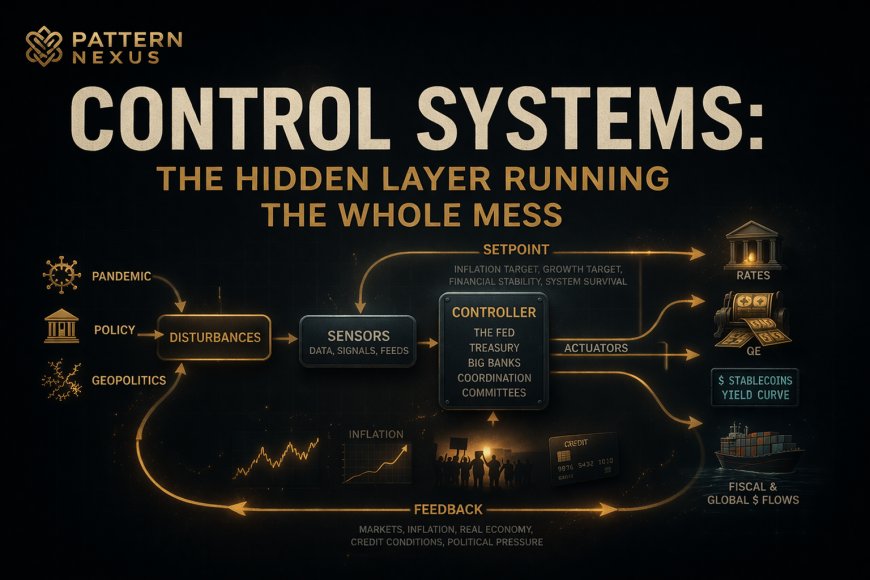
That is why I keep coming back to control systems. None of this is neutral. Debt at scale is not just a line item. It becomes a way to shape behavior, labor, timing, access, vulnerability, and compliance. It becomes part of the operating system. That is why every time intervention appears, it is always presented as temporary, exceptional, and necessary. Then it never really leaves. It just changes wrapper.
Before 1997 and before 2008, direct central-bank intervention was not normalized the way it is now. Then you move through LTCM, through 2008, through QE, through repo facilities, reverse repo, liquidity operations, targeted support, “temporary” balance sheet expansion, and all the rest of it. Here we are decades later and the so-called temporary tools are basically part of the permanent language of the system.
That is why I made the point months ago that something on the order of tens of trillions in global liquidity over a decade is not remotely as insane as people act like it is. When the entire structure is built around needing more, then more is exactly what it will continue to demand.
Planned Obsolescence, Consumer Junk, and Demographic Friction
This is where the article gets more controversial for people who still confuse throughput with progress.
The majority of things people buy are pointless. The majority of gadgets people are sold do nothing meaningful for humanity. I am not saying all technology is useless. I am saying a shocking amount of modern production exists to create churn, not civilizational advancement. It exists to shave two seconds off some trivial task, convince you that convenience equals necessity, then extract more money from you on the back end.
We know how to build things to last. We choose not to, because durability is often bad for the machine. Planned obsolescence is not some fringe complaint. It is a structural feature. Furniture, kitchenware, appliances, entertainment products, subscriptions, warranty cycles, replacement parts, disposable design, software locks, artificial scarcity, upgrade pressure. A lot of the consumer economy is just monetized friction disguised as innovation.
Could we make a furnace that lasts decades? Of course we could. Older systems did. Could we build more products around repairability and durability? Obviously. We often do not because replacement demand supports the broader system better than long-term functionality does.
That matters for demographics because younger generations do not spend the way older ones did. They do not form households on the same timetable. They do not buy the same way. Their priorities are different. Their constraints are different. The older generations often interpret that as cultural failure or laziness when a lot of it is structural. They inherited a more expensive, more conditional, more debt-loaded version of life.
Then you layer in the next fracture. AI versus anti-AI. Futurists versus people stuck in the past. Data center wars. People who want the next stage of productivity and people who want to stop the future because it threatens the old arrangement. Everybody thinks they are morally right. Progress still moves anyway. It always has. You can accept that or waste your energy screaming at the clock.
Within a century, almost everyone alive right now will be gone. Their opinions about what should or should not change will be gone with them. That is not nihilism. It is scale. Human beings project way too much of their own temporary existence onto the future as if the future owes them permanence.
War, Oil, Recession Risk, and Why This Matters Now
Now bring it back to the current environment.
I laid out possibilities around Venezuela. I talked about the type of action that might happen there. I did not expect some giant drawn-out occupation. The same general logic applied to Iran. I expected an air campaign and an attempt to move on. Iran’s response has made that much harder. It has widened the conflict logic. It has changed the cost profile. It has changed the assumptions behind a quick, clean outcome.
A lot of Gulf countries want Iran disarmed or removed whether they say that publicly or not. You do not get this level of ongoing damage absorption, infrastructure risk, and regional exposure unless powerful actors actually want the underlying issue resolved in a more permanent way. Their countries are taking damage. Their systems are being hit. Their infrastructure is exposed. That matters.
If this war creates an environment negative enough for the economy, then it can become the exact type of cover the system needs. If oil gets high enough, that matters directly. But even before the highest-end oil scenarios, the environment may already be doing the job because the economy is more structurally fragile than people want to admit.
I remember the gas shock years personally. I remember being a teenager and seeing what $5 gas felt like in the mid-2000s. That shock is burned into my memory. Today is not identical to that period because the economy is different, demand composition is different, and the energy system is more diversified than it was. But that does not mean the shock channel is gone. It means the shock transmits through a wider set of systems now.
Oil is not just gas prices. It is freight, food, logistics, insurance, industrial cost, expectations, and bond repricing. A real energy shock is never just an energy story. It leaks outward. It puts pressure on households. It tightens financial conditions. It changes the inflation narrative. And if the downturn becomes sharp enough, suddenly the next round of support starts looking inevitable.
That is the whole point. This war, this broader event chain, may create the exact environment necessary for them to do what they already structurally need to do. And if that happens, the result may not be relief in the clean sense people imagine. It may be another inflation wave, another asset bubble, and another round of system preservation sold as necessity.
Rome, Sea Power, Drones, and the Limits of Collapse Talk
People hear arguments like this and think I am saying America is collapsing tomorrow. I am not.
I am not really a doomer. The United States does not just disappear because people are anxious online. The only real version of American collapse that matters at the hard-power level is loss of control over the seas, and we are not there. But that does not mean everything is fine. It means the battleground is changing.
If you study Rome for real, then none of this should surprise you. Systems can be decaying long before the population understands the decay is structural. People inside empires are very good at mistaking prolonged instability for permanent continuity.
At the same time, it is much harder for the U.S. Navy to project uncontested power than it was twenty years ago. That is not because America disappeared. It is because the cost profile changed. Small countries and non-state actors have access to much cheaper tools of disruption now. Drones changed the battleground. Cheap precision changed the battleground. Maritime harassment changed the battleground. It is not the old world anymore.
That is why I do not want to reduce this to simple doom language. The United States is not some brittle glass object about to vanish. But the environment is more contested, more expensive, and more complex than it used to be. That changes how stress propagates through markets, energy, shipping, and power projection.
I also do not want to go so far as saying everything is orchestrated in some grand perfect way. That is not necessary for the argument. What matters is that events keep arriving in forms that benefit the continuation of the system and the people with the most leverage over it. You do not need total orchestration for that. Incentive, sequence, and structural advantage are enough.
The Human Lens, Borders, and False Measures of Success
This is where the article widens back out because the liquidity argument is only one layer of what I am actually getting at.
Human beings constantly evaluate themselves and each other through a human lens, then act like those measurements are eternal truth. Wealth, status, career prestige, ideology, labels, hierarchy, national identity, moral superiority, all of it is filtered through human perception. That means bias. That means incompleteness. That means we are measuring ourselves against rules we created and then pretending those rules are fundamental reality.
They are not.
A whale does not care what country’s water it is in. A bird does not care that it crossed an international border. Human beings draw lines on maps, stack force and law on top of them, then start acting like the lines are natural law. They are not. They are administrative claims backed by power.
The same goes for the stories people tell themselves about permanence. We have a normalcy bias that is far more extreme than most people realize. Most people think the last few years of their life are the normal version of reality. Then when conditions change, they ask what happened. The better question is why they assumed things would stay still in the first place.
Life never stops moving. Systems never stop evolving. History never stops grinding through civilizations, cities, institutions, and narratives. Human beings just keep forgetting that because they are trapped in the scale of their own lifespan.
Even if you hold power, you are still tiny relative to the full system. Even presidents are small relative to time, structure, and species-level continuity. That is not me trying to put people down. It is me trying to correct the scale. Human beings overstate their own permanence constantly.
We are not the measure of all things. We are one species on one planet, louder and more destructive than the rest, pretending our temporary arrangements are universal truth.
Why Leadership Itself Has Become a Structural Problem
No one should be in power for decades. Period.
I do not care if it is a president, senator, prime minister, parliamentary fixture, regulator, governor, party operator, or some bureaucratic class that never leaves. Public service should be service. It should not be permanent habitation. You do the role. You leave. You do not get to build a life inside the state and then call that normal.
The longer people stay in power, the more influence compounds, the more networks harden, the more narratives get managed, and the more the structure starts serving itself instead of the public. That is not a partisan statement. That is how power behaves.
The deeper issue is behavioral. The same person who meddles in everything inside a family system would meddle in everything at national scale if given the opportunity. Office does not purify character. It magnifies the consequences of it.
That is why I do not understand why human beings normalize leaders staying in power for decades. You would not accept that in most parts of daily life. You would not let one person dominate your neighborhood for thirty years. You would not let one person run your local group forever. Yet on the scale where the consequences are largest, people accept permanence as normal.
It is insane. One term should mean one term. Then you are done. No return. No permanent administrative class. No lifelong public-position pipeline. That entire arrangement needs to end if people actually want to reduce the structural pathologies that keep reproducing themselves.
Tweet-Driven Markets and Algorithmic Insanity
Part of why I have not been posting as much is because it has gotten harder to articulate the economy honestly when so much of the short-term movement is being driven by fragments, tweets, rumors, and machine reaction.
People still talk like the market is this elegant wisdom machine pricing the future with perfect efficiency. Come on. A politician can say something at 10 a.m. and the entire day’s direction changes. Not because reality changed that fast, but because algorithms react faster than humans can think and because human beings chase the machines after the fact.
So now we have a system where stupid computers cannot even reliably determine whether a statement is authentic, serious, tactical, emotional, or meaningless, yet they can move billions in positioning because they are wired to act first and let interpretation come later.
No human being should have that much power over other human beings through an information channel. Yet that is the arrangement we tolerate. People act like this is normal because the chart still updates and the apps still work. It is not normal. It is preposterous.
And that loops directly back into the broader thesis of this article. When liquidity is fragile, when intervention needs cover, when war affects oil, when oil affects inflation, when inflation affects rates, and when the market can violently react to a single digital fragment, then you are not living inside a stable system. You are living inside a highly managed, highly reactive, highly narrative-sensitive machine that keeps needing larger justification events to preserve itself.
That is the real issue. Not whether one day is green or red. Not whether the next tweet pumps or dumps the tape. The real issue is that the architecture underneath all of it is unstable and keeps requiring more force, more management, more intervention, and more story to maintain the illusion that it is fundamentally normal.
Pattern Nexus Lens
The question is not whether the system likes intervention. Of course it does. The question is what kind of stress creates enough political room for the next intervention to become unavoidable.
If liquidity is tight, inflation is still alive, rates are still elevated, and policymakers do not have a clean lane to openly support the structure again, then the next major shock matters far beyond its own category. War matters beyond war. Oil matters beyond energy. Credit matters beyond finance. Narrative matters beyond media. All of them can widen the policy lane for the next move.
Modern instability is not random noise. It is often the interaction between structural fragility, narrative management, political permission, and the system’s need for more support than it can openly justify under normal conditions.
FAQ
Are you saying every crisis is orchestrated?
No. The argument is narrower than that. Structural stress can already exist underneath the system, and then a sufficiently large shock can create the political cover needed for the next intervention.
Are you saying war is just an excuse?
No. War is real. Damage is real. Death is real. The point is that war can also function as a permission structure that changes what becomes politically possible in finance and policy.
Why bring consumer junk and planned obsolescence into a liquidity article?
Because the economy is not just rates and charts. It is also demand composition, replacement cycles, household formation, monetized friction, and the kinds of production the system relies on to keep consumption moving.
Why does this get philosophical?
Because the issue is not just market pricing. It is the operating system underneath the market, underneath politics, underneath borders, underneath status, and underneath how human beings interpret their own reality.
Are you trying to write a hard-news article here?
No. This is a worldview piece. It uses factual anchors, but the point is to lay out the frame and the structure underneath the surface story.
Sources
These sources support the repo, Fed, oil, inflation, energy-demand, and market-volatility claims referenced through the macro parts of this essay.
- New York Fed: Statement Regarding Repurchase Operations (September 20, 2019)
- New York Fed Economic Policy Review: The Market Events of Mid-September 2019
- Federal Reserve History: Near Failure of Long-Term Capital Management
- U.S. Treasury: Troubled Asset Relief Program (TARP)
- Federal Reserve: March 18, 2026 FOMC Statement
- Federal Reserve: H.15 Selected Interest Rates
- Reuters: NY Fed official said central bank bill buying should moderate soon
- Reuters: Global watchdog flags risks in government-backed repo markets
- IMF: Coping and Thriving in a Fluid World
- Reuters: U.S. pump prices jump since Middle East war began
- Reuters: Options market signals rising risk of $150 oil
- Reuters: Larry Fink warns sustained $150 oil could trigger global recession
- Reuters: Oil prices stay elevated across Iran war scenarios
- EIA FAQ: U.S. gasoline consumption
- IEA: Global Energy Review 2025 — Oil
- EIA: Strong electricity-demand growth fueled by data centers
- Journal of Financial Research: Trump’s tweets, sentiment, stock market volatility, and jumps
- Finance Research Letters: Impacts of Donald Trump’s tweets on stock-market volatility
Phản Ứng Của Bạn Là Gì?
 Thích
0
Thích
0
 Không Thích
0
Không Thích
0
 Yêu
0
Yêu
0
 Hài hước
0
Hài hước
0
 Wow
0
Wow
0
 Buồn
0
Buồn
0
 Giận dữ
0
Giận dữ
0

Founder of Pattern Nexus. I research markets, macro, geopolitics, AI, history, ancient systems, and the patterns most people overlook. I’m also building Market Radar, a trading scanner designed to read pressure, risk, confirmation, and setup quality before chasing a move. Pattern Nexus is where I connect the dots between data, history, technology, and the bigger system playing out around us.
















Các bình luận (0)