
The AI Causal Chain Explained Like You're Five: From Cold War Radar to Robots and the Economy
AI did not begin with ChatGPT. This accessible, fully sourced Pattern Nexus research map follows the 1943 artificial-neuron paper, Cold War radar computers, predictive internet systems, transformer models, agents, embodied AI and humanoid robots into the real questions about jobs, energy, productive ownership, wages and the economy.
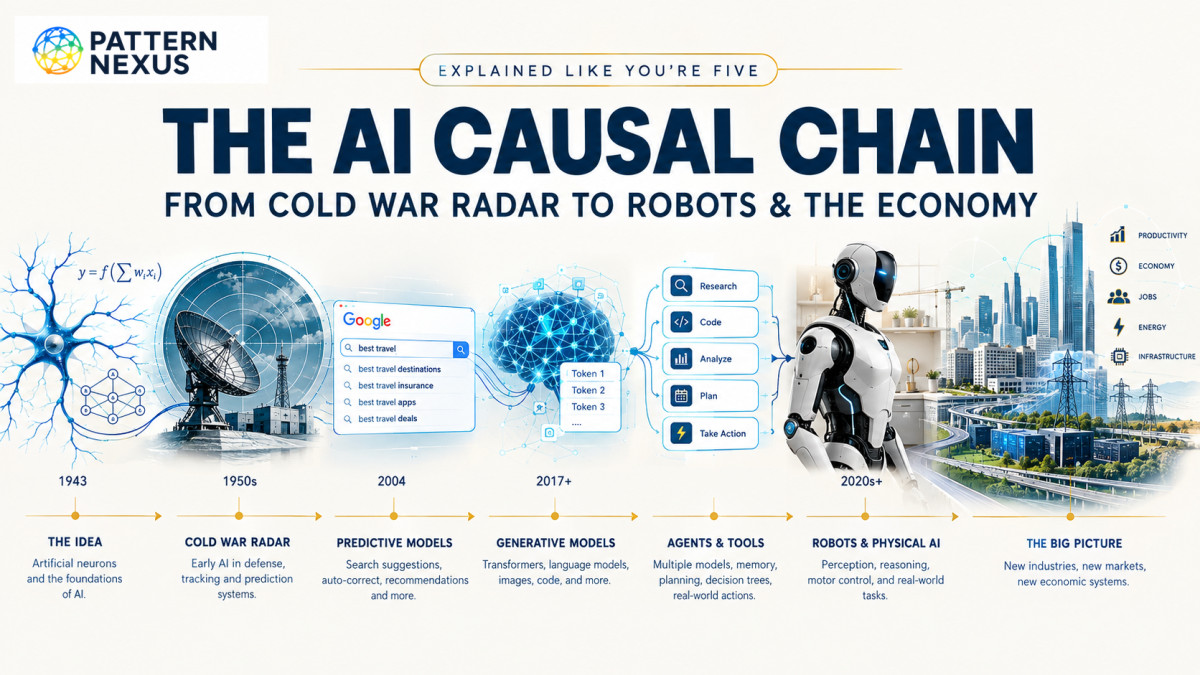
Guys, listen. Artificial intelligence did not suddenly appear when ChatGPT opened a chat window. The research goes back generations. Computers were already processing radar signals and supporting military decisions during the Cold War. Predictive systems were already shaping what you searched, watched and purchased long before everybody started calling everything “AI.” The chatbot made the technology visible. It did not create the underlying field.
- 1943 was a foundation, not a product launch. McCulloch and Pitts described a mathematical model of artificial neurons. AI did not arrive as one finished invention.
- The Cold War built the control-system layer. SAGE connected radar, computing, displays and people into real-time air-defense decision support. It was not a modern self-learning neural network.
- The internet made prediction ordinary. Search suggestions, recommendation engines, filters, translation and fraud detection placed increasingly sophisticated algorithms into daily life.
- The chatbot is the interface. A model produces responses; additional tools, instructions, retrieval systems and software turn a conversational model into a workflow or agent.
- Generation becomes economically consequential when it becomes action. An answer is one thing. An authorized system that can search, plan, operate software, monitor results and repeat is another.
- Robotics moves AI into physical labor. Sensors, motors, controls and trained models connect the digital world to warehouses, factories, construction sites and, eventually, more homes.
- Job displacement begins at the task level. A robot does not have to master every part of a trade to reduce the amount of labor a business purchases.
- The last link is economic. When ownership of productive machines becomes more important and wages become less central to production, the questions become income, purchasing power, energy, credit and distribution.
That's the whole point of following a causal chain: do not stare at the robot video, the chatbot answer or this month's model benchmark. Follow what each layer enables next, what it costs to build, and which part of the economy changes when it works.
AI did not start with a chatbot. The public interface changed. The underlying research is decades old.
Automation and learning are different. An older radar computer could automate calculations without being a modern machine-learning model.
One useful task is enough to matter. The economic threshold is not “robot does every job.” It is “robot changes the cost and staffing of enough tasks.”
Don't confuse a demonstration with a labor force. Sales, pilots, productive deployments, uptime and cost per useful hour are different measurements.
01 · THE FRAMEWORK
What I Mean When I Tell You to Follow the Causal Chain
Here's the simplest way I can explain it. A causal chain is what happens when one development makes another development possible, cheaper or more attractive. A better computer allows a larger model. A better model makes software automation more useful. Useful automation creates demand for more computers. Better perception and planning improve robots. Robots make different kinds of work automatable. The resulting change in work changes investment, employment, income and, ultimately, the economy.
It is not the claim that every invention follows one secret master plan. It is not the claim that every technology is new, that every company will succeed, or that progress follows a perfectly smooth exponential curve. It means that the things people insist on debating separately are interacting parts of one system.
Read this as a sequence: mathematical ideas → real-time computing → digital data → machine learning → large-scale generative models → tools and agents → robot perception and control → useful automation → reorganized labor → changed income and ownership → macroeconomic response.
If you only look at the last link, you will think AI appeared out of nowhere. If you go through the chain, much of what looks sudden becomes understandable.
02 · THE FOUNDATIONS
The 1940s: We Were Modeling Artificial Neurons Before Your Grandparents Had a Home Computer
In 1943, Warren McCulloch and Walter Pitts published A Logical Calculus of the Ideas Immanent in Nervous Activity. They showed how simplified artificial neurons could be represented with logical rules and organized into networks. It was an important conceptual ancestor of neural-network research, not the invention of every later form of AI and certainly not a working version of ChatGPT.[1]
Imagine drawing a very simple artificial neuron on paper. It receives signals. Depending on the combined signals, it switches on or stays off. Now connect lots of those units. The question becomes whether complicated behavior can emerge from collections of relatively simple operations. The 1943 paper helped make that a mathematical problem rather than only a philosophical argument.
The field was named later. The 1955 proposal for the 1956 Dartmouth Summer Research Project on Artificial Intelligence explicitly asked whether aspects of learning and intelligence could be described precisely enough for machines to simulate them. Language, abstraction, problem-solving and improvement were on the agenda before most homes had a television remote, much less a smartphone.[2]
Explain-it-like-you're-five version: First we worked out how to describe little pieces of intelligence with mathematics. Only later did we build enough machinery, data and training methods to make extremely complex versions useful.
03 · THE MILITARY COMPUTING LAYER
The Cold War Radars Were Already Part of a Machine-Assisted Decision System
The next piece was not an app. It was air defense. During the early Cold War, the United States needed to detect incoming aircraft, combine radar observations from many locations, understand where an aircraft was going and coordinate a response before it was too late. Humans with pencils and telephone calls were not fast enough for the problem the military wanted to solve.
MIT's Project Whirlwind, Lincoln Laboratory and IBM contributed to SAGE: the Semi-Automatic Ground Environment. The system linked radar stations, communications, large digital computers, displays and human operators. The first AN/FSQ-7 installation became operational in 1958. A radar return became digital information; digital information became a track; the track became an air picture; the air picture informed a response.[3][4]
Let me be precise, because the distinctions matter. SAGE was not an early large language model, and a radar tracking calculation is not automatically machine learning. Much of the system was explicitly programmed real-time computing and human-in-the-loop control. The connection to today's AI is architectural: collect signals, build a model of a changing world, predict or evaluate what follows, and help people act.
That architecture migrated into civilian computing: networked systems, interactive displays, reliability engineering, communication between machines and real-time software. The Cold War did not secretly invent every contemporary AI model. It helped pay for and accelerate some of the computing infrastructure and engineering disciplines on which later technologies depended.
And yes, classified programs existed. Their undisclosed capabilities are not a substitute for evidence. The documented, public chain is significant enough without pretending to know what is still behind closed doors.
04 · THE EVERYDAY INTERNET
You Were Already Using Predictive Systems While Imagining AI as the Terminator
Jump forward to the internet most of us actually remember. You type into a search bar and suggestions appear. A website recommends another product. Email filters spam. A bank flags an unusual card transaction. A phone guesses the next word. Netflix recommends something to watch. Some of these systems used trained statistical or machine-learning models; others relied more heavily on rules or ranking methods. They were not one identical technology, and not every spellchecker was “AI.” But they made machine prediction ordinary.
Google launched Google Suggest in December 2004, providing search suggestions while a person was still typing. Google later renamed the feature Autocomplete. This was an observable example of prediction becoming an ordinary consumer interface almost two decades before the conversational-AI boom.[5]
Here's the easy distinction. An older spelling system might consult a dictionary and a list of correction rules. A more advanced predictive system may use statistics about previous searches, language or user behavior to rank likely possibilities. A modern language model learns much richer relationships and can generate responses across a wider set of contexts. All three can be useful. They are not all the same sophistication.
Meanwhile, the internet was producing more digital material to train and evaluate models against. More users generated more text, images, transactions, locations, interactions and feedback. Better chips and networks made processing all of that material cheaper. Companies had financial incentives to improve prediction because better prediction could improve search, advertising, recommendations, logistics, security and customer retention.
So while people were waiting for a metal skeleton to walk through the door, machine-learning systems were already influencing daily decisions from behind an ordinary screen. The chatbot did not start that process. It made the machine's output speak back to you.
I've documented that broader transition in The Internet Was Wild: From AOL to AI, How 25 Years Built the Digital Control Layer.
05 · SCALE AND MODEL ARCHITECTURE
The Breakthrough Was Not One Magic Paper. It Was Several Things Finally Working Together.
By the 2010s, neural-network research was benefiting from faster GPUs, better training techniques, large datasets and software frameworks that made experiments easier to repeat. Deep-learning systems became increasingly capable at image recognition, speech, translation and other narrow tasks. Not every improvement was a neural network, but the overall computing ecosystem was becoming far more capable.
The 2017 paper Attention Is All You Need introduced the transformer architecture. Its attention mechanisms gave researchers a different way to process relationships across sequences while enabling efficient parallel training. Transformers became a central building block for many later language models. That paper was enormously important. It still did not arrive in isolation: it depended on the earlier mathematics, silicon, data, training methods and decades of language-processing research.[6]
Now think about what happens when you make a trained model larger, improve the training, and give it better ways to use context. It can learn useful statistical relationships among words, code, images and other material across enormous datasets. Training does not turn a model into an infallible encyclopedia. It changes the model's internal parameters so it can produce new outputs in response to inputs.
Explain-it-like-you're-five version: We spent decades improving the recipe, gathering ingredients and building a much bigger kitchen. The public noticed when the meal was finally served in a chat window.
06 · THE WINDOW AND THE ENGINE
A Chatbot Is How You Talk to the Model. It Is Not the Entire Machine.
This is one of the most basic distinctions people keep missing. A chatbot is an interaction layer. A language model is the underlying trained system that processes input and generates output. The complete product can also include search, retrieval, safety controls, memory features, a file system, software tools and other models.
Language models process text using units called tokens. A token is not always an entire word; it may represent part of a word, punctuation or another fragment. A language model estimates what output tokens fit the context and generates a response. It can perform complicated transformations, reasoning-like work and learned procedures in the course of generating those tokens, but a fluent answer is not proof the answer is true.
Think of the chatbot as a service desk. You ask a question at the desk. Behind it may be a library, specialist tools, records, a calculator, other workers and a system for deciding what happens next. If you judge the whole operation only by the service desk, you miss the machinery behind it.
AI also includes systems that are not chatbots at all: machine vision, protein-structure prediction, fraud detection, speech recognition, control systems, recommender systems and robotics. A general-purpose conversational model is only one category in a larger field.
07 · THE WORKFLOW LAYER
Now Give the Model Tools, Instructions, Memory and Other Models
Now we move past asking one question and reading one answer. Give a model permission to search documents. Let it run a calculator. Connect it to a coding environment. Supply a goal and a series of constraints. Require it to inspect a result and revise its work. You have moved from a single response to a workflow.
An agent is a system that can select and carry out actions toward an objective, usually through an interaction between a model, software, tools and feedback. It may plan steps, call an external tool, assess what happened and decide what to do next. The degree of autonomy depends on its permissions, design and oversight; not every tool-using chatbot is fully autonomous.
Now use different systems for different functions. A language model handles instructions; a vision model interprets a photograph; a database answers a factual query; a specialized planner organizes steps; a software test verifies code. Some teams use several copies of the same model with different roles. Others combine genuinely distinct models. That can resemble a team, but more agents do not automatically mean better work. They can also repeat the same error, incur extra cost or confidently agree on a false premise.
This is where my own Pattern Exercise: AI Workflow Collapse in 11 Minutes comes into the chain. The story wasn't a music clip. It was how quickly an idea moved through several software stages to a finished result, and how the remaining bottleneck shifted to verification, context and communication.
One sentence to remember: a model supplies a capability; the surrounding system determines what that capability is allowed to do.
08 · FROM OUTPUT TO ACTION
Predictive AI, Generative AI and Action-Taking AI Are Related, Not Interchangeable
| Layer | Five-year-old explanation | Practical example |
|---|---|---|
| Prediction | “What will probably happen or fit here?” | Suggest a search, flag a transaction, forecast demand. |
| Classification | “What kind of thing am I looking at?” | Identify a defect, face or suspicious email. |
| Generation | “Make a new version of something.” | Produce text, software code, images, audio or a design. |
| Agentic action | “Use permitted tools to work toward a goal.” | Research, edit a file, test code or execute a workflow. |
| Physical control | “Move a real machine in the world.” | Grip a part, navigate a room, inspect a site or operate equipment. |
Generative AI expands the range of outputs a system can produce. But I want to refine one thing from the simplified version of this argument: generative AI is not automatically the dangerous category, and not every robot contains a chatbot. Physical danger comes when perception, planning and action are coupled to real motors or other consequential tools without enough reliability or supervision. A conventional automated industrial machine can be dangerous too. A text-generating model that cannot affect the world has a different risk profile from a system controlling heavy equipment.
The significant threshold is permission and consequence. Can the system only advise you? Can it edit a file? Can it spend money? Can it issue commands to equipment? Can it affect someone else's health, livelihood or physical safety? Every added capability creates an additional layer of accountability.
09 · EMBODIED AI
Now Put the System Into a Body
A humanoid robot is not just a language model bolted to a pair of legs. It is an engineered combination of cameras, depth sensors, force and torque sensors, actuators, balance control, power systems, safety systems, planning software and learned models. Some functions run through fast, conventional controllers. Others can be informed by large learned models that connect what the robot sees and hears to intended action.
A useful phrase here is vision-language-action, or VLA. Instead of only reading a sentence and writing another sentence, a VLA-style model can relate a visual scene and an instruction to actions a robot might take. Google DeepMind's robotics work, including its September 2025 Robotics 1.5 release and July 2026 Robotics 2 update, publicly documents efforts to combine perception, planning, motor commands and whole-body behavior. These are research and product-development milestones, not evidence that every advertised household task works reliably in every home.[7][8]
Picture a robot next to a washing machine. It needs to locate the clothes, distinguish fabric from the door, open the machine, grasp a flexible object, avoid catching its fingers, move without falling and know whether it succeeded. Language alone will not do that. Its control system must continually reconcile intent with real-world sensory feedback.
That is the difference between writing a list of instructions for doing laundry and actually doing the laundry. When AI begins to close that gap, the technology changes categories economically. It is no longer only selling information or software output. It may also supply labor.
10 · HOW SKILLS COMPOUND
The Robot Arrives With a Body. That Doesn't Mean It Arrives Knowing How to Use It.
Humans spend years developing motor coordination while our bodies grow and change. A manufactured robot arrives with its mechanical form assembled, and it may also arrive with pretrained perception and movement capabilities. That is a real advantage in standardization. But its hands, balance, controllers and learned behavior are not magically perfect on day one.
Robotic systems can be improved through human demonstrations, teleoperation, simulation, reinforcement learning, curated task data and carefully evaluated field experience. Repetition matters, but repetition alone is not learning. Repeatedly performing a task while the deployed model's parameters stay fixed does not necessarily make the model smarter. Engineers may collect data, train a new model and release an update, or a system may use explicitly designed online adaptation. Those are different mechanisms.
Now consider what happens when one useful improvement can be distributed to many similar robots. A software update can potentially transfer a learned capability across a fleet without requiring each unit to independently repeat the entire training history. That is not unlimited instant skill transfer: different bodies, grippers, sensors, surroundings and safety requirements can prevent direct transfer. But it can alter the economics of improving physical work.
A person who learns a complicated task generally cannot upload the skill directly into the nervous systems of a thousand coworkers. Standardized machines sometimes can share validated software improvements across many units. That is one reason fleet-level learning and common hardware platforms matter so much.
11 · SEPTEMBER 2026 REALITY CHECK
Seven Thousand Humanoids Sold Is a Signal. It Is Not Seven Thousand Fully Productive Replacement Workers.
Here is a useful measurement instead of another promotional video. According to figures from the International Federation of Robotics reported on September 21, 2026, approximately 7,000 humanoid robots were sold globally in 2025 for industrial and professional service applications. The IFR's category excludes consumer, military and medical robots, and many purchases were for research and development rather than mature labor deployment. The same reporting cited roughly 542,000 conventional industrial robots and 199,000 professional service robots installed in 2024, although those categories and years are not directly interchangeable.[9]
That distinction matters. A sale is not a successful deployment. A factory pilot is not proof of economy-wide cost competitiveness. A five-minute video does not tell you what happens on hour six of a shift, on the third day without maintenance, or when the robot encounters a damaged tool, wet floor, odd-shaped part or unplanned human movement.
| What people show | What I want measured |
|---|---|
| Robot can perform a task once | Success rate over many repetitions and settings |
| Robot works in a demonstration | Hours of productive operation without intervention |
| Robot is sold or reserved | Number actually deployed in useful work |
| Company shows a low purchase price | All-in cost: power, service, supervision, insurance, downtime and software |
| Robot learns a new skill | Transfer to other tasks, buildings and machines |
| Company says “general purpose” | Range of tasks independently verified outside the lab |
This is precisely why I am watching the industry. The technology can be advancing meaningfully while the current deployment numbers remain small. Overstating the present makes the research weaker. Ignoring the development because it is not yet mature makes the analysis incomplete.
12 · PHYSICAL LABOR
Stop Telling Me the Trades Are Safe Because Every Job Site Is Different
I've worked in the trades. I understand the objection better than somebody repeating a robotics company's talking points. An old house is not a clean laboratory. Nothing lines up. You open a wall and find three problems nobody mentioned. Materials are warped. Access is terrible. Weather changes the plan. Somebody has to improvise and recognize what is actually happening.
All true. But that is an argument about the difficulty of automating the entire occupation, not proof that none of its constituent tasks can be automated.
Take a roofing or waterproofing job. The complete job includes diagnosing the leak, estimating materials, communicating with the owner, staging supplies, removing material, cleaning, measuring, preparing surfaces, installing, inspecting, documenting and resolving surprises. Different parts of that sequence have different automation requirements. Material movement, repetitive preparation, inspection, measuring and standardized installation may be easier to mechanize than diagnosis inside an unfamiliar building.
A business does not need a perfect robotic master tradesperson before it can change its staffing model. If machinery handles the repetitive portions and human specialists handle exceptions, the labor hours per completed job can change. It may also create new work in supervision, setup, repair and systems integration. The net employment effect depends on demand, cost, productivity, regulation and how much new work appears as old tasks become cheaper.
The same analysis applies to warehouses, farming, retail, elder care and office work. The correct question is not “Can AI do my whole job today?” It is “Which tasks create the bulk of my paid hours, what would reliably automating them cost, and who captures the savings?”
13 · TASKS BECOME ECONOMIC CHANGE
How One Automated Task Becomes a Labor-Market Shock
The transition normally does not begin with a machine replacing every person in a building. It begins with someone removing a task from a workflow. One person performs more output with software assistance. A team handles higher volume without hiring. A company eliminates an entry-level role while keeping senior reviewers. A robot works alongside employees until management reorganizes the process around the machine.
There are several possible outcomes: people become more productive and earn more, businesses expand output, prices fall and demand rises, workers move to different functions, hiring slows, or headcount declines. These outcomes can happen simultaneously in different industries. It is not defensible to convert a task-exposure statistic straight into a headcount-loss prediction.
The International Labour Organization's 2025 global index found that one in four workers had an occupation with some exposure to generative AI. The ILO's conclusion was that transformation, rather than universal replacement, was the more likely immediate pattern because many occupations still require human inputs and varied tasks. The IMF's 2024 work separately estimated that almost 40% of worldwide employment was exposed to AI, with higher exposure in advanced economies. Their measures differ; neither is a count of people already replaced.[10][11]
Exposure is where you start measuring. Actual changes in hiring, wages, hours, productivity, business creation and employment are where you test the economic outcome. Those are the numbers that matter more than whether a robot can dance.
14 · HUMAN ADOPTION
The Robot That Does Your Dishes Changes the Conversation
This is another part of the chain. People can be opposed to automation in theory and embrace a particular automated product because it saves them effort. We watched people accept recommendation engines, location services, smart speakers and connected cameras for practical reasons while continuing to express concerns about surveillance and privacy.
When a capable domestic robot can reliably carry groceries, clean a floor, fold laundry or help an older adult with routine tasks at an acceptable price, many households will have a reason to consider it. That does not mean everyone accepts it, and it does not mean households will immediately buy one. Price, safety, cybersecurity, accessibility and personal preference will all shape adoption.
But convenience changes behavior, and changed behavior can normalize a technology. At work the incentive is different: a business faces competitors. If one company improves its output per paid labor hour, other companies may feel pressure to respond. Nobody has to organize a single global conspiracy for incentives across thousands of businesses to point in a similar direction.
That is what makes this such a powerful systems story. The consumer sees convenience. The employer sees productivity. The manufacturer sees a recurring market. The investor sees scalable assets. The utility sees electricity demand. The worker sees a potentially changing wage bargain. Each participant is responding to a different part of the same machine.
15 · SELF-REINFORCING DEVELOPMENT
AI Can Help Build the Next Generation of AI — But Physics Still Gets a Vote
Now connect the development process back into itself. AI can help write and test software. It can support chip design, material discovery, scheduling, engineering and the analysis of experimental results. Better systems may help researchers develop improved systems. Better chips make more training and inference possible. Improved automation can support the factories and logistics networks used to produce more computing infrastructure.
That's the feedback loop. A capability contributes to the development of future capability. But people need to stop treating the word exponential as a law of nature. A feedback loop can accelerate; it can also hit limits, suffer diminishing returns or reverse. Energy availability, chip manufacturing, water, land, capital costs, network capacity, reliability and regulation determine what can actually be deployed.
The loop is not “AI will become omnipotent.” It is “improvements in one layer may reduce the cost or development time of another layer.” That is a testable proposition. If the cost falls and capability rises, we should be able to observe the change in model performance, productive output, infrastructure spending and the number of useful deployments.
I've written about the interaction of capital, hardware and infrastructure in AI Isn't a Bubble — It's a Monetary-Industrial Engine.
16 · FOLLOW THE RESOURCES
The Chatbot Is the Part You Can See. The Buildout Is Copper, Steel, Chips, Power and Credit.
Every large AI deployment sits on physical infrastructure: semiconductors, memory, cooling, networking, land, buildings, transformers, substations, transmission, generation and reliable power. A robot adds motors, gearboxes, actuators, batteries, sensors, machining, maintenance and a supply chain for replacement parts. Software is not exempt from physics because the interface looks weightless.
The International Energy Agency's 2025 base case projected global data-center electricity consumption rising to about 945 TWh by 2030, roughly double its 2024 level. That is a scenario, not a measured 2030 outcome, and data centers serve AI alongside other digital workloads. But the scale explains why energy, grid access and long construction lead times belong in an AI article.[12]
When companies finance data centers and other long-lived assets, the story connects to equity, debt, leasing, collateral, utility spending and local electricity prices. Financing conditions affect which projects can be built. Completed projects alter electricity load, industrial demand, local employment and competition for equipment. The productive value of the facilities determines whether the investment ultimately earns its cost of capital.
That is why my AI coverage also discusses monetary conditions, interest rates and the physical supply chain. The link is not that the Federal Reserve sets the intelligence of a model. The link is that financing and resource constraints shape how quickly useful models and machines can become a deployed industrial system.
Related research: AI Data Centers Are an Inflation Engine: The Race to Build a Private Grid.
17 · THE ECONOMIC ENDGAME QUESTION
When Machines Produce More, Who Gets Paid and Who Buys the Output?
Here's where I want everybody to stop thinking about a single robot and look at the economic structure. In the current system, most households rely on labor income or other transfers to purchase goods and services. Businesses sell output. Workers spend wages. Businesses and governments pay suppliers, employees, lenders and owners. Credit helps move spending across time.
Automation can make society wealthier by increasing output and lowering costs. It can also change the division of that wealth. If the machine or the software is owned by a relatively small number of businesses and people, a larger share of the economic return may flow to owners. Whether workers also benefit depends on new tasks, bargaining power, competition, taxes, prices, public services and the way companies and governments distribute the gains.
A very simple hypothetical: a business once needed ten people for a certain volume of work. New systems let six people produce the same volume. If sales remain flat and the other four find no comparable work, the local wage bill declines. If the lower cost allows sales to expand dramatically, the business may retain workers, hire for other tasks or create cheaper goods that support demand elsewhere. The technology does not by itself determine which of those outcomes wins. Ownership, policy, competition and demand matter.
That is why discussions of universal basic income, wage insurance, retraining, shared ownership, shorter hours and different tax bases keep appearing around advanced automation. They are different proposed responses to a possible change in the relationship between productive capacity and wages. None should be treated as an automatic or proven outcome of today's models.
My longer framework is in The Universal Intelligence Economy: AI, Robotics, Jobs, Money, and the 2030–2035 Transition and The Real Reason They Are Building Humanoid Robots: The End of Human Labor as the Foundation of the Economy.
18 · THE ETHICS CAUSAL CHAIN
Every Time You Add Capability, You Add a New Way for a Mistake to Matter
AI ethics is not simply asking a chatbot to be polite. Think through the system. To build a model, developers gather data. Data can contain private information, errors and social biases. Training can preserve or amplify some of those patterns. A product places the trained model inside a user interface. An agent adds tools and permissions. A robot adds a body. An organization deploys it at scale. Each link changes who can be harmed, how errors spread and who should be responsible for correcting them.
A fabricated citation in a chat response is bad. A fabricated citation embedded in a financial report can damage a decision. A faulty diagnosis in a medical workflow can harm a patient. A mistaken command sent to heavy equipment can injure a person. The exact same model output does not have the same consequence in every environment.
The National Institute of Standards and Technology's AI Risk Management Framework emphasizes validity and reliability, safety, security and resilience, transparency, explainability, privacy and fairness. These characteristics have to be considered across design, deployment, evaluation and ongoing use, not pasted onto a product at the end.[13]
Here are the questions I keep coming back to: Who supplied the data? Who benefits from the system? Who can inspect what it did? Who can shut it down? Who pays when it is wrong? Who becomes dependent on it? Who owns the resulting productive capacity? And what happens when the affected person has no meaningful way to challenge the decision?
Those are not separate from the technology story. They are consequences of putting a learned system inside a real social and economic structure.
19 · THE MEASUREMENT BOARD
The Numbers I Want Before Somebody Tells Me Everything Is Either Fine or Doomed
I'm not interested in making a gigantic claim because a promotional video looked impressive. I want a measurement that tells me where the technology sits in the actual causal chain.
| Claim | Evidence that would strengthen it | What would weaken it |
|---|---|---|
| AI is becoming cheaper to use. | Comparable cost per verified useful task falls. | Reported savings vanish after review, integration and errors. |
| Agents are replacing workflows. | Independent task-completion results and sustained enterprise use. | Frequent human rescue and unreliable multi-step work. |
| Robots are becoming useful labor. | Higher uptime, successful tasks per shift, lower all-in cost. | Pilots that require constant teleoperation or never scale. |
| Fleet learning is compounding. | Validated skills transfer to many similar robots. | Each new site requires expensive custom retraining. |
| Automation is changing employment. | Task-specific changes in wages, hiring, hours and output. | Productivity rises while total hiring and real wages rise too. |
| Infrastructure is a bottleneck. | Delayed interconnections, equipment backlogs, rising project costs. | Faster grid buildout and higher compute efficiency ease constraints. |
Public proof also has limits. Companies do not disclose every training set, cost structure or failed pilot. Classified projects are, by definition, incompletely visible. That does not license us to fill the gaps with certainty. It tells us to state what is observed, what is inferred and what remains unknown.
20 · PATTERN NEXUS RESEARCH CHAIN
If You Want the Longer Version, I Already Wrote the Individual Pieces
This article is the readable map. The individual papers and articles below go deeper into the history, digital infrastructure, model development, automation, robotics, economics and neuroscience. They are not interchangeable and they do not all carry the same evidentiary status: some are historical analysis, some document deployed technology and some develop scenarios about what may happen next.
- A Long Arc of Intelligence: How 80 Years of Engineering Created Modern LLMs — the long technical and historical runway behind modern language models.
- The Command Line: How Cold War Compute, Early AI, and Silicon Valley's Birth Turned Information Into Power (1956–1969) — the military, commercial and computing infrastructure layer.
- The Internet Was Wild: From AOL to AI, How 25 Years Built the Digital Control Layer — how prediction, networks and everyday data collection became ordinary.
- The Pattern Exercise: AI Workflow Collapse in 11 Minutes — what happens when production stages collapse into a coordinated AI workflow.
- AI Isn't a Bubble — It's a Monetary-Industrial Engine — the loop between financial capital and physical compute infrastructure.
- AI Data Centers Are an Inflation Engine: The Race to Build a Private Grid — why the energy system matters to the pace of deployment.
- The Real Reason They Are Building Humanoid Robots: The End of Human Labor as the Foundation of the Economy — the physical-labor and ownership thesis.
- The Universal Intelligence Economy: AI, Robotics, Jobs, Money, and the 2030–2035 Transition — the full economic scenario framework.
- Toward Mind Uploading in an Era of Exponential AI Acceleration — my original 2024 exploratory roadmap, reproduced as historical work, not a claim that its dated forecasts have all occurred.
I can research multiple subjects and still be working on one connected question. What is being made possible, which older systems does it depend on, what new bottleneck does it create, and what happens when enough people begin using it?
21 · FAQ
Questions People Are Going to Ask Anyway
Was AI invented in 1943?
No single paper invented the entire field. The 1943 McCulloch–Pitts model was a major neural-network precursor; the field acquired the name “artificial intelligence” in the 1955 Dartmouth proposal for the 1956 summer project.
Was Cold War radar already using ChatGPT-style AI?
No. SAGE combined radar, programmed real-time computing, tracking, displays and human decision-making. The connection is the evolution of computerized sensing and control, not identical algorithms.
Was every old autocorrect feature AI?
No. Some early features used dictionaries and rules; others used statistical or machine-learning techniques. The useful point is that predictive and automated systems entered everyday life long before modern chatbot products.
Is a chatbot the same thing as a model?
No. The chatbot is a user-facing interaction product. A model is one component; the product may also use tools, retrieval, storage, other models and safety systems.
Does a robot learn everything it does in real time?
No. Some models are updated offline using collected data. Some systems have limited online adaptation. Repetition is not automatically parameter learning.
Can one robot's learning be shared with other robots?
Potentially, yes, when the hardware, task, training and validation allow software or learned-model updates to transfer. Transfer is harder across dissimilar bodies and unpredictable environments.
Are humanoid robots already replacing workers everywhere?
No. The September 2026 reporting on 2025 sales indicates a small and immature market, with many units used in research and pilots. Existing conventional automation is much more widespread.
Are the trades safe?
Not automatically. Unpredictable environments and dexterous work remain difficult, but automating portions of a job can change labor demand before the whole occupation is automated.
Does AI exposure mean a worker loses a job?
No. Exposure measures potential interaction with a technology. Labor outcomes depend on cost, demand, adoption, human complementarity and how workplaces reorganize.
Does more automation guarantee a post-work economy?
No. It raises questions about wages, productive ownership, prices and distribution. The pace and outcome are not predetermined by today's models.
22 · SOURCES
Sources and Research Notes
- [1] McCulloch, W. S., and Pitts, W. (1943), “A Logical Calculus of the Ideas Immanent in Nervous Activity,” Bulletin of Mathematical Biophysics. Original paper / DOI.
- [2] McCarthy et al. (1955), “A Proposal for the Dartmouth Summer Research Project on Artificial Intelligence” (1956 project). Proposal PDF.
- [3] MIT Lincoln Laboratory, “SAGE: Semi-Automatic Ground Environment Air Defense System.” Institutional history.
- [4] IBM, “SAGE”; Astrahan and Jacobs (1983), “History of the Design of the SAGE Computer — The AN/FSQ-7.” IBM history; Historical paper.
- [5] Google, “I've Got a Suggestion,” December 10, 2004; Google Search history. Launch announcement; Google retrospective.
- [6] Vaswani et al. (2017), “Attention Is All You Need.” Research paper.
- [7] Google DeepMind (September 25, 2025), “Gemini Robotics 1.5 Brings AI Agents Into the Physical World.” Technical announcement.
- [8] Google DeepMind (July 30, 2026), “Gemini Robotics 2 Brings Whole Body Intelligence to Robots.” Technical announcement.
- [9] Reuters (September 21, 2026), “Humanoid robot sales tally hit 7,000 globally last year,” reporting International Federation of Robotics figures and category limits. Report.
- [10] International Labour Organization (May 20, 2025), “Generative AI and Jobs: A Refined Global Index of Occupational Exposure.” Working paper and findings.
- [11] International Monetary Fund (January 14, 2024), “AI Will Transform the Global Economy. Let's Make Sure It Benefits Humanity.” IMF analysis.
- [12] International Energy Agency (2025), Energy and AI, energy demand and executive summary. Data-center electricity scenarios.
- [13] U.S. National Institute of Standards and Technology, “AI Risk Management Framework FAQs.” Risk framework.
Guys, the chatbot was the part you noticed because it finally talked back. The underlying system has been accumulating ideas, data, computing power, networks and capital for decades. Now the software is beginning to act, and the machines are beginning to move. Don't stop the analysis at the screen. Follow the work, the infrastructure, the owners, the wages and the purchasing power. That's the causal chain.
What's Your Reaction?
 Like
0
Like
0
 Dislike
0
Dislike
0
 Love
0
Love
0
 Funny
0
Funny
0
 Wow
0
Wow
0
 Sad
0
Sad
0
 Angry
0
Angry
0

Founder of Pattern Nexus. I research markets, macro, geopolitics, AI, history, ancient systems, and the patterns most people overlook. I’m also building Market Radar, a trading scanner designed to read pressure, risk, confirmation, and setup quality before chasing a move. Pattern Nexus is where I connect the dots between data, history, technology, and the bigger system playing out around us.

Comments (0)