
The Real Reason They Are Building Humanoid Robots: The End of Human Labor as the Foundation of the Economy
Humanoid robotics is not simply about building machines that walk, talk, and perform household chores. It is about creating a scalable physical labor force that can operate alongside artificial intelligence, transforming production, ownership, wages, consumer demand, and the monetary system. This analysis connects the robotics revolution to the wider Pattern Nexus framework: structural deflation, expanding liquidity, concentrated ownership, universal intelligence, programmable money, and the transition toward a post-labor economy.
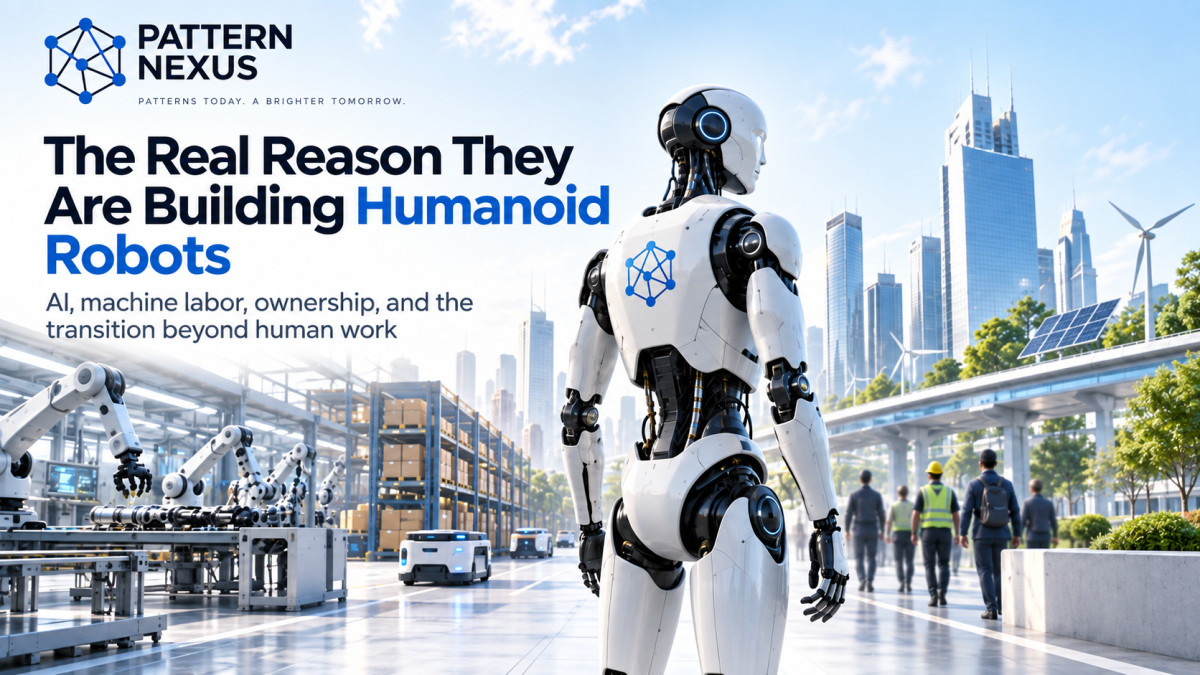
I've been writing about artificial intelligence, humanoid robotics, the future of money, structural deflation, debt, liquidity, and the breakdown of our existing economic model for years. I've covered these subjects independently, connected their causal relationships, and explained why I believe they converge into something substantially larger than the technological revolution most people think they are witnessing.
Today, I want to connect the entire system.
Because I don't think most people understand the full economic implications of the world's largest technology companies investing in machines designed to perform the same activities as human beings.
People see a robot walking through a warehouse, folding laundry, carrying boxes, or performing another physical task, and they evaluate that individual activity.
Can it do the job? Is it faster than a person? How much does it cost? When can I buy one?
Those are relevant questions. They are not the questions that reveal the complete economic implications.
What happens when the machine can perform thousands of different tasks? What happens when intelligence is distributed across millions of machines? What happens when improvements learned by one machine can be deployed across an entire fleet? What happens when businesses replace recurring labor expenses with capital expenditures?
And what happens when the resulting system can produce increasing quantities of goods and services without distributing equivalent purchasing power through human wages?
That is where the discussion becomes considerably more interesting.
My central thesis is that humanoid robotics is one component of a larger transition away from human labor as the primary mechanism through which the economy produces goods, distributes income, and organizes society.
The companies building these systems do not necessarily need to be coordinating around a shared secret objective. The economic incentives, technological capabilities, and competitive pressures can produce the same systemic result even when individual participants have different intentions.
Understanding that distinction is essential.
This article connects the humanoid robot industry to the larger Pattern Nexus framework I've been developing: artificial intelligence, universal intelligence, the industrial feedback loop, structural deflation, the debt system, liquidity expansion, ownership concentration, programmable money, and the potential transition toward a post-labor economy.
The robot is not the destination. It is part of the physical infrastructure for an entirely different economic system.
The economic objective. General-purpose robotics can extend automation into physical activities previously dependent on adaptable human labor. The market is substantially larger than any individual industrial task.
The ownership problem. If machine labor generates increasing amounts of economic output, the financial returns flow according to the ownership, financing, taxation, and distribution structure of the productive assets.
The monetary contradiction. An economy can become more productive while households become less capable of servicing debt and purchasing output if wage income weakens without sufficient replacement income.
The transition risk. Machine capability may improve faster than existing employment, education, taxation, welfare, and financial institutions can adapt.
The potential outcome. Automation could expand human freedom and material abundance, or it could increase economic dependence on whoever controls productive machinery and access to its output. The technology does not independently determine the distributional outcome.
The Question Almost Everyone Is Asking Incorrectly
When most people discuss humanoid robots, the conversation begins with whether a robot will eventually replace their particular job.
Factory workers wonder whether robots will take over assembly lines. Warehouse employees wonder whether machines will handle the loading and distribution of products. Drivers wonder about autonomous vehicles. Accountants, programmers, analysts, and administrative employees are beginning to recognize that artificial intelligence threatens portions of their work without requiring a physical machine at all.
Each group views the technology through its immediate exposure.
That is understandable, but it creates a fragmented view of the transition.
People are evaluating individual occupations while companies are developing increasingly general-purpose labor systems.
There is an enormous difference between those two developments.
A traditional industrial robot might weld a component thousands of times. It is extremely useful, but its capabilities are concentrated within a relatively narrow operating environment.
A general-purpose humanoid is intended to perform a wider and changing set of tasks.
A sufficiently capable machine could carry materials in the morning, handle inventory in the afternoon, assist with equipment maintenance later, and be reassigned when production requirements change.
The ultimate objective is not simply to automate one activity.
It is to develop machinery that can economically substitute for an expanding portion of the activities human beings perform.
Now connect that physical machinery to advanced artificial intelligence.
The system can potentially reason through a task, plan its actions, identify objects, manipulate equipment, interact with other machines, report its performance, and receive updated instructions or learned capabilities through software.
Human labor and machine labor begin competing across a much broader range of economic activities.
That is the distinction that matters.
Pattern Nexus Lens: The important question is not when robots become indistinguishable from people. It is when machine systems become sufficiently reliable and inexpensive to perform economically valuable human tasks without requiring an equivalent amount of human labor.
A machine does not need consciousness, emotions, complete human intelligence, or perfect dexterity to affect employment.
It only needs to become economically preferable for enough tasks.
And once enough of those individual tasks are automated, the structure of the occupation itself begins to change.
Why Are They Building Robots That Look Like Us?
This is one of the most important engineering decisions in the entire robotics industry.
There is no universal physical law requiring a robot to look like a human being.
A wheeled platform may transport materials more efficiently than a walking robot. A stationary industrial arm may manipulate components with greater speed and precision. A specialized agricultural machine may outperform a humanoid across acres of farmland.
Specialized robotics will continue to exist because specialization often produces better performance.
So why pursue the humanoid form?
Because the existing human environment represents an enormous amount of infrastructure already constructed around the dimensions, movements, and capabilities of the human body.
Think about your house.
The stairs, door handles, countertops, appliances, electrical switches, plumbing fixtures, furniture, and tools were designed for people.
Now consider commercial and industrial environments.
Warehouses, factories, hospitals, schools, construction sites, retail stores, and office buildings all contain infrastructure shaped by decades or centuries of human use.
There are two broad approaches to automating these environments.
We can redesign the environment around specialized machinery, or we can develop adaptable machinery that operates within the existing environment.
The humanoid approach attempts to reduce the need to rebuild everything that already exists.
A machine with appropriate mobility, reach, hands, perception, and reasoning could potentially use tools and navigate environments originally designed for human workers.
The commercial implication is substantial.
Instead of developing an entirely different automated system for every building and task, a company could purchase a more general-purpose physical platform and deploy different software capabilities according to its requirements.
The International Federation of Robotics has identified this compatibility with human-centered environments as an important rationale for humanoid development.[2]
There is also an important qualification: a humanoid robot does not necessarily require two walking legs. Some platforms use wheels because they can be more efficient or practical in particular environments.
The underlying engineering objective is adaptability within human-oriented spaces, not perfect anatomical imitation.
The total addressable labor market
A general-purpose physical platform potentially creates a market far beyond any single industry.
The same underlying technology could have applications in logistics, manufacturing, agriculture, construction, hospitality, domestic assistance, and eventually a wide range of service activities.
That changes the addressable market from individual automated processes toward a portion of the world's total labor expenditure.
The humanoid form is therefore not merely an aesthetic choice.
It is a strategy for making physical automation compatible with the infrastructure humanity has already built.
And once you recognize that, the larger economic objective becomes easier to understand.
The Transition Is Already Measurable, but It Is Not Yet Mass Replacement
Before moving further into the economic argument, I want to establish where the technology actually stands.
As of September 21, 2026, the evidence supports a transition from research and demonstration toward early commercial operation.
It does not establish that millions of humanoid robots have already replaced millions of human workers.
Those are different claims.
According to International Federation of Robotics statistics reported by Reuters on September 21, approximately 7,000 humanoid robots were sold globally in 2025 for industrial and professional service applications.
The count excludes consumer, military, and medical robots. Many reported units were purchased for research and development rather than productive employment.[1]
For comparison, the federation reported approximately 542,000 conventional industrial robot installations in 2024, with approximately 4.66 million industrial robots operating globally by the end of that year.[3]
The categories and reporting periods differ, so the numbers should not be treated as interchangeable measures of one market.
Nevertheless, they establish where we are in the transition.
Humanoids remain a small component of the existing industrial automation system.
My thesis does not depend on pretending the deployment has already happened. It concerns the economic consequences if general-purpose machine labor becomes reliable and scales beyond the current early commercial market.
BMW and Figure AI
BMW's September 21, 2026 announcement provides a useful example of measurable industrial deployment.
During a ten-month project at the company's Spartanburg, South Carolina plant, Figure 02 humanoid robots supported production of more than 30,000 BMW X3 vehicles.
BMW reported approximately 1,250 operating hours, more than 90,000 components handled, and roughly 1.2 million steps.
The machines retrieved and positioned sheet-metal components for welding operations.
BMW also announced a pilot involving AEON humanoid robots at its Leipzig plant in Germany.[4]
What matters here is the difference between a promotional demonstration and a machine performing repeatable tasks in a real industrial environment.
Production hours, component handling, task accuracy, maintenance, and operational reliability provide the evidence required to evaluate whether the technology can generate economic value.
Agility Robotics and Digit
Agility Robotics provides another example.
In a September 15, 2026 announcement included in a Securities and Exchange Commission filing, the company reported more than 65,000 operational hours for its Digit platform across customer sites.
Its customer relationships include GXO, Schaeffler, Amazon, and Toyota Motor Manufacturing Canada.
Agility also reported more than $300 million in multi-year orders for its next-generation Digit 5 platform, subject to the terms and milestones of the relevant agreements.[5]
These are company-reported operational and commercial figures.
They are meaningful evidence of progress, but booked orders are not completed deployments, and operating hours are not the same as jobs eliminated.
The distinction matters because the next phase will be determined by whether companies can turn early successes into repeatable, economical deployments across additional facilities.
My interpretation: The industry is approaching a series of economic thresholds, not demonstrating that it has already crossed every one. The indicators that matter are productive operating cost, task reliability, autonomous performance, manufacturing throughput, and whether customers continue purchasing machines after initial evaluations.
A Human Employee and a Machine Are Different Economic Assets
Now we get into the part of the analysis I believe will drive the actual transition.
Most people compare the purchase price of a robot to the annual salary of a worker.
That is an incomplete comparison.
Businesses evaluate the total cost of performing a task over time.
For a human employee, that cost can include wages, payroll taxes, health insurance, retirement contributions, paid leave, overtime, recruitment, training, safety requirements, and management.
Those expenses differ significantly between occupations, employers, and countries.
A robot introduces a different expense structure: acquisition or leasing, financing, software, electricity, maintenance, replacement parts, insurance, supervision, and integration into existing operations.
It may also require significant upfront engineering to perform a particular task reliably.
The important comparison is therefore the cost per completed unit of useful work.
| Human Labor | Machine Labor |
|---|---|
| Wages and compensation | Acquisition or leasing expense |
| Payroll taxes and benefits | Software and computing expenses |
| Recruitment and training | Integration and commissioning |
| Working hours and scheduling | Operating hours and utilization |
| Occupational safety requirements | Machine safety and liability requirements |
| Human management | Fleet management and supervision |
| Skill development | Software updates and task learning |
| Human absence and turnover | Downtime, repairs, and hardware replacement |
The correct financial comparison includes all of those variables.
For a robot, a simplified model is:
Annual machine labor cost = annualized acquisition and integration cost + maintenance + electricity + software and inference + insurance and financing + human supervision + other operating expenses.
Then:
Cost per productive hour = annual machine labor cost divided by verified productive operating hours.
This is not the same as dividing a robot's advertised purchase price by the number of years it might survive.
Downtime, failed tasks, changing workloads, safety requirements, and supervision can materially change the economics.
But consider what happens as these variables improve.
The acquisition cost falls through production scale. Software becomes more capable. The same platform can perform more tasks. Maintenance becomes predictable. Productive operating hours increase. Fleet management becomes more efficient.
The machine becomes more economically competitive across additional occupations.
And unlike a human employee, the machine does not require a salary to purchase groceries, pay rent, support children, or maintain its household.
That is not a moral statement about human workers. It is a distinction between a biological participant in society and an owned productive asset.
It is also why the transition can create an enormous distribution problem.
The critical economic threshold
The incentive to substitute becomes particularly strong when the risk-adjusted machine cost per completed task falls below the risk-adjusted human cost per completed task.
That threshold will arrive at different times across occupations.
It may arrive earlier for predictable material handling than for emergency plumbing, complex construction, or highly variable domestic environments.
But it does not need to arrive everywhere at once.
Each successful application expands the market, creates more operating data, attracts additional capital, and finances further improvements.
The economic curve becomes self-reinforcing.
The Physical Robot Is Only One Part of the Intelligence System
This is where I connect humanoid robotics to the larger body of artificial intelligence research I've been publishing.
People have spent years arguing about artificial general intelligence, superintelligence, autonomous agents, and the ability of AI systems to reason.
Those discussions frequently happen separately from the robotics industry.
I believe that separation increasingly misses the important development.
A robot does not need to contain the entire intelligence system inside its physical body.
Depending on its design, processing can be divided among onboard hardware, local industrial infrastructure, and external computing systems.
The physical machine contains sensors and actuators. Its software interprets information, selects actions, and interacts with its environment.
Additional systems may handle planning, training, updates, data analysis, and fleet coordination.
It becomes a physical endpoint in a much larger computational network.
This is why I have repeatedly argued that artificial intelligence should be understood as infrastructure rather than simply a collection of software applications.
Think of the entire stack.
The Machine Intelligence Stack
Energy and electricity
↓
Data centers and computing infrastructure
↓
AI models and world models
↓
Autonomous agents and planning systems
↓
Robotic control systems
↓
Physical machine labor
↓
Production and logistics
↓
Revenue and capital accumulation
↓
Additional compute and robotics investment
Every layer supports the next.
The physical robot generates observations from the environment. Those observations may improve the machine's ability to perform similar tasks.
Improvements can then be deployed to other compatible machines.
The learning process is not perfectly automatic. Data quality, model training, testing, safety validation, and hardware differences all introduce limitations.
Nevertheless, a potentially important distinction remains.
Human beings acquire much of their physical experience individually.
A robotics company can attempt to aggregate experience from many deployed machines and distribute validated software improvements across an entire fleet.
If that process works economically, the productivity of existing machines can improve without every machine requiring the same amount of independent training.
That is a different mechanism of labor-force development.
It is also where the convergence becomes more important than the capability of any single machine.
The Machine That Helps Manufacture More Machines
There is another layer to this that I think deserves significantly more attention.
What happens when robotic systems become capable of participating in the production of additional robotic systems?
That does not mean a robot can suddenly mine its own materials, manufacture advanced semiconductor chips, produce every component, and assemble a complete replacement without external infrastructure.
Modern industrial supply chains are much more complicated than that.
But full independence is not required for a powerful feedback loop to emerge.
Imagine a factory that manufactures robotic components.
At first, human employees perform most of the assembly, inspection, packaging, transportation, and maintenance.
Over time, the factory introduces additional automation into selected operations.
The cost of producing each new machine may decline as throughput improves.
Increased production creates more data, supports supplier investment, and allows further automation.
Eventually, more of the machinery required to manufacture robots is itself operated or assisted by machines.
The result is an industrial feedback loop.
The Robotics Industrial Flywheel
More robots
↓
More automated production capacity
↓
Lower cost per machine
↓
Broader economic applications
↓
More robot demand
↓
Larger production facilities
↓
More robots
This loop is constrained by energy, materials, capital, software capability, reliability, and manufacturing capacity.
But if those constraints are progressively relaxed, deployment can accelerate.
The important point is that the production system begins contributing to its own expansion.
Human labor has historically required generations of population growth, education, training, migration, and institutional development.
Machine labor capacity can potentially expand through industrial investment and manufacturing throughput.
Those are fundamentally different scaling mechanisms.
And that difference is one of the reasons I believe the next decade could produce changes that traditional labor-market models struggle to capture.
Who Owns the Machines That Produce Everything?
This is the center of the argument.
Not the robot's appearance. Not whether it can dance. Not whether it looks like a person. Not even whether a particular occupation disappears.
Who owns the productive assets when those assets no longer require equivalent human employment?
Under the existing economic model, most households primarily receive income by selling labor.
Some own businesses, stocks, rental properties, bonds, or other productive assets. But for much of the population, wages remain the central mechanism through which they access the economy.
They work, receive compensation, and use that compensation to purchase goods and services.
Business owners receive income through the profits generated by productive assets, after operating expenses and other obligations.
Now introduce machine labor.
The company purchases or leases robotic equipment. The equipment performs economically useful work. Revenue is generated through the resulting production.
But the machine does not receive wages that it subsequently spends in the consumer economy.
The financial return flows through the ownership and financing structure of the company.
That can include shareholders, lenders, robotics manufacturers, software providers, equipment lessors, and other participants in the capital structure.
The distribution of income begins shifting according to who owns or supplies the productive machinery.
Of course, employees can also own shares and retirement accounts. Businesses may distribute productivity gains through wages, lower prices, or new employment.
Governments may tax and redistribute part of the resulting income.
That is precisely why ownership and distribution arrangements matter.
The technological capability alone does not determine whether most households become wealthier or poorer.
The institutional structure determines how the resulting economic gains are distributed.
The ownership distinction: A society in which millions of households own productive machine assets has a different income-distribution structure from a society in which a small number of institutions own most machine labor capacity and the majority of households remain dependent on wages.
Both societies could possess similar artificial intelligence and robotics capabilities.
They could produce comparable quantities of goods.
Yet the economic experience of their populations could be dramatically different.
That is why I consider the ownership structure as important as the technology itself.
The Economy Can Produce More While Its Customers Earn Less
Now connect the robotics revolution to the structure of the American economy.
According to Bureau of Economic Analysis data available through the Federal Reserve Bank of St. Louis, personal consumption expenditures represented approximately 68.1% of U.S. GDP in 2025.[6]
That is a substantial proportion of total economic activity.
Consumer spending supports businesses, employment, investment, real estate, credit markets, and government revenue.
Household purchasing power is therefore not an isolated social issue.
It is a fundamental part of the economic system.
Now consider what happens when a company introduces machines that reduce the amount of human labor required for production.
At the individual business level, the decision can make perfect economic sense.
Lower operating costs improve margins. Increased efficiency allows production to expand.
A company that successfully adopts automation may gain an advantage over competitors.
But what happens when similar decisions occur across a large enough portion of the economy?
One company reduces staffing. Another consolidates administrative departments. Another automates warehouse operations.
Another slows hiring because AI systems can absorb additional workloads.
These decisions do not need to happen simultaneously, and they do not need to appear immediately as mass layoffs.
The first effects may show up through fewer entry-level openings, reduced replacement hiring, lower wage growth, and changing occupational requirements.
Eventually, if the reduction in labor demand is large enough and alternative income sources do not compensate, aggregate household purchasing power can weaken.
That creates a macroeconomic contradiction.
Businesses are individually incentivized to reduce labor costs, but collectively depend on customers with sufficient purchasing power to buy what they produce.
Machines can produce products.
They do not automatically create household demand for those products.
This does not mean automation inevitably produces economic collapse.
Lower prices can increase real purchasing power. New industries can create employment. Profits can finance investment, and government policy can change the distribution of income.
The point is that production and income distribution must remain connected through some mechanism.
If wages become less important, another distribution mechanism has to become more important.
That is an accounting reality, not a prediction that every automated economy must fail.
Now Add a Debt-Based Financial System
This is where the robotics story becomes a Pattern Nexus macroeconomic story.
Our modern financial system depends on the ability of households, businesses, and governments to meet their financial obligations.
Households have mortgages, credit cards, auto loans, student loans, and other liabilities.
Businesses rely on debt to finance operations, acquire assets, and expand production.
Governments borrow to finance spending beyond current revenues and refinance maturing obligations.
These are different categories of debt with different financial characteristics, but they share an important feature.
Debt requires future payment capacity.
For households, that capacity is frequently connected to employment income.
Now imagine a transition in which the economy becomes increasingly productive while wage growth slows or employment contracts across exposed sectors.
The productive capacity of the economy may increase, but the income available to certain borrowers may deteriorate.
The financial system does not automatically forgive a mortgage because a robot has made the economy more efficient.
The contractual obligation remains.
That can create a mismatch between technological productivity and financial stability.
The adverse transmission pathway
Automation expands
↓
Human labor requirements decline
↓
Wage income weakens in exposed sectors
↓
Household cash flow deteriorates
↓
Debt-servicing capacity weakens
↓
Credit losses and demand pressure increase
↓
Financial institutions and public finances face additional stress
That is the adverse pathway.
It is not the only pathway.
Productivity gains, falling prices, new employment, debt restructuring, asset ownership, and fiscal transfers can interrupt the sequence.
But notice what the system now requires.
As human labor becomes less necessary for production, the economy needs a way to maintain household access to the output and meet financial obligations.
Otherwise, technological abundance can coexist with financial stress.
And in a highly indebted system, widespread financial stress can become a problem for the banking system and government finances, not merely individual households.
This is the connection I have been emphasizing in my broader research.
Artificial intelligence and robotics cannot be evaluated independently of the monetary system in which they are being introduced.
Why Deflationary Technology Can Coexist With an Expanding Money Supply
I have repeatedly described a structural deflationary force operating beneath the modern economy.
Technological productivity, global competition, labor substitution, demographic changes, and debt saturation can all influence prices, wages, and demand.
Humanoid robotics introduces another potential source of productivity growth and labor substitution.
If machines reduce the cost of producing goods and services, competitive markets can transmit some of those savings into lower prices.
That is a disinflationary or deflationary force at the product or sector level.
But monetary authorities operate in an economy with nominal debts, financial assets, government obligations, and inflation objectives.
They are not responsible only for the price of a manufactured product.
They must consider employment, inflation, financial stability, and the transmission of monetary policy.
In a scenario where automation contributes to weak demand, lower inflation, and credit stress, central banks may face pressure to ease financial conditions.
Governments may also increase transfers, investment, tax relief, or other fiscal support.
That is where the two opposing forces can interact.
The automation and liquidity transmission
Productivity and automation
↓
Lower unit production costs
↓
Pressure on selected prices and wages
↓
Potential demand and credit stress
↓
Fiscal and monetary response
↓
Changes in liquidity, credit, and asset prices
I want to be precise here.
Central banks are not compelled to create money simply because robots exist.
Quantitative easing is not an automatic consequence of artificial intelligence.
Monetary policy depends on economic conditions, mandates, and institutional decisions.
But the broader interaction is important.
An increasingly automated economy could face downward pressure on some costs while experiencing upward pressure on assets, scarce resources, infrastructure, or other sectors supported by credit and investment.
Those forces can occur simultaneously.
Electricity can become more expensive because AI infrastructure requires enormous investment while some forms of manufactured output become cheaper through automation.
Asset owners can benefit from rising valuations while workers experience weaker wage bargaining power.
A household can experience declining prices for certain products while housing, insurance, taxes, and other fixed obligations remain expensive.
There is no contradiction in those outcomes.
They are different parts of the same economic system responding to different forces.
Pattern Nexus Macro Lens: The important question is not whether robots produce inflation or deflation in isolation. It is how automation changes production costs, employment income, credit creation, investment demand, fiscal policy, and the distribution of liquidity throughout the economy.
This is why I do not separate the AI industrial revolution from the long-term monetary cycle.
They are connected through production, household income, capital investment, and debt.
The Two- or Three-Speed Economy I Have Been Describing
One of the major problems with discussing the future economy as a single system is that the transition will not affect every group at the same speed.
Some businesses will own the automation.
Others will purchase its services.
Others will compete against it.
Some workers will develop valuable capabilities that complement automated systems.
Others will find that increasing portions of their existing responsibilities can be performed with fewer people.
And some industries will remain constrained by physical infrastructure, regulation, liability, and human preferences long after their digital counterparts have changed.
That creates the possibility of several economies operating within the same broader financial system.
The machine-owning economy
This includes owners of automation platforms, productive intellectual property, semiconductor infrastructure, energy systems, data centers, robotic fleets, and businesses that benefit from automation.
These participants may experience increased productive capacity and potentially higher returns on capital.
They also face substantial capital requirements, technological competition, operational risk, and possible investment losses.
The machine-complementing economy
These are individuals and organizations that use artificial intelligence and robotics to increase their productive capacity.
Engineers, entrepreneurs, skilled tradespeople, researchers, technicians, and business operators may be able to accomplish significantly more with fewer supporting employees.
Their output may increase even if the total demand for workers in related occupations does not grow proportionally.
The labor-dependent economy
This includes households that primarily depend on selling their time and capabilities without substantial ownership of productive assets.
Some will benefit through lower prices, improved services, and access to new technology.
Others may experience lower demand for their labor, slower wage growth, or difficulty entering occupations that once provided stable careers.
The same technological development can produce gains for one group and disruption for another.
That distinction matters when evaluating economic indicators.
GDP can increase while certain households experience declining income.
Stock markets can appreciate while labor-market entry becomes more difficult.
Business profitability can improve while aggregate employment growth weakens.
It is possible for all of these developments to occur without any single indicator telling the complete story.
That is why I examine the relationships between the variables rather than focusing exclusively on one headline economic number.
Universal Basic Income Is One Possible Response, but It Does Not Solve Everything
When people hear the argument that robots may replace significant portions of human labor, they often respond with universal basic income.
Governments will simply provide people with enough money to live.
That is one possible policy response.
It is not a complete economic model by itself.
Money provides purchasing power only when the economy can supply the goods and services being purchased.
If a government distributes additional income while the supply of housing, energy, healthcare, food, and other essential goods remains constrained, the additional demand may increase prices rather than create equivalent real improvements in living standards.
On the other hand, if automation significantly expands the productive capacity of the economy, an income-transfer system could help households retain access to output that no longer requires equivalent human employment.
The real-resource capacity matters as much as the monetary transfer.
There is also the funding question.
Traditional tax systems receive revenue from income, payrolls, consumption, property, and business activity.
If machine labor reduces payroll income while increasing certain forms of capital income and production, governments may reconsider how the tax base is structured.
Several approaches are possible:
- Transfers funded through general government revenue.
- Greater taxation of selected forms of capital income or economic rents.
- Public ownership interests in productive infrastructure.
- Social wealth funds that distribute investment returns.
- Targeted wage supplements and refundable tax credits.
- Expanded access to essential goods and services.
- Direct fiscal support financed partly through government borrowing.
Each has different economic, administrative, and distributional consequences.
I am not arguing that one specific program is guaranteed to become the global standard.
My argument is that a sufficiently large shift away from labor income would create pressure for the system to develop alternative ways of distributing purchasing power.
Existing social insurance arrangements were largely designed around an economy in which employment is the central organizing institution of adult economic life.
A substantially automated economy may require a different arrangement.
The technology can change faster than the institutions responsible for adapting to it.
That transition gap is one of the central risks.
Programmable Money, Digital Identity, and Economic Control
This is another connection I've explored extensively in earlier Pattern Nexus research.
Artificial intelligence, robotics, digital identity, tokenization, payment infrastructure, and financial surveillance are frequently discussed as separate technological developments.
But there are ways they could become connected.
Imagine a future economy in which a significant portion of production is automated, a growing number of households receive some form of public income support, and most commercial transactions occur through digital payment systems.
Now consider the infrastructure necessary to manage that economy.
Governments and financial institutions need mechanisms for identification, payment delivery, taxation, fraud prevention, and account administration.
Businesses need mechanisms for charging customers, licensing software, financing equipment, monitoring assets, and handling automated transactions.
Artificial intelligence may increasingly participate in portions of these processes.
That creates the possibility of a highly integrated economic operating system.
A potential digital distribution system
Digital identity
↓
Eligibility and access
↓
Payment infrastructure
↓
Automated goods and services
↓
Transaction records
↓
Economic and administrative systems
Those systems do not necessarily require a central bank digital currency.
Existing bank accounts, payment networks, stablecoins, and other digital infrastructure can support many of the same functions.
It is also important to distinguish technical capability from actual policy.
A system capable of programmable restrictions does not establish that every government intends to impose them.
Nevertheless, the architecture matters.
When access to economic output becomes increasingly dependent on digital systems, the rules governing identity, eligibility, privacy, appeals, data access, and financial autonomy become more consequential.
The same infrastructure could make public payments faster and services more accessible.
It could also create new forms of dependency if households have limited alternatives or inadequate control over their information and economic access.
This is why the social and institutional design of a post-labor economy cannot be treated as an afterthought.
The question is not simply how much money people receive.
It is also how independently they can participate in the resulting economy.
Countries Are Competing for the Next Industrial Labor System
The transition is not limited to the American technology industry.
China, the United States, Europe, Japan, South Korea, and other industrial economies are developing artificial intelligence and robotics capabilities.
Their industrial conditions and strategies differ.
Some have advantages in software and advanced computing. Others possess extensive manufacturing supply chains, industrial automation expertise, or large domestic markets.
The International Federation of Robotics reported that China accounted for approximately 54% of worldwide industrial robot installations in 2024, with roughly 295,000 new installations.[3]
Those figures concern conventional industrial robots, not humanoid robots specifically.
But they illustrate the importance of existing industrial infrastructure when considering the next stage of automation.
Robotics depends on actuators, motors, batteries, sensors, precision manufacturing, semiconductors, and a large network of component suppliers.
It is not simply a software competition.
Why machine labor matters strategically
A country that can economically automate more production may be able to reduce certain labor bottlenecks, increase domestic manufacturing capacity, and produce some goods at lower cost.
That may change the economic logic of offshoring.
If labor becomes a smaller share of the total production cost, access to energy, infrastructure, capital, markets, technology, and supply-chain security may become relatively more important in determining where production occurs.
For countries experiencing population aging or labor shortages, automation can also offset some constraints on productive capacity.
These are potential benefits, not guaranteed outcomes.
Lower labor costs do not eliminate the need for materials, specialized skills, engineering, infrastructure, or international trade.
But they can change the relative importance of those inputs.
That is why robotics development has consequences for industrial policy, trade, supply chains, national security, and economic competition.
The contest is not merely about selling household robots.
It is about who develops, manufactures, supplies, finances, and controls increasingly capable physical production systems.
Intelligence Does Not Eliminate the Need for Energy and Materials
One of the mistakes people make when discussing artificial intelligence is assuming that improved intelligence automatically eliminates physical scarcity.
It does not.
An artificial intelligence system can improve the efficiency of a manufacturing process, but the factory still requires materials, machinery, electricity, and an operating environment.
A humanoid robot requires physical components and a dependable energy supply.
Data centers require electricity, cooling, computing hardware, and communications infrastructure.
Expanded industrial output may require additional transportation and electrical capacity.
That is why energy remains central to my broader economic framework.
According to a Department of Energy report based on Lawrence Berkeley National Laboratory research, U.S. data centers consumed approximately 176 terawatt-hours of electricity in 2023, representing roughly 4.4% of national electricity consumption.
The report projected that data-center demand could reach approximately 325–580 terawatt-hours by 2028, equivalent to roughly 6.7–12% of U.S. electricity consumption under its scenarios.[7]
Those projections concern data centers broadly, not humanoid robots alone.
They nevertheless illustrate the scale of infrastructure required as artificial intelligence expands.
Physical robotics introduces additional industrial demand beyond computing.
Motors, batteries, metals, electronics, maintenance facilities, electrical infrastructure, and transportation networks all contribute to the real cost of deployment.
The economics of abundance
It is possible for AI and robotics to make many goods cheaper while certain resources become more expensive.
Electricity may become a strategic bottleneck.
Industrial land may become more valuable near suitable power infrastructure.
Specialized materials may experience supply constraints.
And the ability to produce abundant manufactured goods does not automatically create abundant housing in locations where people want to live.
Therefore, the claim that robots can create abundance needs to be examined product by product and sector by sector.
Automation can expand productive capacity.
It does not remove every physical, geographic, institutional, or political constraint.
This is also why a monetary system designed around machine productivity must remain connected to the real economy.
Printing money cannot replace the production of scarce essentials.
Neither can artificial intelligence.
Why Telling Everyone to Adapt May Not Be a Complete Solution
Every major technological transition creates changes in occupational demand.
New industries emerge. Existing industries become more productive. Some activities disappear while others expand.
That is why arguments that every worker will simply become unemployed are not supported by the current evidence.
But the opposite assumption—that displaced workers can always retrain into new occupations at the same rate technology changes—is also too simple.
Retraining is effective when there is sufficient demand for the new skills being developed.
It becomes less effective when the destination occupation is also experiencing rapid automation.
Imagine someone whose administrative work is increasingly performed by artificial intelligence.
They retrain for another digital occupation.
By the time they complete their education, the tools available to that industry have improved further.
That does not mean their new skills have no value.
It means the economic return on retraining depends on the trajectory of both technology and labor demand.
Now extend that problem to physical occupations.
Humanoid robotics could eventually increase automation exposure in sectors that previously appeared relatively protected from software-based artificial intelligence.
That creates a broader potential substitution problem.
The IMF's 2024 analysis estimated that approximately 40% of global employment was exposed to artificial intelligence, with exposure reaching approximately 60% in advanced economies.
The IMF emphasized that exposure can result in either labor substitution or increased productivity through complementary use.[8]
The ILO's 2025 research similarly found that one in four workers worldwide held jobs with some generative AI exposure, while concluding that transformation was more likely than complete replacement under the capabilities being assessed.[9]
Those findings are important.
They describe the evidence available from particular technologies and research methods.
They do not establish a permanent limit on future automation.
My concern is the convergence of increasingly capable digital systems and increasingly capable physical machines.
When new technology expands the range of tasks it can perform, the labor market may need to create new forms of employment faster than existing occupations lose their economic advantages.
Whether that occurs is an empirical question.
It should not be settled by assuming that the outcome of every previous industrial revolution must repeat itself.
What Happens When Human Beings Are No Longer Required for Every Stage of Production?
Now we arrive at the part of this discussion that extends beyond finance and engineering.
Much of modern society is organized around employment.
People are educated to enter the workforce.
They select careers. They accumulate experience. They establish households and financial obligations around expected future earnings.
Employment shapes social identity, economic opportunity, geographic mobility, and access to certain benefits.
Many people derive purpose from their work.
Others work primarily because survival requires income.
Both experiences exist within the same economic system.
What happens when increasingly capable machines reduce the amount of human labor required to maintain that system?
One possibility is a society with shorter working hours, greater material security, expanded access to education, and more freedom to pursue activities outside paid employment.
Another possibility is a society where productive assets become more concentrated while people who depend on wages experience declining economic opportunity.
Neither outcome is determined solely by whether a humanoid robot can perform a task.
The difference depends on ownership, access, institutions, and the distribution of productivity gains.
This is why I do not believe the robotics revolution can be fully understood through employment statistics alone.
It challenges the relationship between human worth and economic productivity.
People have value beyond the labor they can sell.
But an economic system that allocates access to resources primarily through wages may struggle to recognize that distinction if paid labor becomes less necessary.
A transition toward abundant machine production could expand human freedom.
It could also create new economic dependencies.
Those outcomes involve social choices that engineering capability alone cannot resolve.
The Pattern Nexus Transition Model: How I Expect the System to Develop
I've written extensively about a 2026–2035 convergence involving artificial intelligence, robotic automation, energy infrastructure, liquidity, and the monetary system.
I want to be clear about what this timeline represents.
It is my working scenario, not a claim that the dates or outcomes are guaranteed.
The purpose is to establish a sequence of developments that can be tracked against actual data.
Early commercialization and industrial learning: 2026–2028
During this phase, I expect the emphasis to remain on selected industrial environments where machine labor can be tested against measurable operational requirements.
Material handling, logistics, inspection, repetitive assembly, and other bounded activities provide opportunities to establish reliability and unit economics.
Companies will continue developing hardware and AI systems while experimenting with deployment models.
Labor effects may initially appear through hiring decisions and the reorganization of work rather than obvious mass replacement.
The key variable is not the number of impressive demonstrations.
It is verified productive output under commercial operating conditions.
Broader substitution and fleet economics: 2028–2031
In this scenario, successful applications begin expanding across more facilities and industries.
Manufacturing scale and software improvements reduce costs. Businesses gain more operating data.
Customers become better able to compare robotic services against conventional labor expenses.
The range of economically competitive tasks expands.
Labor-market effects become more visible if machine adoption begins outpacing the creation of alternative employment opportunities for affected workers.
At this stage, the relationship between productivity, wages, household income, and corporate profitability becomes increasingly important.
The distribution problem becomes a macroeconomic issue: 2030–2035
Under a faster automation scenario, an expanding portion of economic output can be produced with less human labor per unit of output.
That does not imply human employment disappears.
It means the relationship between economic growth and labor demand may weaken across more sectors.
Institutions could face increasing pressure to modify income support, taxation, education, employment benefits, and ownership arrangements.
The monetary consequences would depend on how households maintain purchasing power, how debt obligations are managed, and whether productivity gains expand real supply sufficiently.
A different relationship between people and production: beyond 2035
If the technological and economic trends continue, it becomes possible to imagine a system in which human labor is no longer necessary for a growing share of essential production.
Human work would not necessarily disappear.
People may continue working because they enjoy an activity, because society values human involvement, because they own businesses, or because certain occupations remain difficult to automate.
But employment could gradually become less central to the distribution of basic economic resources.
That would be a major change in the organization of modern society.
It would also create questions about ownership, autonomy, political participation, and social identity that extend far beyond the robotics industry.
What Would Challenge or Invalidate My Argument?
I do not want to build an argument that cannot be tested.
My thesis depends on several developments occurring together.
First, general-purpose robotic systems must become capable of performing a meaningful range of economically valuable tasks.
Second, their total operating costs must become competitive with the alternatives.
Third, manufacturers must demonstrate that hardware production can scale while maintaining reliability.
Fourth, artificial intelligence must become sufficiently dependable in relevant physical environments.
Fifth, adoption must become broad enough to affect labor markets beyond isolated facilities.
If those conditions fail to materialize, the timeline stretches or the transition remains limited to selected industries.
There are several indicators I would watch closely.
| Indicator | What I Am Looking For | Why It Matters |
|---|---|---|
| Verified commercial deployments | Increasing numbers of machines performing paid work in customer operations | Separates economically useful robotics from demonstrations and research sales |
| Productive operating hours | Growth in completed work and effective utilization | Determines whether machines can provide economically competitive labor |
| Cost per completed task | Declining total operating cost after supervision, maintenance, and downtime | Establishes where machine substitution becomes financially attractive |
| Manufacturing throughput | Verified production volumes rather than announced capacity targets | Measures whether hardware supply can support broader adoption |
| Labor-market entry | Changes in entry-level hiring, wages, and occupational openings | May reveal substitution before aggregate employment statistics do |
| Labor share of income | Changes in compensation relative to economic output | Tests whether productivity growth is becoming less connected to wages |
| Household purchasing power | Real disposable income, consumption, debt service, and household balance sheets | Tests the consumer-demand transmission mechanism |
| Energy infrastructure | Power availability, delivered electricity prices, grid capacity, and computing costs | Tests the physical limits of machine expansion |
| Ownership distribution | Who receives returns from AI and robotics capital | Tests whether machine productivity gains become broadly distributed |
I would also pay close attention to contrary evidence.
If widespread AI and robotics adoption creates enough new employment, higher real wages, and broadly distributed productivity gains, the argument that labor-income displacement will create systemic demand problems becomes weaker.
If general-purpose humanoids remain more expensive or less reliable than conventional automation, the physical substitution timeline extends.
If households gain meaningful ownership of productive machinery or receive sufficient income through alternative mechanisms, the distribution problem becomes less severe.
And if energy, materials, and manufacturing constraints prevent large-scale deployment, many of the proposed long-term outcomes could arrive much later than expected.
These are not peripheral considerations.
They are the conditions under which the argument succeeds or fails.
They Are Not Just Building Robots. They Are Building the Next Productive Infrastructure.
When I look at artificial intelligence, humanoid robotics, automation, data centers, energy infrastructure, debt, liquidity, and the evolution of money, I do not see unrelated developments.
I see increasingly connected components of an economic transition.
That does not mean every company involved has the same motives.
It does not mean the technological outcome is predetermined.
And it certainly does not mean every prediction about humanoid robots will come true.
But the underlying incentives are becoming clearer.
Businesses want to produce more efficiently. Robotics companies want to expand the range of economically valuable tasks their machines can perform.
AI companies want their systems to become more capable and useful.
Investors want returns on capital.
Governments want productive capacity, economic growth, and technological competitiveness.
Each participant has reasons to develop and adopt increasingly capable automation.
They do not need to agree on the final structure of society for their individual decisions to contribute to the same broader transformation.
That is how complex economic systems evolve.
Now consider the destination those incentives could produce.
Artificial intelligence handles an increasing share of cognitive work.
Robotics handles an increasing share of physical work.
Industrial automation increases output per worker.
Some businesses expand without hiring proportionally more employees.
The ownership of productive assets becomes increasingly important in determining who receives income.
Governments confront the question of how to maintain purchasing power and financial stability if the relationship between output and employment weakens.
The monetary system adapts to the distribution and financing requirements of the new economy.
And society begins reconsidering the role human labor plays in determining who has access to the products of civilization.
That is the causal chain I have been developing throughout my Pattern Nexus research.
It is larger than humanoid robotics.
It is larger than artificial intelligence.
It is larger than the future of employment.
It concerns the relationship between human beings, productive capacity, ownership, and economic access.
The Central Question
If machines eventually perform a substantial portion of economically necessary work, what determines the economic security and independence of human beings who no longer need to perform that work themselves?
That question cannot be answered by making a robot faster, stronger, or more intelligent.
It must be answered through the structure of the society that owns and uses the technology.
I believe we are entering the early stages of a transition in which human labor becomes less indispensable to a growing number of productive activities.
The exact pace remains uncertain.
The distributional outcome remains uncertain.
And the technology itself still faces substantial engineering, economic, and physical constraints.
But if the capabilities continue improving and commercial adoption expands, the consequences will reach well beyond individual job descriptions.
We are not merely deciding how robots will participate in the human economy. We are approaching a period in which the economy itself may need to be reorganized around the existence of machine labor.
That is the part of this revolution I believe deserves considerably more attention.
And it is why I have spent so much time connecting artificial intelligence to debt, liquidity, energy, ownership, and the future of money.
The robot is one part of the system.
The system is what changes everything.
Frequently Asked Questions
Are humanoid robots already replacing millions of workers?
No. The verified evidence as of September 2026 shows early commercial deployments, industrial pilots, research sales, and substantial investment. The scale of general-purpose humanoid employment remains far below the total global labor force. Conventional industrial automation is much more mature.
Why do companies want general-purpose humanoid robots instead of conventional industrial machines?
General-purpose humanoids are intended to work across different tasks and within environments built for people. They will not replace specialized machines in every application, but they may expand automation into activities that previously required adaptable human movement and manipulation.
Does artificial intelligence have to become conscious before it can replace workers?
No. Economic substitution depends on capability, reliability, cost, and the ability to complete useful tasks. Consciousness is not a requirement for commercial automation.
Could robotics create new jobs rather than destroy employment?
Yes. Technology can create new industries, occupations, investment opportunities, and consumer demand. The key long-term question is whether new employment and other income sources expand sufficiently to offset labor displaced by automation.
Would universal basic income solve the problem?
An income floor could preserve household purchasing power, but it would not independently resolve constraints in housing, healthcare, energy, food, infrastructure, or access to productive assets. Its effects would depend on financing, real supply, distribution, and implementation.
Does automation automatically require quantitative easing?
No. Monetary policy would depend on the resulting inflation, employment, credit, and financial conditions. Automation could contribute to disinflation or income pressures under some circumstances, but quantitative easing is not a mechanical consequence of robotic deployment.
What is the most important economic variable in this transition?
For individual deployments, it is risk-adjusted cost per completed unit of useful work. For the broader economy, it is whether households retain sufficient purchasing power and access to productive output as the amount of human labor required per unit of production changes.
Does this analysis claim that corporations are secretly coordinating to eliminate humanity?
No. The argument is based on competitive incentives, technological development, capital accumulation, and the potential consequences of large-scale labor substitution. Similar economic outcomes can emerge from decentralized decisions without a coordinated secret objective.
What is the biggest uncertainty?
Whether robotics capability, reliability, manufacturing scale, energy supply, and unit economics improve together quickly enough to create broad labor-market effects within the proposed timeline.
Sources and Research Notes
- Reuters — Humanoid Robot Sales Tally Hit 7,000 Globally Last Year. September 21, 2026. International Federation of Robotics statistics covering 2025 humanoid sales for industrial and professional service applications.
- International Federation of Robotics — Humanoid Robots: Vision and Reality. August 14, 2025. The engineering rationale, opportunities, and limitations of general-purpose humanoid systems.
- International Federation of Robotics — World Robotics 2025. Global industrial robotics statistics, including 2024 installations and operational stock.
- BMW Group — Leipzig Debut: BMW Group Introduces Humanoid Robots, a First in Germany. September 21, 2026. Figure 02 deployment measurements and the AEON Leipzig pilot.
- SEC Filing — Agility Robotics Unveils Digit 5 Humanoid Robot. September 15, 2026. Company-reported operational hours, deployment metrics, and multi-year order disclosures.
- U.S. Bureau of Economic Analysis via FRED — Shares of Gross Domestic Product: Personal Consumption Expenditures. Annual U.S. consumption share data.
- U.S. Department of Energy — Report Evaluating Increased Electricity Demand From Data Centers. December 20, 2024. Lawrence Berkeley National Laboratory electricity demand estimates and scenarios.
- International Monetary Fund — AI Will Transform the Global Economy. January 2024. Global labor-market exposure and the distinction between substitution and complementarity.
- International Labour Organization — Generative AI and Jobs: A 2025 Update. May 20, 2025. Occupational exposure estimates and job-transformation findings.
- World Economic Forum — Future of Jobs Report 2025. Employer-based projections of labor-market creation, displacement, and transformation through 2030.
- Acemoglu and Restrepo — Robots and Jobs: Evidence From US Labor Markets. National Bureau of Economic Research, 2017. Historical research covering industrial robot adoption and local U.S. labor markets between 1990 and 2007.
- The REAL Reason They're Building Humanoid Robots To Replace Us. Companion video supplied by the author. The video URL is separately assigned to the CMS Optional URL field for site-managed placement above the article.
The important transition is not that a robot can walk through a warehouse or perform a particular physical task. It is that intelligence and physical labor are becoming increasingly reproducible forms of capital. If that development continues, the relationship between production, wages, ownership, debt, and economic access will have to adapt.
That is why I keep connecting these seemingly separate developments.
They are components of the same system.
What's Your Reaction?
 Like
0
Like
0
 Dislike
0
Dislike
0
 Love
0
Love
0
 Funny
0
Funny
0
 Wow
0
Wow
0
 Sad
0
Sad
0
 Angry
0
Angry
0

Founder of Pattern Nexus. I research markets, macro, geopolitics, AI, history, ancient systems, and the patterns most people overlook. I’m also building Market Radar, a trading scanner designed to read pressure, risk, confirmation, and setup quality before chasing a move. Pattern Nexus is where I connect the dots between data, history, technology, and the bigger system playing out around us.





Comments (0)