
Subprime Autos, Buy-Now-Pay-Later, and Bank Stress: Cracks at the Edge of the Consumer Balance Sheet
As of December 4, 2025, subprime auto borrowers and Buy-Now-Pay-Later users are showing rising strain. This Pattern Nexus deep dive maps where the real risk sits, how much of it flows back into banks, and whether these “buy more, pay more later” rails are the real source of bank stress.
Cracks at the edge of the consumer balance sheet as of December 4, 2025
Executive overview
Two places everyone keeps pointing to when they feel something “off” in the system right now: the subprime auto market, and the whole Buy-Now-Pay-Later ecosystem — the cultural shift I’d summarize as buy more, pay more later.
As of December 4, 2025, both are clearly flashing stress at the edges of the consumer balance sheet: subprime auto delinquencies are at record highs, car repossessions are running hotter, and BNPL usage is climbing among exactly the people who have the least room for error. But the crucial question isn’t “are people hurting?” — they are. The question is: is this what’s actually stressing the banks, or just another signal that the bottom rungs are cracking?
Big picture: subprime auto and BNPL are where the strain is loudest, but not where the systemic risk is concentrated. They’re more like seismographs on the consumer floor than the core fault line in the banking system.
The short version:
- Auto loan balances keep growing, but the growth is overwhelmingly prime. New York Fed data show that 2024 auto balances rose by tens of billions, driven by borrowers with credit scores above 760. Subprime originations were roughly flat, and only about one-sixth of new loans were subprime.
- Stress is real at the bottom: subprime 60+ day delinquencies are at the highest levels on record, serious delinquencies (90+ days) are at multi-year highs, and repossessions have surged. Prime borrowers are still holding up.
- Subprime auto risk is concentrated in nonbank finance companies and subprime ABS structures, not on large-bank balance sheets. Banks’ direct auto exposure is heavily prime. The big recent hits from failures like Tricolor show up as isolated nine-figure charges, not systemic capital events.
- BNPL has exploded from a niche gimmick into a mainstream credit rail. Around 15–20% of U.S. adults used it in the last year; usage and late payments are highest among low-income, minority, and younger households. It’s effectively a shadow “micro-credit card” system embedded in checkout flows.
- BNPL balances are still small compared with credit cards and auto loans, and most risk sits on fintech and merchant balance sheets. Regulators are now forcing BNPL back into the standard credit-card framework, which pulls some of the opacity out of this “buy more, pay more later” rail.
- For the banks, the primary stress in 2025 is still interest-rate risk, unrealized securities losses, commercial real estate, and deposit competition — not subprime autos or BNPL. But both are early-warning signals for the health of the lower half of the consumer distribution.
How the subprime auto market is actually structured
“Subprime auto” gets thrown around like it’s one monolithic thing. It isn’t. The auto credit stack is segmented by both borrower and lender type, and that segmentation is the entire reason this hasn’t turned into a 2008-style bank story.
On the borrower side, the market is a spectrum:
- Super-prime / prime: credit scores roughly 720–760 and above.
- Mid-prime: roughly 660–719.
- Subprime / deep subprime: below ~660, and especially below 620.
New York Fed work on auto loans shows that growth in the last couple of years has been driven by the top of that spectrum. Prime borrowers with scores above 760 accounted for the bulk of new originations, while subprime volumes stayed roughly flat and made up only about 16% of new loans in 2024.
On the lender side, a Federal Reserve working paper using Equifax data cuts the market like this:
- Banks and credit unions: skew heavily toward prime and super-prime borrowers.
- Captive finance companies: the automaker arms (Ford Credit, Toyota Financial, etc.) that mostly finance prime or near-prime new car buyers.
- Non-captive finance companies: the independent finance shops and “buy-here-pay-here” outfits that specialize in subprime and deep subprime borrowers.
Translation: banks are not where most of the subprime auto risk lives. They are primarily lending to the top half of the credit spectrum. The riskiest paper is pushed into nonbank finance and securitizations.
U.S. auto loan balances overall are now in the mid–trillion-dollar range, second only to mortgages in household debt buckets. But the risk profile is bifurcated: prime borrowers with stable jobs and high scores on one side, and thin-file or damaged-credit borrowers financing used cars at double-digit rates on the other.
That bifurcation matters because it tells you who will fail first, and who can muddle through a high-rate regime without blowing up their bank’s balance sheet.
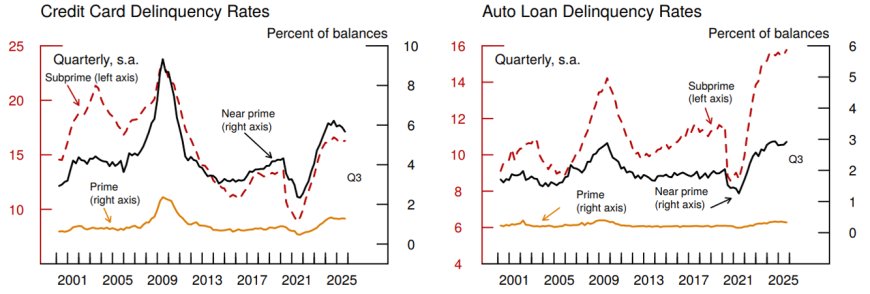
Delinquencies, repossessions, and who is breaking first
Once you split the market by credit tier, the picture is brutally clear: this isn’t a “everyone is failing” problem, it’s a bottom-quartile is getting crushed problem.
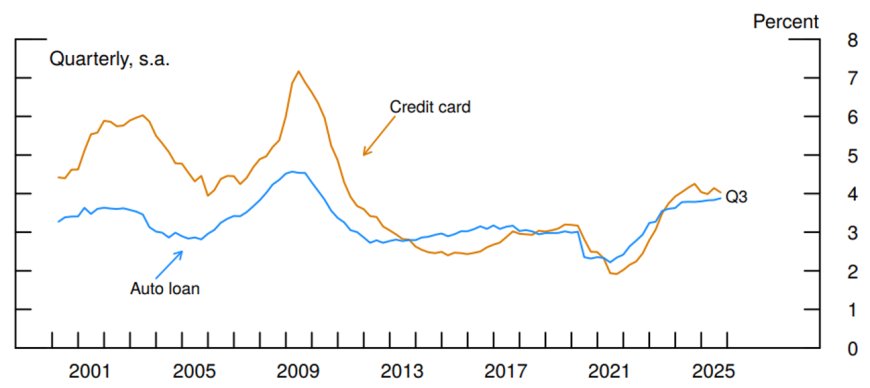
Key patterns across the data:
- Delinquencies above pre-pandemic levels across the board. New York Fed estimates show that the probability of a borrower with a 620–679 score becoming 30 days past due in a given quarter has roughly doubled versus the pre-COVID baseline. That’s the middle of the credit book starting to fray, not just the absolute bottom.
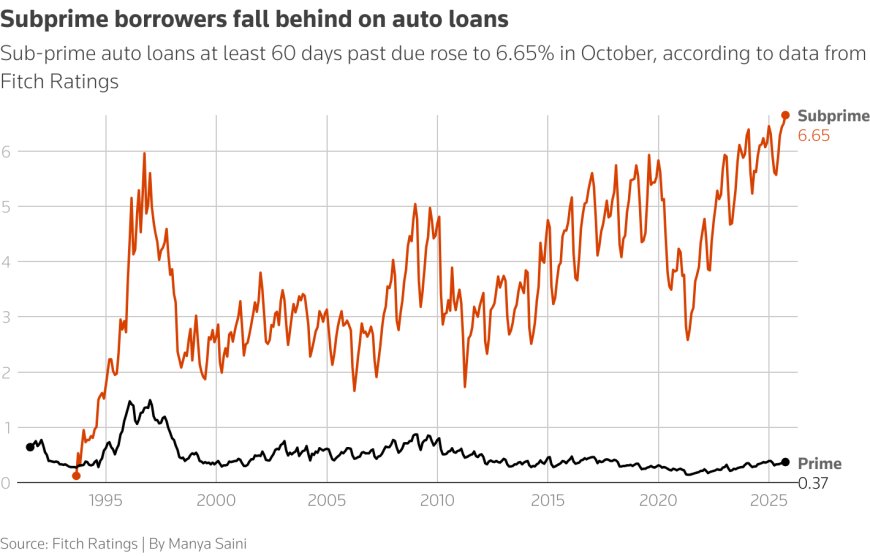
- Subprime is at multi-decade highs. Fitch and ABS-monitor data put subprime 30+ day delinquency rates in the mid-teens, with 60+ day delinquencies above any prior reading since the early 1990s. Prime borrowers’ 60+ day delinquencies are still well under 1%.
- Serious delinquencies and repossessions are climbing. Serious (90+ day) delinquencies on auto loans are at 15-year highs, and repossession volumes have surged compared with the immediate post-pandemic period. This is consistent with high-rate loans resetting reality for the weakest borrowers as savings buffers disappear.
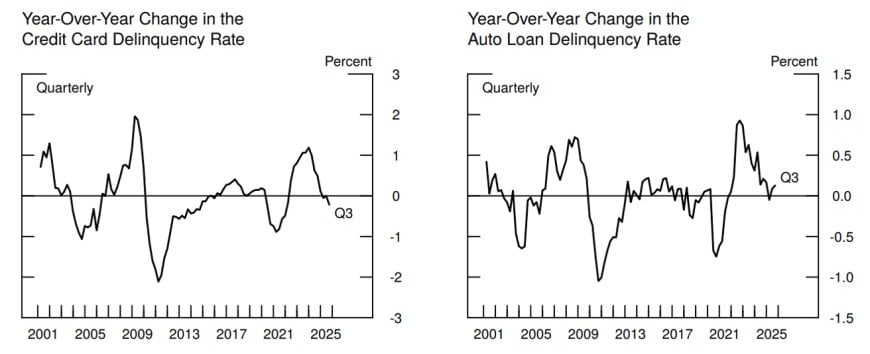
Fitch’s October 2025 reading drives the point home: subprime auto loans at least 60 days past due hit 6.65%, the highest level since the index began.
The drivers are straightforward and ugly:
- Loan coupons priced during a high-rate regime, often in the teens for subprime borrowers.
- Sticker shock: new vehicle prices hovering near record levels, pushing subprime borrowers into older used inventory.
- Insurance, repairs, and general living costs marching higher while wage growth cools.
- In some cases, fraud and misrepresentation at the lender level — as seen in the failures of certain buy-here-pay-here and specialty lenders — compounding the risk.
What the data is telling you: the marginal American with a weak credit file and an expensive used car is in trouble. The average prime borrower in a late-model vehicle with a locked-in rate is not.
Viewed through a cycle lens, this is the early phase of a “household credit downshift”: the stress shows up first in the most fragile segments (deep subprime autos, fringe unsecured credit), then slowly migrates up the quality stack if the macro backdrop deteriorates further.
Where banks really sit in the auto stack
The next layer is to ask: okay, if subprime autos are blowing up, where does that show up in bank books? Two channels matter: direct auto lending, and indirect exposure via warehouse lines and securitization finance.
Direct exposure: mostly prime
U.S. banks hold hundreds of billions in auto loans on balance sheet. But because their business is tilted toward prime borrowers, the performance numbers look very different from the headlines about subprime. Non-performing ratios on bank auto portfolios are only a bit above pre-pandemic levels and materially below Great Recession peaks.
FDIC’s 2025 risk work makes the point: consumer loan quality (autos, cards, personal loans) has deteriorated compared with the sugar-high stimulus years, but is still well within historical norms. Community and smaller banks show more stress than money-center institutions, because they lean harder into consumer credit and smaller regional markets.
In other words, banks feel this as a slow grind in provisioning and margins, not as an existential solvency problem — at least so far.
Indirect exposure: nonbank lenders and ABS
The more interesting — and fragile — channel is indirect:
- Banks provide warehouse and term financing to nonbank finance companies that specialize in subprime autos. These are the pipes that fund the loans until they’re securitized.
- They also hold some auto ABS, including subprime tranches, as investments or in trading books. Here the risk lives in spread widening and mark-to-market volatility, not just pure defaults.
When subprime lenders implode, those warehouse lines and residual exposures can take a hit. That’s exactly what we saw with high-profile failures where regional banks had to take nine-figure charges on exposures to specialty auto lenders accused of fraud or misreporting collateral. In dollar terms, that hurts earnings, but relative to total loan books, those charges were on the order of a tenth of a percent of assets.
This is why you’re not seeing “subprime auto contagion” in the way you saw subprime mortgage contagion in 2008. The risk is concentrated in thinly capitalized nonbanks and specific ABS structures, not sitting quietly inside the core of the banking system.
If this escalated into a true systemic problem, the path wouldn’t be “subprime autos → instant bank failures.” It would be more like “subprime autos → regional earnings hits → risk-off in ABS funding markets → tighter credit for all auto borrowers → spillover into broader consumer and dealer credit.” We’re not in that spiral yet, but the channel is there.
The rise of Buy-Now-Pay-Later: “buy more, pay more later”
Parallel to the auto story, another credit rail has quietly gone mainstream: Buy-Now-Pay-Later. On the surface, it’s simple — split a $100 purchase into four $25 payments over six weeks, often with no interest. Underneath, it’s changing how people layer leverage onto everyday life.
From gimmick to embedded credit rail
Over the last few years, BNPL volume has exploded. Federal and central bank research, plus the CFPB’s data, collectively show:
- BNPL loans grew from under 20 million per year to well over 100 million in just a couple of years.
- Loan values jumped from low-single-digit billions to tens of billions.
- By 2024, BNPL was financing around 6% of U.S. e-commerce transactions, up from low-single-digit percentages early in the decade, with forecasts that it could approach a high single-digit share by the mid-2020s.
Surveys from the Fed’s household well-being work and regional Fed banks paint a consistent demographic picture:
- Around 15% of adults used BNPL in the past 12 months, up from around 10% a few years earlier.
- Usage is highest among younger adults (late teens through 40s), renters, and those with lower incomes.
- Black and Hispanic households are roughly twice as likely to use BNPL as white or Asian households, even after controlling for income and age.
- A large share of users explicitly say BNPL was the only way they could afford the purchase.
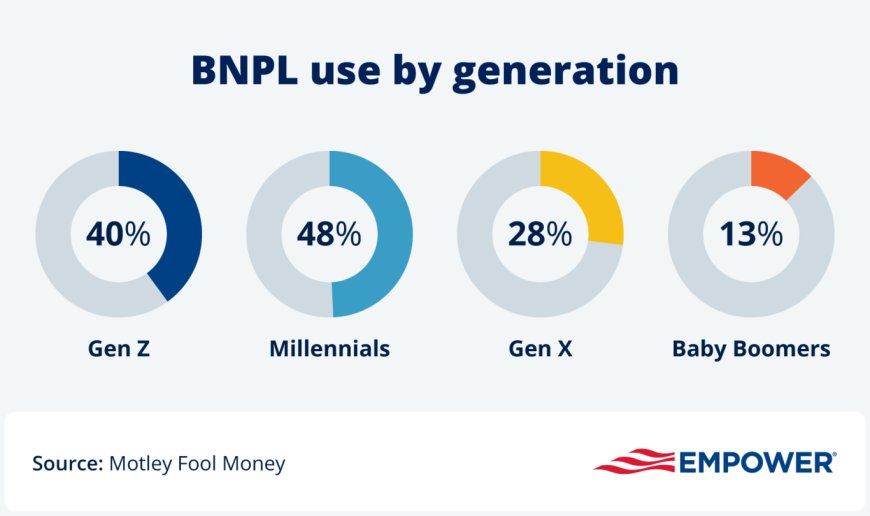
BNPL is not just “I don’t feel like pulling out my card.” For a big chunk of users, it’s “I couldn’t buy this any other way.” That’s a different risk story.
Morgan Stanley’s own surveys add another layer: average BNPL balances per user are in the mid-hundreds of dollars, and usage is increasingly for everyday items — clothing, groceries, small electronics — rather than a one-off big-ticket purchase. That’s where this morphs from “convenient payments” into “embedded short-term leverage” at the grocery store.
BNPL risk, regulation, and hidden leverage
The core risk in BNPL isn’t any single ticket size; it’s how the product interacts with credit reporting, underwriting, and already-stressed households.
Financially fragile users and late payments
Kansas City Fed research on BNPL users is blunt:
- BNPL users, on average, display far more indicators of financial constraint than non-users.
- Among those who have paid BNPL bills late, almost all exhibit multiple signs of deep financial stress, with a non-trivial share stacking many different stress indicators at once.
- Across demographics, roughly a quarter of BNPL users reported paying late; late payment rates are highest among lower-income and younger cohorts.
Other surveys and industry data echo this: a large share of BNPL users have missed at least one payment, and late-payment incidence has climbed over the last couple of years. Many report something very basic as the cause — they simply lost track of multiple concurrent instalment plans.
BNPL isn’t just a replacement for credit cards; it’s a second, semi-invisible tab system that a lot of people are running in parallel to cards, overdrafts, and other loans.
Hidden leverage and regulatory clampdown
For banks and regulators, two things about BNPL are especially uncomfortable:
- Soft checks, thin reporting. Most BNPL providers rely on soft inquiries and don’t fully report tradelines to credit bureaus. That means traditional measures like FICO scores and debt-to-income can underestimate total obligations.
- Stacking across providers. A consumer can hold multiple BNPL plans across several apps and merchants at once. From any single lender’s perspective, the rest of the stack is invisible.
Regulators are now trying to drag BNPL into the normal credit framework:
- The consumer regulator has moved to treat BNPL like credit cards for key purposes: dispute handling, statements, and some disclosure rules.
- The national bank regulator has issued guidance telling banks to treat BNPL as a bona fide instalment product: do real underwriting, manage third-party risk carefully, and report to bureaus rather than letting it sit in the shadows.
At the same time, market research from large sell-side shops stresses that—even with growth— BNPL balances and losses are small compared with traditional consumer portfolios. Default rates per dollar of exposure remain below credit cards, in part because terms are short, loan sizes are modest, and providers have been quick to cut off chronic non-payers.
The real risk, again, is second-order: a heavily BNPL-dependent household is likely also stretched on rent, utilities, cards, and autos. When one domino falls, the others are not far behind.
Pattern Nexus lens: how this fits into the bigger system
This isn’t just a “bad borrowers, bad lenders” story. Through a Pattern Nexus lens, subprime autos and BNPL are signals inside a much larger machine: how a high-rate, post-QT world allocates pain across the distribution.
Credit bifurcation and the K-shaped household
At the top of the distribution, prime households have:
- Fixed-rate mortgages from the ZIRP era.
- Access to low-rate credit, strong credit scores, and asset buffers.
- Increasing exposure to equity and asset gains that at least partially offset inflation and higher rates.
At the bottom, subprime and thin-file households face:
- Floating or high-rate credit on depreciating collateral (used cars, BNPL for everyday goods).
- Limited savings, weak bargaining power, and volatile incomes.
- Higher exposure to inflation in non-discretionary categories (rent, food, transport, insurance).
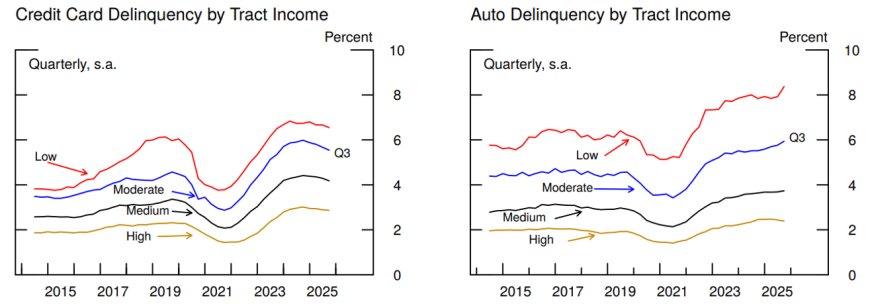
Same interest-rate regime, two completely different realities. One side cuts back on streaming services; the other loses their car.
Where this plugs into the larger liquidity regime
In a system where liquidity is being rationed after a long era of excess, the hierarchy is simple:
- The sovereign and the core banking system defend their funding first.
- Capital flows into strategic capex (AI, energy, defense, data centers) where returns look structurally high.
- Risk is pushed outward into the fringes: nonbanks, ABS structures, and lower-tier consumers.
Subprime autos and BNPL live right at that fringe: they are the credit rails that keep consumption alive for the households who are least able to absorb shocks, using the most expensive and least transparent forms of debt. When macro conditions tighten, those rails fragment first.
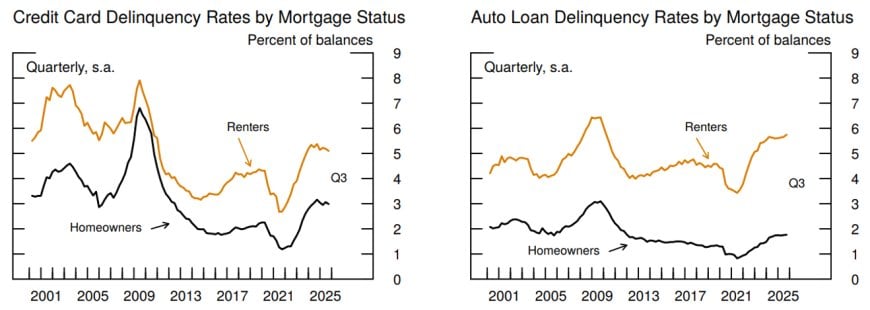
Signal vs cause
From this vantage point, the key question is not “Will subprime auto or BNPL cause the next crisis?” A more useful frame is:
- Signal: Rising delinquencies and repos here tell you how quickly the lower half of the distribution is decaying under higher rates and higher prices.
- Transmission: Warehouse losses, ABS spread blowouts, and merchant BNPL write-offs tell you how that decay is being transmitted into the formal financial system.
- Feedback: If banks and investors pull back from these fringes at the same time, credit deserts expand and the real economy slows from the bottom up.
In other words, subprime autos and BNPL are the dashboard lights, not the engine. But when enough lights go red at once, the driver eventually has to slow down — or pull over.
Are these actually what’s stressing the banks?
When you zoom out to the 2025 banking picture, three big stressors dominate:
- Interest-rate risk and unrealized losses on securities bought during the zero-rate era. Long-duration Treasuries and mortgage-backed securities still sit at mark-to-market losses that eat into tangible capital and keep management nervous.
- Commercial real estate — especially office and some retail — where vacancies, refinancing risk, and repricing are a slow-motion problem on many balance sheets.
- Funding and deposits, where banks are paying up to keep customers from fleeing into money funds and T-bills, compressing net interest margins.
Subprime auto and BNPL sit in a different category: they’re edge-of-household indicators. They can and do generate:
- Higher charge-offs and provisioning needs in consumer books (especially for smaller banks leaning into auto and card lending).
- Earnings hits from specific failures (for example, when a highly levered subprime auto lender blows up and its warehouse banks have to eat losses).
- Market volatility in ABS spreads and funding costs when defaults spike in subprime pools.
Put simply: subprime autos and BNPL aren’t the core fire — they’re the smoke seeping out of the basement. If the labor market or economy rolls over harder, that smoke can become a full-on house fire, but we’re not there yet.
The real risk is second-order. If the same households that are missing BNPL and subprime auto payments start missing rent, utilities, and then prime auto or mortgage payments, you’ll see it propagate into the parts of bank balance sheets that actually matter systemically. If unemployment rises meaningfully, or if another shock erodes income and savings at the bottom of the distribution, these “buy more, pay more later” rails could end up being an accelerant.
For now, though, the evidence points to this: the U.S. banking system is watching subprime autos and BNPL as warning lights, not as the main source of the current stress. The real battle is still being fought on duration, CRE, and funding — with subprime autos and BNPL telling you how much damage the shrapnel is doing to the bottom of the consumer ladder.
FAQ and practical watchpoints
Is this 2008 all over again?
No. In 2008, systemically important banks were stuffed with the worst mortgage paper and levered to it through complex derivatives. Today, the riskiest auto and BNPL exposures are mostly in nonbanks, specialty finance, and ABS structures. The banks have exposure, but it’s smaller, more ring-fenced, and better capitalized.
Could subprime autos still trigger something bigger?
They could contribute to a broader risk-off move, especially in securitized credit, but they are unlikely to be the sole trigger. A more plausible scenario is that rising auto and BNPL delinquencies coincide with a weakening labor market, rising credit-card delinquencies, and stress in other consumer buckets. In that world, subprime autos are part of the story, not the entire plot.
What would make BNPL genuinely dangerous for banks?
Three things together: banks aggressively scaling their own BNPL books; regulators failing to force proper reporting and underwriting; and a recession that hits BNPL-heavy households hard. In that scenario, BNPL losses could stack on top of card and auto losses inside bank books, rather than sitting mostly on fintech and merchant balance sheets.
What should I watch as a simple dashboard?
If you want a lightweight dashboard to track this theme:
- Auto loan 30+ and 90+ day delinquency rates (especially for subprime segments).
- Car repossession volumes and auction prices for used vehicles.
- Household surveys on BNPL usage and late-payment rates.
- ABS spreads for subprime auto deals (BBB and below).
- Provisioning and charge-offs for consumer loans in regional/community bank earnings.
If all of those trend worse at the same time, the “smoke” narrative gets less comforting.
As a borrower, what does this mean for me?
If you’re a prime borrower, it mostly means tighter underwriting and maybe slightly higher rates at the margin. If you’re mid-prime or subprime, it means fewer approvals, tougher terms, and a higher chance that a missed payment turns into repossession or collections quickly. For BNPL, expect more identity checks, more reporting to credit bureaus, and less “frictionless” approval over time.
As an investor or observer, how should I read the headlines?
Separate the layers:
- “Subprime auto delinquencies hit record” = stress at the bottom, but mostly nonbank exposure.
- “Regional bank takes $X hundred million charge on auto lender fraud” = idiosyncratic, but a reminder to check their nonbank and ABS exposure.
- “BNPL regulation tightens” = a move to convert shadow credit into more visible, card-like credit, which is painful for some fintechs but healthier systemically.
The signal is not that the system is collapsing; it’s that the system is being forced to recognize where it has been leaning on the most fragile borrowers to preserve consumption.
Sources
External sources referenced in this article (no in-text links; all external links are collected here):
- New York Fed Liberty Street Economics – “Breaking Down Auto Loan Performance” (Feb 2025). https://libertystreeteconomics.newyorkfed.org/2025/02/breaking-down-auto-loan-performance/
- Federal Reserve Bank of Philadelphia – Working Paper “Who Provides Credit in Times of Crisis? Evidence from the Auto Loan Market” (2025). https://www.philadelphiafed.org/the-economy/education-and-data/who-provides-credit-in-times-of-crisis-evidence-from-the-auto-loan-market
- IMF – “U.S. Asset-Backed Securities Monitor – October 2025”. https://www.imfconnect.org/.../GMM%20US%20ABS%20Monitor%20October%202025%20.pdf
- FDIC – “2025 Risk Review”. https://www.fdic.gov/analysis/risk-review/2025-risk-review.pdf
- Reuters – “Record number of U.S. subprime borrowers miss car loan payments in October” (Nov 2025). https://www.reuters.com/
- Money.com – Coverage of rising subprime auto delinquencies and serious auto loan delinquencies (2025). https://money.com/ (search “subprime auto delinquencies 2025”)
- Federal Reserve – “Report on the Economic Well-Being of U.S. Households in 2024: Banking and Credit” (May 2025), BNPL section. https://www.federalreserve.gov/publications/2025-economic-well-being-of-us-households-in-2024-banking-and-credit.htm
- Federal Reserve Bank of Kansas City – “Financial Constraints Among Buy Now, Pay Later Users” (Economic Review, 2024/2025). https://www.kansascityfed.org/research/economicreview/financial-constraints-among-buy-now-pay-later-users/
- Federal Reserve Bank of Richmond – “Buy Now, Pay Later: Market Impact and Policy Considerations” (Payments System research brief, 2025). https://www.richmondfed.org/ (search BNPL brief)
- Office of the Comptroller of the Currency – Bulletin 2023-37, “Retail Lending: Risk Management of ‘Buy Now, Pay Later’ Lending” (Nov 2023). https://www.occ.treas.gov/news-issuances/bulletins/2023/bulletin-2023-37.html
- Morgan Stanley – “Buy Now, Pay Later (BNPL) Growth Raises Concerns” (2025). https://www.morganstanley.com/insights/articles/buy-now-pay-later-trends-2025
- Credit and Collection News – “BNPL Usage Rises as Does Late Payments” (Nov 23, 2025). https://www.creditandcollectionnews.com/bnpl-usage-rises-as-does-late-payments/
What's Your Reaction?
 Like
0
Like
0
 Dislike
0
Dislike
0
 Love
0
Love
0
 Funny
0
Funny
0
 Wow
0
Wow
0
 Sad
0
Sad
0
 Angry
0
Angry
0

Founder of Pattern Nexus. I research markets, macro, geopolitics, AI, history, ancient systems, and the patterns most people overlook. I’m also building Market Radar, a trading scanner designed to read pressure, risk, confirmation, and setup quality before chasing a move. Pattern Nexus is where I connect the dots between data, history, technology, and the bigger system playing out around us.











Comments (0)