
United Wholesale Mortgage: The Dividend Cut, the Ishbia Structure, Oaktree, and the Real Risk in UWMC
I rebuilt the UWM panic from the ownership structure outward: who actually received the distributions, what the dividend suspension retains, why the $451.9 million quarterly loss does not describe the core origination business, what the $603.2 million failed-deal hedge did to equity, how the Oaktree preferred recapitalization changes the common stock, and what would actually have to happen for a bankruptcy thesis to become real.
What the filings actually establish
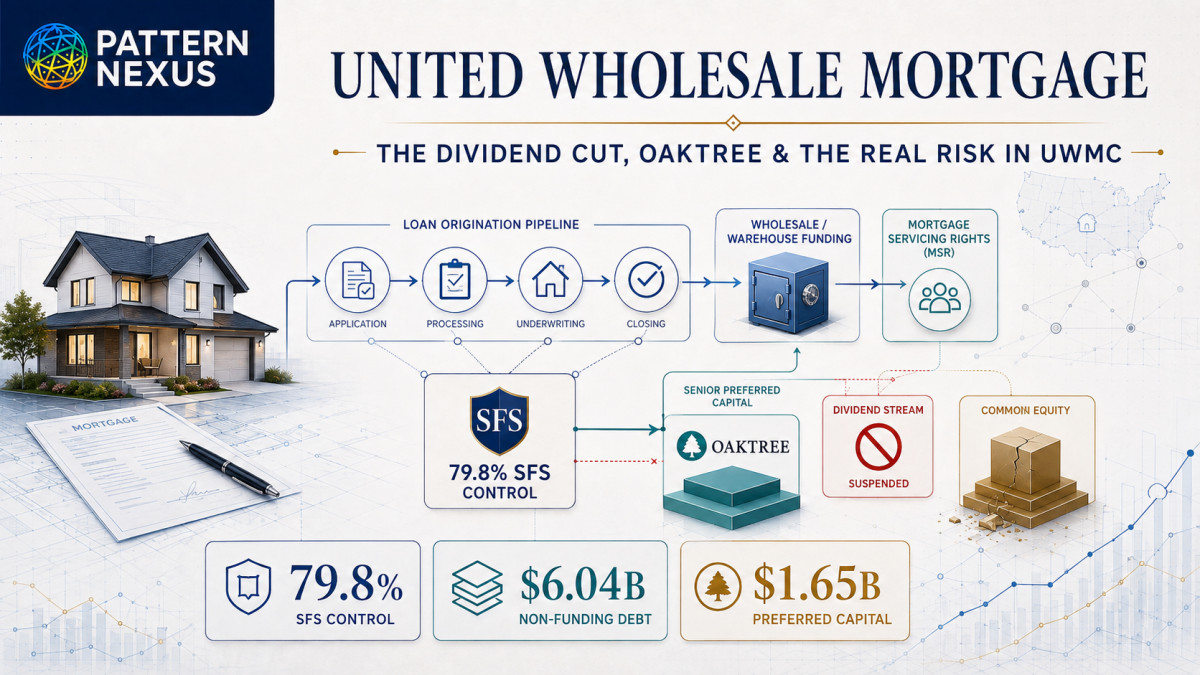
- My original instinct was mostly right: Mat Ishbia, through SFS Holding Corp., controls UWM and held roughly four-fifths of its economic interest. When the ordinary common payout stops, most of the recurring cash no longer goes to the controlling-owner side of the structure.
- But “they are only stopping payments to themselves” is incomplete. The public Class A dividend also disappears, some tax-related SFS distributions can still occur, and the recapitalization inserts a new senior preferred claim ahead of every common holder.
- The core mortgage platform did not collapse in the second quarter. UWM originated $39.7 billion, reported $888.0 million of revenue, improved gain margin to 133 basis points, and produced $185.9 million of adjusted EBITDA.
- The $451.9 million GAAP loss was still serious. It was driven primarily by a $603.2 million loss on interest-rate derivatives tied to the failed Two Harbors transaction, plus a $122.7 million decline in MSR fair value. A transaction-specific loss can be nonrecurring and still destroy real equity.
- The mortgage-spread explanation needs correction. On August 6, the 10-year Treasury was 4.69% and Freddie Mac's 30-year mortgage average was 6.69%—a 200-basis-point gap. That spread was not unusually narrow, and it is not UWM's gain-on-sale margin.
- The real operating pressure is the level of rates, not a collapsed 10-year/mortgage spread. High mortgage rates suppress affordability, housing turnover and refinancing. They reduce industry volume and intensify price competition. They also interact with UWM's large MSR book.
- The pre-recapitalization balance sheet was the warning. Non-funding debt reached $6.04 billion against $985.3 million of equity, or 6.13 times. That is not a cosmetic ratio.
- The Oaktree transaction lowers near-term default risk while damaging the common-equity contract. The company received $1.65 billion of preferred capital, plans a $400 million rights offering, suspended the common dividend, granted warrants on 330 million shares, and accepted expensive redemption and governance terms.
- Bankruptcy is not the base case in the evidence available today. The company still has positive adjusted EBITDA, material origination volume, agency outlets, disclosed liquidity, fresh capital and no disclosed covenant default or warehouse-funding run.
- That does not make UWMC automatically cheap. A business can survive while its common stock is diluted, subordinated, deprived of dividends and forced to carry the residual risk behind a compounding preferred instrument.
- My conclusion: this is not Lehman, not a harmless dividend adjustment, and not an obvious mega-short. It is an intact operating franchise underneath a badly damaged common-equity contract.
I started with the same basic reaction I kept having while watching people post about UWM: everyone was treating the dividend suspension as if an outside funding source had vanished and the company was hours from bankruptcy. That framing did not make sense to me because the controlling Ishbia structure receives most of the economic distribution. If the company stops that payout, the largest immediate cash sacrifice is internal to the controlling-owner side.
After going through the proxy, annual reports, quarterly filings, the second-quarter release, the preferred certificate and the rights-offering agreement, I would state it more precisely.
The dividend suspension is a major cash-retention action, not proof that the mortgage machine stopped working. It also is an admission that UWM allowed cash distributions and leverage to outrun the earnings environment for too long.
The panic is wrong when it treats a falling public stock price as capital physically leaving UWM. Shares changing hands in the market do not remove cash from the corporation. The panic becomes more credible only if warehouse lenders, MSR lenders, agency counterparties, bond investors or regulators pull funding capacity, increase haircuts, impose curtailments or find UWM out of compliance. I found no disclosed evidence that this later-stage funding cascade had begun as of this article's cutoff.
But the bullish shortcut is also wrong. The company did not simply cancel a family check and return to normal. It took $1.65 billion of expensive preferred capital, agreed to a $400 million rights offering, issued enormous warrant coverage, restricted future common dividends and gave Oaktree meaningful governance and protective rights. That is a recapitalization. It is designed to keep the operating company durable, but it transfers value and optionality away from the old common structure.
The clean Pattern Nexus reading: separate the operating company, the funding stack and the common stock. UWM the mortgage platform can remain viable. UWM the balance sheet can require repair. UWMC the common share can still be impaired even if neither of the first two fails.
Contents
- First, get the company right
- What the market is reacting to
- How UWM actually makes money
- The Ishbia and SFS control structure
- How much cash went to SFS
- What the dividend suspension really changes
- The second-quarter operating business versus the headline loss
- The failed Two Harbors hedge
- The 10-year, the mortgage rate and the spread correction
- The MSR book and the natural hedge
- The pre-recapitalization balance sheet
- What Oaktree actually received
- What the recapitalization can repair
- What the ratings agencies were warning about
- The bankruptcy test
- The “mega-short” test
- What I would monitor next
- Final Pattern Nexus judgment
- Frequently asked questions
- Research and primary sources
First, get the company right
The company people are discussing is UWM Holdings Corporation, ticker UWMC. It is the publicly traded indirect parent of United Wholesale Mortgage. It is not “United Home Mortgage.” That sounds like a minor naming correction, but it matters because the legal entity chain is central to the dividend and ownership analysis.
UWMC sits above UWM Holdings LLC. United Wholesale Mortgage, LLC is the operating mortgage company. The Ishbia-controlled SFS structure owns Class B units in the holding LLC paired with Class D shares at the public parent. Public investors generally own Class A common stock of UWMC. That Up-C architecture is why the controlling-owner cash flow is usually described in the filings as member distributions to SFS Corp., while public investors receive Class A common dividends.
If those two cash flows are casually combined under the word “dividend,” the intuition is directionally understandable but the accounting becomes sloppy. I am going to keep them separate.
What the market is reacting to
The stock did not collapse because of one isolated headline. Investors received a stack of bad signals at once:
- a $451.9 million second-quarter net loss;
- a $603.2 million loss on other interest-rate derivatives;
- equity falling from $1.60 billion at March 31 to $985.3 million at June 30;
- non-funding debt reaching $6.04 billion, or 6.13 times equity;
- the suspension of the $0.10 quarterly common dividend;
- $1.65 billion of new preferred capital from Oaktree and the Ishbia family;
- a planned $400 million rights offering;
- 330 million warrants attached to the rescue capital; and
- credit-rating downgrades into speculative-grade territory.
That is enough to justify a violent repricing of the common stock. What it does not justify is skipping the causal chain and declaring bankruptcy as an accomplished fact.
A public stock sale transfers ownership from one investor to another. Unless UWM is issuing shares in that trade, corporate cash does not leave the company. A lower share price can still matter because it raises the cost of equity, changes counterparty perception, impairs employee compensation, affects warrant economics and limits the usefulness of stock as acquisition currency. But it is not the same thing as depositors pulling money from a bank or a warehouse lender cancelling a funding line.
The market move is evidence of a damaged security. It is not, by itself, evidence of a funding run.
UWM is not a traditional bank holding a giant book of 30-year mortgages to maturity
UWM is a nonbank wholesale mortgage originator. Independent mortgage brokers bring borrowers to UWM. UWM underwrites and funds the loans, generally uses short-term warehouse facilities while the loans are in inventory, then sells or securitizes them into the secondary market. In 2025, roughly 90% of its loan production was sold to or pooled through Fannie Mae, Freddie Mac and Ginnie Mae channels. The loans are generally held for a short period rather than warehoused for decades. [4]
The basic operating loop is:
- Broker acquisition: an independent mortgage broker submits the borrower and loan package.
- Underwriting and closing: UWM processes, underwrites and funds the mortgage.
- Warehouse financing: short-term facilities finance the loan while it is held for sale.
- Sale or securitization: the loan is delivered into agency or other secondary-market channels.
- Gain-on-sale economics: UWM recognizes loan-production income relative to origination volume.
- Servicing decision: UWM may retain the mortgage servicing right, sell it, finance it, or sell excess servicing cash flows.
This is why the 2008 comparison has to be handled carefully. UWM is exposed to mortgage-market plumbing, liquidity, collateral marks, hedging, agency requirements and counterparty confidence. But it is not a commercial bank funded primarily by runnable retail deposits, and its core conforming/government loan production is not the same asset pool as a pre-crisis subprime balance sheet.
The genuine nonbank failure channels are different: loss of warehouse capacity, higher haircuts, margin calls, MSR-facility curtailments, agency net-worth or liquidity noncompliance, cross-defaults, inability to roll senior debt, or a forced MSR sale into a weak market. Those are the channels I care about. A collapsing stock chart is downstream of the system; it is not the system itself.
The Ishbia side did control the company and did own the large majority of the economics
The 2026 proxy is direct. As of April 6, 2026, SFS Holding Corp. held 1,276,482,620 Class D shares. On an as-exchanged economic basis, that represented 79.8% of the common stock. Mat Ishbia was president and sole director of SFS, and the trust holding SFS voting stock took direction from him regarding the Class D shares and corresponding LLC units. The company's charter caps SFS voting power at 79%. [3]
| Proxy date: April 6, 2026 | Shares / equivalents | Economic percentage | Reported voting power |
|---|---|---|---|
| SFS Holding Corp. Class D / exchangeable equivalents | 1,276,482,620 | 79.8% | 79.0% |
| Class A outstanding | 323,883,751 | 20.2% | Minority block |
| Total common economic interests | 1,600,366,371 | 100.0% | — |
By June 30, after additional exchanges and public share issuance, UWM reported 342,247,135 Class A shares and 1,261,862,603 Class D shares. That still left the SFS side with about 78.7% of the common economic interests. [1]
The proxy also disclosed that 648,792,940 of the SFS Class D shares—and the corresponding as-exchanged Class A shares—were pledged as collateral under two separate loan facilities. That is a family-level or SFS-level financing fact, not a UWM corporate-debt item. It deserves monitoring because pledged control stock can create its own pressure if collateral terms tighten, but I found no filing evidence that a margin call on those facilities caused the August recapitalization.
Control does not mean the public shareholders are imaginary. It means the controlling side can determine governance, capital allocation and the dividend decision within the charter and contractual constraints. It also means the largest ordinary distribution recipient can rationally choose to stop paying itself if retaining cash protects the value of the much larger underlying ownership position.
Yes, billions of dollars went to the controlling SFS side
The cash-flow statements show the scale. Member distributions paid to SFS totaled approximately $6.275 billion from 2020 through the first quarter of 2026. The 2021 amount includes a $1.1 billion distribution made before the January 2021 public business combination, so the clean post-combination total is lower—approximately $3.206 billion from the post-combination portion of 2021 through Q1 2026. [5] [4] [6]
| Period | Cash distributions paid to SFS | Context |
|---|---|---|
| 2020 | $1.969554 billion | Private-company period |
| 2021 | $1.468832 billion | Includes $1.1 billion before the public combination and $368.832 million after it |
| 2022 | $751.035 million | Primarily proportional LLC distributions |
| 2023 | $600.828 million | Cash-flow statement amount |
| 2024 | $714.027 million | Cash-flow statement amount |
| 2025 | $637.999 million | Cash-flow statement amount |
| Q1 2026 | $133.148 million | Paid alongside $26.842 million of Class A dividends |
| Total shown | $6.275423 billion | Includes private-company and pre-combination cash |
The most revealing comparison is 2023 through 2025. Over those three years, public Class A dividends plus SFS member distributions totaled approximately $2.108 billion. Cumulative GAAP net income over the same period was approximately $503.6 million. The payout was about 4.19 times cumulative net income.
That comparison is not a perfect cash-flow test. Distribution timing differs from earnings timing. The Up-C structure requires tax distributions under some conditions. GAAP net income includes noncash MSR marks and other fair-value movements. And SFS distributions are not identical to public dividends in legal form. But the scale still matters. Cash left the consolidated structure much faster than earnings were rebuilding equity.
KBRA later said almost exactly that in credit language: leverage rose because of continued large dividend payments despite lower earnings after the mortgage market changed. [12]
The tax-receivable agreement is another separate cash channel
The business combination also created a tax receivable agreement under which SFS can receive 85% of certain realized tax savings generated by exchanges and related basis increases, subject to the agreement's conditions. The filings warn that TRA payments can exceed actual cash tax savings under some circumstances and can accelerate after a change of control or material breach. [4]
That is why “the dividend is gone, so every payment to SFS is gone” is not correct. The ordinary proportional distribution tied to the common dividend is the major recurring item being shut down. Required tax distributions and permitted contractual payments can still exist.
What the dividend suspension actually changes
At the old $0.10 quarterly rate, every common economic interest effectively supported a $0.40 annual distribution. Using the June 30 share and unit counts—342,247,135 Class A shares plus 1,261,862,603 Class D / corresponding Class B unit interests—the gross annualized common payout was approximately:
1.604109738 billion economic interests × $0.40 = approximately $641.644 million per year.
On those counts, approximately $504.745 million of that annualized amount belonged to the SFS side and approximately $136.899 million belonged to the public Class A side. Those are Pattern Nexus calculations from reported counts, not company guidance.
So my initial instinct was not trivial. Roughly four dollars out of every five in the old recurring common distribution went to the controlling-owner side. Suspending it retains a very large amount of cash that otherwise would have left the consolidated structure.
But there are four reasons I will not reduce the entire event to “they stopped paying themselves.”
- Minority holders lose their cash return too. Public investors bought a security that carried a $0.40 annual dividend. That economic contract is gone for the foreseeable future.
- The preferred stock now sits ahead of the common. Retained common cash does not flow directly to old shareholders. It first supports debt reduction, liquidity and a 10% cash or 13% compounding preferred claim.
- The suspension follows a period of distributions that credit analysts already considered too large relative to earnings. A corrective action is helpful, but the need for the correction is information.
- Some SFS cash channels survive. The new preferred terms permit specified tax distributions and certain other tightly defined payments even while broad Class B-unit distributions are restricted.
The most accurate statement is this:
The operating business and the headline loss were telling different stories
UWM's second-quarter release is why this cannot be analyzed from one EPS number. The company reported a $451.9 million net loss, but the production engine did not look like a lender that had stopped functioning. [1]
| Metric | Q2 2026 | Q1 2026 | Q2 2025 | What it says |
|---|---|---|---|---|
| Originations | $39.7B | $44.9B | $39.7B | Sequentially lower; flat year over year |
| Purchase originations | $23.8B | $18.7B | $27.3B | Seasonally stronger; below prior year |
| Refinance originations | $15.9B | $26.3B | $12.4B | Down sequentially; above prior year |
| Total gain margin | 133 bps | 123 bps | 113 bps | Improved, not collapsed |
| Revenue | $888.0M | $901.4M | $758.7M | Resilient operating revenue |
| Adjusted EBITDA | $185.9M | $160.9M | $195.7M | Positive, but excludes major fair-value and capital-structure items |
| GAAP net income / loss | ($451.9M) | $170.4M | $314.5M | The hedge and MSR marks dominate the quarter |
The simple income-statement bridge
Q2 revenue was $888.003 million. Total expenses were $635.050 million. Before the “other gains and losses” line, that leaves approximately $252.953 million. Then UWM recorded:
- change in fair value of MSRs: negative $122.683 million;
- loss on other interest-rate derivatives: negative $603.191 million;
- total other losses: negative $725.874 million.
That arithmetic gets the company to a pre-tax loss of $472.921 million and, after a $21.019 million tax benefit, a net loss of $451.902 million.
The $252.953 million pre-other-loss figure is not free cash flow and should not be sold as “true earnings.” It includes revenue affected by MSR capitalization, includes funding interest expense but not every economic capital cost, and precedes legitimate fair-value movements in assets and hedges. It is useful for one narrower reason: it proves the origination and servicing platform was not operationally producing a $452 million hole before the hedge and mark-to-market lines.
Adjusted EBITDA tells the same directional story and has the same limitation. UWM's definition excludes the derivative loss, selected MSR valuation changes, non-funding interest and other adjustments. That makes it useful for operating comparison and useless as a substitute for the equity damage that actually occurred.
The $603.2 million derivative loss was not ordinary mortgage spread compression
Management tied the loss to a hedge established around UWM's attempted acquisition of Two Harbors Investment Corp. The acquisition would have brought a large MSR portfolio and materially increased UWM's servicing exposure. UWM put on a hedge for that expected exposure. The deal did not close. The hedge remained a real market position, moved against the company and was ultimately removed after the equity drain reached management's risk threshold. [14]
This distinction is central. A normal hedge offsets a risk already on the balance sheet. A transaction hedge offsets an exposure expected to arrive if a deal closes. If the deal fails, the company can be left with the hedge but not the asset it was supposed to protect. That is what turned an attempted strategic acquisition into a standalone balance-sheet loss.
I do not accept the idea that “nonrecurring” means irrelevant. The loss was transaction-specific, but the equity was still gone. It exposed three things:
- risk sizing: the position was large enough to erase more than one-third of March-quarter equity;
- governance: a controlled company made a concentrated transaction-related rate bet while already carrying rising leverage;
- capital planning: the failed acquisition and hedge loss accelerated the need for outside preferred capital.
The correct treatment is neither “the core business lost $603 million every quarter” nor “it was one-time, so ignore it.” The correct treatment is: a nonrecurring risk-management failure inflicted recurring consequences on the capital structure.
The high 10-year matters. The “too-narrow mortgage spread” argument does not fit the current data.
This is where I had to correct the initial thesis instead of forcing it.
On August 6, 2026, the 10-year Treasury constant-maturity yield was 4.69%. Freddie Mac's weekly 30-year fixed mortgage average was 6.69%. The simple difference was 2.00 percentage points, or 200 basis points. [10] [11]
That is not a compressed 10-year-to-mortgage gap. Fannie Mae explains that the borrower mortgage rate is constructed from two major spread layers over the Treasury benchmark:
- secondary mortgage spread: MBS yield over the Treasury benchmark, compensating investors for prepayment, convexity, liquidity and other MBS-specific risks;
- primary-secondary spread: the borrower rate over the MBS yield, covering guaranty fees, servicing, origination expenses and lender economics.
From 1995 to 2005, Fannie Mae estimates the primary-secondary spread averaged about 0.50 percentage points and the secondary spread about 1.17 points. After the financial crisis, the primary-secondary component averaged about 1.01 points; from 2012 to 2019, the secondary component averaged about 0.71 points. From January 2022 through November 2024, the secondary component averaged about 1.40 points as private investors replaced some Federal Reserve MBS demand. [9]
The current 200-basis-point Treasury/mortgage gap therefore is not proof that lenders have no room to make money. More importantly, it is not the same series as UWM's reported gain margin. UWM defines gain margin as total loan-production income divided by origination volume. That margin rose to 133 basis points from 123 in Q1 and 113 a year earlier. The quarter's own numbers directly disprove the claim that UWM's production margin had just collapsed because the mortgage rate and 10-year were too close.
What the original intuition got right
The 10-year yield at 4.69% keeps the mortgage rate high. A 6.69% mortgage rate does four damaging things to the industry:
- Affordability: the monthly payment on the same house and loan balance remains far above the 2020–2021 regime.
- Turnover lock-in: homeowners with 3%–4% mortgages resist selling and replacing them with loans near 7%.
- Refinance suppression: the pool of borrowers who can save money by refinancing is limited unless rates fall or cash-out demand is strong.
- Competitive intensity: lenders fight over fewer transactions, which can pressure pricing and raise customer-acquisition costs even when one quarter's reported gain margin improves.
That is real. The mistake is attaching the correct demand conclusion to the wrong spread mechanism.
The 55-year context
Freddie Mac has published the 30-year mortgage series since April 1971. The United States has operated through double-digit mortgage rates, falling-rate refinancing booms, the post-2008 agency and Federal Reserve intervention regime, the 2020 record-low period and the current return to higher long-duration yields. [10]
What changed over that half-century is not merely the rate. The distribution of mortgages through securitization expanded; government-sponsored enterprises became central; nonbank originators gained share; mortgage servicing rights became a major financed asset class; and Federal Reserve MBS purchases compressed secondary spreads before quantitative tightening reversed part of that effect.
So I do not evaluate UWM by asking whether 6.69% is historically unprecedented. It is not. I ask whether today's rate level, home prices, locked-in borrower base, private MBS demand, warehouse terms, MSR leverage and common-capital structure are compatible. That is the actual system.
The MSR book is both a hedge and a source of leverage
At June 30, UWM reported an MSR portfolio tied to $247.6 billion of unpaid mortgage principal, with a 5.93% weighted-average coupon and an average age of only 12 months. The recognized MSR asset was $5.311 billion, up from $4.592 billion at March 31 and $3.445 billion one year earlier. [1]
An MSR is the contractual right and obligation to service a mortgage—collect payments, administer escrow, remit funds, manage delinquencies and perform the rest of the servicing function—in exchange for a fee. Its value is the discounted present value of expected future servicing cash flows, net of costs.
The rate sensitivity usually works like this:
- Rates rise: borrowers refinance more slowly, the servicing stream lasts longer and the MSR tends to gain value. At the same time, new origination volume usually falls.
- Rates fall: refinance and origination opportunities improve, but existing borrowers prepay more quickly and the MSR tends to lose value.
UWM has historically described the origination platform and the servicing portfolio as a natural hedge. The operating franchise can capture refinances when falling rates shorten the life of the old servicing asset. That natural hedge is imperfect because timing, borrower recapture, competition, pricing, basis movements and servicing costs do not line up mechanically.
The failed Two Harbors transaction broke the simplicity of that natural-hedge model. UWM expected a much larger servicing exposure and added a separate market hedge. The expected MSR asset never arrived; the derivative loss did.
The sensitivity is not theoretical
UWM's 2025 annual report showed that, on the year-end MSR book, a 20% adverse change in prepayment-speed assumptions would have reduced fair value by roughly $323 million, while a 20% adverse change in discount-rate assumptions would have reduced it by roughly $286 million. The June 2026 MSR asset was materially larger than the year-end 2025 asset. [4]
Those sensitivities are not forecasts and should not be added together mechanically. They show why MSR financing is collateral-sensitive. If values fall, advance rates can change, lenders can require curtailments, and equity supporting the facility can rise. That is a real bankruptcy pathway component—but it is several steps away from “mortgage rates are high, therefore filing is imminent.”
The pre-recapitalization leverage was the part I would not dismiss
The mortgage loans and warehouse lines should be read together. UWM had $9.619 billion of mortgage loans held at fair value and $8.600 billion of warehouse borrowing. Those short-term facilities largely fund loans moving through the sale and securitization pipeline. Treating all $8.6 billion as long-term corporate leverage would misdescribe the business.
UWM separately defines non-funding debt as senior notes, secured lines, borrowings against investment securities and finance leases. That number reached $6.040 billion against $985.308 million of equity. The reported non-funding-debt-to-equity ratio was 6.13 times. [1]
| June 30, 2026 item | Amount | How I read it |
|---|---|---|
| Cash and cash equivalents | $498.4M | Actual cash, not total disclosed liquidity |
| Available liquidity | About $1.3B | Cash plus available secured and unsecured borrowing capacity |
| Mortgage loans at fair value | $9.619B | Short-duration held-for-sale inventory |
| Warehouse lines | $8.600B | Funding matched primarily to mortgage inventory |
| Mortgage servicing rights | $5.311B | Longer-lived, model-valued and financeable asset |
| Secured lines of credit | $2.950B | Largely connected to MSR and other collateral financing |
| Senior notes | $2.984B | Unsecured term capital with the first disclosed senior maturity in June 2027 |
| Total non-funding debt | $6.040B | The capital-structure debt metric |
| Total equity | $985.3M | Down $615.6M in one quarter |
| Non-funding debt / equity | 6.13x | Too high for the earnings volatility and collateral exposure |
Available liquidity is not the same as unrestricted cash. Borrowing capacity can depend on eligible collateral, advance rates, covenants and counterparty discretion. That is why I treat $1.3 billion as a useful liquidity measure and $498.4 million as the cleaner cash number.
The latest full quarterly filing before Q2 showed that, as of March 31, UWM complied with the most restrictive disclosed agency requirements: minimum net worth of $733.3 million, minimum liquidity of $345.0 million and minimum capital or risk-based capital ratios of 6%. It also said the company complied with its warehouse and MSR-facility covenants at that date. [6]
What I did not have at this cutoff was the full Q2 Form 10-Q disclosure package updating every agency calculation, every facility amendment and every covenant after the June equity decline. The August earnings addendum gives the main financial statements, but the full facility footnotes matter. That is an open evidence item, not permission to assume either compliance or failure.
Balance-sheet verdict: the operating company was active; the pre-deal capital structure was overextended; the hedge loss removed the margin for pretending otherwise.
Oaktree did not buy ordinary stock on ordinary terms
On August 5, UWM closed $1.65 billion of preferred financing: $1.50 billion of Series A-1 preferred purchased by Oaktree funds and $150 million of Series A-2 preferred purchased by the Ishbia family's new SFS Group Capital vehicle. The company also committed to a rights offering intended to raise at least another $400 million. [2] [7] [8]
The word “equity” makes this sound friendlier than it is. Preferred equity is permanent capital for regulatory and balance-sheet purposes, but economically it behaves like a senior claim with a coupon, liquidation preference, redemption premium, covenants and governance rights.
| Term | What UWM agreed to | Common-stock consequence |
|---|---|---|
| Initial capital | $1.5B Oaktree Series A-1 plus $150M Ishbia Series A-2 | Restores equity but inserts $1.65B ahead of common |
| Dividend rate | 10% annually if paid in cash; 13% if not paid and added to stated value | $165M annual cash cost at inception or a compounding senior claim |
| Redemption premium | 10% in year one, 20% in year two, then 30%, 40%, 50% and 60%, with additional escalation after the sixth anniversary | The longer it remains, the more expensive it becomes to remove |
| First-two-year protection | Minimum 1.40x multiple of invested capital on specified early redemption and liquidation outcomes; at least 60% of original A-1 generally remains after an optional partial redemption | UWM cannot cheaply erase the instrument with a quick refinancing |
| Warrants | 165M shares at $2 and 165M shares at $6, expiring in 2036 | 330M potential new common shares if exercised |
| Board rights | Oaktree can nominate two directors and a nonvoting observer while ownership thresholds are met | Outside capital gains direct governance influence in a previously family-dominated company |
| Escalation rights | Potential board majority and liquidity-process rights after seven years or specified serious noncompliance events | A failure to redeem or comply can shift control over the exit process |
| Financial tripwires | Among the defined tests: minimum liquidity of at least $500M, tangible-book-value protection and corporate net leverage not above 3.5x for two consecutive quarters, subject to cure terms | The investor negotiated an early-warning and intervention framework |
The rights offering is real capital, not a $2 stock-price floor
The planned offering covers 200 million Class A shares and targets at least $400 million. The subscription price is the greater of $2.00 or 85% of the 10-trading-day VWAP ending shortly before expiration. The record date is October 2, the expected launch is October 5 and the scheduled expiration is November 12, 2026. Rights are expected to be transferable, and holders who exercise their basic rights can request additional unsubscribed shares. [8]
With UWMC closing at $1.28 on August 7, the $2 term is not a market-price floor. It is a minimum subscription price. If the stock remains below $2, public holders would not rationally buy a $2 share through the offering when they could buy it more cheaply in the market, absent a change in circumstances or value attached to participation. The backstop is what protects the company's proceeds.
Oaktree has an option on an unsubscribed amount and can choose common or Series A-3 preferred. The Ishbia parties then backstop the remaining amount, also through common if the required shareholder approval exists or through Series A-3 preferred. That means the company can still receive the $400 million even if public participation is weak, but the final security mix can change.
The common-dividend ceiling has been rewritten
The preferred certificate permits—but does not require—limited regular common dividends. Through the end of 2026, the contractual ceiling is an annualized $0.08 per Class A share for the relevant partial period. After 2026, the quarterly ceiling is the least of:
- $0.02 per Class A share;
- 30% of quarterly net income attributable to Class A holders after the preferred allocation; or
- $15 million in aggregate.
Any permitted common dividend also reduces the warrant exercise prices dollar for dollar, and preferred dividends generally must be current in cash before common cash returns. The old $0.10 quarterly dividend is not merely “paused” under the new architecture. It has been structurally displaced. [7]
Tax distributions are carved out
The preferred agreement restricts broad Class B-unit distributions while allowing specified tax distributions and certain required payments through the LLC structure. That confirms the distinction I made earlier: most of the ordinary owner distribution stops, but not every legally required cash flow to SFS disappears.
What the recapitalization can repair—and what it cannot
The company said proceeds would be used primarily to repay debt and MSR financing facilities, including a commitment in the rights agreement to redeem the $500 million 5.75% senior notes due June 2027 after the rights offering. [2] [8]
The following is a deliberately simplified pro forma. It assumes every dollar of proceeds reduces reported non-funding debt, preferred capital is counted in equity, cash remains $498.4 million, and there are no fees, taxes, operating changes, mark-to-market changes or different accounting classifications. It is not company guidance.
| Simplified scenario | Non-funding debt | Equity | Gross debt / equity | Net debt / equity |
|---|---|---|---|---|
| June 30 reported | $6.040B | $0.985B | 6.13x | 5.62x |
| After $1.65B preferred, all applied to debt | $4.390B | $2.635B | 1.67x | 1.48x |
| After full $2.05B, all applied to debt | $3.990B | $3.035B | 1.31x | 1.15x |
This is why the “imminent bankruptcy” thesis weakened after the capital closed. A company that had $985 million of equity before the deal can move above $2.6 billion of equity before the rights offering, subject to accounting and use-of-proceeds details. It is also why saying “nothing happened except a dividend cut” is wrong. UWM paid a very high economic price to make that repair.
The annual cash-retention bridge
The old common payout ran at approximately $641.6 million annually on June counts. The new preferred would cost $165 million annually if paid fully in cash at the initial principal amount. Management and analysts discussing the transaction estimated that debt repayment could reduce interest expense by roughly $100 million to $125 million annually. [14] [16]
A simple steady-state bridge is therefore:
$641.6M common cash retained − $165M preferred cash cost + $100M–$125M debt-interest savings = roughly $576.6M–$601.6M of annual cash improvement.
That is a useful run-rate estimate, not free cash flow guidance. It excludes offering fees, redemption premiums, changing debt balances, tax distributions, TRA payments, rights-offering outcomes, MSR sales, PIK compounding and operating volatility. Still, it shows why the dividend suspension is economically powerful. The recap can replace an unsustainable owner-heavy payout with balance-sheet retention even after paying Oaktree.
The dilution map
Before the new instruments, June 30 common economic interests totaled approximately 1.604 billion. The planned rights offering adds 200 million shares. The warrants can add another 330 million. If every one is ultimately issued or exercised, the gross potential increase is 530 million shares, or roughly 33% of the existing economic count. Existing common interests would represent about 75.2% of the expanded 2.134 billion total, before any other issuance or exchange effect.
That simple percentage does not capture economic dilution completely. Warrant exercise brings in cash, some rights shares are offered pro rata, and Series A-3 may replace part of common issuance. On the other hand, the preferred's coupon, redemption premium and senior claim create value transfer even before a single warrant is exercised. The common is diluted in both share count and priority.
The ratings agencies were warning about leverage before the stock panic
On July 14, KBRA downgraded United Wholesale Mortgage's issuer and senior unsecured ratings from BBB- to BB+ with a stable outlook. Its explanation was unusually direct: continued large dividend payments despite lower earnings had driven core leverage from 1.1x in Q3 2024 to 3.1x in Q1 2026. KBRA still described the operating model as attractive and well run, but said the company needed to deleverage and reduce operating cash burn. [12]
On August 7, Fitch also lowered UWM into a B+ category with a stable outlook following the second-quarter results and recapitalization. [13]
These ratings do not say “bankruptcy tomorrow.” They say the debt is speculative grade and the margin for capital-allocation mistakes has narrowed. That has three practical effects:
- future unsecured refinancing can become more expensive;
- counterparties and secured lenders can demand more protection; and
- management has less freedom to distribute cash or run high leverage without another downgrade.
The most balanced external assessment came from the combination of KBRA's two observations: the operating business is genuinely strong, and the prior capital policy was genuinely too aggressive. Both can be true.
What would actually have to happen for the bankruptcy thesis to become real?
Bankruptcy does not begin with a dividend cut. It begins when a company cannot meet obligations or cannot roll the funding structure required to operate. For a nonbank mortgage originator with a large MSR portfolio, I would expect a recognizable sequence.
- Repeated equity loss: another large derivative, MSR or operating loss materially erodes the recapitalized equity base.
- Collateral pressure: MSR or loan marks reduce borrowing bases and trigger curtailments, margin calls or higher haircuts.
- Covenant or agency breach: tangible net worth, minimum liquidity, profitability, leverage or regulatory requirements are breached and not cured.
- Cross-default: a default or acceleration in one facility activates cross-default or cross-acceleration provisions elsewhere.
- Funding withdrawal: warehouse lenders or agency programs reduce or terminate the capacity UWM needs to fund and sell new loans.
- Forced asset sales: UWM has to sell MSRs or other assets quickly at discounts, creating more equity loss.
- Term refinancing failure: senior obligations cannot be repaid, refinanced or exchanged on workable terms.
- Insolvency process: the company seeks court protection or a negotiated restructuring because the funding stack no longer functions.
Evidence against an imminent filing
- Q2 originations remained $39.7 billion.
- Gain margin improved to 133 basis points.
- Adjusted EBITDA was positive at $185.9 million.
- UWM disclosed about $1.3 billion of available liquidity before the new preferred capital.
- The $1.65 billion preferred investment closed; it was not merely an unsigned proposal.
- The $400 million rights offering is contractually backstopped.
- The first disclosed senior-note maturity is June 2027, and the rights agreement directs proceeds to redeem it.
- I found no disclosed warehouse default, uncured agency violation, missed payment or broad funding-line withdrawal.
Evidence that the risk cannot be waved away
- Equity fell by $615.6 million in one quarter before the recapitalization.
- Non-funding debt / equity hit 6.13x.
- The failed transaction hedge lost $603.2 million.
- MSR value and related advance rates remain assumption-sensitive.
- Credit ratings are speculative grade.
- The conventional MSR facility had a June 26, 2026 maturity in the last full quarterly filing, making the updated facility treatment and debt repayment important.
- The last full 10-Q agency test available in this source set was March 31, before the Q2 equity decline.
- The new preferred certificate itself defines $500 million minimum liquidity, tangible-book-value protection and a 3.5x net-leverage test among its noncompliance tripwires.
- Oaktree received unusually strong economics and control rights because the company needed durable capital immediately.
Bankruptcy verdict: the filings show a company that had to recapitalize, not a company that had already entered the late stages of a funding collapse. That distinction can change. Today it remains decisive.
The “new mega-short” thesis arrives after the security has already been repriced
UWMC closed at $1.28 on August 7 after a violent two-day reaction to the earnings and capital package. The latest published short-interest settlement before the event—July 15—already showed 73.697 million shares short. Depending on the float definition, that was roughly 22% to 25% of public float. [15]
That means the trade was crowded before the new social-media narrative declared it discovered.
A short position initiated at $1.28 has a maximum gross unlevered profit of $1.28 per share if the stock goes to zero. Its loss is not capped at $1.28 if the company survives, the recap works, mortgage rates fall, originations accelerate, an MSR sale releases cash, analysts revise survival odds, or crowded shorts cover into limited liquidity.
The recapitalization makes the common worse in one dimension and the short thesis worse in another:
- Worse common economics: preferred priority, warrants, rights shares, restricted dividends and redemption premiums reduce residual value.
- Lower near-term insolvency probability: $1.65 billion of closed capital plus a $400 million backstop makes the zero path harder to reach immediately.
That is not a bullish recommendation. A stock can be a bad long and a bad short at the same time. At this price, the question is not whether the old common contract was damaged—it was. The question is whether the remaining market value still exceeds the probability-weighted residual value after the capital repair, dilution and preferred extraction.
I would not call it the “new mega-short” unless I could demonstrate one of the later bankruptcy-pathway steps: a facility withdrawal, agency breach, uncured liquidity test, forced MSR liquidation, failed rights backstop, inability to redeem the 2027 notes, or another equity-destroying hedge event. I do not have that evidence.
What I would monitor next instead of reacting to posts
- The full Q2 10-Q: updated warehouse terms, the conventional MSR facility, covenant compliance, agency capital calculations, derivative detail, subsequent events and cash-flow classification.
- Use of the $1.65 billion: which exact senior notes and MSR balances were repaid, how quickly, and whether gross and net leverage land near management's target.
- The October–November rights offering: record date, final subscription price, participation, oversubscription, how much Oaktree or SFS must backstop, and whether the backstop is common or Series A-3 preferred.
- Preferred payment choice: 10% cash preserves stated value but consumes cash; 13% PIK preserves cash but compounds the senior claim.
- MSR sales and marks: realized sale prices, portfolio UPB, fair-value changes, prepayment assumptions, discount rates, recapture and financing advance rates.
- Warehouse availability: total commitments, utilization, maturities, haircuts, profitability covenants, renewals and any counterparty concentration.
- Agency compliance: net worth, liquidity and capital ratios at the operating-company level—not just consolidated parent equity.
- Origination confirmation: volume, purchase/refinance mix, gain margin, direct loan costs and adjusted EBITDA. One good margin quarter does not end the cycle.
- Common and SFS cash leakage: whether ordinary Class B distributions actually cease, how large tax distributions remain, and whether TRA payments accelerate.
- Pledged SFS shares: changes in the 648.8 million-share collateral disclosure, loan-facility amendments or signs of forced exchange or sale pressure.
- Warrant and governance thresholds: exercise-price adjustments, ownership thresholds, board nominations and any event-of-noncompliance notice.
- The rate regime: the 10-year level, mortgage rate, MBS spread, housing turnover and refinance incentive—not a single oversimplified spread.
The bearish thesis strengthens if liquidity contracts, MSR collateral is curtailed, agency capital approaches minimums, the rights offering shifts into more preferred capital, PIK begins compounding, origination economics deteriorate and debt reduction misses plan.
The survival thesis strengthens if debt falls as promised, equity remains above $3 billion after the full raise, cash preferred dividends are covered, warehouse access renews, the 2027 notes are redeemed, gain margin remains healthy and the company sells MSRs selectively without distressed pricing.
The operating franchise, the balance sheet and the common stock are three different layers
My first instinct was that people were overreading the dividend cut because the controlling owner received most of the payout. The filings support that. SFS owned roughly four-fifths of the economics, received more than $6.2 billion of distributions across the full 2020–Q1 2026 period shown, and would have received about $505 million a year at the old June-count run rate.
The filings also show why the dividend had to go. UWM kept distributing cash while earnings weakened and non-funding leverage rose. The company then sized a transaction hedge large enough to lose $603.2 million when the Two Harbors deal failed. Equity fell to $985.3 million and non-funding leverage reached 6.13 times. The dividend suspension is rational. The fact that it became necessary is still a warning.
The rate argument also needed refinement. The high 10-year yield is absolutely part of the system because it keeps mortgage rates high, suppresses affordability, locks homeowners in place and limits refinance demand. But the 10-year-to-mortgage spread was 200 basis points, not unusually narrow, and UWM's gain margin improved to 133 basis points. The immediate Q2 damage came from the hedge and capital structure, not a production margin that vanished.
Oaktree then changed the probability distribution. The $1.65 billion closing and $400 million backstop materially reduce the near-term chance that UWM runs out of capital. The preferred coupon, PIK rate, redemption premium, warrants, rights shares, dividend restrictions and governance rights materially reduce the value and freedom of the old common stock.
That produces a conclusion the social-media argument does not want because it is not emotionally clean:
I would not confuse survival with upside. I would not confuse dilution with bankruptcy. I would not confuse a one-time hedge with an imaginary loss. And I would not confuse a falling share price with funding physically leaving the operating company.
The correct trade decision—long, short or no position—comes after the next layer of evidence: the full Q2 filing, actual debt repayment, rights-offering participation, preferred-payment choice, MSR marks and warehouse renewals. Until then, the bankruptcy story is a pathway to monitor, not a fact to repeat.
Questions readers should ask before making the UWM story simpler than it is
Did UWM cut or suspend the dividend?
UWM announced a suspension of the quarterly common dividend. The new preferred terms permit only a much smaller common-dividend ceiling under specified conditions; permission does not mean the board will pay it.
Was Mat Ishbia effectively paying most of the dividend to himself?
Through SFS, the controlling side owned roughly four-fifths of the economic interests and received proportional LLC member distributions when public Class A dividends were paid. “To himself” is imprecise because the legal owner is the SFS structure and the cash includes different distribution types, but the controlling-owner side was by far the largest recipient.
How much did SFS receive?
Cash-flow statements show about $6.275 billion from 2020 through Q1 2026. That includes private-company cash and a $1.1 billion pre-combination 2021 distribution. The approximate post-public-combination amount through Q1 2026 was $3.206 billion.
Does stopping the dividend save UWM about $642 million a year?
Approximately, using June 30 common economic counts and the old $0.40 annual rate. That is a run-rate calculation. Tax distributions, preferred dividends, changing unit counts and other contractual cash flows mean it is not a complete cash-flow forecast.
Did UWM's mortgage profit margin collapse?
No. Reported total gain margin rose to 133 basis points in Q2 2026 from 123 in Q1 and 113 in Q2 2025. The headline loss was driven mainly by the derivative loss and MSR fair-value decline.
Was the 10-year-to-mortgage spread too narrow?
No. On August 6, the 10-year Treasury was 4.69% and Freddie Mac's 30-year mortgage average was 6.69%, a 200-basis-point gap. The high rate level hurts demand, but that gap is not UWM's gain margin.
Was the $603 million hedge loss real if it was nonrecurring?
Yes. It was a transaction-specific mark tied to the failed Two Harbors strategy, but it destroyed real equity and helped force a permanent change in the capital structure.
Did Oaktree bail UWM out?
“Recapitalized” is the more precise term. Oaktree and the Ishbia family supplied $1.65 billion of preferred capital on expensive, protective terms, with another $400 million rights offering backstopped. The transaction improves solvency and liquidity while subordinating the common.
Is the $2 rights-offering price a floor under UWMC?
No. It is the minimum subscription price under the offering formula. It does not obligate the public market to trade at $2. The backstop protects proceeds to UWM, not the trading price of the common.
Will the 330 million warrants definitely dilute shareholders?
Only if exercised, which generally requires the market price to justify the $2 or $6 strike and the other terms to be satisfied. They still represent substantial potential dilution and give the preferred investors long-dated upside.
Is UWM going bankrupt?
The available evidence does not support imminent bankruptcy. It supports a company that had dangerous leverage, suffered a major hedge loss and completed an expensive recapitalization. The thesis changes if funding, agency compliance, collateral or refinancing begins to fail.
Is UWMC therefore a buy?
No automatic conclusion follows. Survival of the operating company does not guarantee an attractive return for the common stock after preferred priority, dividend loss, rights issuance, warrants and redemption economics.
Is it an obvious short?
No. The common contract is damaged, but the recap reduces the near-term zero probability and the short was already crowded before the crash. At a low share price, downside dollars are capped while squeeze and survival upside are not.
What single filing matters next?
The full Q2 2026 Form 10-Q, because it should update facility terms, covenants, regulatory capital, derivatives, cash flows and subsequent events after the June equity decline.
Primary filings, market data and mortgage-rate methodology
- [1] UWM Holdings Corporation, Second Quarter 2026 Results and financial-statement addendum, August 5, 2026.
- [2] UWM Holdings Corporation, $2.05 Billion Strategic Capital Partnership with the Ishbia Family and Oaktree, August 5, 2026.
- [3] UWM Holdings Corporation, 2026 Definitive Proxy Statement.
- [4] UWM Holdings Corporation, 2025 Annual Report on Form 10-K.
- [5] UWM Holdings Corporation, 2022 Annual Report on Form 10-K.
- [6] UWM Holdings Corporation, Quarterly Report on Form 10-Q for March 31, 2026.
- [7] UWM Holdings Corporation, Series A-1 Preferred Stock Certificate of Designation.
- [8] UWM Holdings Corporation, Support and Backstop Purchase Agreement for the rights offering.
- [9] Fannie Mae, “What Determines the Rate on a 30-Year Mortgage?”
- [10] Freddie Mac, Primary Mortgage Market Survey and historical rates since 1971.
- [11] Federal Reserve Bank of St. Louis, FRED, 10-Year Treasury Constant Maturity Rate (DGS10).
- [12] KBRA, “KBRA Downgrades Ratings for United Wholesale Mortgage, LLC,” July 14, 2026.
- [13] Fitch Ratings, UWM rating action, August 7, 2026.
- [14] National Mortgage Professional, “UWM Ties $603 Million Hedge Loss to Failed Two Harbors Bid,” August 2026.
- [15] MarketBeat, UWMC short-interest history and August 7, 2026 market close.
- [16] HousingWire, UWM preferred, warrant, interest-savings and dilution analysis, August 2026.
All company calculations are derived from the cited filings and releases unless identified as management or analyst estimates. Pattern Nexus calculations include the distribution totals, annualized common-payout estimate, simplified recapitalization pro forma, cash-retention bridge and potential share-count expansion. These are analytical reconstructions, not company forecasts.
Editorial and data note: This article separates public Class A dividends, SFS member distributions, required tax distributions and tax-receivable-agreement payments because they are legally and economically different cash channels. It also separates warehouse funding matched to mortgage inventory from UWM's non-funding-debt metric. Market and transaction facts are current through August 8, 2026.
What's Your Reaction?
 Like
0
Like
0
 Dislike
0
Dislike
0
 Love
0
Love
0
 Funny
0
Funny
0
 Wow
0
Wow
0
 Sad
0
Sad
0
 Angry
0
Angry
0

Founder of Pattern Nexus. I research markets, macro, geopolitics, AI, history, ancient systems, and the patterns most people overlook. I’m also building Market Radar, a trading scanner designed to read pressure, risk, confirmation, and setup quality before chasing a move. Pattern Nexus is where I connect the dots between data, history, technology, and the bigger system playing out around us.




Comments (0)