

The Asian Liquidity Supercycle: How Deregulation, Dollar Flows, and the Tech Boom Rewired Global Finance (1994–2001)
Between 1994 and 2001, the world entered a new liquidity regime driven by capital account liberalization, dollar-denominated borrowing, export surpluses, and the explosive rise of technology markets. From the Tequila Crisis and Asian Financial Crisis to the dot-com bubble, this era created the modern global liquidity…
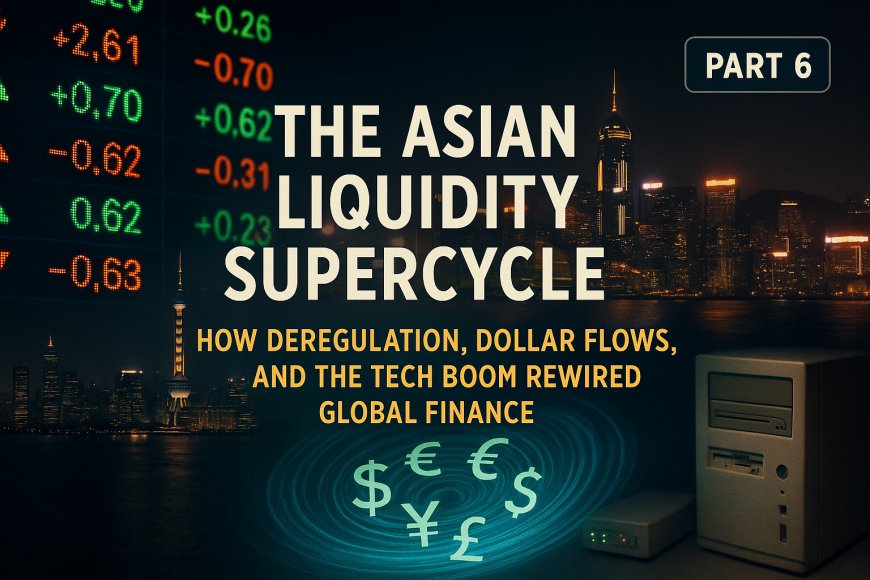
Between 1994 and 2001, the world entered a new liquidity regime driven by capital account liberalization, dollar-denominated borrowing, export surpluses, and the explosive rise of technology markets. From the Tequila Crisis and Asian Financial Crisis to the dot-com bubble, this era created the modern global liquidity…
Jump to a section
The Setup: From Leverage Machine to Global Liquidity Wave
By the mid-1990s, the architecture from Part 5 was in place. Inflation was tamed. Volcker’s pain trade was an unpleasant memory. The Reagan–Thatcher deregulation wave had turned banks into pipes for market-based credit. Derivatives, securitization, and globalized trading desks were standard tools.
At the same time:
- capital controls were being loosened or removed in many emerging markets
- the Washington Consensus promoted privatization, deregulation, and liberalized capital flows
- the United States had become the world’s consumer and tech hub of last resort
- Japan was stuck in its post-bubble stagnation, pushing its own capital outward
The ingredients for a global liquidity cycle were all there:
- surplus capital in advanced economies looking for yield
- emerging markets promising high growth and “convergence”
- a rising belief that central banks, especially the Fed, would smooth out shocks
- a new technological narrative — the internet — to justify sky-high valuations
Between 1994 and 2001, these elements fused. The leverage machine went global. The first modern Asian-centered liquidity supercycle took shape, from Mexico’s warning shot to the Asian Financial Crisis, Russia and LTCM, and finally the dot-com blowoff.
The Tequila Crisis: First Warning Shot
The decade opened with a hint of what was coming. In 1994, Mexico suffered what became known as the Tequila Crisis. After a period of capital inflows and reform optimism, political shocks and widening deficits undermined confidence in the peso. The government devalued, triggering capital flight, collapsing asset prices, and a broader emerging-markets selloff.
Why it mattered for the supercycle:
- Mexico had liberalized its capital account and attracted large foreign inflows into local bonds and equities
- investors assumed implicit support from the U.S. and multilateral institutions
- the crisis showed how quickly sentiment could reverse when a pegged or managed currency came under pressure
- the U.S.-led rescue package signaled that systemic emerging-markets crises would be met with international support, reinforcing “moral hazard” in future cycles
The Tequila Crisis was a contained event. It did not topple the global system. But it was a prototype: a capital-inflow boom, a sudden stop, a currency break, and a rescue framed as both discipline and stabilization. Asia, watching closely, continued on its own path — with even larger imbalances.
The Asian Miracle and the Dollar Debt Trap
Through the 1980s and early 1990s, a group of economies labeled the “Asian Tigers” — South Korea, Thailand, Malaysia, Indonesia, among others — were celebrated as development success stories:
- high growth rates
- export-led industrialization
- rising incomes and rapid urbanization
- deepening integration into global trade
Beneath the miracle narrative, the financial structure looked increasingly fragile:
- many countries maintained soft or hard pegs to the dollar to stabilize trade and attract capital
- banks and corporations borrowed heavily in dollars, often at shorter maturities, because dollar funding was cheaper
- domestic financial systems were liberalized faster than supervisory capacity improved
- credit surged into property, stocks, and large conglomerates tied to political networks
In effect, a regional carry trade formed:
borrow in cheap, abundant dollars → convert into local currency → lend into booming domestic sectors backed by export growth and rising asset prices.
As long as:
- the dollar remained relatively weak
- global growth was strong
- confidence in the pegs held
the model looked unbeatable. The problem was that the same structure that amplified growth would amplify losses once flows reversed.
The Asian Financial Crisis: When the Pegs Break
The crisis began in Thailand in 1997. After years of rapid credit growth, a property boom, and widening current-account deficits, speculative pressure mounted against the baht’s peg to the dollar. Authorities burned through reserves defending the currency. Eventually, the peg broke. The baht plunged. Contagion followed.
In quick succession, pressure hit:
- Indonesia
- Malaysia
- South Korea
- other regional economies with similar structures
The mechanics were classic but turbocharged by global markets:
- foreign investors, sensing vulnerability, pulled capital
- local borrowers suddenly faced ballooning dollar liabilities as their currencies fell
- banks with currency and maturity mismatches saw their balance sheets implode
- asset prices crashed, unemployment surged, and political regimes were shaken
IMF rescue packages arrived with standard conditionality:
- fiscal tightening
- interest-rate hikes to defend currencies
- structural reforms and openness to foreign ownership
Supporters argued these measures restored stability and discipline. Critics argued they deepened recessions and forced crisis countries to open their assets at distressed prices.
For the global liquidity supercycle, the Asian crisis delivered several core lessons:
- currency pegs plus dollar debts are dangerous when capital is mobile and supervision is weak
- hot money can reverse faster than local institutions can react
- the international response will prioritize system stability and creditor protection, even if local social costs are high
It also generated a powerful reaction in Asia that would shape the next decades: the desire to accumulate large foreign-exchange reserves, especially dollars, and to run current-account surpluses as a buffer against future crises. That choice would feed directly into the 2000s global imbalances story.
Russia, LTCM, and the First Global “Everything Is Connected” Moment
The 1997–98 turmoil did not stay confined to Asia. In 1998, Russia defaulted on parts of its domestic debt and effectively devalued the ruble after falling oil prices, weak fiscal capacity, and policy missteps made its debt dynamics unsustainable.
The direct economic weight of Russia’s default in global GDP terms was limited. The financial shock waves were not. One of the most dramatic casualties was Long-Term Capital Management (LTCM), a highly leveraged hedge fund run by prominent Wall Street traders and academics, including Nobel laureates.
LTCM had built large positions in bond markets, using heavy leverage layered on the assumption that spreads and relationships between different instruments would converge in predictable ways. When Russia defaulted, correlations broke. Liquidity vanished from the markets LTCM relied on. Losses mounted to levels that threatened counterparties across the system.
The Federal Reserve convened a private-sector rescue in which major banks injected capital and took over LTCM’s positions. The message was clear:
even a single, highly leveraged fund could be large and interconnected enough to pose systemic risk in a deregulated, derivative-heavy, globalized market.
This was a preview of 2008 in miniature:
- complex models assuming “normal” correlations and liquidity
- massive leverage on top of small arbitrage spreads
- a shock from a seemingly peripheral sovereign default
- a coordinated intervention framed as market stability
The Asian crisis plus Russia and LTCM collectively marked the first time the post–Bretton Woods, deregulated, Eurodollar-powered system clearly behaved as a single, tightly coupled global network.
The Dot-Com Bubble: Liquidity Finds a New Story
While emerging markets dealt with crisis, the United States staged a different kind of experiment: a full-spectrum technology and equity mania.
The commercial internet was moving from curiosity to mainstream. Browsers, networking equipment, servers, and software platforms promised a rewiring of commerce, communication, and culture. The narrative was simple and powerful: this time really is different.
In practice, the dot-com era looked like a classic Pattern Nexus script:
- falling interest rates and a “Greenspan put” mindset supported risk-taking
- capital, shaken by emerging-markets crises, flowed into U.S. assets seen as safer and higher-tech
- venture capital and IPO markets poured money into unproven business models chasing growth over profits
- equity valuations detached from fundamentals and became liquidity barometers instead
The NASDAQ surged, then ultimately collapsed in 2000–2001 as expectations reset and many firms failed to deliver sustainable revenues, let alone earnings.
Yet, as with many bubbles, the wreckage left behind real infrastructure:
- fiber networks
- data centers
- software stacks
- a culture of digital entrepreneurship
These would power later waves of tech growth once capital returned after the bust. The dot-com bubble was the first major proof that in a global liquidity supercycle, technology narratives become natural sinks and amplifiers for excess money.
China, WTO, and the New Export Core
While crisis and mania played out elsewhere, China was steadily repositioning itself. Through the 1990s, it pursued a controlled opening with:
- special economic zones
- gradual liberalization of trade
- managed integration with global supply chains
In 2001, China joined the World Trade Organization. This was the formal entry ticket into the post–Cold War global trading system. The consequence for the liquidity supercycle was enormous, even if the full effects took a few more years to appear.
China would:
- become a central node in global manufacturing and export flows
- run sustained trade surpluses with the United States and others
- accumulate large foreign-exchange reserves, primarily in dollars
- recycle those reserves into U.S. Treasuries and other assets
In other words, the post-Asian-crisis strategy of reserve accumulation and export-led growth would eventually scale up to a whole new level. The 1994–2001 period is when this pathway is locked in — setting up the 2000s as a decade of even larger global imbalances.
Plumbing Lessons: Hot Money, Dollar Funding, and the IMF Playbook
Stepping back from the narrative, the Asian liquidity supercycle offers a set of hard plumbing lessons.
Hot Money Is a Feature, Not a Bug
Liberalizing capital accounts while maintaining pegged or heavily managed exchange rates creates a structural temptation: borrow cheap foreign currency, invest in higher-yielding domestic assets, and assume the peg will hold. When everyone does this at once, the system becomes extremely sensitive to shifts in sentiment.
Dollar Funding Is a Global Operating System
Emerging markets could have borrowed more in local currency. Many did not, because dollar funding was cheaper and more readily available. This preserved and extended the dollar’s role as the central funding currency, with the Eurodollar system providing pipes and the U.S. Treasury market providing collateral.
IMF Programs Encode a Particular Logic
The crisis response in Asia and elsewhere followed a similar pattern:
- emergency loans tied to policy conditionality
- fiscal tightening and higher interest rates
- structural reforms and greater openness to foreign capital and ownership
Supporters saw necessary discipline and long-term benefits. Critics saw asymmetry: debtors bore much of the adjustment while global creditors and core institutions preserved their claims.
Post-Crisis Behavior Sets Up the Next Cycle
After 1997–98, many Asian economies decided never again to be at the mercy of sudden stops and conditional bailouts. They:
- built large FX reserves
- ran current-account surpluses
- maintained more cautious external balance sheets
Ironically, these defensive strategies contributed to the global savings glut and low-yield environment of the 2000s, which in turn fueled new leverage in advanced economies. Liquidity does not disappear; it changes direction.
Why 1994–2001 Looks Like a Dress Rehearsal for the AI–Energy Era
The 1994–2001 period is not just about emerging-market crises and goofy dot-com ads. It is a template for how the current AI–energy–digital collateral cycle might play out.
Global Capital Chasing Convergence Stories
Then, the pitch was emerging markets “catching up” and the internet transforming everything. Now, the pitch is AI productivity, energy transition, and new industrial policy. In both cases, global capital chases narratives of inevitability and scale.
Dollar Funding as the Base Layer
Then and now, most large-scale global projects ultimately touch dollar funding and dollar pricing, whether through direct borrowing, hedging, or collateral structures. New instruments — from structured products to tokenized assets — may change the top layer, but the base currency logic persists.
Tech as a Liquidity Sink
Then, the internet soaked up capital with promises of future cash flows that would justify any multiple. Now, AI models, data centers, and chips play a similar role. In both cases, genuine transformative technology sits next to speculative excess.
Crisis as Parameter Tuning, Not Regime Change
The Asian crisis, Russia and LTCM, and the dot-com crash did not break the system. They tuned parameters: more reserves here, more caution there, more central-bank readiness everywhere. The underlying global liquidity machine survived and scaled.
The Pattern Nexus lesson is simple:
Global liquidity supercycles are not accidents; they are the natural output of a world wired around a single funding currency, deregulated capital flows, and powerful technology narratives.
The question for the 2020s is not whether the pattern will repeat, but which balance sheets will be left holding the bag when the next version of 1997–2001 shows up in an AI–energy costume.
Pattern Nexus Framework: From Leverage Engine to Liquidity Supercycle
In the Pattern Nexus megaseries, each chapter is a layer on the same machine:
- Part 1: build the industrial hardware (1870–1914).
- Part 2: build the dollar fortress to control it (1947–1953).
- Part 3: build the command line — the compute–defense complex (1956–1969).
- Part 4: break the gold rules and shift to oil and Eurodollars (1968–1979).
- Part 5: discipline the system with pain, deregulate the pipes, and embed leverage (1979–1994).
- Part 6: open the gates to global capital flows, let the leverage engine run through emerging markets and tech, and learn what a true liquidity supercycle feels like (1994–2001).
The core Pattern Nexus takeaways from Part 6:
- Capital account liberalization without robust institutions creates boom–bust pipelines. The Asian crisis was not an accident; it was a structural consequence of how flows were opened.
- Dollar funding remains the spine of the system. Even “local” crises in emerging markets and hedge funds ultimately traced back to dollar funding and collateral dynamics.
- Reserves and surpluses are a rational response to vulnerability. Asia’s decision to accumulate reserves and run surpluses after 1997 set up the global imbalances of the 2000s.
- Technology bubbles are not just froth; they are infrastructure allocation mechanisms. The dot-com era mispriced value but correctly guessed direction, leaving behind networks and data centers that later waves would exploit.
- Crisis management preserved the architecture. Tequila, Asia, Russia, LTCM, and dot-com did not trigger deeper redesign; they strengthened the expectation that authorities would stabilize the system without fundamentally changing its leverage and liquidity logic.
The next parts of the series will follow how this architecture rolls into the 2000s housing and credit boom, the 2008 crisis, the QE era, and the emerging AI–energy–digital collateral regime. But the emotional and mechanical feel of a global liquidity supercycle — fast, euphoric, and brutal on reversal — is stamped here first.
FAQ: Quick Answers and “So What?”
Was the Asian Financial Crisis purely an emerging-markets problem?
No. The vulnerabilities were concentrated in emerging Asia, but the underlying drivers included global dollar lending, deregulated capital flows, and advanced-economy investors chasing yield. The crisis exposed system-wide behaviors, not just local mistakes.
Did the IMF “cause” or “solve” the crisis?
The IMF did not cause the underlying imbalances, but its policy prescriptions shaped the depth and distribution of the adjustment. Programs helped stabilize exchange rates and restore confidence for creditors, but often at the cost of sharp recessions and social strain in the crisis countries.
Why did the dot-com bubble happen at the same time as these crises?
Liquidity and risk appetite do not disappear when one region blows up; they often rotate. As capital lost faith in certain emerging-market stories, it crowded into U.S. tech and other perceived safe or high-upside assets. The dot-com bubble was, in part, a reallocation of global liquidity.
What is the main lesson about dollar borrowing for emerging markets?
Borrowing in a currency you do not control, especially at short maturities, is dangerous when your exchange rate policy is rigid and your capital account is open. The Asian crisis burned that lesson into policymaker memory, leading to more cautious external balance-sheet management in later decades.
How does this help us understand today’s world?
The 1994–2001 supercycle shows how global liquidity, technology narratives, and dollar plumbing interact. It suggests that in the AI–energy transition, we should expect similar patterns: capital chasing convergence, new forms of dollar-linked leverage, defensive reserve strategies, and periodic crises that are managed but rarely used to redesign the underlying system.
Sources
- Overviews of the Asian Financial Crisis and its causes and consequences. IMF – The Asian Crisis: Causes and Cures
- Background on the Mexican Tequila Crisis and its impact on emerging markets. BIS – The Mexican Crisis: Overview and Analysis
- Analyses of the Russian default and the LTCM episode as global financial shocks. Federal Reserve History – LTCM
- Historical material on the dot-com boom and bust in U.S. equity markets. Federal Reserve History – The Dot-Com Bubble
- Resources on China’s WTO accession and the evolution of global trade patterns. WTO – China’s Accession
What's Your Reaction?
 Like
0
Like
0
 Dislike
0
Dislike
0
 Love
0
Love
0
 Funny
0
Funny
0
 Wow
0
Wow
0
 Sad
0
Sad
0
 Angry
0
Angry
0

Nexus (Christopher)
Founder of Pattern Nexus. I research markets, macro, geopolitics, AI, history, ancient systems, and the patterns most people overlook. I’m also building Market Radar, a trading scanner designed to read pressure, risk, confirmation, and setup quality before ch…
Related research

State Street and the Hidden Operating System of Modern Finance
State Street is not just another bank. It is one of the hidden infrastructure layers of modern finance, sitting inside custody, ETFs, asset…
3 shared topics, 1 shared asset, same research avenue.
The Silent Currency War: Containment, Collateral, and the 2030 Regime Window
The United States and China have entered a silent currency war layered on top of maritime containment, commodity dependencies, and financia…
5 shared topics, 1 shared asset.
Why a 150-Year-Old Market Chart Still Haunts Modern Finance
A deep Pattern Nexus breakdown of Samuel Benner’s 19th-century market cycle chart and why it still aligns with modern financial stress wind…
5 shared topics.
The Reverse Repo Trap: How the Fed Quietly Controls Liquidity & Markets
A deep dive into the Federal Reserve’s overnight reverse repo facility — why trillions parked at the Fed aren't “normal,” how it secretly t…
4 shared topics, 1 shared asset, same research avenue.
Fed Cuts Rates but Markets Fade — Powell Plays Psychological Games as Bonds Call Bluff (Oct 29, 2025 Market Roundup)
The Federal Reserve cut rates on Oct 29, 2025, triggering a brief rally before markets faded as Powell tried to temper expectations for fut…
2 shared topics, 2 shared assets.
When the 10-Year Won’t Behave: Why Markets and Gold Slipped Even With a Cut Looming
Stocks and gold pulled back even with a widely expected Fed rate cut days away. Here’s how the 10-year, earnings headlines, dollar strength…
2 shared topics, 2 shared assets.
The Myth of Collapse: Why the Future Doesn’t End Like the Past
Every “Final Crisis” narrative tries to force pre-digital history onto a post-digital civilization. Debt, fiat, gold, and markets aren’t dy…
4 shared topics, 1 shared asset, same research avenue.
Algorithmic Authority: Scoring Systems, Risk Models, and Invisible Veto Power
Algorithmic authority is the new governance layer. Scoring systems and risk models now decide eligibility, visibility, pricing, and access—…
4 shared topics, same research avenue.
Comments (0)
Security Check
Please complete the captcha to verify you are human.