
Fed Chair Odds as a Term-Premium Signal: Warsh Takes the Lead
Prediction markets are repricing Trump’s Fed chair pick toward Kevin Warsh. In the Pattern Nexus framework, this is not “personality politics.” It’s a term-premium and governance-risk signal that can move the long end, especially as allies fracture on trade blocs (Canada–China EV deal) and the U.S. deficit regime persists.
The tape tightened materially overnight: Trump said he will announce his Fed chair nominee Friday morning, and Reuters reports he met with Kevin Warsh at the White House ahead of the decision. Markets treated this as “Warsh-base-case” positioning: stronger dollar, firmer yields, and risk assets leaning defensive into the announcement window.
- Announcement timing is now explicit: Trump says the pick is coming Friday morning. This compresses the odds curve and increases gap-risk in rates/FX.
- Warsh is the focal point: Reuters notes Trump met Warsh at the White House and is expected to name a nominee Friday; other reported contenders remain in the mix, but the market is leaning into a Warsh outcome.
- Pattern Nexus translation: this is not “politics content.” This is a governance-risk / independence-risk repricing event that pushes the term premium before any macro data can explain it. When the chair seat turns into a contested lever, duration demands higher compensation.
Prediction market = marginal belief + liquidity. Not truth. Not a forecast. A live, tradable probability curve that moves when real information hits the tape. Think of it as a constantly updating poll where people back their opinion with money.
Chair pick = governance premium. The market charges extra yield when it worries that the central bank will be pushed around by politics or will swing too hard between regimes. That “worry” shows up as a fatter term premium.
10-year moves on term premium, not vibes. The 10-year yield isn’t just “what the Fed will do next meeting.” It’s the sum of rate expectations over a decade plus a safety margin for uncertainty. When that safety margin jumps, yields can pop even with no new data print.
Bloc drift matters. Canada opening the door to Chinese EVs in exchange for better treatment on canola is not “EV news.” It is a visible sign that the North American trade block is fraying at the edges. That feeds into long-run risk pricing.
The signal and the setup
The signal: what Polymarket is pricing
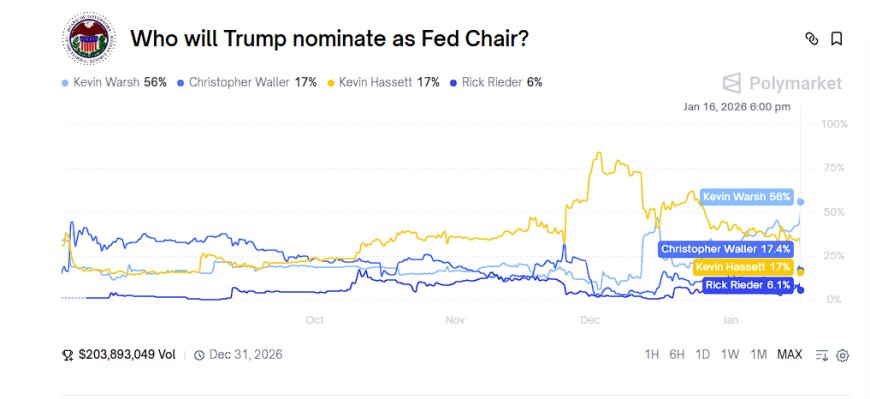
The screenshot posted is a clean distribution: Warsh in the lead, Waller and Hassett clustered, Rieder as the tail. The only reason this matters is because it is tradable. The odds didn’t move because a strategist wrote a think piece. They moved because real money adjusted positions after new comments from Trump and new headlines on Powell and the DOJ.
For anyone who has never looked at a prediction market: each line on that chart is basically “a share” that pays out if that person becomes chair. If Warsh is trading at 56, the market is saying “roughly 56% chance.” That number is not magic, but when it lurches higher in a single day, you know information just hit the system.
The setup: why this chair pick can move the curve
Jerome Powell’s current term as Fed chair ends on May 15, 2026. His separate term as a Fed governor runs until 2028, but the key job – steering the ship and speaking for the institution – is the chair term. In this window, every headline about “who’s next” is really a headline about the future rule set for money.
The post-QT world I have been writing about is already here. Quantitative tightening has effectively hit its political and market limits. From here forward, the system is running with: high structural deficits, industrial-policy spending, and an expanding web of tokenized collateral. In that regime the bond market becomes the main shock absorber. If the Fed looks less independent or less predictable, that shock absorber demands a thicker cushion – higher term premium – especially in the 10-year and out.
The chair-odds chart is not “political gossip.” It is plumbing: a live gauge of how much regime risk the bond market is being asked to swallow for the next decade.
Why odds moved and who the market is pricing in
Why odds moved this week (not “old news”)
The “Powell renovation subpoena” story and Trump’s public frustration with Powell have been simmering in the background for days. But the odds really shifted when Trump said, out loud, that he wanted to keep Kevin Hassett at the White House. If Hassett is staying put, the probability mass has to go somewhere. The market pushed more of it onto Warsh.
Layered on top of that, Fed Vice Chair Jefferson came out and defended Powell, calling him a person of “the highest integrity.” That is not about feelings. That is the Fed’s number two trying to reassure investors that the institution will not bend to the DOJ or to the White House. When central bankers feel the need to say that on the record, markets hear “something is off” and start charging a governance premium.
Candidate map: Warsh vs Waller vs Hassett vs Rieder
Kevin Warsh (base case in the odds)
Warsh sat on the Fed Board from 2006 to 2011, inside the 2008 crisis. Back then he was one of the people worrying that quantitative easing and a massive balance sheet would eventually create inflation and entangle the Fed with fiscal policy. More recently, he has been on TV and in op-eds saying the current regime has gone off course and calling for a reset in how the Fed operates.
Markets read him as someone with central-bank experience, Republican ties, and a willingness to criticize the current Fed. That combination makes him both confirmable in the Senate and change-agent enough to count as a regime shift. That is why his line sits on top of the Polymarket chart.
Christopher Waller (internal continuity candidate)
Waller is already a sitting governor. His speeches are generally straightforward: keep inflation heading back toward 2%, avoid over-reacting to every data wobble, and stay focused on the medium run. A Waller chair would likely mean fewer surprises in how the Fed communicates, even if rates stay relatively high. For markets that value stability, that kind of “boring” is worth something.
Kevin Hassett (White House control candidate)
Hassett is the current Director of the National Economic Council and previously chaired the Council of Economic Advisers. In plain English: he is Trump’s in-house economist. That makes him very close to the president’s political and electoral priorities. Traders worry that putting the NEC director straight into the chair seat could blur the line between the Fed and the White House. That worry is exactly what people mean when they say “Fed independence.”
Rick Rieder (outsider tail)
Rieder runs massive bond portfolios in the private sector. He knows markets inside out, but he is not a career central banker. The market keeps him on the board as a low-probability “wild card” – an option the White House could exercise if it wants a markets-savvy outsider. The low odds do not mean “impossible,” they just mean the system sees easier confirmation paths in the others.
Rates plumbing, bloc drift, and what to watch
Rates plumbing: how this hits the 10-year
Take the jargon out and the mechanics are simple. When an investor buys a 10-year Treasury, they are asking two questions:
- What do I think short-term interest rates will average over the next ten years?
- How much extra yield do I need as a cushion for all the things that might go wrong?
That second piece is the term premium. Chair politics, DOJ subpoenas, and open fights over Fed independence live almost entirely in that bucket. They do not change tomorrow’s funding rate. They change how confident you feel about the rules of the game.
When odds swing toward a chair the market reads as “regime change” and the selection process itself turns into a fight, term premium can jump in an afternoon. That is what our 10-year chart is picking up: not a sudden wave of inflation, but a sudden increase in what investors demand to be paid for uncertainty.

The bond market is pricing the Fed chair seat as a control lever, not as a résumé contest. That pushes term premium before the headlines – or most commentators – catch up.
Canada–China EV tariffs: bloc drift as term-premium fuel
Now overlay the Canada–China deal. Canada just agreed to slash tariffs on Chinese electric vehicles from around 100% down to 6.1% and to allow up to 49,000 units into the Canadian market each year. In exchange, China is cutting tariffs on Canadian canola seed from about 85% to 15% and easing up on a list of other Canadian exports like canola meal and seafood.
Washington’s reaction was immediate: U.S. officials called the move “problematic” and warned that Canada may regret giving China that kind of foothold in North America’s auto supply chain. They also made it clear those vehicles will not be allowed to slide into the U.S. through the back door.
If you view the world through the Pattern Nexus lens, this is not about who sells more EVs next quarter. It is about bloc drift. A core ally just signaled that it is willing to trade a piece of industrial policy alignment with the U.S. for better commodity access to China. That increases the odds of future tariff fights, USMCA disputes, and retaliatory subsidies. All of that implies larger, messier deficits and more policy noise over the coming decade – again, term-premium fuel.
What to watch next
- Any explicit Trump statement naming a finalist or giving a short list. Odds will gap the moment names are narrowed.
- Signals from Senate leadership about who is “confirmable.” Markets care less about preferences and more about what can actually get 51 votes.
- The 2y/10y relationship. If 10s jump while 2s barely move, that is term premium, not a “more hikes” story.
- Whether the U.S. follows through with hard responses to the Canada–China EV deal: new rules of origin, targeted auto tariffs, or industrial subsidies.
- Any escalation in DOJ pressure on Powell and any more public defenses from Fed officials. Each round adds to the independence risk narrative.
Pattern Nexus Lens
This is not a “Fed chair gossip” story. It is a governance-risk story in a deficit regime. When the chair seat becomes an openly contested political lever, the long end stops being about inflation prints and starts being about credibility pricing. The market is telling you it wants a higher yield for the same country risk. The Polymarket chart is simply the first place you can see that belief move in real time.
The chair race is how regime risk gets translated into basis points on the long end. Ignore the personalities; watch what duration is being paid to absorb.
FAQ
When does Powell’s term end?
Powell’s current term as chair ends on May 15, 2026. His term as a Fed governor runs until January 31, 2028. He could, in theory, stay on as a governor under a new chair, but markets are focused on who holds the chair role.
Does the chair “control” the Fed?
The Fed votes as a committee, but the chair controls the agenda, frames the debate, and speaks for the institution. In practice, that means the chair strongly shapes how markets interpret every decision and every data point.
Are prediction markets reliable?
They are not crystal balls. But they are honest in one important way: people put money behind their view. When the odds swing hard, it tells you that informed participants believe something real has changed, even if TV pundits have not caught up yet.
Sources
This write-up is built from the prediction market page plus same-day reporting on the Fed chair selection, the Powell/DOJ conflict, and the Canada–China tariff deal.
- Polymarket: Who will Trump nominate as Fed Chair?
- Reuters: Trump tells Hassett he may want to keep him at White House (Jan 16, 2026)
- AP: Trump says he wants to keep Hassett in White House, clouding Fed chair selection (Jan 16, 2026)
- Reuters: Fed’s Jefferson defends Powell integrity amid DOJ action (Jan 16, 2026)
- Brookings: Fed leadership terms and succession mechanics
- Congress CRS: Federal Reserve Board current/historical membership and term dates
- FT: Canada and China slash tariffs as they mend ties (Jan 16, 2026)
- Reuters: U.S. says Canada’s Chinese EV decision is “problematic” (Jan 16, 2026)
- Reuters: CAD and Canada rates reaction to China trade deal (Jan 16, 2026)
- Federal Reserve History: Kevin M. Warsh
- Hoover: “Inflation Is a Choice” – Warsh critique of current Fed regime
- Federal Reserve: Waller speeches on inflation and policy outlook
- Wikipedia: Kevin Hassett biography and NEC role
- BlackRock: Rick Rieder bio
- Reuters: Trump says he will announce his Fed chief nominee on Friday (Jan 30, 2026)
- Reuters: Trump says Fed pick due Friday after meeting Warsh at White House (Jan 30, 2026)
- AP: Trump says he will announce his Federal Reserve chair nominee Friday morning (Jan 30, 2026)
- WSJ: Trump expected to pick Kevin Warsh as Fed chair; announcement Friday (Jan 30, 2026)
คุณมีปฏิกิริยาอย่างไร?
 ชอบ
0
ชอบ
0
 ไม่ชอบ
0
ไม่ชอบ
0
 รัก
0
รัก
0
 ตลก
0
ตลก
0
 ว้าว
0
ว้าว
0
 เศร้า
0
เศร้า
0
 โกรธ
0
โกรธ
0

Founder of Pattern Nexus. I research markets, macro, geopolitics, AI, history, ancient systems, and the patterns most people overlook. I’m also building Market Radar, a trading scanner designed to read pressure, risk, confirmation, and setup quality before chasing a move. Pattern Nexus is where I connect the dots between data, history, technology, and the bigger system playing out around us.











ความคิดเห็น (0)