
24/7 Markets + Tokenized Stocks: NYSE/ICE Signals the Next Equity Rail
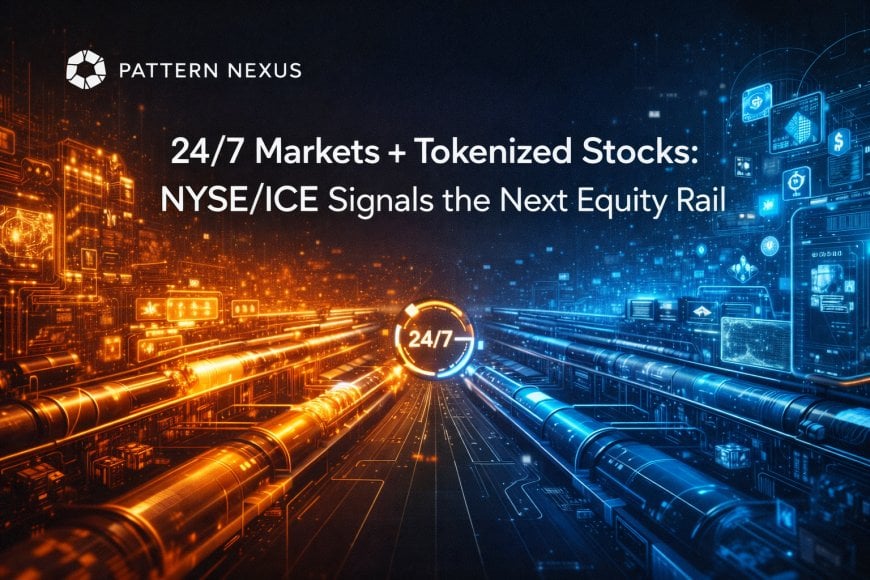
![[HERO_IMAGE_ALT: Abstract dual-rail market plumbing graphic showing legacy equities vs tokenized settlement rails]](https://patternnexus.com/uploads/images/202601/image_870x_696efc301ce25.jpg)

This is not “NYSE is now 24/7.” It’s a new, separate platform designed to trade tokenized representations of U.S. equities and ETFs, pending regulatory approval.
Risk vector: 24/7 access without harmonized clearing, market data, and supervision can amplify fragmentation and “ghost liquidity” — especially during weekends and off-peak global hours.
The real product isn’t 24/7 trading. The product is fast settlement with tokenized capital and stablecoin funding. That’s a direct challenge to the legacy T+1/T+2 plumbing model.
The fight is moving upstream: not “who has the best exchange,” but who owns tokenized dollars, compliant custody, market data, and the surveillance layer that regulators can actually sign off on.
What Was Announced (and What Was Not)
On January 19, 2026, Intercontinental Exchange (ICE) announced it is developing a new digital platform designed to enable 24x7 trading and settlement of tokenized securities, including U.S. listed equities and ETFs, with fractional share trading and immediate settlement via tokenized capital. The company framed the project as subject to regulatory approval.
The critical distinction is structural: this is not a blanket shift of the NYSE core market to 24/7 continuous trading. It’s the buildout of a parallel tokenized venue, with a different settlement architecture and a different funding layer (stablecoin-backed funding is included in the concept). In other words: a new rail, not a longer clock on the same rail.
This also lands inside a larger institutional shift: exchanges and clearinghouses are responding to the same demand signal (global continuity) but they are constrained by the same non-negotiables (clearing, settlement finality, corporate actions processing, surveillance, and market data integrity). If you want to understand why “24/7” is hard in equities, ignore the matching engine. Focus on the back half of the stack.
This ICE announcement landed inside a broader market-structure migration. Nasdaq has stated it intends to enable 24-hour trading on the Nasdaq Stock Market with an anticipated timeline in the second half of 2026 (pending regulatory approval and alignment with infrastructure providers). NYSE Arca has described a near-continuous 23-hours-per-day, five-days-per-week design (with a 1-hour daily break) pending SEC approval. Separately, 24X and other venues are filing around extended sessions as the ecosystem moves toward continuous access.
Extended hours expands the session. Tokenization attacks the settlement layer. If the new platform can compress settlement toward T+0 using tokenized capital and stablecoin-backed funding, then “time” stops being an operational constraint and starts being a design choice. That is why this announcement matters even if it takes time to reach production.
The New Market Stack: Tokenized Trading + Tokenized Settlement
![[IMAGE_1_ALT: Diagram of legacy equity rail vs tokenized rail, showing order entry, matching, clearing, settlement, collateral]](https://patternnexus.com/uploads/images/202601/image_870x_696efcf6a5ea1.jpg)
“Tokenization” is the technical verb, but the economic verb is simpler: compressing time. When you push settlement toward immediate (or near-immediate), you alter:
- Counterparty risk window: the time exposure between trade and settlement shrinks.
- Collateral and margin behavior: faster settlement changes intraday credit and collateral demands, because the system has less time to net, reconcile, and fund.
- Capital efficiency: less time trapped in settlement limbo means higher potential velocity for certain participants, but also tighter operational tolerances.
ICE’s concept highlights stablecoin-backed funding and tokenized capital as settlement mechanisms. That is a direct bridge between the dollar’s emerging tokenized “shadow rail” (stablecoins and tokenized deposits) and public equities. If tokenized dollars become usable for margin, settlement funding, and cross-time-zone obligations, the market begins to behave like a continuous system instead of a batch-processed one.
Matching buyers and sellers at 2:00 a.m. is trivial. The hard part is everything that makes equities “equities”: consolidated market data, audit trails, best execution, LULD/halts, corporate actions, record dates, borrow/locate plumbing for shorting, securities lending, and the clearinghouse guarantee that the trade is actually good. That’s why the biggest workstreams sit behind the curtain.
The always-on global investor base wants continuity. But the industry constraint has never been “matching buyers and sellers.” The constraint is clearing, settlement, market data, surveillance, and operational integrity across a system designed around a daily open/close cycle. Tokenized settlement is the attempt to modernize the slowest layer of the stack.
Another key driver is competitive positioning. If global investors can trade crypto 24/7 and settle in minutes, the expectation pressure migrates into equities. The demand signal is not “I want to gamble at 3 a.m.” It’s “I want to hedge, rotate, and manage risk continuously without waiting for New York’s morning.”
The subtext is that clearing is expanding too. DTCC/NSCC has publicly outlined plans to extend clearing and processing windows to support near-continuous equity trading (subject to regulatory approval). That’s the back-end infrastructure trying to keep pace with what the exchanges and venues are filing on the front end. This is an ecosystem move, not a single-company move.
![[IMAGE_2_ALT: Timeline chart of U.S. equities moving from session-based to near-continuous trading and tokenization]](https://patternnexus.com/uploads/images/202601/image_870x_696efe5c6490d.jpg)
The timeline distinction matters: extended-hours proposals are generally converging on a “23/5” shape (nearly continuous weekdays with a short break for processing and date rollover). Tokenized platform concepts are aiming for “24/7” (continuous access across weekends), which forces the hardest questions to the surface: what is the reference price, how do corporate actions and halts work, and where does final settlement live when banks are closed.
Implications: Liquidity, Volatility, Fragmentation, and Control
If you want the cleanest way to think about this: U.S. equities are being pulled toward the same shape as crypto markets (continuous access), but with a fundamentally different regulatory and plumbing burden.
The upside case is obvious: more access, more global participation, more flexible execution windows, and potentially faster settlement. The downside case is also obvious: fragmentation, thin liquidity during off-peak hours, and a new venue-layer that can diverge from the “reference” price discovery of the primary sessions.
The real question is not “will 24/7 exist.” It’s “where does the real price form.” Equities still anchor to events that are batch-like: earnings releases, corporate actions, index rebalances, large auction prints, and liquidity concentrations around the U.S. session. A 24/7 venue can trade continuously and still have weak price discovery if liquidity is thin and fragmented.
When trading becomes continuous and settlement compresses, the control points move. The new chokepoints are not the trading floor and not even the matching engine. The chokepoints become: who provides tokenized dollars, who clears tokenized securities, who controls the wallet/custody layer, who operates the market-data and surveillance layer, and who gets regulator blessing to intermediate flows.
Fragmentation isn’t just “more venues.” Fragmentation becomes a market-data problem. If liquidity spreads across sessions and rails, the surveillance and best-execution burden increases. The consolidated tape (SIP) and market-data governance become strategic: which prints count, how they’re reported, and how brokers prove best execution when liquidity is thin at odd hours.
There’s also a microstructure issue: wide spreads and jumpy prints in off-hours can create the illusion of price discovery. If you’ve traded thin books before, you know the phenomenon: markets are “open,” but the effective market is not deep. That’s where “ghost liquidity” shows up: quotes exist, size doesn’t.
Shorter settlement cycles reduce counterparty exposure but tighten funding constraints. The system has less time to net trades, meet margin calls, and resolve exceptions. Tokenized dollars (stablecoins or tokenized deposits) are one solution: keep the funding asset “awake” even when parts of the banking system are not. If that layer matures, the feasibility of true 24/7 equities improves materially.
Watch the incentives. Exchanges want to own the venue. Clearinghouses want to own settlement. Banks want tokenized deposits to be the “approved” on-chain money. Brokers want control of the front end. Regulators want the system observable and enforceable. Same chessboard, new surface area.
Practical watchlist over the next 30–180 days:
- SEC filings and approval posture for extended-hours changes (Nasdaq 23/5 proposals, NYSE Arca near-continuous sessions, other venue filings).
- How ICE frames custody, AML/KYC, surveillance, and market data for tokenized equities (this is where regulators will focus).
- Whether tokenized deposits become the preferred settlement asset vs stablecoins, and which banks/clearinghouses operationalize it first.
- How the platform handles corporate actions, halts, LULD-like protections, and “date rollover” when the market never really closes.
- Evidence of price divergence between primary-session price discovery and off-hours venues (if/when launched), and how brokers route around it.
Pattern Nexus Lens
This is a control-systems upgrade. “Hours” are a surface feature. The deeper signal is the migration of equities toward a programmable settlement rail where tokenized dollars and tokenized securities can clear with less temporal friction. In a world where liquidity is increasingly routed through software-defined channels, market structure becomes policy, and settlement speed becomes power.
In PN terms: the legacy rail is a batch-processed system designed around daily resets and multi-day settlement (now compressed to T+1). The new rail is an always-on system designed around continuous state. The winners are the entities that control state transitions: identity, custody, collateral, clearing, compliance, and the market-data layer that defines what “the” price is at 3 a.m.
Always-on trading is the headline. Always-on settlement is the structural shift. Tokenization is the mechanism that lets the market’s control plane move from time-based sessions to continuous rails.
FAQ
Is the NYSE itself going 24/7 right now?
No. ICE described a new digital platform concept for 24/7 trading and settlement of tokenized securities, pending regulatory approval. That is distinct from the traditional NYSE cash equity market structure.
Is this the same thing as “24/5” or “23/5” extended-hours trading?
Not exactly. Extended-hours proposals (like near-continuous 23-hours-per-day, five-days-per-week) keep the asset in the traditional market structure but extend the session design. Tokenization changes the settlement rail and funding layer, not just the clock.
What’s the biggest risk if this rolls out?
Fragmentation and thin liquidity during off-peak hours, plus new failure modes around custody, market surveillance, operational resilience, corporate actions handling, and the stability of the funding asset (stablecoin or tokenized deposits). The market can be “open” 24/7, but that does not guarantee deep, continuous liquidity.
Does “instant settlement” automatically make the market safer?
It reduces the counterparty risk window, but it can increase funding pressure and operational tightness. Faster settlement can shift risk rather than erase it: the system has less time to net, reconcile, and fund, so the quality of the collateral/funding layer becomes more important.
Why do tokenized deposits matter in this story?
They are the institutional bridge: a bank-deposit liability represented in a tokenized form that can potentially move and settle on-chain in near real-time. If tokenized deposits become broadly usable for margin and funding across time zones, they make 24/7-style equity settlement more realistic than relying on legacy banking cutoffs.
Sources
Primary announcements and regulatory/infrastructure materials supporting the platform details, extended-hours proposals, and clearing/settlement context.
- ICE press release: NYSE develops tokenized securities platform (Jan 19, 2026)
- Reuters: ICE developing 24/7 platform for tokenized securities (Jan 19, 2026)
- AP: NYSE working on new platform for around-the-clock digital token trading (Jan 19, 2026)
- Nasdaq: 24-hour trading intent and timeline (24x5 page)
- NYSE Arca: Extended-hours trading FAQ (near-continuous 23/5 concept)
- Federal Register: Nasdaq proposed rule change for 23 hours/day, 5 days/week (Jan 13, 2026)
- Federal Register: 24X National Exchange filing context (Jan 8, 2026)
- SEC: Statement on implementation of T+1 settlement (May 21, 2024)
- DTCC: The Shift to 24x5 Trading (Dec 2025)
- Reuters: DTCC plans to extend clearing hours to support extended trading (Mar 18, 2025)
- BNY: Tokenized deposits/digital cash capabilities update (Jan 9, 2026)
คุณมีปฏิกิริยาอย่างไร?
 ชอบ
0
ชอบ
0
 ไม่ชอบ
0
ไม่ชอบ
0
 รัก
0
รัก
0
 ตลก
0
ตลก
0
 ว้าว
0
ว้าว
0
 เศร้า
0
เศร้า
0
 โกรธ
0
โกรธ
0

Founder of Pattern Nexus. I research markets, macro, geopolitics, AI, history, ancient systems, and the patterns most people overlook. I’m also building Market Radar, a trading scanner designed to read pressure, risk, confirmation, and setup quality before chasing a move. Pattern Nexus is where I connect the dots between data, history, technology, and the bigger system playing out around us.
















ความคิดเห็น (0)