
Supply Chain Governance
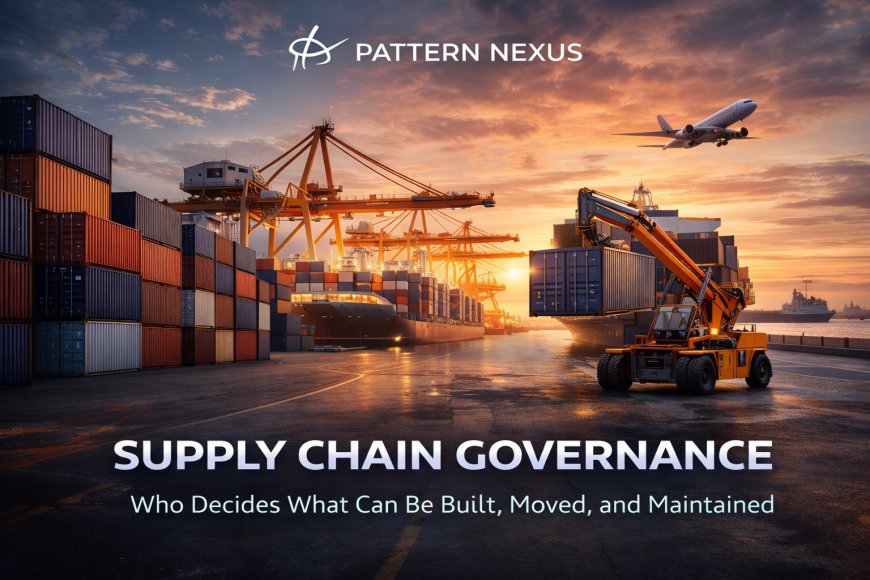
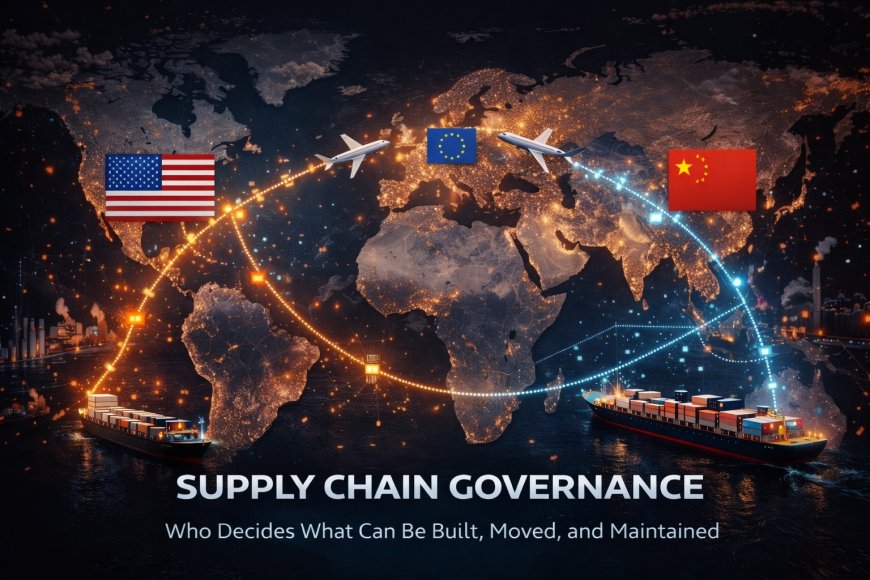

System Reality: What cannot be certified, insured, financed, shipped, or serviced effectively does not exist.
Hidden Constraint: Control does not require blocking every pathway — only the ones that scale.
Enforcement Shift: Power now operates through dependency, timing, and compatibility rather than ownership.
Executive Summary
Supply chains have evolved from efficiency systems into enforcement systems. Modern economies depend on dense, optimized, globally distributed production networks. Those networks require certification, insurance, shipping access, financing, software, spare parts, and regulatory alignment to function.
Once a system becomes dependent on a supply chain, control no longer requires force. It only requires withholding compatibility. If something cannot be certified, insured, financed, shipped, or serviced, it effectively does not exist.
System Reality: In the modern economy, what cannot move cannot survive.
This chapter explains how supply chains became a governance layer—one that enforces outcomes through dependency, fragility, and chokepoints rather than commands.
The key shift is not that “trade got political.” The shift is that modern production is so specialized, so compliance-bound, and so financially intertwined that the chain itself becomes the law. A factory can have workers and capital and demand, and still be dead on arrival if it cannot obtain certified inputs, insured transportation, compliant routing, and serviceable components.
In practice, enforcement looks mundane. It looks like a missing certificate, a failed audit, a denied policy, a financing refusal, a routing restriction, a customs hold, a software lock, or a parts embargo. None of these require a speech. None of these require an army. They are governance without the optics of governance.
From Logistics to Governance
In classical economics, supply chains were neutral conduits. Raw materials entered one end, finished goods exited the other. Power resided elsewhere: in states, capital, or labor.
That model is obsolete.
Modern supply chains are:
- capital-intensive
- highly specialized
- dependent on certification and compliance
- optimized for cost, not resilience
- embedded in financial and insurance systems
This transformation turned supply chains into governance systems. Decisions about sourcing, redundancy, routing, and certification now determine which activities are possible at all.
Myth vs Mechanism: Myth: supply chains are neutral logistics. Mechanism: supply chains enforce participation rules.
The old mental model treats the chain like plumbing you can reroute with price signals. The modern reality is closer to a licensing regime. You’re not “buying parts.” You’re buying admission into a standards stack: electrical codes, material specs, process certifications, quality audits, traceability requirements, and liability structures that force certain behaviors whether anyone calls it “policy” or not.
That’s why “just build your own” is usually fantasy. Capability isn’t just machine tools. It’s supplier qualification. It’s paperwork. It’s test labs. It’s inspection regimes. It’s recalls. It’s insurance coverage. It’s legal exposure. The control layer is the ecosystem, not the factory.
When the chain is optimized, standardized, and insured, it becomes a rule system. Participation is conditional. Scaling is permissioned.
The Supply Chain Control Architecture
Supply chain governance emerges from a layered architecture similar to the compliance stack.
Text Diagram:
Design Standards → Supplier Qualification → Certification → Insurance → Trade Finance → Shipping Access → Customs Clearance → Maintenance & Parts → Market Access
Failure at any layer can halt the entire chain. Control does not need to be centralized. It is distributed across institutions responding to liability, regulation, and risk.
Hidden Constraint: You do not need to block every pathway—only the ones that scale.
This is why control looks “invisible” to most people. Nobody has to announce it. The architecture enforces itself because each layer is trying to reduce exposure. Standards bodies reduce accident risk. Certifiers reduce product failure risk. Insurers reduce claims risk. Banks reduce default and sanctions risk. Carriers reduce route and port risk. Customs reduces legal risk. Vendors reduce warranty and support risk. Each node is rational in isolation, and together they produce governance.
The practical effect is that “permission” is modular. A system can exist at prototype scale while being blocked at production scale. A product can be built locally but cannot be shipped. A machine can be installed but cannot be serviced. A company can sell domestically but cannot access global markets. The architecture controls the transition from small to large, from local to global, from informal to institutional.
Chokepoints: Where Control Is Applied
Supply chains concentrate control at chokepoints where substitution is difficult and delay is costly.
Common chokepoints include:
- specialized components
- tooling and molds
- rare inputs and materials
- certification bodies
- key ports and shipping routes
- software and firmware dependencies
Chokepoints are powerful because disruption does not need to be permanent. Temporary denial often suffices to force compliance or concessions.
System Reality: Supply chain power comes from timing, not ownership.
Timing leverage is the core mechanic. If a factory has two weeks of buffer, disruption is noise. If a factory has two days of buffer, disruption is a command. This is why supply chain pressure targets the “time constant” of the system: lead times, reorder points, safety stock, critical spares, and maintenance cycles. When the time constant is short, the control surface is high.
Chokepoints also stack. A product can be blocked by a component shortage and then re-blocked by certification, and then re-blocked by financing, and then re-blocked by shipping capacity. This layering is why “just find another supplier” often fails. You’re not just replacing an input; you’re replacing a validated and insurable relationship inside a compliance graph.
The most effective chokepoints are the ones you cannot swap quickly, cannot certify quickly, and cannot finance without reputation and paperwork.
Insurance, Certification, and Trade Finance
Goods do not move because they exist. They move because they are insurable, certifiable, and financeable.
Insurance markets quietly govern supply chains by:
- pricing risk
- denying coverage
- requiring compliance with standards
Trade finance adds another layer. Without letters of credit, guarantees, and settlement assurance, large-scale trade collapses.
System Reality: If insurers and financiers say no, the shipment does not move.
This is where governance becomes “private-sector law.” Insurance and finance are not ideology-driven; they are exposure-driven. They enforce compliance because claims and defaults are existential. That makes them the cleanest enforcement mechanism available: deny coverage, deny settlement, deny the guarantee, deny the credit line, deny the shipper’s risk acceptance. The product can be real, and still be economically illegal.
Trade finance is also a scalability gate. Small trade can happen via cash or trust. Large trade requires instruments: letters of credit, bank guarantees, documentary compliance, inspections, and verifiable origin. That means the financial layer can condition scale on documentation, jurisdiction, and policy alignment without looking like “geopolitics.”
Fragility by Design: Just-in-Time as Control
Just-in-time systems maximize efficiency by minimizing inventory. They also maximize fragility.
Once buffers are removed, systems become dependent on continuous flow. This creates leverage.
A delayed shipment becomes:
- a factory shutdown
- a missed contract
- a cascading failure
Second-Order Effect: Efficiency trades resilience for enforceability.
JIT is usually marketed as “good management.” In a control-systems frame, it’s also a leverage amplifier because it collapses response time. When inventory is treated as a sin, supply continuity becomes sacred. That flips the balance of power toward the nodes that can interrupt flow: upstream suppliers, shippers, ports, customs, certifiers, insurers, and financiers.
The second-order effect is that fragility becomes policy. Not because anyone “wants” fragility, but because short-term incentives reward it. Balance sheets prefer low inventory. KPIs reward turnover. Procurement rewards lowest cost. Each micro-incentive removes redundancy until the system becomes governable through timing.
The less buffer you hold, the less “disruption” you can tolerate, which means the more you comply to avoid it.
Maintenance, Parts, and Repair Lock-In
Control does not end after delivery. Modern products require:
- software updates
- authorized parts
- certified technicians
- ongoing support contracts
If maintenance or parts are denied, assets degrade rapidly.
System Reality: If you cannot repair it, you do not own it.
This is the post-sale governance layer. In older industrial eras, ownership meant control because the asset was mechanically serviceable. In modern systems, serviceability is permissioned. Firmware locks. Serial-matched parts. Remote diagnostics. Subscription-based tooling. Vendor-only calibration. “Authorized technician” gatekeeping. The product exists in a support graph that can be tightened or loosened.
Repair lock-in is also a strategic weapon because it degrades capability quietly. Deny spares and updates and the asset doesn’t explode. It just becomes unreliable. It becomes unsafe. It becomes uninsurable. It fails audits. It misses uptime targets. It gets retired early. That’s governance through entropy instead of violence.
Reshoring, Friendshoring, and Managed Dependence
Recent reshoring and friendshoring initiatives are often framed as sovereignty moves. In practice, they frequently reconfigure dependence rather than eliminate it.
Production shifts toward politically aligned jurisdictions—but remains embedded in compliance, capital, and standards regimes.
Myth vs Mechanism: Myth: reshoring restores autonomy. Mechanism: reshoring redistributes control.
The core question isn’t “where is it made?” It’s “what stack does it belong to?” A supply chain can be physically closer and still politically permissioned through standards, finance, insurance, software, and service. Friendshoring often trades one dependency for another while tightening governance because aligned jurisdictions share enforcement assumptions.
Managed dependence is the real pattern: diversify away from adversaries, consolidate within the compliant network, and keep critical nodes (certification, financing, IP, service tooling) inside the control perimeter. That is not full sovereignty. It is controlled redundancy inside the same rule set.
If the chain still depends on external standards, external finance, external insurance, and external service permissions, then autonomy is partial at best.
Supply Chains as Geopolitical Instruments
Supply chains now function as strategic tools:
- pressure can be applied without military force
- disruption can be plausibly denied
- compliance can be framed as risk management
This makes supply chain governance one of the most attractive instruments of modern power.
System Reality: Supply chains turn economic interdependence into leverage.
The geopolitical advantage is obvious: you can shape outcomes without triggering the optics of conflict. A blocked component shipment can look like “normal shortages.” A denied insurance policy can look like “risk management.” A financing refusal can look like “bank policy.” A service cutoff can look like “contract terms.” This is why supply chain governance is the preferred battlefield of the modern era.
Interdependence becomes leverage specifically when a system cannot tolerate delay. That is the convergence point between geopolitics and operations. When states talk about “strategic autonomy,” what they often mean is “time autonomy” and “repair autonomy” under stress. If you can’t maintain your own industrial base during a shock, you don’t have sovereignty in practice.
Why Exiting Supply Chain Control Is So Hard
True exit requires:
- redundant suppliers
- local tooling
- independent certification
- alternative insurance and finance
- inventory buffers
These are expensive, slow, and politically difficult.
Hidden Constraint: Independence requires accepting inefficiency.
Exit is hard because the chain is not one dependency. It is a bundle of dependencies. You can localize production and still be trapped by certification. You can localize tooling and still be trapped by finance. You can localize finance and still be trapped by shipping insurance. You can localize shipping and still be trapped by software service. True exit requires rebuilding the entire stack, not just moving a factory.
Independence also collides with incentives. Resilience looks “wasteful” until the day it’s the only thing keeping a society functioning. That means building redundancy requires political will, budget tolerance, and a culture willing to pay for buffers. Most systems only learn that lesson after a shock, and even then the incentives drift back toward efficiency.
If you still need external permission to certify, insure, finance, ship, and service, you have not exited supply chain control. You’ve only relocated it.
Pattern Nexus Lens
Supply chain governance is enforcement through dependency.
It does not issue commands. It removes compatibility.
System Reality: In the control-systems era, what cannot be supplied cannot exist.
The control-systems pattern is consistent across the entire series: the most stable form of power is not direct orders, it’s default constraints. Supply chains are now one of the cleanest constraint layers available because they sit between intention and execution. You can want to build. You can want to repair. You can want to scale. The chain decides whether your intent is actionable.
That is why “supply chain resilience” is not just an operations topic. It is a sovereignty topic. It is a governance topic. It is an economic survival topic. The future will be defined by who controls compatibility, not who gives speeches about freedom.
The chain is the policy. The policy is “compatibility granted” or “compatibility denied.” Everything else is narrative.
FAQ
Are supply chains intentionally weaponized?
Not always. Control emerges from optimization and risk management.
Even when nobody “plans” weaponization, the incentives and liability structures create chokepoints that are easy to activate under stress. The mechanism exists first. Intent arrives later.
Can resilience reduce control?
Yes, but resilience is costly and slow to build.
Resilience means buffers, redundancy, and domestic capability across multiple layers. It also means accepting higher steady-state cost to reduce crisis-time leverage.
Why do firms accept this fragility?
Because efficiency is rewarded in the short term.
Markets price quarterly performance more aggressively than long-horizon resilience. That bias turns fragility into the “rational” corporate posture until shocks force a reset.
Sources
These sources support the structural role of supply chains in governance and power enforcement.
- World Trade Organization (WTO)
- OECD supply chain resilience studies
- McKinsey Global Institute on global value chains
- Academic literature on logistics and power (starting point: UNCTAD trade logistics research hub)
คุณมีปฏิกิริยาอย่างไร?
 ชอบ
0
ชอบ
0
 ไม่ชอบ
0
ไม่ชอบ
0
 รัก
0
รัก
0
 ตลก
0
ตลก
0
 ว้าว
0
ว้าว
0
 เศร้า
0
เศร้า
0
 โกรธ
0
โกรธ
0

Founder of Pattern Nexus. I research markets, macro, geopolitics, AI, history, ancient systems, and the patterns most people overlook. I’m also building Market Radar, a trading scanner designed to read pressure, risk, confirmation, and setup quality before chasing a move. Pattern Nexus is where I connect the dots between data, history, technology, and the bigger system playing out around us.

















ความคิดเห็น (0)