
The $42 Illusion: How the Market Repriced America’s Gold and Accidentally Revealed the Dollar’s Hidden Backing
Gold hit $4,400 in 2025—but the U.S. still prices its hoard at $42. This article breaks down the real backing of the dollar: gold, stablecoins, and power.
The $42 Illusion: Gold, Stablecoins, and the Hidden Backing of the Dollar
On paper, America still pretends its gold is worth $42 an ounce. In reality, the market has quietly repriced that hoard to well over a trillion dollars as gold has pushed toward $4,400 an ounce, while a new digital “stablecoin reserve” layer grows on top of the Treasury market. If you want to understand what actually backs the dollar in 2025, you have to look at all three layers at once.
The $42 Illusion on America’s Balance Sheet
Let’s start with one of the dumbest numbers in global finance: the official U.S. government price of gold is still $42.2222 per ounce. That number was set in the early 1970s and then basically fossilized in law. Nobody updated it. Nobody indexed it. It just sat there.
Meanwhile, we live in a world where gold in 2025 has traded mostly in the high $3,000s and spiked to almost $4,400 an ounce at the peak. The market screams one thing, the statute books mumble another.
Why does that matter? Because the United States happens to own a lot of gold. And the way they choose to value it on the books tells you how honest they’re being about the true backing of the dollar system.
When the Treasury and the Fed report their balance sheets, they carry the gold line at that ancient $42 price. So on paper, all of America’s official gold reserves together are worth roughly $11 billion. In a world of $38 trillion in federal debt and a $30 trillion economy, that’s a rounding error. It might as well be office furniture.
But if you mark the same metal to market, something completely different pops out. At modern prices, with gold pushing toward $4,400, that hoard is closer to $1.1–$1.2 trillion. Same metal, same vaults, same country – just a ninety-fold difference in the sticker.
That gap is what I’m calling the $42 Illusion. It’s not that the gold isn’t there. It’s not that it doesn’t matter. It’s that the accounting pretends it’s worth almost nothing, while the market is loudly saying, “No, actually, this chunk of the sovereign balance sheet matters a lot.”
How Much Gold Does the U.S. Actually Have?
The United States officially reports about 261.5 million fine troy ounces of gold, which is roughly 8,133 metric tons. That makes America the single largest holder of gold in the world in official terms. Most of it is supposedly sitting in places like Fort Knox, West Point, and the New York Fed’s vault.
Do the simple math:
- At $42.22/oz → about $11 billion in book value.
- At, say, $4,400/oz → about $1.15 trillion in market value.
Call it roughly $1.1 trillion. That’s easier to think about, and we’re still being conservative.
Put that next to some big macro numbers:
- U.S. nominal GDP is around $30.5 trillion.
- Gross federal debt is over $38 trillion.
So if you mark the gold to market:
- Gold is roughly 3.8% of GDP.
- Gold is roughly 3% of the federal debt.
That’s not enough to run a 1950s-style gold standard. It is enough to matter in any conversation about “what backs the dollar” and “how strong is the U.S. balance sheet really.” Higher gold just makes that hard-asset plug a little bit fatter.
And it’s not just about the U.S. either. Once you zoom out and look at what other central banks have been doing, you realize the gold story isn’t some fringe goldbug narrative. It’s a quiet sovereign repositioning that’s already happened.
The Global Gold Binge That Nobody Wants to Explain
Since around 2010, central banks have quietly turned into the biggest, most consistent buyers of gold on the planet. Year after year they’ve been adding to reserves. The last few years? It’s gone parabolic.
From 2022 through 2024, central banks were buying around 1,000 tonnes of gold a year. That’s not normal. That’s a “something big changed” signal. You don’t casually stack thousands of tonnes of metal if you think the system you’re in is totally fine as-is.
Today, the official sector — central banks and finance ministries — holds something on the order of 36,000 tonnes of gold. The World Gold Council estimates that total above-ground gold is roughly 216,000 tonnes, which means official institutions hold around 17% of all gold ever mined.
And here’s the part nobody wants to talk about:
In 2025, gold officially surpassed U.S. Treasuries as a share of global central-bank reserves — for the first time in modern history.
This isn’t speculation or goldbug propaganda. Multiple reserve surveys (IMF COFER, ECB analysis, and independent central-bank reporting) all show the same structural shift: central banks now hold more value in gold than in U.S. Treasuries. Some estimates put gold’s share of official reserves near 30%, with Treasuries slipping below that for the first time since the 1970s.
That flips the entire post–Bretton Woods era on its head. For decades the reserve hierarchy was:
- U.S. Dollar (USD)
- U.S. Treasuries
- Everything else
But in 2025, the hierarchy quietly shifted to:
- U.S. Dollar (still dominant)
- Gold
- U.S. Treasuries
Let that sink in. The world’s central banks — the ultimate insiders — now trust metal more than U.S. government debt. In a supposedly digital, post-industrial world, physical gold just leapfrogged America’s own IOUs as a preferred reserve asset.
The European Central Bank has been hinting at this for years, noting that gold’s share of global reserves has been climbing faster than any fiat asset. By late 2024, the ECB confirmed that gold had overtaken the euro as the world’s #2 reserve asset. And by mid-2025, gold had overtaken Treasuries globally.
This isn’t behavior you see when the world thinks everything is perfectly stable. This is what sovereign hedging looks like. They’re not abandoning the dollar — but they are preparing for a world where U.S. fiscal policy, geopolitical tensions, and debt saturation make Treasuries a little less “risk-free” than before.
And remember: the U.S. sits on 8,133 tonnes of gold — about 23% of all official gold on earth. At today’s market price (~$4,400), that’s over a trillion dollars in hard collateral the U.S. still values at $42 on paper.
So when we talk about “U.S. gold reserves,” we’re not talking about a side-pocket. We’re talking about nearly a quarter of the metal core of the global financial system — carried at 1970s prices while the market is screaming something very, very different.
The Stablecoin Reserve Layer: Digital Dollars With Real Collateral
Now we add the weird new piece: stablecoins.
Over the last few years, dollar-denominated stablecoins (USDT, USDC, and the rest of the alphabet soup) have turned into a shadow plumbing system for the dollar. They’re how a huge chunk of crypto and offshore finance moves “dollars” around without ever touching a bank wire.
Here’s the important part: the biggest stablecoins are supposed to be backed 1:1 by high-quality assets — basically cash, bank deposits, and, more importantly, short-term U.S. Treasuries.
There’s already draft legislation and policy push in the U.S. to force large stablecoin issuers into a regulated box where their reserves are essentially a special-purpose Treasury fund. Washington doesn’t want free-floating private money. It wants regulated digital dollars that plug straight into its debt machine.
Depending on the day and market conditions, the total dollar stablecoin market is roughly in the ballpark of $300 billion. The biggest issuer alone has reported tens of billions in U.S. Treasury holdings; some analyses put aggregate stablecoin Treasury exposure near the hundred-billion mark and climbing.
Think about what that means. A non-trivial slice of Treasury bills are now being held not by traditional foreign central banks or money market funds, but by entities whose entire purpose is to mint tradeable “digital dollars” on blockchains.
Functionally, that creates a new reserve layer on top of the old one:
- The base is still U.S. Treasuries and the tax base.
- On top of that sits a stablecoin reserve tranch, where Treasuries are held specifically to collateralize on-chain dollars.
- Parallel to that sits the gold layer, which doesn’t directly issue anything, but backstops the whole structure.
In other words, the dollar system in 2025 looks like this:
- Promises and power – the ability to tax, regulate, and enforce.
- Paper and digital debt – $38 trillion in Treasuries and other obligations.
- Metal – roughly $1.1 trillion worth of gold at market.
- Digital reserve – about $300 billion worth of stablecoin reserves that are themselves stuffed with Treasuries and cash.
Nobody talks about those last two layers when they say “fiat isn’t backed by anything.” But they’re sitting there, humming quietly in the background.
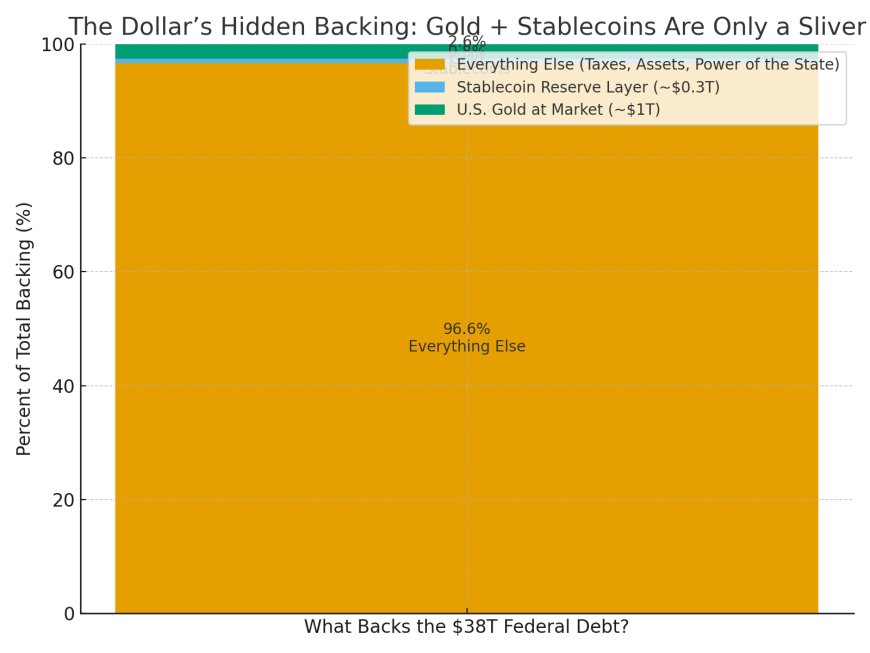
What Really Backs the $38 Trillion Federal Debt?
Let’s put all of this together in a way an exhausted wage earner or small landlord can understand in one glance.
Imagine lining up the entire federal debt — roughly $38 trillion — and asking a brutally simple question: “Out of this gigantic IOU stack, how much is backed by hard assets like gold or ring-fenced digital reserves, versus how much is just the promise of future taxes and political power?”
If you take the U.S. gold hoard at a market value of about $1.1–$1.15 trillion, that’s roughly 3% of the $38T stack.
If you take the dollar stablecoin market at around $300 billion, and you treat that as a distinct “digital reserve layer” that lives on top of Treasuries, that’s another 0.8% of the stack.
The rest — about 96.2% — is everything else: the tax base, federal land, regulatory power, military power, and the general belief that the United States can always roll, refinance, or inflate away its obligations.
Put differently, if you had a $100 bill that was perfectly proportional to the federal balance sheet, about $4 of it would be implicitly backed by gold, about $1 would be linked to digital-dollar reserves, and the other $95 would be backed by the ability of the U.S. government to keep the lights on and the tax receipts flowing.
That’s the part almost nobody asks: not “is the dollar backed by gold,” which is the wrong question, but “how big is the gold and digital reserve slice relative to everything else that makes the dollar credible?”
The answer is: it’s small — but not irrelevant. In a system that’s ultimately about confidence, even a 3–4% hard-asset plug can matter a lot in an extreme scenario. The higher gold goes, the thicker that plug gets.
Here’s the punchline: the market has already revalued that plug. It doesn’t care what the statute says about $42 gold. Every tick on the gold chart – including the spike toward $4,400 – is the market continuously repricing the hard-asset layer of America’s sovereign balance sheet.
Why Nobody Will Officially Revalue the Gold
At this point the natural question is: if the gold is really worth over a trillion dollars, why doesn’t Washington just change the statutory price, book the gain, and brag about how strong the balance sheet looks?
The funny part is that people inside the system have already modeled exactly this. Fed staff have published notes running the math on what happens if you mark gold to market. At today’s prices you’d get a one-off boost of a few percent of GDP to the sovereign balance sheet. It’s not nothing.
But there are three big reasons they haven’t pushed the button.
It admits gold still matters
The official line for decades has been that we live in a pure fiat world where gold is just another commodity. Formally revaluing the entire sovereign gold hoard would be an admission that the metal still anchors the system.
Once you say that out loud, the next question is: “Okay, so what is the right price? Could you do this again? Are we on a stealth gold standard now?” They don’t want to open that door.
It looks like a stealth default
Imagine you’re a creditor holding Treasuries. One day the U.S. government announces: “We just changed the gold price from $42 to $8,000. Look, our balance sheet is healthier now.”
That’s basically a form of financial repression. You didn’t pay back the debt. You didn’t run a surplus. You changed an accounting rule to pretend the hole is smaller.
Politically, that’s dynamite. It hands hard-money critics and foreign rivals a giant talking point: “See, the dollar is so fragile they had to wave a magic wand over the gold line item.”
They get most of the benefit without admitting anything
The truth is, the system already enjoys most of the stabilizing effect of the gold hoard without ever revaluing it officially.
As long as people believe the U.S. holds the metal, and as long as the market keeps repricing it higher in times of stress, that gold functions as shadow collateral. It’s not pledged in repo. It’s not tokenized. But everyone who studies this stuff knows it’s there.
The same goes for stablecoins. The U.S. doesn’t need to officially brand them as part of the dollar reserve framework to enjoy the benefit of global demand for safe digital dollars that in turn funds Treasury issuance.
So from the system’s point of view, the current setup is perfect: the market revalues the gold, the digital reserve layer quietly expands, and the official narrative never has to admit that fiat is leaning on metal and tokenized collateral again.
Three Scenarios Where the Gold Price Suddenly Matters
Just because they don’t want to revalue the gold today doesn’t mean they never will. There are a few paths where the official price suddenly matters again.
Crisis collateral event
Picture a nasty Treasury market accident: failed auctions, spiking yields, foreign buyers pulling back, politics blocking any new round of traditional QE.
In that environment, a government that wants to preserve the system might reach for every weird lever it has. One of those is a formal revaluation of gold.
The playbook would look something like:
- Raise the statutory price of gold to something closer to market – or even well above it.
- Sit the Treasury and Fed across the table from each other and have them transact the gold at the new price.
- Use the revaluation gain to plug holes in the central bank balance sheet or retire some debt.
It’s financially ugly. But in an extreme crisis, ugly options suddenly become “creative policy tools.”
Tokenized reserve era
Another path is slower: the march toward tokenized Treasuries, tokenized repo, and programmable digital money.
Once you start putting all the plumbing on-chain, you eventually have to answer concrete questions like: “What is the on-chain representation of U.S. sovereign gold? What price do we use? Can people hold claims on it?”
The temptation to create some kind of tokenized gold certificate backed by official reserves will be high — especially if other countries do it first.
The moment that happens, you’ve quietly moved from “gold as a dead relic” to “gold as tokenized collateral,” even if nobody calls it a standard.
Bargaining chip in a confidence reset
Finally, there’s the long game. If, sometime down the line, the U.S. needs to repair confidence in the dollar after some policy disaster, marking gold to market is a lever they can pull.
They could say: “We’re not going back to gold, but we are marking our sovereign metal to current prices and we’re committing it as part of a new, more disciplined framework.”
Whether you believe them is another story. But in a brutal reset context, being the country that owns 23% of official gold is a much better position than being the one that doesn’t.
What This Actually Means for Normal Humans
Okay, that’s a lot of macro plumbing. What does any of this mean if you’re just trying to survive rent hikes, grocery inflation, and a market that feels rigged?
The dollar isn’t “backed by nothing”
First, the simple correction: the dollar isn’t backed by nothing. It’s backed by a messy mix of:
- Future tax receipts.
- Regulatory and military power.
- A giant stack of Treasury IOUs.
- Over a trillion dollars’ worth of gold at market.
- Hundreds of billions in stablecoin reserves tied to Treasuries.
Whether you like that mix is another question, but pretending it’s pure air isn’t accurate.
Gold is a small but real part of the system
Second, gold is not going to magically “save” anybody. Three or four percent of GDP and about three percent of the debt stack does not give you an instant hard-money paradise.
What gold does do, inside this system, is act as a kind of emergency anchor. In a genuine panic, the fact that the U.S. holds a quarter of official gold gives it more options than a country that holds none.
That’s one reason central banks from Asia to the Middle East have been backing up the truck. They’re not leaving the dollar, they’re hedging it.
The digital reserve layer isn’t going away
Third, the stablecoin layer is probably not a fad. Every time people choose to hold a regulated dollar stablecoin instead of a random altcoin or a collapsing local currency, they are voting for the U.S. debt machine.
Regulators will fight over the wrappers and the rules, but the basic direction is clear: the dollar is spreading into places traditional banks either can’t or won’t go, and it’s doing that through tokenized IOUs backed by U.S. Treasuries.
That is the digital reserve layer. It’s small now, but it’s growing.
You’re living inside a stacked system
When you zoom out, you see that we’re all living inside a multi-layered collateral stack:
- Human layer – your labor, your taxes, your rent payments.
- Fiat layer – bank deposits, credit, and government spending.
- Debt layer – Treasuries and other sovereign promises.
- Digital reserve layer – stablecoins and tokenized dollar rails.
- Metal layer – gold sitting quietly in vaults, repriced by the market every second.
Most people only see the first two layers. This article is about the bottom three — the ones that decide how far the system can stretch before something has to give.
Whether you’re stacking cash, stacking gold, buying productive assets, or just trying not to get wiped out, it helps to know what’s actually under the hood. Because none of this is theoretical. When the next big “re-pricing” comes, these layers decide who eats the loss and who gets handed a new set of rules.
Core Reading Path
- The AI Industrial Flywheel and the New U.S. Industrial Policy
- Dollar’s Last Stand: Yield-Curve Control and the End of Free Pricing
- The Coming Reset: Tokenized Treasuries and the New Reserve Order
- The Quiet Crisis: Rising Foreclosures, Falling Rents, and the Stress Beneath U.S. Housing
Macro & Monetary Mechanics
- Global Liquidity Dashboard
- The Fed’s 2026 Liquidity Shift
- The Tokenized Reserve Era: The New Operating System of Global Finance
- Why the 10-Year Yield Is Breaking the Old Regime
AI, Energy & Industrial Policy
- The U.S. Energy & Data Center Map (Interactive)
- AI, Power Grids & the New Energy Bottleneck
- AI’s Nuclear Backstop: Powering the Compute Boom
Geopolitics, Crypto & Digital Money
- Stablecoin Geopolitics & the Coming Digital Dollar Era
- The New Dollar Hierarchy: Stablecoins, CBDCs & Global Liquidity
- The Free Crypto Era & the Regulatory Endgame
Deep Research Series
- The U.S. Fiscal Supercycle
- The AI Capex Supercycle
- Yield Curve Reconstruction & the 2026 Regime Shift
Latest From Pattern Nexus
Sources
These are some of the public sources and references that informed the data and framing in this article:
- U.S. Department of the Treasury – Debt, TGA, and policy releases
- U.S. Treasury / Federal Reserve notes on valuation of U.S. gold reserves and revaluation scenarios
- Federal Reserve data on U.S. GDP, balance sheet, and interest rates
- World Gold Council – data on above-ground stocks and central-bank gold holdings
- European Central Bank analysis on gold’s share of global official reserves
- Federal Reserve Bank of New York – overview of global reserve composition
- Reports on record central-bank gold purchases since 2022
- Bank for International Settlements – work on tokenized money, stablecoins, and CBDC
- U.S. Treasury speeches and remarks on stablecoin regulation and the role of Treasuries as backing assets
- Stablecoin issuer reserve reports and independent analyses of their U.S. Treasury holdings
คุณมีปฏิกิริยาอย่างไร?
 ชอบ
0
ชอบ
0
 ไม่ชอบ
0
ไม่ชอบ
0
 รัก
0
รัก
0
 ตลก
0
ตลก
0
 ว้าว
0
ว้าว
0
 เศร้า
0
เศร้า
0
 โกรธ
0
โกรธ
0

Founder of Pattern Nexus. I research markets, macro, geopolitics, AI, history, ancient systems, and the patterns most people overlook. I’m also building Market Radar, a trading scanner designed to read pressure, risk, confirmation, and setup quality before chasing a move. Pattern Nexus is where I connect the dots between data, history, technology, and the bigger system playing out around us.
















ความคิดเห็น (0)