
Wall Street Trap and Strait of Hormuz Risk: Markets, Oil, and Macro Pressure
Three videos breaking down Wall Street stress, Strait of Hormuz risk, oil shock pressure, shipping disruption, and the broader macro consequences for markets and supply chains.
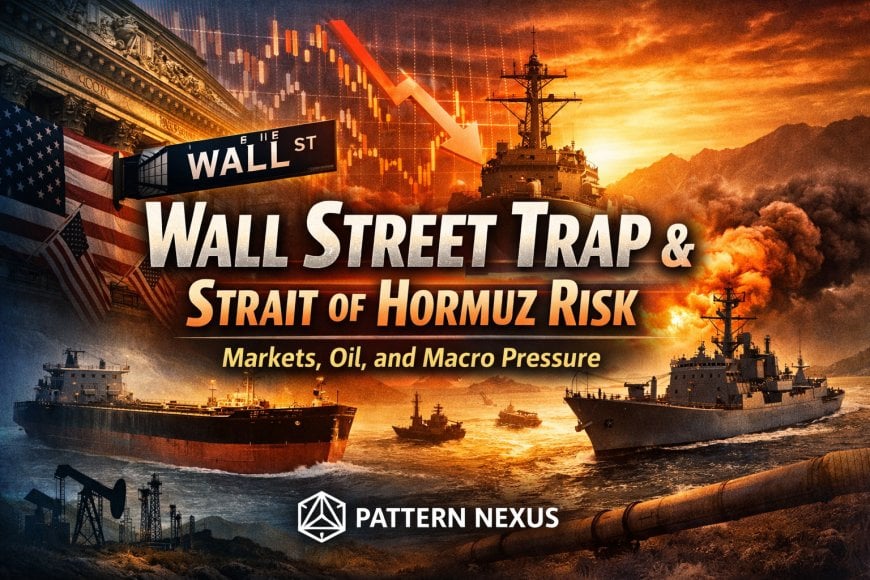
Wall Street Trap, Strait of Hormuz Risk, and the Chokepoint Feedback Loop
These three videos matter because they all point at the same larger structure. Not just geopolitics. Not just oil. Not just Wall Street. What they are really circling is a system problem. When financial fragility meets a physical chokepoint, the narrative changes fast. At that point the market is no longer trading a clean macro path. It is trading uncertainty around movement, insurance, time, inventories, and the cost of keeping the machine running.
That is the real Pattern Nexus lens here. The Strait of Hormuz is not simply a headline location on a map. It is a pressure valve in the global system. And Wall Street is not separate from that pressure. It sits downstream from it. If energy flows tighten, if shipping gets rerouted, if insurance gets pulled, if inventories start getting trapped behind the chokepoint, then the issue stops being “what is the price of oil today?” The issue becomes how many layers of the system need to reprice at once.
Watch the breakdown
What this post is really about
Most people still frame a story like this in a shallow way. They ask whether oil spikes. They ask whether stocks sell off. They ask whether war expands. Those are surface questions. The deeper question is what happens when one of the most important physical transit points in the world begins injecting uncertainty into every layer above it. That is where a shipping problem becomes an inflation problem. That is where an inflation problem becomes a rates problem. That is where a rates problem becomes a credit problem. And that is where a credit problem becomes a market-wide repricing event.
This is why I keep saying the system has to be read as a control structure. Critical corridors are not just routes. They are leverage points. The moment a corridor becomes unstable, every actor connected to it starts making defensive decisions. Tankers delay. Insurers reprice. Charter rates move. Refiners hedge. Governments intervene. Funds rotate. Bond investors start demanding more compensation for uncertainty. The machine does not need a full shutdown to feel stress. It only needs enough friction at the right node.
The Pattern Nexus lens
Hormuz is not valuable because it is dramatic. It is valuable because it is dense. Too much flow depends on too little room. That is the signature of a true chokepoint. The tighter the corridor, the more nonlinear the consequences become when confidence breaks. The oil itself matters, but the optionality matters more. How much can bypass the strait? How much can reroute? How much can be insured? How long can inventories buffer the disruption? How fast do buyers start paying up for certainty? Those are the real market questions.
This is where the Wall Street side of the story gets misunderstood. The market is not just trying to guess the next candle on crude. It is trying to price the probability that a physical disruption turns into a macro feedback loop. If that loop forms, then what gets hit is not only energy-sensitive sectors. Duration gets hit. Growth expectations get hit. Credit gets hit. Anything dependent on a clean disinflation path gets hit. That is why this is a trap. Too many people still trade it like a headline event instead of a systems event.
Why Hormuz matters more than most headlines admit
The Strait of Hormuz remains one of the single most important oil chokepoints on earth. U.S. Energy Information Administration data shows roughly 20 million barrels per day moved through the strait in 2024, about one-fifth of global petroleum liquids consumption and more than one-quarter of global seaborne oil trade. Around one-fifth of global LNG trade also moved through the strait. That means this is not a niche regional risk. It is a global flow risk with immediate spillover potential.
Even more important, the bypass options are limited. Saudi Arabia and the UAE do have some pipeline capacity that can reduce part of the stress, but not enough to casually replace the corridor if disruption becomes prolonged. That means the market cannot assume “the barrels will just find another way.” Some can. A lot cannot. And when the system starts to believe that, the risk premium begins to move before the full physical damage even arrives.
This is not just an oil price story
The most common mistake in commentary like this is reducing everything to the spot price of crude. That misses the real transmission mechanism. The market impact comes from uncertainty around flow, not just a single print on a commodity screen. If shipping volumes drop, producers can face storage limits behind the chokepoint. If storage fills, shut-ins follow. If shut-ins follow, the market has to price not just transport risk, but actual supply constraint. That is a very different problem.
And then there is the second-order effect. Longer routes, slower deliveries, higher freight, delayed inputs, squeezed margins, and wider inflation pass-through. Even when the initial shock starts in energy, the economic damage spreads through time and logistics. That is why these events are dangerous. They do not stay where they begin. They move outward through the system.
Wall Street’s problem: supply shock meets financial fragility
This is where the Wall Street angle becomes more serious than most people realize. Recent Federal Reserve analysis explicitly notes that adverse supply shocks are the type of shock that can push inflation higher while weakening real activity at the same time. That is the worst mix for markets built on the assumption of cleaner growth or cleaner disinflation. In other words, the same kind of shock that damages the real economy can also force a harder rates backdrop and worsen recession risk.
That matters because the market has spent a long time trying to price a world where disinflation eventually creates room. But a corridor shock can reverse that comfort quickly. If energy stress feeds headline inflation, and headline inflation feeds into expectations, and expectations feed into yields and risk premia, then the market is suddenly fighting two fronts at once. Growth is weaker. Financial conditions are tighter. That is exactly the type of setup that reveals hidden fragility in overextended parts of the system.
The shipping side is the story too
The broader regional shipping picture matters because the market never prices one chokepoint in isolation for long. World Bank work on regional shipping disruption showed that by late 2024, traffic through the Suez Canal and Bab el-Mandeb had collapsed relative to prior norms, with major rerouting around the Cape of Good Hope. That same work also noted spillover into Hormuz-linked traffic and broader supply chain stress. That is the important part. When one corridor destabilizes, pressure does not disappear. It migrates. It redistributes. It compounds.
That is why you have to think in lanes, not headlines. You have to think in time, distance, insurance, capacity, and substitution. The market does not care whether a problem is politically dramatic. It cares whether the system has cheap alternatives. And cheap alternatives are exactly what vanish first in a chokepoint environment.
The real trap
The trap is that many people still think these are separate stories. A Wall Street stress story. An oil story. A war story. A shipping story. They are not separate. They are one interconnected pricing problem. The financial system sits on top of physical throughput. So when the throughput becomes uncertain, the pricing above it becomes unstable. That is the feedback loop.
This is also why narrative often lags reality. First the public gets the headline. Then the market gets volatility. Then analysts argue over whether the move is justified. Only later do people start tracing the actual system links. By then the repricing is often already underway. That is why Pattern Nexus focuses on structure first. When the pipes tighten, everything sitting on the pipes eventually has to adjust.
What I would actually watch
I would not just watch oil. I would watch transit behavior, insurance behavior, storage pressure, rerouting evidence, and whether the market starts pricing persistence instead of a temporary scare. I would watch whether the premium in oil looks like fear or actual flow impairment. I would watch whether rates start reflecting a more stubborn supply-shock regime. And I would watch credit for signs that the system is no longer treating this as noise.
- Tanker traffic and confirmed transit willingness through Hormuz
- Insurance availability and premium repricing
- Any evidence of storage backup or production shut-ins behind the chokepoint
- Brent curve structure and whether backwardation or risk premium keeps widening
- Inflation expectations, term premium behavior, and long-end rates
- Credit spreads, refinancing stress, and sectors most exposed to transport and fuel cost shock
Bottom line
The big takeaway is simple. This is not a story about whether one thing goes up tomorrow. It is a story about whether a critical corridor starts imposing enough friction on the global machine that everything downstream has to reprice. That means energy. That means shipping. That means inflation. That means rates. That means Wall Street.
When people say “it is just another geopolitical scare,” what they usually mean is they are still looking at the surface. The deeper issue is that modern markets are built on assumptions of movement, optionality, and continuity. The Strait of Hormuz sits directly in the middle of those assumptions. So the moment confidence around that corridor weakens, the larger macro story changes with it.
That is the real Pattern Nexus read. Not just conflict. Not just oil. Not just markets. A chokepoint feedback loop pressing against an already fragile financial structure. And if that loop tightens further, the repricing will not stay contained to one chart.
Sources
- U.S. Energy Information Administration — Amid regional conflict, the Strait of Hormuz remains critical oil chokepoint
- U.S. Energy Information Administration — Short-Term Energy Outlook, Global Oil section
- Federal Reserve — Why have far-forward nominal Treasury rates increased so much in the past few years?
- World Bank — The Deepening Red Sea Shipping Crisis: Impacts and Outlook
- World Bank — Commodity Markets Outlook, April 2024
คุณมีปฏิกิริยาอย่างไร?
 ชอบ
0
ชอบ
0
 ไม่ชอบ
0
ไม่ชอบ
0
 รัก
0
รัก
0
 ตลก
0
ตลก
0
 ว้าว
0
ว้าว
0
 เศร้า
0
เศร้า
0
 โกรธ
0
โกรธ
0

Founder of Pattern Nexus. I research markets, macro, geopolitics, AI, history, ancient systems, and the patterns most people overlook. I’m also building Market Radar, a trading scanner designed to read pressure, risk, confirmation, and setup quality before chasing a move. Pattern Nexus is where I connect the dots between data, history, technology, and the bigger system playing out around us.










ความคิดเห็น (0)