
Record Holidays, Fragile Foundation: Black Friday 2025 vs the ADP Labor Shock
Black Friday and Cyber Week 2025 set new spending records, but the November ADP report showing a surprise 32,000-job loss reveals a fragile labor market underneath. Pattern Nexus connects the consumer sugar high to the small-business labor squeeze.
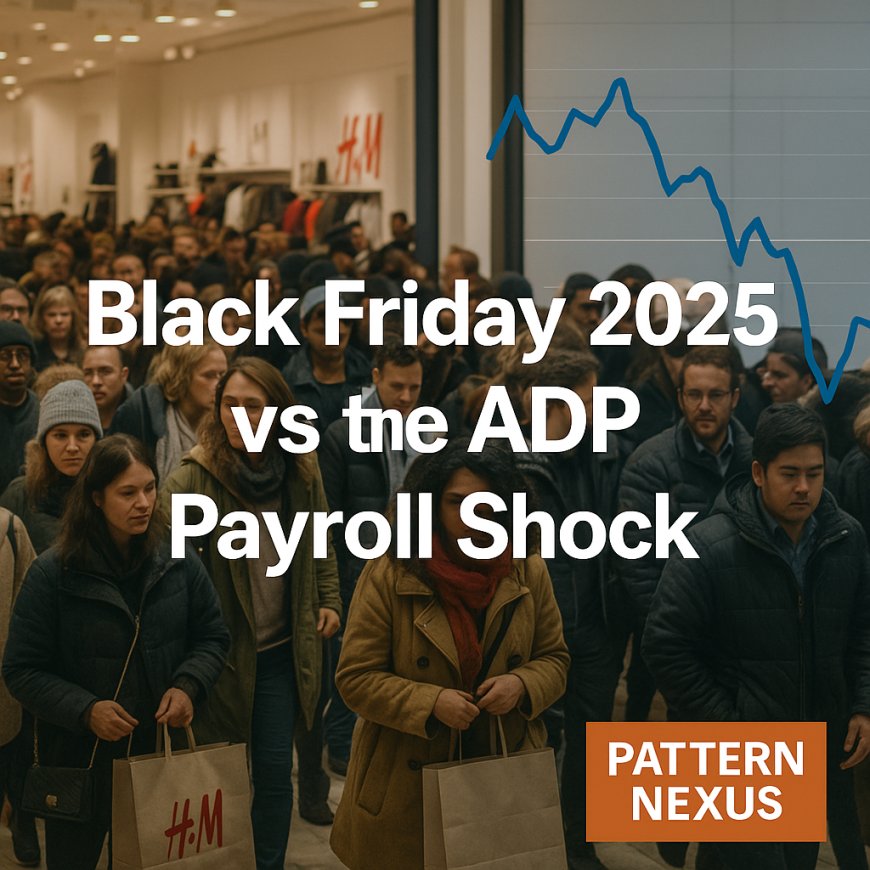
On the surface, the U.S. consumer is still doing exactly what the system needs them to do: spend aggressively into the holidays. Black Friday and Cyber Week 2025 printed record numbers across online channels, and the big platforms all got their headline “best ever” banners.
Underneath that glitter, the November ADP National Employment Report just threw a bucket of cold water on the narrative. Instead of adding jobs, the private sector lost 32,000 positions, with small businesses taking the brunt of the hit and wage growth continuing to ease.
Black Friday and Cyber Week 2025: What Actually Happened
Start with the top-line numbers. Black Friday and Cyber Week 2025 were, in nominal terms, a clear record:
- Adobe’s holiday tracking shows Cyber Monday online sales hitting roughly $14.25 billion, a new high and up just over low–single-digit percentages versus last year on a nominal basis.
- Across the full Cyber Week window (Thanksgiving through Cyber Monday), online spending in the U.S. came in north of forty billion dollars, with peak minutes running at tens of millions in sales.
- Mastercard’s SpendingPulse data shows U.S. Black Friday retail sales ex-autos up about 4.1% year over year, combining both online and in-store channels.
- Shopify reports merchants on its platform generated a record $14.6 billion in gross merchandise value over Black Friday–Cyber Monday, up roughly a quarter from 2024, with more than 80 million shoppers transacting globally.
The picture from the big processors and platforms is consistent: nominal holiday sales are up, records are being set, and digital channels continue to grow faster than brick and mortar. On any surface macro dashboard, that looks like a healthy consumer.
Traffic vs. Sales: The Brick-and-Mortar Drag
The traffic data tells a more nuanced story. Sensormatic Solutions’ Black Friday recap shows in-store traffic down about 2.1% versus 2024, roughly in line with the year-to-date trend. Shopper visits during the Black Friday week were up sharply versus the prior week, and Black Friday still dwarfed a normal Friday, but the year-on-year comparison is negative.
Other traffic monitors show similar patterns: weekend footfall under pressure, especially where weather was bad, even as card-spend data and online receipts move higher. In plain language: it took fewer trips to rack up higher nominal sales.
How Consumers Are Spending: Discounts, BNPL, and Intentional Buying
The qualitative color around this year’s holiday sales lines up with what has been building all year: consumers are still willing to spend, but they are less casual about it.
Reporting from multiple retail channels and card networks points to three key themes:
- Heavier discount hunting. Shoppers are actively tracking promotions, waiting for specific deals, and clustering their purchases into windows where markdowns are deepest. This is the opposite of the “YOLO” impulse buying environment of the stimulus era.
- More financing, especially BNPL. Buy-now-pay-later volume through major providers surged again over Cyber Week, with reports of BNPL share of online spending continuing to climb. The consumer is stretching cash flow, not swimming in it.
- Intentional, not random, spending. Retail executives describe shoppers as “intentional”: fewer unplanned purchases, more focused baskets built around essentials, gifts, and specific big-ticket items.
CBS and others are already framing it this way: Americans are spending more for the holidays while simultaneously reporting dour views on the economy and their own finances. That mismatch is exactly what you’d expect when price levels are structurally higher, wages are decelerating, and social pressure to “show up” at the holidays is still strong.
There is also a widening gap across income tiers. Affluent households, whose balance sheets were padded by the post-2020 asset boom, can sustain higher nominal spending longer. Lower and middle-income households are more likely to be leaning on credit and BNPL.
The November 2025 ADP Shock: Small Business at the Edge
The ADP National Employment Report for November 2025 lands in that context like a warning shot. Instead of modest job gains, ADP estimates that the U.S. private sector lost 32,000 jobs in November, versus expectations for a small positive number and a revised 47,000 gain in October.
The details matter more than the headline:
- Small businesses (under 50 employees) drove the weakness, shedding on the order of 120,000 jobs in the month, according to breakdowns reported by the financial press.
- Larger firms still added jobs, which is how you can get a negative net number despite positive hiring at the top end. The bleeding is concentrated in the most fragile part of the corporate size spectrum.
- Sector-wise, the cuts were heaviest in construction, manufacturing, information, and professional and business services – all cyclical and interest-rate sensitive.
- Offsetting gains came mainly from education, health services, and leisure and hospitality, the more resilient and necessity-driven parts of the service economy.
ADP’s own commentary emphasizes that job creation has been essentially flat in the second half of 2025 and that pay growth has been on a clear downward trend. November’s negative print is not an isolated blip; it is the latest point on a curve that has been bending lower.
Wage Growth, “No Hire, No Fire,” and the Fed
On the wage side, ADP estimates that annual pay growth slowed again to around 4.4% year over year in November, down from roughly 4.5% in October and well below the peaks reached earlier in the cycle. That is exactly what the Federal Reserve has been trying to engineer: a gradual cooling in wage inflation without a mass layoff wave.
For most of 2025 the labor market sat in a “no hire, no fire” equilibrium: companies were reluctant to add headcount aggressively, but also reluctant to cut, in part because hiring and training costs had exploded during the earlier labor crunch. The November ADP report looks like the first meaningful crack in that equilibrium, at least for smaller firms.
Because the official Bureau of Labor Statistics nonfarm payroll report has been delayed by the federal government shutdown, ADP’s numbers are doing more work than usual in shaping expectations. Markets have already responded by pushing up the implied probability of another Fed rate cut at the December meeting. A labor print this weak, against an already-slowing wage backdrop, gives the Fed cover to move further.
The key nuance: from the Fed’s vantage point, slower wage growth and softening small-business hiring are “features” of policy transmission. From the perspective of the real economy, especially away from the mega-caps and large platforms, it looks and feels like the early stages of a demand and margin squeeze.
Putting It Together: Record Holidays on a Hairline Labor Crack
Put the two data sets side by side – record nominal holiday spending and a surprise negative ADP print – and a pattern emerges:
- The headline U.S. consumer is still capable of delivering record sales when the calendar demands it, especially through online channels orchestrated by the largest platforms.
- The underlying labor engine that supports that consumption – particularly among small businesses and cyclicals – is weakening. Jobs are being cut at the margin exactly where financing costs and operating leverage are highest.
- Price level and financing are doing more of the work than organic volume growth. Households are relying more on BNPL, revolving credit, and targeted discount windows to sustain spending.
- The policy reaction function is shifting: each soft labor print nudges the Fed further toward additional easing, but every cut now comes against a background of already-elevated debt loads and a system structurally reliant on high asset valuations.
On a short-term trading basis, this cocktail can still be bullish: softer labor data plus strong holiday sales is the kind of “Goldilocks” mix that supports a bid under risk assets, at least until hard data catches up.
On a structural basis, though, it is another datapoint in the emerging pattern of this cycle: a consumption model that leans on financialization and platform scale at the top, while the smaller, more labor-intensive parts of the economy slowly grind down.
Sources
- Adobe, “Cyber Monday Hits Record $14.25 Billion in Online Spending as Cyber Week Reaches New Highs,” December 2, 2025. https://news.adobe.com/news/2025/12/adobe-cyber-monday-hits-record
- Mastercard SpendingPulse / The Corner, “US Black Friday retail sales, excluding automobiles, up almost 4.1% on 2024,” December 3, 2025. https://thecorner.eu/news-the-world/us-black-friday-retail-sales-excluding-automobiles-up-almost-4-1-on-2024-according-to-mastercard/123242/
- Sensormatic Solutions, “2025 Black Friday Recap,” November 2025. https://www.sensormatic.com/resources/pr/2025/2025-black-friday-recap
- BusinessWire, “Inclement Weather Impacted Brick-and-Mortar Retail Traffic Throughout Black Friday Weekend,” December 2, 2025. https://www.businesswire.com/news/home/20251202247374/en/Inclement-Weather-Impacted-Brick-and-Mortar-Retail-Traffic-Throughout-Black-Friday-Weekend
- Shopify, “Shopify merchants generate record-breaking $14.6 billion in sales over Black Friday Cyber Monday weekend,” December 2, 2025. https://www.shopify.com/news/bfcm-data-2025
- Shopify Inc. investor release, “Shopify Merchants Achieve Record-Breaking $14.6 Billion in Black Friday Cyber Monday Sales,” December 2, 2025. https://shopifyinvestors.com/media-center/news-details/2025/Shopify-Merchants-Achieve-Record-Breaking-14-6-Billion-in-Black-Friday-Cyber-Monday-Sales/default.aspx
- CBS News, “Americans spending more for the holidays despite dour economic views,” updated December 1, 2025. https://www.cbsnews.com/news/black-friday-cyber-monday-2025-spending-deals-inflation/
- Reuters, “US holiday shoppers shake off economic blues for online spending spree,” December 2, 2025. https://www.reuters.com/business/finance/cyber-monday-spending-us-hit-142-billion-adobe-analytics-forecasts-2025-12-01/
- ADP, “ADP National Employment Report – November 2025: Private employers shed 32,000 jobs in November,” December 3, 2025. https://adpemploymentreport.com/
- Financial Times, “US private employers shed 32,000 jobs in November,” December 3, 2025. https://www.ft.com/content/7d41313c-fb16-409c-b54d-4821937caa33
- Reuters, “US private payrolls unexpectedly decrease in November, ADP says,” December 3, 2025. https://www.reuters.com/business/us-private-payrolls-unexpectedly-decrease-november-adp-says-2025-12-03/
คุณมีปฏิกิริยาอย่างไร?
 ชอบ
0
ชอบ
0
 ไม่ชอบ
0
ไม่ชอบ
0
 รัก
0
รัก
0
 ตลก
0
ตลก
0
 ว้าว
0
ว้าว
0
 เศร้า
0
เศร้า
0
 โกรธ
0
โกรธ
0

Founder of Pattern Nexus. I research markets, macro, geopolitics, AI, history, ancient systems, and the patterns most people overlook. I’m also building Market Radar, a trading scanner designed to read pressure, risk, confirmation, and setup quality before chasing a move. Pattern Nexus is where I connect the dots between data, history, technology, and the bigger system playing out around us.













ความคิดเห็น (0)