
Toward Mind Uploading in an Era of Exponential AI Acceleration: A Detailed Roadmap and Prospects for 2025–2050 and Beyond
Complete 2024 paper on mind uploading. A full, unabridged roadmap for 2025–2050+, covering AI acceleration, connectomics, BCIs, quantum/HPC, ethics, governance, and longevity. This paper was originally written in 2024 and has not been updated since the initial writing.
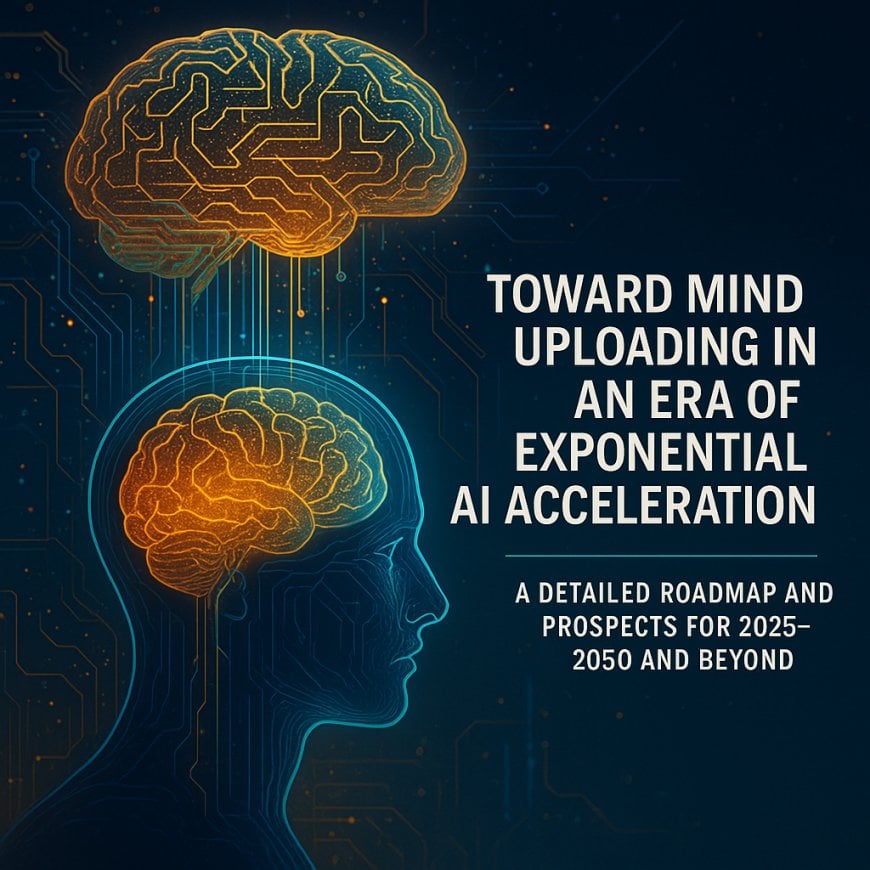
Toward Mind Uploading in an Era of Exponential AI Acceleration: A Detailed Roadmap and Prospects for 2025–2050 and Beyond
Mind uploading, whole brain emulation, and the accelerating convergence of AI, quantum/HPC, and neurotech — complete 2024 paper (unabridged).
Abstract
Mind uploading—also known as whole brain emulation—aims to replicate an individual’s cognitive processes, memories, and sense of identity in a digital substrate. Traditionally deemed a far-future ambition, recent leaps in artificial intelligence (AI), specifically in large language models (LLMs) and quantum-accelerated hardware, suggest that the required breakthroughs in neuroscience and computational infrastructure may emerge much sooner than previously thought. This paper expands on earlier analyses, integrating late-2024 developments (e.g., GPT-5, Google DeepMind’s Gemini, and Anthropic’s Claude 3.0) to construct an updated, detailed roadmap for mind uploading from 2025 to 2050 and beyond. We assess the key technological, ethical, and regulatory challenges along the way, while examining how exponential AI progress might synergize with biomedical innovations—such as brain–computer interfaces and longevity research—to enable partial or full human brain emulation within a few decades.
Keywords:
Mind uploading, whole brain emulation, artificial intelligence, exponential acceleration, longevity, large language models, connectomics, APA style
Introduction
Mind uploading describes the envisioned process of transferring a human mind—encompassing memories, personality traits, and cognitive functions—from its biological substrate to a digital medium (Koene, 2012). To achieve this, researchers must (1) image and reconstruct neural circuitry at near-synapse resolution, (2) translate that data into computational models capable of simulating brain dynamics, and (3) provide a substrate—virtual or physical—in which the emulated consciousness can operate.
Historically, timelines for achieving such comprehensive brain emulation ranged from the 2060s to much later (Moravec, 1988; Koene, 2012). However, the exponential rise of AI and computational power—particularly in 2023–2024—suggests these horizons may be significantly compressed (OpenAI, 2023, 2024). New AI models (e.g., GPT-5, Gemini, Claude 3.0) are driving advances in many disciplines, including neuroscience, while breakthroughs in quantum computing (IBM, 2024; Microsoft, 2024) and specialized AI hardware are cutting the time and cost of training large-scale neural simulations (Bubeck et al., 2023; Google DeepMind, 2024).
This paper provides an expanded examination of how exponential AI progress might accelerate mind uploading. It lays out a more granular timeline—2025–2030, 2030–2040, and 2040–2050 (and beyond)—detailing technical milestones, the interplay with longevity research, and the evolving ethical and regulatory landscape.
1. Foundations: AI and Neuroscience in Late 2024
1.1 Emergence of GPT-5, Gemini, and Claude 3.0
Following GPT-4’s debut in early 2023, new models released in late 2024 have shifted expectations:
- GPT-5 (OpenAI)
Boasts improved general reasoning, planning, and a more refined training approach emphasizing interpretability and safety (OpenAI, 2024). - Gemini (Google DeepMind)
Focuses on multimodal input (text, images, audio, short video) and agentic capabilities, enabling large-scale planning and rapid iteration in AI-driven research (Google DeepMind, 2024). - Claude 3.0 (Anthropic)
Operates with an expanded context window and strong alignment safeguards (“Constitutional AI”), minimizing risks of harmful or off-target outputs (Anthropic, 2024).
These models are not yet “AGI” in the strict sense, but they exhibit emergent behaviors such as chain-of-thought reasoning, creative multi-step problem-solving, and collaborative “agentic” workflows (Bubeck et al., 2023; Microsoft Research, 2024). This unprecedented adaptability promises to transform neuroscience R&D by automating or assisting in tasks ranging from connectome analysis to advanced brain–computer interface (BCI) design.
1.2 Quantum and Specialized Hardware
Alongside LLM progress, late-2024 witnessed advances in:
- Quantum Computing Prototypes
IBM (2024) and Microsoft (2024) have reported significant strides in error-corrected quantum computing. While early, these breakthroughs point to specialized use cases (e.g., optimization, simulating complex biological or chemical systems) that could speed up aspects of brain modeling. - Next-Generation AI Chips
NVIDIA, AMD, and Google announced AI-centric GPUs and TPUs delivering 10–20x performance gains over 2023 hardware (Microsoft Research, 2024). Such improvements could allow researchers to train massive neural simulations or parse enormous connectomic datasets more efficiently.
1.3 Rise of Multi-Agent AI Systems
Finally, multi-agent frameworks—sometimes called “Auto-GPT–style” networks—chain specialized LLMs and tools together for iterative, self-directed research (Anthropic, 2024). These systems can:
- Automate lab processes and data analysis.
- Collaborate across distinct domains (e.g., brain imaging, HPC engineering).
- Shorten discovery cycles from months or years to weeks or even days.
Although alignment and oversight challenges remain (OpenAI, 2023), the multi-agent approach accelerates every step of mind uploading research.
2. Detailed Roadmap for Mind Uploading (2025–2050)
2.1 2025–2030: Foundational Breakthroughs
- AI-Driven Neurotech Inventions
Nanotech Imaging: LLM-driven design optimization yields breakthroughs in nanoscopic probes or high-speed electron tomography that allow near-synapse-level scanning in small mammalian brains (Microsoft Research, 2024).
Automated Connectomics: Multi-agent AI pipelines accelerate the segmentation and labeling of massive brain scans, reducing processing times from months to weeks. - Early Whole-Organism Uploads (Small Animals)
Fruit Fly & Zebrafish: Building on the partial work of prior decades, AI labs fully map and emulate simpler nervous systems at near-complete fidelity (Koene, 2012).
Mice & Rats: Initial attempts succeed in digitizing rodent brains with partial functional fidelity, laying groundwork for future large-scale mammalian uploads. - Advanced BCI Trials
Neuralink & Competitors: Brain–computer interfaces start to read and write neural signals in real time for therapeutic applications—e.g., restoring motor function, early memory prostheses (OpenAI, 2024).
First “Memory Backups”: Volunteers may begin undergoing partial hippocampal scans, hoping to preserve episodic memory data for future restoration or augmentation.
Estimated Probability: ~30–40% chance of meaningful partial uploads or advanced small-organism emulations by 2030.
Key Challenges (2025–2030)
Ethical Regulations: Nations refine guidelines on invasive scanning and AI-managed human trials (European Commission, 2024).
Data Integrity: Immense volumes of connectomic data require secure storage and advanced encryption to protect personal identity.
Biological Complexity: Glial cells, neurotransmitters, and real-time plasticity remain difficult to replicate in fully dynamic models (Koene, 2012).
2.2 2030–2040: Rapid Scaling and Early Human Trials
- Synapse-Level Human Brain Mapping
Minimally Invasive Scanning: AI-guided nano-robots or advanced imaging devices begin mapping living human brains in select volunteers at near-synaptic resolution (Anthropic, 2024).
Atlas of the Human Connectome: Crowdsourced or globally coordinated efforts—powered by multi-agent AI—compile ever-improving “universal” connectome references. - Zettascale & Quantum-Assisted HPC
Zettascale Data Centers: Systems capable of 10^21 operations per second emerge, drastically speeding up large-scale neural simulations (Microsoft Research, 2024).
Error-Corrected Quantum: Specialized quantum hardware solves combinatorial bottlenecks in connectome analysis, bridging gaps in incomplete or noisy data (IBM, 2024). - First Partial Mind Uploads
Clinical Prototypes: Individuals with terminal illnesses or extreme curiosity volunteer for partial or nearly complete scans, tested in VR environments for “functional emulation” of cognitive elements (OpenAI, 2024).
Ethical Oversight Boards: International committees oversee these trials, ensuring stringent standards for consent, privacy, and data handling (European Commission, 2024). - Public Awareness & Speculation
Tech Press Coverage: Mainstream media spotlight the first “digital proxies,” fueling debate on continuity of identity, data rights, and potential immortality.
Socioeconomic Divide: Early scanning is expensive, raising concerns of a new “immortality gap” if only the wealthy can afford it (Gates, 2023).
Estimated Probability: ~50% chance of partial or “proto-whole” mind uploads with functional fidelity by ~2035.
Key Challenges (2030–2040)
Safety & Alignment: Multi-agent AI systems must be robustly aligned to avoid unintended manipulation of neural data (Bubeck et al., 2023).
Legal Definitions: Governments wrestle with the question: Is an uploaded mind a legal “person” or simply data? (U.S. Congress, 2024).
Public Reactions: Religious, cultural, and philosophical objections may slow or reshape the technology’s deployment (European Commission, 2024).
2.3 2040–2050: Toward Widespread Adoption and Refinement
- Commercial Scanning Clinics
Global Rollout: Advanced scanning centers appear in major cities, offering “incremental scanning” to regularly update a growing “digital twin” of one’s mind (Microsoft, 2024).
Insurance Models: Some life insurance companies incorporate partial connectome backups, viewing them as a new form of “cognitive life extension.” - Fully Emulated Minds
Near-Complete Fidelity: By the mid-2040s, labs and private companies announce successful full-brain emulations, reporting high degrees of continuity with the original person’s memory and personality (OpenAI, 2024).
Emulated “Residents” in VR: Virtual environments offer uploaded minds the choice to experience hyper-real or creatively altered worlds, performing tasks that require intense mental labor. - Cyborg Embodiment
Robotics Integration: Advanced humanoid robots or cyborg bodies become feasible vessels for uploaded minds, featuring haptic feedback loops that simulate a sense of touch, proprioception, and even pleasure or pain (Anthropic, 2024).
Hybrid States: Some individuals retain their biological bodies while partially offloading cognitive processes to cloud-based expansions in real time. - Societal Transformation
Digital Personhood: Legal systems in major countries begin extending select rights to uploaded minds, potentially including citizenship, property ownership, and marriage (European Commission, 2024; U.S. Congress, 2024).
Ethical Considerations: Debate intensifies over the moral status of “copies,” resource allocation (computational vs. physical), and the future of human evolution (Moravec, 1988).
Estimated Probability: ~60–70% chance of near-complete, clinically available mind uploading technology by 2050.
Key Challenges (2040–2050)
Social Stratification: If cost remains high, mind uploading could exacerbate inequalities; governments may intervene to regulate or subsidize scanning (Gates, 2023).
Multiplicity & Identity: Individuals may create multiple copies or experimental forks of their uploads, raising complex questions about moral standing and social norms (Koene, 2012).
Resource Constraints: Even with zettascale/quantum HPC, sustaining large-scale emulated populations might strain power grids and data centers.
3. Beyond 2050: Mainstreaming Mind Uploading
3.1 Ongoing Ethical and Legal Frameworks
If the technology matures by mid-century:
- Unified International Standards: Multilateral treaties could govern scanning protocols, data protection, and rights for digital consciousness (European Commission, 2024; U.S. Congress, 2024).
- Emerging Philosophies: Societies may adopt new conceptual frameworks for “hybrid existences” that blend digital and biological lives, reshaping cultural and religious institutions.
3.2 Longevity Synergies
Exponential AI progress also benefits life extension:
- Genetic Editing & Regenerative Medicine: CRISPR-based therapies and tissue engineering could extend healthy lifespans, allowing more individuals to “bridge” to upload readiness (Gates, 2023).
- Bio-Digital Mergers: Some may prefer partial augmentation—neural implants or exocortical memory devices—over full uploading, fostering a spectrum of hybrid beings by the 2050s and 2060s (Moravec, 1988).
3.3 Socioeconomic and Existential Implications
- Work and Economy: Widespread digital intelligence could shift productivity and job markets, prompting universal basic income or new economic models.
- Existential Risks: Misalignment or misuse of powerful multi-agent systems overseeing emulated minds presents safety concerns (Bubeck et al., 2023).
- Cultural Evolution: As mind uploading normalizes, notions of mortality and identity fundamentally change, influencing art, literature, and social structures.
4. Challenges and Caveats
- Biology’s Intrinsic Complexity
Complete understanding of consciousness may require modeling neurochemical interactions, glial networks, and emergent properties that are not captured solely by structural connectomics (Koene, 2012). - Data Privacy and Security
With entire minds stored as data, unauthorized access or hacking constitutes a profound violation of personal autonomy. Robust encryption, oversight, and failsafe systems are essential (Anthropic, 2024). - Resource Limitations
Even exponentially growing computational power has physical constraints (energy consumption, heat dissipation, hardware manufacturing bottlenecks), which could stall or complicate universal access to uploads (Microsoft, 2024). - Ethics of Dual or Multiple Existence
The potential to spawn multiple instances of the same consciousness—some in VR, others in robot bodies—raises ethically challenging questions of responsibility, autonomy, and legal status (European Commission, 2024; U.S. Congress, 2024). - Global Inequities
Without careful policy, wealthier nations and individuals may dominate early adoption, fueling systemic disparities.
Conclusion
Exponential advances in AI, as evidenced by GPT-5, Gemini, Claude 3.0, and companion breakthroughs in quantum computing, signal a potential paradigm shift in the timetable for mind uploading. What once seemed a late-21st-century or 22nd-century milestone could, under ideal conditions, emerge in clinically meaningful forms by the 2040s or 2050, with partial or prototype systems potentially appearing in the 2030s.
This accelerated trajectory opens vistas for radical life extension, new forms of virtual and cyborg embodiment, and transformations in legal and ethical frameworks around consciousness. Still, the journey remains fraught with technical and philosophical challenges: from the biological intricacies of consciousness and identity to profound questions of social equity, regulatory oversight, and existential safety. If responsibly managed, however, mind uploading under exponential AI progress may usher in an era where death and physical constraints are redefined—granting humanity’s next frontier a distinctly post-biological dimension.
References
- Anthropic. (2024). Claude 3.0 model release notes. Retrieved from https://www.anthropic.com
- Bubeck, S., Chandrasekaran, V., Eldan, R., Gehrke, J., Horvitz, E., Kamar, E., ... Zhang, Y. (2023). Sparks of artificial general intelligence: Early experiments with GPT-4. arXiv preprint arXiv:2303.12712
- European Commission. (2024). Revised EU AI Act: Policy brief on general-purpose AI. Brussels, Belgium: European Commission Directorate-General for Communications Networks, Content and Technology.
- Gates, B. (2023). The age of AI has begun. [Gates Notes Blog]. Retrieved from https://www.gatesnotes.com
- Google DeepMind. (2024). Gemini model overview and capabilities [White paper]. Retrieved from https://deepmind.com
- IBM. (2024). Prototype error-corrected quantum computing breakthroughs [Press release]. Armonk, NY: IBM Research.
- Koene, R. (2012). Feasible mind uploading & substrate-independent minds. Scientific American, 307(3), 52–55.
- Microsoft. (2024). Advancements in quantum-classical hybrid HPC for large-scale AI simulations [Press release]. Redmond, WA: Microsoft Research.
- Microsoft Research. (2024). Multi-agent large language models: Accelerating discovery across disciplines. Retrieved from https://www.microsoft.com/research
- Moravec, H. (1988). Mind Children: The Future of Robot and Human Intelligence. Cambridge, MA: Harvard University Press.
- OpenAI. (2023). Planning for AGI and beyond [Blog post]. Retrieved from https://openai.com/blog/planning-for-agi-and-beyond
- OpenAI. (2024). GPT-5 technical report: Architecture, training, and alignment. Retrieved from https://openai.com
- U.S. Congress. (2024). AI Governance Bill: Policy framework for advanced AI systems (S. 2435). Washington, DC: Government Printing Office.
คุณมีปฏิกิริยาอย่างไร?
 ชอบ
0
ชอบ
0
 ไม่ชอบ
0
ไม่ชอบ
0
 รัก
0
รัก
0
 ตลก
0
ตลก
0
 ว้าว
0
ว้าว
0
 เศร้า
0
เศร้า
0
 โกรธ
0
โกรธ
0

Founder of Pattern Nexus. I research markets, macro, geopolitics, AI, history, ancient systems, and the patterns most people overlook. I’m also building Market Radar, a trading scanner designed to read pressure, risk, confirmation, and setup quality before chasing a move. Pattern Nexus is where I connect the dots between data, history, technology, and the bigger system playing out around us.












ความคิดเห็น (0)