

War Is Back On: The U.S.–Iran Ceasefire Has Collapsed Into a Wider Logistics and Chokepoint War
The United States is striking Iranian military, port, power, transportation, and logistics infrastructure. Iran is retaliating against the American Gulf basing network. Israel is ready to reenter. The conflict is evolving from a Hormuz chokepoint war into a wider campaign over Iran’s maritime and Eurasian connections.
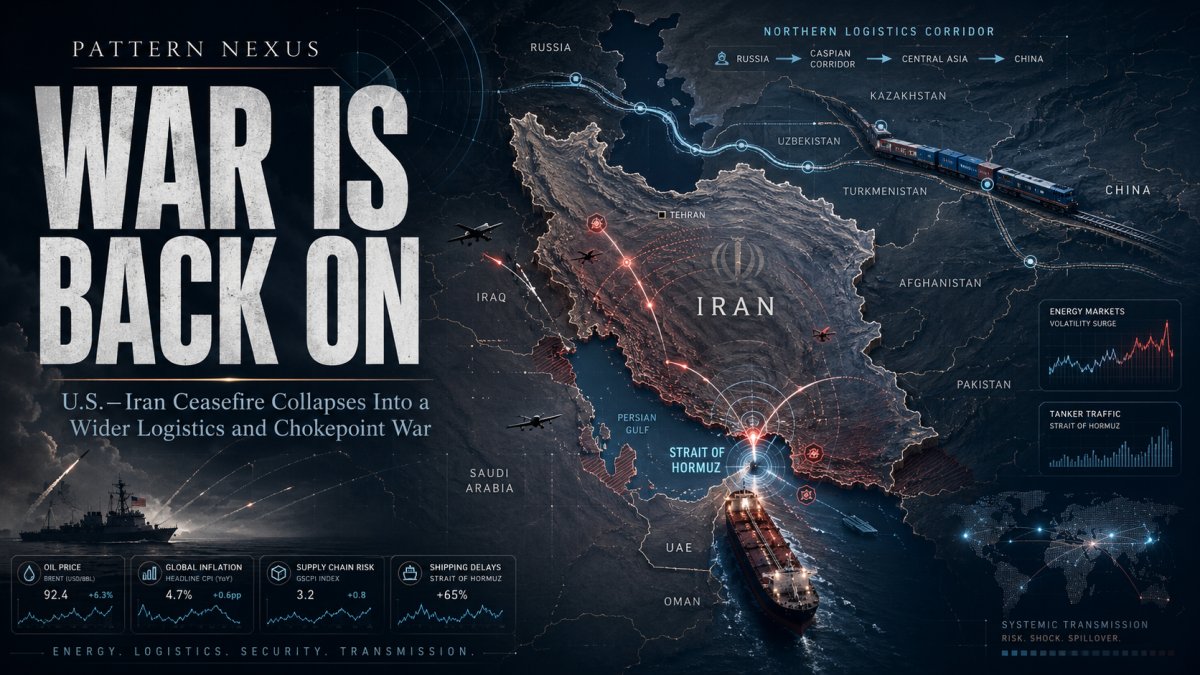
The United States is striking Iranian military, port, power, transportation, and logistics infrastructure. Iran is retaliating against the American Gulf basing network. Israel is ready to reenter. The conflict is evolving from a Hormuz chokepoint war into a wider campaign over Iran’s maritime and Eurasian connections.
Jump to a section
The War Has Entered an Attritional Enforcement Phase
The central thesis of this article has now been tested across three additional weeks of fighting.
The United States did not stop after one retaliatory strike cycle. Iran did not surrender its claim over passage through the Strait of Hormuz. The temporary pause did not become a durable ceasefire. Instead, the conflict developed into a sustained campaign of American airstrikes, Iranian missile and drone retaliation, maritime enforcement, port blockade, regional-base attacks, proxy activation and intermittent negotiations conducted under fire.
The war is no longer simply “back on.” It has entered an attritional enforcement phase in which both sides are attempting to prove that their version of regional control can survive longer than the other side’s ability to impose costs.
What Has Happened Since the Original Article
When this article was published on July 9, the United States had completed two renewed strike rounds against approximately 170 Iranian military and infrastructure targets. Iran had retaliated against American facilities across Bahrain, Kuwait, Qatar and Jordan. A railway bridge inside the northern China–Turkmenistan–Iran corridor had also been struck.
Since then, the escalation has moved through several additional layers.
- The United States continued striking Iran for thirteen consecutive nights, according to U.S. Central Command.
- American target sets continued to include military command centers, missile and drone facilities, communications networks, coastal surveillance, naval capabilities and logistical infrastructure.
- Washington reinstated its blockade of Iranian ports and oil exports.
- Iran continued attacking American facilities and the Gulf states hosting them.
- Iranian attacks killed American personnel in Jordan, while another American service member was killed in Iraq during the disposal of unexploded Iranian drone ordnance.
- Kuwait reported attacks against military facilities and desalination infrastructure.
- Iran continued attempting to control, stop or redirect commercial vessels in the Strait of Hormuz.
- The Houthis declared a maritime embargo against Saudi Arabia, extending the chokepoint conflict toward Bab el-Mandeb and the Red Sea.
- The United States temporarily paused strikes for diplomacy, but renewed them after Iran launched what Washington described as an attempted surprise missile attack against American forces in Jordan.
- The latest American strike round hit dozens of IRGC command, missile, drone, coastal-defense and maritime targets.
- Iran subsequently claimed that it stopped two vessels and forced four others to turn around in Hormuz, although those claims could not immediately be independently verified.
This sequence confirms that the ceasefire did not merely suffer another violation. Its enforcement structure completely failed.
The Original Thesis Was Confirmed—but It Needs to Be Refined
The original article argued that the conflict was evolving from a chokepoint war into a network-isolation war.
That direction was correct. The American campaign expanded from missile launchers and coastal defenses into ports, transportation, communications, logistics and the economic systems Iran uses to sustain the war.
However, the experience of the northern railway bridge also revealed the limitation of that strategy.
Iranian authorities said the damaged bridge was repaired rapidly and rail operations resumed. That claim has not been fully independently verified, but the broader lesson remains: destroying one bridge does not sever Iran from Russia, China or Central Asia. Iran possesses multiple rail, road, maritime and Caspian routing options. Fixed infrastructure can also be repaired much faster than advanced air-defense systems, missile launchers, radar networks or naval assets can be replaced.
The railway strike was therefore more important as a signal than as a permanent physical disconnection.
Washington demonstrated that northern trade corridors were inside the target map. Iran demonstrated that temporary infrastructure damage does not automatically create strategic isolation.
Hormuz Remains the Unresolved Control Surface
The most important fact has not changed.
The United States and Iran still have incompatible definitions of an open Strait of Hormuz.
Washington defines an open strait as one in which commercial vessels can pass without Iranian permission, route approval or political conditions. Tehran continues acting as though passage can be authorized, managed or denied through an Iranian-controlled permit and routing system.
That is why both sides can claim simultaneously that the strait is open or closed.
Some vessels are still passing. Others are negotiating directly with Tehran. Some are traveling with American military support. Others are turning around, delaying passage or remaining outside the waterway. Automatic ship-tracking data also fails to capture every vessel operating with its transponder disabled.
The Strait is therefore not completely sealed, but neither is it functioning as a normal international commercial corridor.
It is selectively permeable, militarized and politically contested.
That condition is exactly what allows Iran to retain leverage. Tehran does not have to prevent every barrel from leaving the Gulf. It only has to keep transit unreliable enough to raise insurance costs, delay shipments, redirect vessels and force importing countries to account for persistent interruption risk.
The War Has Expanded Into a Two-Chokepoint System
The most consequential development since the original article is the activation of Bab el-Mandeb as a second pressure point.
On July 20, the Houthis declared a maritime embargo against Saudi Arabia. Saudi Arabia responded by preparing protective measures for vessels moving through Bab el-Mandeb and later proposed a multinational maritime-defense coalition.
This matters because Saudi Arabia and other Gulf producers have attempted to compensate for restricted Hormuz traffic by moving additional oil through western pipelines, Red Sea terminals, the Suez Canal and Egypt’s SUMED pipeline.
Pressure at Bab el-Mandeb attacks the primary workaround to pressure at Hormuz.
The strategic geometry is now:
- Iran pressures Hormuz and the eastern maritime exit from the Gulf.
- The United States blockades Iranian ports and attacks the military systems enforcing Iranian control.
- Saudi Arabia redirects additional energy toward the Red Sea.
- The Houthis threaten Saudi shipping and the southern entrance to that alternative corridor.
- Shipping companies, insurers and energy traders must price both chokepoints simultaneously.
This does not mean the Houthis can permanently close Bab el-Mandeb. It means the conflict is now capable of placing the original chokepoint and its most important alternative route under pressure at the same time.
Iran Has Shifted From Symbolic Retaliation Toward Cost Imposition
The original article expected Iran to favor calibrated retaliation designed to preserve deterrence without intentionally creating a mass-casualty American event.
That forecast was only partially correct.
Iran continued using mixed missile and drone attacks against dispersed American facilities, but American personnel were eventually killed. Iranian attacks also affected civilian and dual-use infrastructure, including Kuwait’s desalination system, and placed Gulf governments under growing pressure.
This represents a meaningful change.
Iran is no longer relying entirely on symbolic retaliation. It is attempting to impose recurring military, economic and political costs while still avoiding the kind of catastrophic American casualty event that could trigger a much larger campaign against Iranian leadership, energy infrastructure or nuclear facilities.
The danger is that this distinction becomes increasingly difficult to maintain.
Iran may intend to damage a runway, radar system or storage facility. A missile can instead strike barracks, civilian infrastructure or a populated area. An intercepted weapon can produce casualties through falling debris. A proxy force can exceed Tehran’s instructions. A tanker attack can kill an international crew.
The more frequently these systems are used, the less credible the concept of controlled escalation becomes.
The United States Has Entered a Retaliation Trap
The American campaign has clearly degraded Iranian military systems. But destroying capabilities and achieving a political objective are not the same thing.
Washington is now operating inside a retaliation trap:
- Iran attacks a commercial vessel or American facility.
- The United States responds with a larger strike round.
- Iran must retaliate to demonstrate that it remains capable of resistance.
- The retaliation exposes new launchers, communications nodes and command networks.
- The United States strikes those newly exposed targets.
- Diplomatic mediators attempt to create a pause before the next exchange.
- The control dispute over Hormuz remains unresolved, restarting the cycle.
This structure can continue for weeks or months because neither side has yet found a low-cost way to stop.
If Washington stops striking without restoring reliable commercial passage, Iran can claim that its resistance preserved control of the Strait. If Iran accepts unrestricted passage without political or economic concessions, the government risks appearing to surrender its principal source of leverage.
Military escalation is therefore being used to compensate for the absence of a politically acceptable settlement.
Russia and China Are Supporting Iran Below the Threshold of Entry
The original article expected Russia and China to increase support without entering direct combat. That remains the most likely pattern.
Neither Moscow nor Beijing has shown a willingness to fight the United States directly for Iran. Their support is more likely to remain concentrated in intelligence, replacement components, air defense, financial routing, diplomacy and the preservation of Iranian trade corridors.
Reports that Iran may receive hundreds of Chinese-made man-portable air-defense systems fit this model. These systems could increase the danger to lower-flying aircraft, drones and helicopters, but they would not give Iran a complete air-defense umbrella against the full American campaign.
The deeper Chinese problem is energy security. China is already transmitting the war’s higher oil costs into domestic gasoline and diesel prices. Beijing wants Iranian resistance to limit American freedom of action, but it does not want prolonged disruption of the energy system supporting the Chinese economy.
Russia faces a similar contradiction. Iran is strategically useful as a southern partner and transportation corridor, but Moscow is already heavily committed elsewhere and has little incentive to risk direct confrontation with American forces.
The likely Russia–China approach remains: keep Iran functioning, prevent its total collapse, increase the cost of American operations and avoid formally entering the war.
Where the War Is Going
The most likely direction is not an immediate peace agreement, a conventional American invasion or a sudden Iranian military collapse.
The most likely path is a prolonged cycle of airstrikes, Iranian retaliation, maritime disruption and temporary diplomatic pauses.
Most Likely: Sustained Strike-and-Pause Campaign
Estimated probability: 55%.
The United States continues periodically striking Iranian command networks, missile systems, drone facilities, coastal defenses, maritime assets and logistics. Iran responds with smaller missile and drone waves, attacks on shipping and pressure against American bases. Mediators repeatedly create short pauses, but no durable enforcement mechanism is reached.
Second Most Likely: Limited Maritime Agreement Without a Full Peace
Estimated probability: 25%.
Oman, Qatar, Pakistan and other intermediaries produce a temporary transit arrangement that allows more commercial traffic through Hormuz while postponing the nuclear, sanctions, port-blockade and regional-security disputes.
This could reduce oil prices temporarily, but it would resemble the previous memorandum: a pressure-release mechanism rather than an actual end to the war.
High-Impact Escalation: Energy and Civil Infrastructure Enter the Main Target Set
Estimated probability: 15%.
A mass-casualty Iranian attack, an operation against a major tanker, a sustained Houthi campaign, or another deadly strike against American personnel could push Washington toward Iranian power generation, oil-loading infrastructure, Kharg Island, additional bridges or wider industrial systems.
This is the point at which the war would begin moving from military degradation toward systemic economic coercion.
Low Probability but Extreme Consequence: Ground Seizure or Regime-Change Campaign
Estimated probability: 5%.
A limited operation against an island or coastal installation is more plausible than a broad invasion. A full regime-change campaign would require enormous forces, expose American bases across the region and create an open-ended occupation problem.
Threats involving Kharg Island should be taken seriously as coercive signaling, but an actual seizure would be far more difficult and escalatory than another airstrike.
The Next Four Weeks
The next stage is likely to be longer than the market and political system are currently accounting for.
The United States has demonstrated that it can strike Iranian targets repeatedly. What it has not demonstrated is that air power alone can force Iran to abandon its control claim over Hormuz.
Iran has demonstrated that it can keep launching missiles and drones after months of attack. What it has not demonstrated is that it can impose enough cost to force the United States out of the region without triggering even greater damage to Iran itself.
That produces a war of endurance.
The decisive questions are becoming:
- How rapidly can Iran replace missiles, drones, radar and communications equipment?
- How much Chinese and Russian assistance reaches Iran without becoming visible enough to trigger American retaliation?
- How long can the United States sustain high-tempo strikes without creating munitions, budget or political constraints?
- How much pressure can Gulf governments absorb before demanding a negotiated settlement?
- Can Saudi Arabia protect the Red Sea alternative if the Houthis expand their campaign?
- Can commercial insurers normalize Hormuz transit while Iran retains the demonstrated ability to attack vessels?
- Does another American casualty event push Washington into power, energy or nuclear targets?
Updated Pattern Nexus Conclusion
The July 9 article correctly identified that the ceasefire had failed because it never resolved the control architecture beneath it.
That unresolved control question has now produced thirteen consecutive nights of American strikes, repeated Iranian attacks across the Gulf basing network, American fatalities, a renewed blockade of Iranian ports, continued restrictions in Hormuz and the opening of a second maritime pressure front around Bab el-Mandeb.
The conflict is moving toward a prolonged logistics, regeneration and endurance war.
The United States is trying to destroy Iranian systems faster than Iran can rebuild or replace them. Iran is trying to impose economic, military and political costs faster than Washington can normalize shipping and sustain public support.
Neither side has yet achieved its core objective.
Hormuz remains contested. Iran remains capable of retaliation. American strikes continue. Russia and China remain below the threshold of direct entry. Diplomacy remains active but subordinate to the battlefield.
A separate Pattern Nexus deep dive will examine the larger military, political, economic and election framework, including the American target ladder, Iran’s remaining force structure, munitions consumption, congressional pressure, the Gulf-state alignment and the possible pathways into 2027.
Sources
[1] U.S. Central Command, “U.S. Concludes 13th Night of Strikes on Iranian Military Targets,” July 23, 2026.
[2] Reuters, “Trump Resumes Iran Port Blockade and Threatens Strikes on Energy Targets,” July 14–15, 2026.
[3] Reuters, “U.S. Renews Strikes After American Military Personnel Killed,” July 18–19, 2026.
[4] Reuters, “Houthis Announce Saudi Naval Blockade,” July 20–21, 2026.
[5] Reuters, “U.S. Military Says Latest Strikes Hit Dozens of Iranian Targets,” July 29–30, 2026.
[6] Reuters, “Oil Rises After Iran Says It Stopped Ships in Hormuz,” July 31, 2026.
[7] Reuters, “House Votes to Curb Trump’s Iran War Powers,” July 23, 2026.
[8] Reuters, “Oil Prices Seen Rising as Middle East Supply Disruptions Persist,” July 31, 2026.
BREAKING UPDATE · JULY 11, 2026 · U.S. STRIKES BEGAN AT 7:15 P.M. ET
The Weekend Window Is Now Active: Iran Hits a Civilian Ship, Declares Hormuz Closed, and the United States Launches a Third Strike Round
The escalation pattern described in this article has now moved another full step forward.
At 7:15 p.m. Eastern Time on Saturday, July 11, U.S. Central Command began launching the third round of American strikes against Iran this week. The immediate trigger was an Islamic Revolutionary Guard Corps attack against the M/V GFS Galaxy, a Cyprus-flagged container ship transiting the Strait of Hormuz.
CENTCOM says the vessel suffered an onboard fire and significant engine-room damage, leaving it unable to continue its journey. One civilian crew member remains missing.
This is no longer a hypothetical weekend escalation window. The commercial-shipping confrontation, the dispute over who controls passage through Hormuz, and the American retaliatory strike cycle have now converged into one active event.
Iran’s Action
The IRGC said several vessels ignored Iranian instructions to change course and use what Tehran considers an approved route. Iranian authorities described the strike against the ship as a warning shot and announced that the Strait of Hormuz would be closed until further notice and until American intervention in the region ends.
The American Response
The United States responded within roughly an hour by opening another strike round. Initial reporting indicates the target architecture includes Iranian air and surface-surveillance radars, missile and drone storage facilities, missile and drone launch sites, and surface-to-air missile launchers.
Initial Strike Geography
Iranian reporting described explosions around Bandar Abbas and Sirik, with additional early reports involving Qeshm Island, Chabahar, Bushehr, and other coastal areas. A complete American target list and battle-damage assessment have not yet been released.
The Control Question
The unresolved question beneath the entire ceasefire has now become the direct cause of renewed combat: does Iran possess the authority to approve routes and stop ships inside Hormuz, or does international shipping retain the right to pass without Iranian authorization?
The Diplomatic Mechanism Was Being Tested at the Exact Moment It Broke
Earlier Saturday, Iran and Oman were discussing a proposed two-corridor arrangement for the Strait. Under the reported framework, the southern corridor through Omani territorial waters would operate under largely unrestricted prewar navigation rules. The northern corridor through Iranian waters could require prior Iranian approval, although ships would not be charged a toll.
A U.S. official cited in current reporting said the M/V GFS Galaxy was traveling through the southern route that Oman had proposed reopening without Iranian restrictions.
If that account is confirmed, the importance is difficult to overstate. Iran did not merely enforce its claimed authority inside the northern Iranian corridor. It attacked a ship moving through the southern route that Oman was attempting to establish as the unrestricted international passage lane.
That would mean the proposed control architecture was not simply unresolved. It was rejected through force before it could stabilize the waterway.
Pattern Nexus Read: The Chokepoint War Has Entered Its Enforcement Phase
The original thesis of this article was that the ceasefire never solved the real conflict. It paused some of the shooting without resolving who controls passage through the Strait of Hormuz.
That distinction is now the center of the war.
Iran is attempting to convert military control of the shoreline, missiles, patrol craft, radar coverage, and route enforcement into political authority over commercial navigation. The United States is attempting to prevent that control from becoming accepted reality by escorting vessels, destroying Iranian enforcement capabilities, and retaliating whenever a commercial ship is attacked.
The sequence is now clear:
- Iran designated approved and unauthorized shipping routes.
- A commercial vessel continued through a route Iran rejected.
- The IRGC fired on the ship and disabled it.
- Iran declared the Strait closed.
- The United States immediately opened another strike round.
This is not merely another isolated exchange of missiles. It is the physical enforcement of two incompatible legal, military, and geopolitical systems claiming authority over the same corridor.
The Strait of Hormuz has moved from coercive diplomacy back into active military enforcement.
The Weekend Forecast Has Converted Into a Live Escalation Cycle
The article below identified the July 10–12 weekend as a real escalation window because the American strike cycle was already active, Iran had retaliated, the ceasefire had lost credibility, the target set was widening, and no trusted enforcement mechanism had been created.
It also identified maritime pressure as one of Iran’s most likely remaining options.
Both conditions are now active. Iran returned directly to commercial-shipping pressure, and the United States responded during the forecast weekend window with its third round of strikes this week.
That does not automatically mean Israel enters tonight, that the United States launches a total campaign, or that Hormuz becomes physically impassable to every vessel. It means the cost of the next escalation has fallen again, while the probability of miscalculation has risen.
The next signals are now:
- Whether Iran launches another missile or drone salvo against American Gulf bases.
- Whether commercial vessels stop moving and begin anchoring outside the Strait.
- Whether the United States expands from coastal military targets into deeper command, power, port, or logistical infrastructure.
- Whether Israel changes its airspace, reserve, hospital, or Home Front posture.
- Whether Oman’s proposed corridor arrangement survives the attack.
- Whether the missing civilian crew member is recovered and whether additional casualties are confirmed.
Updated Pattern Nexus conclusion: The war was already back on when this article was published. What changed Saturday is that Iran attempted to enforce its claim over Hormuz against a civilian container ship, and the United States answered by opening another strike round. The chokepoint war is no longer approaching its next phase. It has entered it.
Live-source note: This update reflects information available during the opening hours of the July 11 strike round. Target counts, casualties, vessel damage, and Iranian retaliation remain subject to revision as official assessments are released. Sources: U.S. Central Command, Reuters, Associated Press, and Axios.
The war is back on. The temporary U.S.–Iran arrangement has failed as an effective conflict-control mechanism. Iranian attacks on commercial vessels in and around the Strait of Hormuz triggered renewed American strikes on July 7 and July 8. The first major U.S. round hit more than 80 targets. The next round expanded toward approximately 90 Iranian military and infrastructure targets.
Iran responded by launching missiles and drones at American military infrastructure located in Bahrain, Kuwait, Qatar, and Jordan. Bahrain and Kuwait did not attack Iran. They became part of the battlespace because they host American military facilities and activated their own defenses against Iranian weapons passing through or entering their airspace.
The most important development is not simply that the ceasefire broke. It is that the target architecture widened. The United States is no longer hitting only Iranian launchers, coastal boats, radar systems, and anti-ship capabilities. The campaign has moved into ports, maritime traffic control, power infrastructure, bridges, railroads, and the logistical network that connects Iran internally and externally.
A U.S. strike damaged a railway bridge near Aqqala in northern Iran. Iranian reporting described it as a bridge used for trade with Russia and China. The bridge does not represent the only physical connection between Iran, Russia, and China, but it sits inside the northern Central Asian transportation network linking Iran through Turkmenistan and toward the wider Eurasian system.
Pattern Nexus read: the southern pressure campaign is trying to deny Iran uncontested control of Hormuz. The northern pressure campaign is beginning to threaten Iran’s ability to route around that maritime pressure through continental rail and trade corridors.
That means the conflict is evolving from a chokepoint war into a network-isolation war.
The ceasefire did not fail because of one isolated violation. It failed because the United States and Iran never agreed on who controls passage through the Strait of Hormuz.
The United States is now striking the systems Iran uses to contest that waterway: missiles, drones, radar, command networks, coastal boats, ports, traffic control, power, bridges, railroads, and logistics.
Iran is answering by treating the American Gulf basing network as one distributed military machine, striking or attempting to strike facilities in Bahrain, Kuwait, Qatar, and Jordan.
The railway attack in northern Iran adds a new layer. The south is being pressured through Hormuz and the maritime system. The north is beginning to be pressured through rail, Central Asian corridors, and connectivity with Russia and China.
Pattern Nexus read: the conflict is evolving from a chokepoint war into a network-isolation war. If that continues, the question is no longer whether another limited strike occurs. The question is whether Iran can keep enough external connectivity to sustain a prolonged conflict.
- First, Correct the Gulf Attack Story
- What Happened From July 7 Through July 9
- Why the Ceasefire Failed
- Hormuz Is Still the Center of the War
- The Railway Strike and the Northern Corridor
- Israel’s Position and the Weekend Window
- Iran’s Remaining Options
- The American Decision Tree
- Russia and China’s Problem
- The Gulf States Are Being Pulled Into the War
- Oil, Inflation, Yields, Gold, and Liquidity
- Scenario and Probability Matrix
- Pattern Nexus Outcome Predictions
- Signals to Watch Over the Next 72 Hours
- The Final Pattern Nexus Read
- Sources
The Control Valve
Shipping can remain physically open while becoming economically restricted through escorts, insurance, delays, and attack risk.
Distributed Target Network
Iran is treating U.S. infrastructure across Bahrain, Kuwait, Qatar, and Jordan as one military machine.
Network Isolation
The Aqqala bridge strike puts continental logistics and Russia-China connectivity inside the battlespace.
Armed Standby
Israel can let the U.S. degrade defenses first, then enter if Iran creates a stronger operational or political trigger.
Underpricing Physical Risk
Markets may keep fading headlines until a tanker, port, pipeline, or production site removes real barrels from the system.
Squeeze First, Support Later
Oil and yields tighten conditions first. Fiscal spending, guarantees, reserves, and intervention can expand liquidity later.
First, Correct the Gulf Attack Story
Bahrain and Kuwait did not suddenly join the war by launching an attack on Iran.
Iran attacked American military infrastructure located inside Bahrain, Kuwait, Qatar, and Jordan after the United States resumed large-scale strikes against Iranian territory.
Iranian forces said they targeted American Patriot systems in Kuwait, an early-warning site in Qatar, an American Army fuel facility in Bahrain, and the Azraq base in Jordan, which is used by American forces.
Kuwait reported engaging a cruise missile, three ballistic missiles, and 10 drones. One person was reportedly injured by falling debris. Jordan reported intercepting eight missiles, while Iran said it had fired 10 ballistic missiles toward the Azraq base.
This distinction matters.
Iran is not necessarily trying to begin four separate wars with four separate Gulf governments. It is treating the American regional basing system as one distributed military machine.
From Tehran’s perspective, an American radar in Qatar, an American fuel depot in Bahrain, a Patriot position in Kuwait, and an American operating location in Jordan are all components of the same military network.
From the perspective of the host countries, however, Iranian weapons entering their airspace or threatening installations on their territory become direct violations of sovereignty.
This is how the conflict spreads even when neither Iran nor the Gulf states initially wants a formal state-to-state war.
What Happened From July 7 Through July 9
July 7: The United States Restarts the Strike Campaign
U.S. Central Command announced a new series of strikes after three commercial vessels were hit by projectiles while transiting the Strait of Hormuz.
CENTCOM said the purpose of the strikes was to impose costs on Iran for attacking international commerce and to degrade Iran’s ability to threaten freedom of navigation.
The United States said it hit more than 80 targets, including:
- Iranian air-defense systems.
- Command-and-control networks.
- Coastal radar sites.
- Anti-ship missile capabilities.
- More than 60 Revolutionary Guard small boats in and around the Strait of Hormuz.
Washington also revoked an authorization that had allowed Iran to sell oil under the temporary arrangement.
That was not merely a military response. It was a combined kinetic and economic response.
The United States struck Iran’s ability to contest the Strait while simultaneously removing an economic benefit Iran had received under the ceasefire framework.
July 8: The Strike Set Widens
The next American round expanded toward approximately 90 targets.
Explosions and strikes were reported across several Iranian coastal and strategic locations, including:
- Bandar Abbas.
- Chabahar.
- Konarak.
- Bushehr.
- Iranshahr.
- Areas near Jask and the Gulf of Oman.
- A railway bridge near Aqqala in northern Iran.
Bandar Abbas is not a random city. It is Iran’s largest port and a center of naval and Revolutionary Guard activity near the Strait.
Chabahar is not a random coastal target. It is Iran’s major Indian Ocean port outside the narrowest Hormuz geometry and one of Tehran’s potential routing alternatives when the Persian Gulf becomes contested.
A maritime traffic-control tower was reportedly hit in Chabahar, and power was knocked out in parts of the city before being partially restored.
This target selection shows the United States attacking not merely weapons but the control surfaces Iran uses to manage shipping, surveillance, logistics, and alternative access.
July 9: Iran Expands Retaliation Across the Gulf Network
Iran launched missiles and drones toward American military facilities in Bahrain, Kuwait, Qatar, and Jordan.
The escalation unfolded as Iran buried Supreme Leader Ali Khamenei in Mashhad after his death in the opening U.S.–Israeli strikes of February 28.
The funeral created a politically charged backdrop. Large crowds gathered while new American strikes hit Iranian infrastructure and Iranian forces launched retaliatory attacks across the region.
At the same time, American officials continued saying that technical negotiations had not completely stopped.
That apparent contradiction is important.
This is coercive diplomacy operating under fire. Both sides are trying to improve their negotiating position through military action while leaving a narrow communications channel open in case the next round becomes too expensive.
Why the Ceasefire Failed
The ceasefire did not fail because of one isolated incident.
It failed because the two sides never agreed on who possessed authority over the Strait of Hormuz.
Iran’s position is that the Strait will reopen under Iranian arrangements and that Tehran retains the right to designate routes and supervise traffic.
The American position is that Hormuz is an international waterway and that Iran cannot require permission, impose routing control, or use attacks on vessels to establish sovereignty over global commercial traffic.
Those positions are structurally incompatible.
The temporary agreement paused some attacks, but it did not resolve the central control question:
Who governs passage through the Strait?
Iran attempted to convert military leverage into a political and commercial management role.
The United States attempted to reopen shipping through armed escort and deterrence.
Iran viewed American escort operations as interference with an arrangement that recognized Tehran’s role.
Washington viewed Iranian supervision as a disguised blockade.
Once commercial ships were attacked again, the memorandum stopped functioning as a ceasefire and became an argument over who had violated whose interpretation of it.
Hormuz Is Still the Center of the War
The Strait of Hormuz remains the center of gravity because it is the point where Iranian military power can generate global economic consequences.
Before the war, roughly one-fifth of global oil supply moved through the Strait.
Iran does not need to defeat the United States in a conventional naval war to create leverage.
It needs to create enough uncertainty that:
- Commercial captains delay transit.
- Shipping companies reroute or anchor.
- Insurance providers raise war-risk premiums.
- Ports slow operations.
- Tankers require military escort.
- Energy traders price interruption risk.
- Importing countries pressure Washington to negotiate.
This is why the binary question—“Is Hormuz open or closed?”—has always been too simplistic.
Hormuz is a control valve.
It can be physically open but economically restricted.
It can be legally open but operationally dangerous.
It can carry some traffic under military escort while remaining partially closed to normal commercial behavior.
Iran says traffic under its supervision has recovered to roughly half of prewar levels.
The United States says it has helped more than 800 commercial vessels and approximately 380 million barrels of crude pass through the Strait since early May.
Both sides are making a claim of control.
Iran says vessels move because Tehran permits and manages them.
The United States says vessels move because American forces defend their right of passage.
That is not a resolved ceasefire. It is a dual-sovereignty conflict occurring inside one narrow waterway.
The Railway Strike and the Northern Corridor
The strike on the railway bridge near Aqqala is strategically important, but it needs to be described accurately.
It was not the destruction of one single railway whose loss permanently disconnects Iran from both Russia and China.
Iran has multiple transportation routes:
- Rail connections through Turkmenistan.
- Caspian Sea shipping.
- Road corridors through Central Asia and the Caucasus.
- Routes through Azerbaijan.
- Maritime routes through the Persian Gulf and Gulf of Oman.
- Connections through Pakistan and Afghanistan.
But the bridge is part of the broader northern trade and rail structure linking Iran with Turkmenistan, Central Asia, Russia, and routes extending toward China.
Its destruction or temporary disablement carries meaning beyond the immediate repair cost.
It Signals That Continental Logistics Are Now Inside the Battlespace
Earlier attacks focused heavily on Iranian missile systems, small boats, coastal surveillance, ports, air defenses, and command networks.
A northern railway target widens the geographic and conceptual campaign.
It says that Iranian resupply routes are not protected simply because they are far from Hormuz.
It Pressures Iran’s Ability to Route Around Maritime Disruption
If southern shipping is restricted, northern land and Caspian routes become more valuable.
Striking rail infrastructure therefore attacks the redundancy Iran needs to survive prolonged maritime pressure.
It Sends a Message to Russia and China
Russia and China have invested diplomatic and strategic value in maintaining Iranian connectivity.
A strike on the corridor tells both countries that trade, sanctions-evasion networks, military-adjacent freight, and dual-use logistics moving through Iran may no longer be insulated from direct attack.
It Begins the Shift Toward Network Isolation
The south is pressured through Hormuz, Bandar Abbas, Jask, Chabahar, tanker escorts, port surveillance, and maritime insurance.
The north is pressured through rail bridges, Central Asian corridors, Caspian connections, and access to Russia and China.
The strategic objective does not need to be the total physical isolation of Iran.
The objective may be to increase the cost, delay, uncertainty, and vulnerability of every external route Iran uses.
Israel’s Position and the Weekend Window
Israel says it is prepared to strike Iran again with even greater force if required.
That does not prove Israel will launch a large operation during the weekend of July 10–12.
It does establish that Israel has retained political authorization, target planning, and operational readiness for another round.
Israel has several reasons to remain temporarily outside the center of the current exchange.
The United States Is Already Degrading Iranian Defenses
American strikes against radar, air defense, command networks, missile storage, coastal surveillance, and logistics can create a more permissive environment for later Israeli operations.
Israel may prefer to preserve aircraft, munitions, and surprise while the United States performs the first stage of suppression.
Iranian Retaliation Exposes Targets
Every Iranian missile launch can expose:
- Launch locations.
- Command routes.
- Communications nodes.
- Storage facilities.
- Mobile-launcher patterns.
- Air-defense emissions.
Israel may be watching the retaliatory cycle to identify targets that were hidden during the ceasefire period.
Israel Can Enter Under a Stronger Justification
A direct Iranian strike on Israel, a high-casualty attack against an American base, new activity at a nuclear site, or intelligence involving a time-sensitive leadership target could provide the political trigger for Israeli entry.
The Weekend Is a Real Window, Not a Guaranteed Strike Date
The next 48–72 hours carry elevated risk because:
- The American strike cycle is already active.
- Iran has already retaliated.
- Israeli leaders have publicly declared readiness.
- The target set is expanding.
- The ceasefire has lost credibility.
- Khamenei’s burial has increased domestic pressure for retaliation.
- Negotiations have not produced a trusted enforcement mechanism.
My read is not that a major Israeli strike is certain this weekend.
My read is that the military and political cost of initiating another strike round is now much lower than it was one week ago.
The system is already in motion.
Iran’s Remaining Options
Iran has a serious strategic problem.
It cannot ignore repeated American strikes without appearing unable to defend its sovereignty.
But a retaliation that kills large numbers of American personnel could trigger a far larger campaign against Iranian leadership, nuclear infrastructure, energy exports, power systems, and command networks.
Tehran therefore has several possible paths.
Option One: Controlled Retaliation
Iran continues firing missiles and drones at American facilities but calibrates targeting, timing, and warning to reduce the probability of mass casualties.
This preserves the appearance of deterrence while trying to avoid giving Washington a clean justification for total escalation.
Option Two: Maritime Pressure
Iran returns pressure to shipping, using drones, mines, small boats, coastal missiles, seizures, route restrictions, or ambiguous attacks that are difficult to attribute immediately.
This creates global economic pain without requiring Iran to defeat the United States directly.
Option Three: Regional Proxy Activation
Iran encourages aligned groups in Iraq, Lebanon, Syria, Yemen, or elsewhere to strike American, Israeli, or commercial targets.
This distributes the conflict but risks losing central control over escalation.
Option Four: Nuclear Escalation
Tehran could threaten withdrawal from the Nuclear Non-Proliferation Treaty, reduce monitoring, alter its declared doctrine, disperse material, or create uncertainty about the condition of nuclear sites.
This would raise bargaining leverage but sharply increase the probability of Israeli entry.
Option Five: Expand the Chokepoint Map
Iranian officials have raised the possibility of pressure against Bab el-Mandeb, the entrance to the Red Sea.
Connecting Hormuz and Bab el-Mandeb would place two major energy and commercial corridors under simultaneous pressure.
Option Six: Negotiate Under Fire
Iran could continue limited retaliation while using Oman, Qatar, Turkey, or Pakistan to negotiate a new arrangement.
The objective would be to preserve a claim of resistance while avoiding infrastructure collapse.
Iran’s most likely near-term behavior is a mixture of controlled retaliation, maritime uncertainty, and indirect diplomacy.
Its greatest danger is miscalculation.
A missile that is intended as symbolic can hit a crowded facility. An intercepted weapon can drop debris into a civilian area. A proxy can exceed its instructions. A ship attack can kill a multinational crew.
Controlled escalation works only until something uncontrolled happens.
The American Decision Tree
Washington now has to decide what the strike campaign is supposed to accomplish.
There is a major difference between punishing Iran, reopening Hormuz, degrading Iranian military capacity, isolating Iran from external support, seizing strategic infrastructure, and forcing regime change.
Those are not the same mission.
Mission One: Restore Deterrence
The narrowest objective is to convince Iran that attacks on commercial shipping or American forces will produce unacceptable costs.
This allows Washington to stop after a limited number of strike rounds if Iran reduces activity.
Mission Two: Reopen Hormuz Under International Passage Rules
This is more difficult because it requires more than destroying a few launchers.
The United States would need persistent surveillance, minesweeping, convoy protection, air defense, coastal suppression, port monitoring, and a reliable mechanism for commercial insurance and transit.
That becomes an enduring military mission.
Mission Three: Degrade Iran’s Ability to Rebuild
The strike on transportation infrastructure suggests the campaign may be moving in this direction.
Destroying weapons is temporary if Iran can rapidly replace components, move equipment, and receive support through ports, railroads, roads, and external partners.
Attacking logistics extends the recovery time.
Mission Four: Seize or Neutralize Kharg Island
Kharg Island is central to Iranian oil exports.
An attempt to seize, blockade, or systematically disable it would be an enormous escalation.
It could cripple Iranian export revenue but also produce a major oil-market shock, environmental risk, and pressure for wider retaliation.
Mission Five: Leadership or Regime Pressure
A campaign aimed at command paralysis, leadership removal, internal fragmentation, or regime collapse would require a much broader target set and would carry unpredictable consequences.
Iran is not a small isolated state with no regional reach.
A collapsing Iranian state could produce:
- Unsecured weapons.
- Fragmented military commands.
- Ethnic and regional conflict.
- Mass refugee movements.
- Proxy groups operating without central control.
- Competition among Russia, China, Turkey, Gulf states, and Western powers.
My current read is that the United States is still publicly operating under Missions One through Three: restore deterrence, reopen Hormuz, and degrade Iran’s ability to threaten shipping.
But the wider the target set becomes, the easier it is for a limited mission to drift toward strategic isolation and regime pressure.
Russia and China’s Problem
Russia and China do not need to enter the war directly for the conflict to become a major strategic problem for both.
China’s Problem Is Energy and Corridor Security
China depends heavily on imported energy and on predictable maritime commerce.
A prolonged Hormuz crisis raises:
- Oil-import costs.
- Shipping costs.
- Insurance costs.
- Industrial input costs.
- Pressure on Chinese refiners.
- Pressure on domestic economic stimulus.
China also has an interest in continental routes that reduce dependence on American-controlled maritime systems.
A strike on Iranian rail infrastructure therefore hits two Chinese vulnerabilities at once:
Maritime energy dependence and the fragility of alternative land corridors.
Russia’s Problem Is Strategic Access
Iran provides Russia with:
- A major partner south of the Caspian.
- Access toward the Persian Gulf and Indian Ocean.
- Trade and sanctions-routing opportunities.
- Military and technological cooperation.
- A component of the International North–South Transport Corridor.
Damage to northern Iranian logistics therefore threatens more than Iranian domestic movement.
It threatens Russia’s attempt to build a north-south commercial rail that bypasses Western-controlled maritime and financial systems.
Neither Russia Nor China Has an Easy Response
Direct military intervention would risk confrontation with the United States and Israel.
Doing nothing makes their strategic partnership with Iran look weak.
Their likely response is therefore layered:
- Emergency diplomatic pressure.
- Intelligence assistance.
- Replacement components.
- Air-defense support.
- Alternative routing.
- Financial assistance outside Western payment systems.
- United Nations action.
- Pressure elsewhere against American interests.
The rail strike is therefore also a test.
How much strategic cost are Russia and China actually willing to absorb for Iran?
The Gulf States Are Being Pulled Into the War
Bahrain, Kuwait, Qatar, Jordan, Saudi Arabia, the United Arab Emirates, and Oman all face versions of the same problem.
They need American defense guarantees.
They host American military infrastructure.
They also need stable relations with Iran because they live permanently next to it.
The Gulf states do not want to become launchpads for an unlimited war.
But they also cannot allow Iranian missiles and drones to cross their territory without response.
Qatar is especially important because it hosts the largest American air base in the region while also serving as a diplomatic intermediary.
Oman remains important because it has historically facilitated back-channel communication.
Bahrain hosts the U.S. Fifth Fleet and therefore sits directly inside the naval command structure contesting Hormuz.
Kuwait hosts American forces and air-defense systems while maintaining a domestic political environment that is sensitive to regional escalation.
Jordan is geographically outside the Persian Gulf but is integrated into the American regional military system and often becomes an interception corridor.
Every Iranian attack makes neutrality harder.
Every American strike launched from or supported by regional infrastructure makes Iranian retaliation more likely.
The host states become unwilling participants in a distributed war machine.
Oil, Inflation, Yields, Gold, and Liquidity
Markets initially treated the renewed fighting as another contained strike exchange.
Oil rose during the first round and then pulled back as traders again leaned toward continued shipping and eventual containment.
That market response may be correct if:
- The United States stops after the current rounds.
- Iran limits retaliation.
- No tanker suffers catastrophic damage.
- Hormuz traffic remains partially functional.
- Israel remains outside the immediate exchange.
- Negotiations resume quickly.
But the market is vulnerable if any of those assumptions fail.
Oil
Oil is the first transmission layer.
The largest upside risk does not come from one isolated missile launch. It comes from sustained impairment of shipping, insurance, escort capacity, port operations, or Iranian export infrastructure.
A direct campaign against Kharg Island, major Gulf production facilities, tanker loading systems, or regional pipelines would create a much larger move than the current exchange.
Inflation
Energy enters nearly every part of the economy:
- Transportation.
- Agriculture.
- Food processing.
- Plastics.
- Chemicals.
- Air travel.
- Freight.
- Electricity generation.
- Consumer expectations.
A sustained energy shock would arrive while tariffs, AI infrastructure demand, electricity demand, Treasury financing costs, and consumer-credit stress are already feeding the inflation system.
Treasury Yields
The long end faces conflicting forces.
Risk aversion can create Treasury buying.
But oil inflation, defense spending, emergency fiscal support, larger deficits, and reduced foreign Treasury demand can push term premium higher.
That means war does not automatically lower long-term yields.
Gold
Gold may initially rise as a geopolitical hedge.
It can also fall temporarily if:
- The dollar strengthens.
- Real yields rise.
- Leveraged positions are liquidated.
- Investors raise cash.
- Markets price tighter central-bank policy.
The deeper gold thesis remains tied to monetary credibility, fiscal expansion, reserve diversification, and the inability of governments to finance permanent crisis without expanding balance sheets.
Equities
Equities can ignore the conflict temporarily if earnings, passive flows, technology enthusiasm, and options positioning remain supportive.
The danger comes when oil and yields rise together.
Higher oil compresses consumer spending and corporate margins.
Higher yields compress valuation multiples.
Higher volatility reduces leverage.
A market can absorb one of those pressures. It becomes much more vulnerable when all three arrive together.
Liquidity
The final transmission layer is liquidity.
War creates:
- Emergency government spending.
- Defense procurement.
- Energy subsidies.
- Shipping guarantees.
- Insurance backstops.
- Strategic reserve releases.
- Market stabilization operations.
- Central-bank pressure.
At first, the shock tightens liquidity through oil, inflation, yields, margin pressure, and risk reduction.
Later, the policy response may expand liquidity through fiscal intervention and financial support.
This is why the path can look contradictory:
The war can create a liquidity squeeze first and a liquidity expansion later.
Scenario and Probability Matrix
| Scenario | Current Probability | What It Looks Like | Primary Market Effect |
|---|---|---|---|
| Managed Strike Cycle | 35% | Additional limited U.S. and Iranian attacks followed by mediated talks | Oil remains volatile but below panic levels; equities recover quickly |
| Prolonged Chokepoint Enforcement War | 30% | Repeated shipping incidents, escorts, coastal strikes, and intermittent Iranian retaliation | Persistent oil and insurance premium; inflation expectations remain elevated |
| Direct Israeli Reentry | 20% | Israel strikes missile, command, nuclear, or leadership targets after a new trigger | Oil gaps higher; gold and volatility rise; equities reprice escalation risk |
| Major Regional Expansion | 10% | High-casualty base strike, Gulf infrastructure attack, Bab el-Mandeb activation, or proxy cascade | Severe energy shock, higher yields, stronger dollar, sharp equity drawdown |
| Rapid Durable Settlement | 5% | A new enforceable shipping and nuclear agreement with trusted monitoring | Oil risk premium falls sharply; equities rally; inflation expectations ease |
These are analytical probabilities based on the observable posture as of late July 9, 2026. They are not claims of classified knowledge and will change as new military, diplomatic, airspace, and shipping information emerges.
Pattern Nexus Outcome Predictions
Prediction One: There Will Be Additional American Strikes
Probability: High.
Iran has retaliated against the regional American basing network. Even when damage is limited, Washington faces pressure to demonstrate that retaliation cannot end the cycle on Iranian terms.
The next American targets are likely to remain concentrated on missile systems, drone storage, launch infrastructure, air defense, coastal surveillance, maritime command, logistics, and transportation.
Prediction Two: Iran Will Continue Calibrated Retaliation
Probability: High.
Iran cannot accept repeated strikes without response. But it will probably try to avoid intentionally producing a mass-casualty American event unless leadership concludes that a much wider war is already unavoidable.
Expect mixed salvos, symbolic target claims, attempted attacks on military infrastructure, and continued maritime uncertainty.
Prediction Three: Israel Will Remain Ready but May Let the United States Lead the Next Round
Probability: Moderate to high.
Israel benefits from American suppression of Iranian air defenses and command infrastructure.
It is likely to enter when a time-sensitive target emerges, Iran directly attacks Israel again, nuclear activity changes, or Washington requests coordinated participation.
Prediction Four: The Conflict Will Continue Moving Into Logistics
Probability: High.
The railway bridge strike is unlikely to remain an isolated conceptual event.
Additional attacks may target:
- Bridges supporting military movement.
- Rail yards.
- Road junctions.
- Fuel depots.
- Port-control systems.
- Power infrastructure supporting military and shipping operations.
- Warehouses connected to missile and drone supply chains.
Prediction Five: Russia and China Will Increase Support Without Entering Direct Combat
Probability: High.
Expect stronger diplomatic opposition, intelligence support, replacement parts, routing assistance, financial workarounds, and potentially additional defensive technology.
Direct Russian or Chinese combat participation remains unlikely unless their own personnel, facilities, ships, or strategic assets are struck.
Prediction Six: Hormuz Will Remain Partially Functional but Structurally Unstable
Probability: High.
The Strait is unlikely to remain completely closed for a long period because Iran also needs trade and export revenue.
But it is also unlikely to return quickly to normal commercial operation.
Expect escorted traffic, irregular passage, elevated insurance costs, ship delays, and competing American and Iranian claims of control.
Prediction Seven: Markets Will Underprice the Risk Until Physical Supply Is Hit Again
Probability: High.
Markets have become conditioned to treat military escalation as temporary unless barrels physically disappear from the system.
The strongest market repricing would likely require:
- A major tanker loss.
- A direct hit on Gulf production infrastructure.
- A sustained port closure.
- A Kharg Island operation.
- Israeli reentry.
- Closure pressure at both Hormuz and Bab el-Mandeb.
Prediction Eight: A New Ceasefire Will Be Harder to Enforce Than the Last
Probability: Very high.
Any new agreement must answer questions the previous memorandum avoided:
- Who controls shipping routes?
- Who verifies compliance?
- Can Iran inspect or authorize vessels?
- Can the United States escort them?
- What happens after an unattributed ship attack?
- Which sanctions are removed?
- What limits apply to Iranian missile and nuclear activity?
- What triggers automatic military retaliation?
Without an agreed control mechanism, the next ceasefire will simply reset the clock for another strike cycle.
Signals to Watch Over the Next 72 Hours
Israeli Airspace Changes
Wider civilian-flight restrictions, rerouting, or sudden airspace closures would be one of the strongest public indicators of expected operations or retaliation.
Israeli Home Front and Hospital Posture
Hospital movement underground, reserve activation, shelter directives, and Home Front Command changes would indicate preparation for Iranian counterstrikes.
American Tanker and Bomber Movement
Additional aerial-refueling aircraft, long-range bombers, electronic-warfare aircraft, rescue assets, or surveillance platforms would indicate preparation for sustained operations.
Embassy and Base Protection
New shelter orders, personnel drawdowns, family evacuations, or civilian-flight warnings across Gulf states would show a worsening threat assessment.
Iranian Internet Restrictions
A broad Iranian communications shutdown could indicate internal-control operations, concealment of military movement, fear of targeting, or preparation for another escalation.
Missile-Unit Dispersal
Movement away from known bases, unusual transporter activity, or increased emissions from air-defense systems would signal preparation for another Iranian salvo.
Commercial Shipping Behavior
The most honest real-time signal may be whether tankers continue moving, anchor outside the Strait, request escort, or begin rerouting.
More Northern Logistics Strikes
Another attack against railroads, Caspian logistics, northern bridges, or Central Asian routes would confirm that the campaign is systematically targeting Iran’s connection to Russia and China.
Kharg Island Warnings
Evacuations, naval concentration, explicit threats, or attacks near Kharg would indicate movement toward a far larger oil-export confrontation.
Bab el-Mandeb Activity
New attacks, warnings, or proxy mobilization near Yemen and the Red Sea would indicate Iran is attempting to widen the chokepoint map.
The Final Pattern Nexus Read
War is back on.
But this is not simply a repeat of the opening February strike cycle.
The conflict has evolved.
The first phase centered on leadership, missile systems, air defenses, nuclear risk, and direct retaliation.
The second phase centered on Hormuz, tanker movement, insurance, port activity, and the attempt to convert a military chokepoint into political leverage.
The new phase is moving deeper into the network that sustains Iranian power.
The United States is attacking:
- Coastal defenses.
- Small-boat forces.
- Anti-ship systems.
- Radar and surveillance.
- Air defense.
- Command networks.
- Ports.
- Maritime traffic control.
- Power infrastructure.
- Bridges and railways.
Iran is retaliating against:
- American air-defense systems.
- Early-warning infrastructure.
- Fuel and logistics facilities.
- American bases distributed across Gulf states and Jordan.
- The commercial-shipping system Washington is trying to protect.
Israel is standing at the edge of the cycle, prepared to enter with greater force if a new trigger appears.
Russia and China now face a direct test of how much support they are willing to provide as Iranian continental connectivity becomes vulnerable.
The Gulf states are being pulled into the war because the American military network is embedded inside their territory.
The market is once again assuming that the strike cycle can be contained.
Maybe it can.
But the target architecture is widening, the ceasefire mechanism has lost credibility, and the central dispute over control of Hormuz remains unresolved.
The south is being contested through the sea.
The north is beginning to be contested through the rail and continental trade system.
That is the structural change.
Iran was already the military center of the crisis.
Hormuz became the economic center.
Logistics are now becoming the operational center.
Liquidity remains the final transmission layer.
Sources
- Reuters — Iran says it hit U.S. military targets in Gulf states, July 9, 2026
- Reuters — U.S. launches additional strikes; Iran attacks Kuwait and Bahrain, July 8, 2026
- Reuters — CENTCOM completes strike round against more than 80 Iranian targets
- Reuters — U.S. resumes strikes after attacks on commercial shipping
- Associated Press — U.S. and Iran exchange intensifying attacks across the region
- The Guardian — July 9 live coverage and Israeli readiness statements
- Pattern Nexus — Iran Research Archive
- Pattern Nexus — Strait of Hormuz Archive
- Pattern Nexus — Liquidity Archive
What's Your Reaction?
 Like
0
Like
0
 Dislike
0
Dislike
0
 Love
0
Love
0
 Funny
0
Funny
0
 Wow
0
Wow
0
 Sad
0
Sad
0
 Angry
0
Angry
0

Nexus (Christopher)
Founder of Pattern Nexus. I research markets, macro, geopolitics, AI, history, ancient systems, and the patterns most people overlook. I’m also building Market Radar, a trading scanner designed to read pressure, risk, confirmation, and setup quality before ch…
Related research
Iran: Escalation Ladder — Reactivation Enabled
The Iran escalation ladder is active again. I examine the October strike risk, the infrastructure-war danger, rising tanker attacks alongsi…
7 shared topics, 1 shared asset, same research avenue.
Tehran Turns Hormuz Reopening Into a Seven-Day Energy-Security Bargain
Iranian Foreign Minister Abbas Araghchi says Tehran has sent Washington a seven-day roadmap through Qatar that would reopen the Strait of H…
6 shared topics, same research avenue.
The Oil War Is Becoming a Global Economic War
An extensive Pattern Nexus reconstruction linking the Iran/Hormuz disruption with Ukrainian refinery attacks, diesel shortages, Saudi pipe…
4 shared topics, 1 shared asset.
Larak Strike Turns Hormuz Into a Mine-War Energy Shock
U.S. forces struck two Iranian launchers on Larak Island near the Strait of Hormuz on August 30 after U.S. officials said IRGC personnel we…
6 shared topics, same research avenue.
One System, Many Flags: Ukraine, Iran, North Korea and the Illusion of Separate Wars
The United States can arm Ukraine while temporarily easing pressure on Russian oil, convert stockpile transfers into new procurement, court…
7 shared topics, same research avenue.
Washington Turns the Jones Act Waiver Into an Iran-War Fuel Bypass
President Trump extended a Jones Act waiver for another 90 days, with the new window taking effect on August 17, 2026, after the prior waiv…
5 shared topics, same research avenue.
The Lincoln Trap: 265+ Days Deployed, an Indefinite Iran War, and a Carrier Gap in the Pacific
USS Abraham Lincoln was supposed to return home in May. More than 265 deployment days later, the Navy is pulling USS George Washington—the …
5 shared topics, same research avenue.
Hormuz Ceasefire Breaks Into Direct U.S.-Iran Strike Cycle
The United States launched strikes on Iranian targets near the Strait of Hormuz after the loss of a U.S. Army Apache helicopter, while Iran…
7 shared topics, same research avenue.
Comments (0)
Security Check
Please complete the captcha to verify you are human.