
The Petrodollar Did Not Die. It Mutated Into the Commodity Dollar
The old petrodollar was built around imported oil, dollar invoicing, military protection, and the recycling of global surpluses into American assets. The emerging commodity-dollar system is more direct: the United States produces record volumes of oil and gas, operates enormous refinery and export infrastructure,…
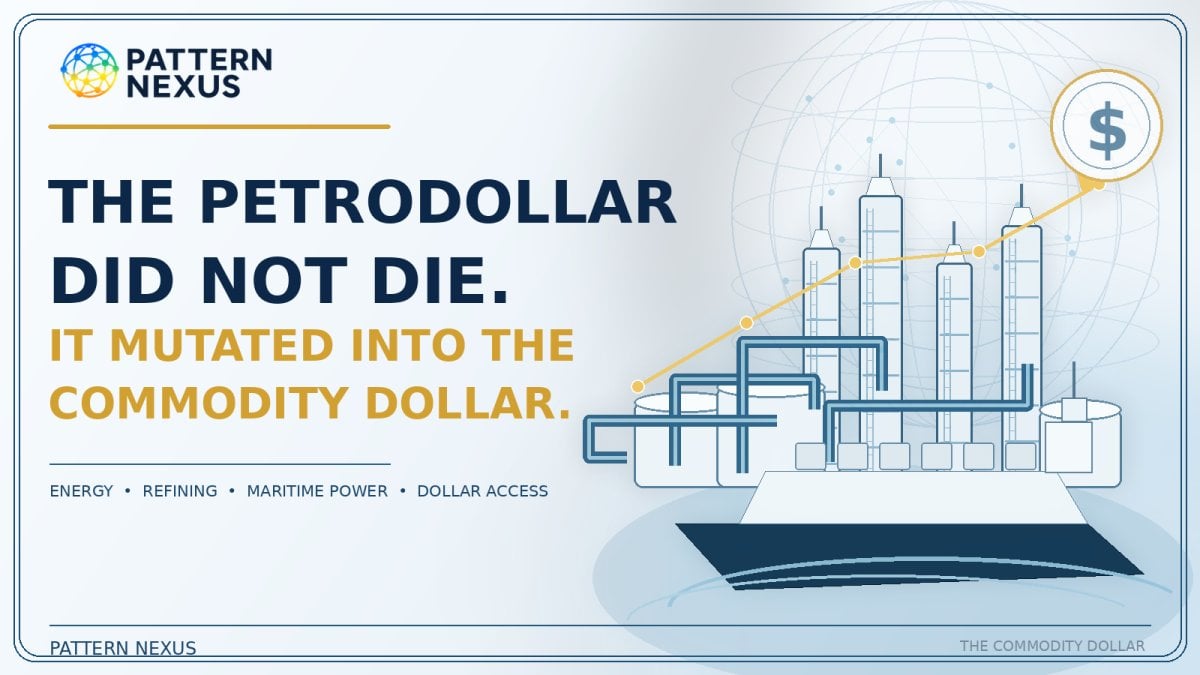
The old petrodollar was built around imported oil, dollar invoicing, military protection, and the recycling of global surpluses into American assets. The emerging commodity-dollar system is more direct: the United States produces record volumes of oil and gas, operates enormous refinery and export infrastructure,…
Jump to a section

The Petrodollar Did Not Die. It Mutated Into the Commodity Dollar
The old petrodollar was built around security, dollar invoicing, and recycled surpluses. The emerging commodity-dollar system is reinforced by U.S. energy production, refinery exports, maritime power, financial settlement, sanctions enforcement, and control over access to the resources that keep the global economy operating.
U.S. distillate exports averaged approximately 1.56 million barrels per day during the second quarter of 2026, 30% above their five-year average. Jet-fuel exports more than doubled as American refineries shifted production toward the fuels global markets needed most. This is not merely an energy-export story. It is evidence of a larger monetary and geopolitical transition. The United States is no longer only the military and financial guarantor of a commodity system centered on foreign production. It is increasingly the producer, refiner, exporter, financier, insurer, security provider, and enforcement authority inside that system. The dollar is not legally backed by commodities, but it is increasingly reinforced by control over commodity production, logistics, financial clearing, maritime access, and strategic infrastructure. The old system was dollar-for-security. The emerging system is dollar-for-access.
This article separates documented facts from systems-level interpretation. The energy-production and export figures come primarily from the U.S. Energy Information Administration. The history of the Nixon shock, U.S.–Saudi economic cooperation, dollar invoicing, global reserve usage, LTCM, freedom-of-navigation operations, sanctions, and tanker seizures is anchored to official government, Federal Reserve, IMF, GAO, Navy, Treasury, and Justice Department material. The phrase “commodity dollar” is not a legal monetary designation. It is a Pattern Nexus framework describing how dollar power is increasingly reinforced by production capacity, logistics, finance, market access, sanctions, and control over strategic commodity corridors.
The petrodollar was never one magical contract. It was an operating system made of security, invoicing, banking, reserves, energy, and recycled capital.
The old system asked the world to use dollars to purchase commodities. The new system increasingly asks the world to use dollars to access American commodities.
Dollar dominance is no longer only about currency preference. It is also about who controls production, insurance, banking, ports, shipping corridors, technology, and legal access.
The old system was dollar-for-security. The emerging system is dollar-for-access.
The Export Surge Is Not a Side Story
U.S. exports of distillate fuel and jet fuel reached unprecedented levels during the second quarter of 2026 as disruptions in Middle Eastern supply tightened global refined-product markets.
According to the U.S. Energy Information Administration, distillate exports averaged approximately 1.56 million barrels per day, 30% above their five-year average. Jet-fuel exports averaged approximately 356,000 barrels per day, more than double their five-year average.[1]
American refineries did not passively benefit from the shortage. They adjusted.
Refiners changed their yields, altered operating decisions, increased jet-fuel production, and redirected more output into international markets. EIA estimates that U.S. jet-fuel production during the quarter ran 24% above the five-year average. Distillate production was 5% higher, while gasoline production was only 1% higher.
That matters.
A refinery is not simply a machine that turns a barrel of crude into a fixed basket of products. Within technical, commercial, and equipment constraints, refiners can change operating severity, crude inputs, unit configuration, blending, and product yields to respond to changing margins.
When international jet-fuel markets tightened, the U.S. refining system responded by producing more jet fuel.
When distillate markets tightened, the United States exported more diesel and related middle-distillate products.
The public sees fuel moving through a port.
The larger system sees something else: the United States converting global disruption into domestic industrial throughput, export revenue, refinery margins, transportation activity, port utilization, and geopolitical leverage.
This is where the energy story becomes a currency story.
It is also where the old petrodollar explanation begins to fail.
The Petrodollar Was Always Shorthand
People talk about the petrodollar as though there was one contract, signed in one room, requiring every barrel of oil on Earth to be sold in dollars forever.
That is not an accurate description.
The petrodollar was an operating system.
It was composed of overlapping arrangements, strategic relationships, market conventions, banking systems, military guarantees, Treasury markets, dollar-denominated credit, oil pricing, and the recycling of commodity-export revenue into American assets.
The oil component mattered because oil was the industrial world’s most important internationally traded commodity. Every major economy needed it. Most major economies had to import at least some of it. Oil was required for transportation, manufacturing, agriculture, military power, chemicals, shipping, and economic growth.
If oil was commonly priced and financed in dollars, governments, central banks, refiners, trading companies, banks, and importers needed access to dollars.
But the dollar system was always broader than oil.
Federal Reserve research shows that dollar use in international reserves, trade invoicing, cross-border banking, debt issuance, foreign-exchange transactions, payments, and stablecoins remains far larger than the United States’ direct share of world trade.[5]
IMF research reaches the same basic conclusion: the dollar’s role in global trade invoicing greatly exceeds the share of trade directly involving the United States. That remains true even when commodity exports are removed from the calculation.[6]
That means “petrodollar” is useful, but incomplete.
A more accurate term would be the trade dollar, settlement dollar, collateral dollar, security dollar, or commodity dollar.
The petrodollar was the most visible part of a much larger dollar network.
From the Nixon Shock to the Saudi Relationship
The modern transition begins in 1971.
Under the Bretton Woods system, foreign governments could convert official dollar holdings into gold at a fixed rate of $35 per ounce. By the late 1960s and early 1970s, the United States had created and distributed more dollars than it could credibly redeem at that price.
On August 15, 1971, President Richard Nixon suspended the dollar’s convertibility into gold. The fixed-rate Bretton Woods structure began breaking apart, and floating exchange rates became the new operating environment.[7]
This created an obvious question.
If dollars were no longer redeemable for gold at a fixed rate, why would the rest of the world continue holding and using them?
The answer did not come from one replacement asset.
It came from an entire system.
The United States still had the world’s largest and deepest capital markets. It had enormous military reach. It had treaty allies. It had a large domestic economy. It had Treasury securities that could absorb global savings. It had banks positioned throughout the international system. It had legal infrastructure, financial clearing, industrial capacity, and security relationships with major commodity producers.
Following the Arab oil embargo and price increases of the 1970s, the United States and Saudi Arabia expanded their economic and strategic relationship.
The U.S.–Saudi Arabian Joint Commission on Economic Cooperation helped strengthen political ties, assist Saudi development, increase purchases of American goods and services, and recycle petroleum-derived surpluses through the dollar-centered financial system.[8]
This was not a simple arrangement in which Saudi Arabia received military protection and signed a secret paper requiring the entire planet to use dollars.
It was more sophisticated.
Oil revenue entered a dollar-based financial architecture. Commodity exporters accumulated dollar surpluses. Those surpluses could be deposited with international banks, invested in Treasury securities, used to purchase American goods, or deployed into dollar-denominated assets.
The United States received financing.
Commodity exporters received security, development support, liquid assets, weapons, market access, and a currency accepted almost everywhere.
The system reinforced itself.
The Original Operating Bargain
The original operating bargain can be simplified like this:
The United States would provide much of the military, financial, and institutional infrastructure necessary to keep international commerce moving.
It would defend major maritime routes.
It would maintain alliances and forward military positions.
It would provide a large market for global exports.
It would provide Treasury securities and other dollar assets capable of absorbing global savings.
It would operate the central banking, correspondent banking, clearing, insurance, legal, and capital-market infrastructure surrounding the dollar.
In exchange, much of the world would price, settle, finance, and reserve its trade in dollars.
This was never a perfectly equal bargain.
It was also never a free service provided by the United States out of global generosity.
The United States benefited from persistent international demand for its currency and debt. Foreign governments and companies benefited from access to a liquid, standardized, globally accepted settlement system.
The U.S. Navy publicly describes freedom of navigation, free trade, unimpeded commerce, and lawful access to the seas as principles connected to global security and prosperity.[10]
But the military layer was only one part.
The bargain also depended on trust.
The world did not expect the United States to preserve the dollar’s purchasing power perfectly. No fiat currency does that.
It expected the United States to maintain a more credible monetary, legal, financial, and institutional structure than most alternatives.
It expected American markets to remain liquid.
It expected Treasury securities to remain usable as reserve assets and collateral.
It expected contracts to remain enforceable.
It expected dollars to be available during crises.
And it expected the United States not to destroy the system faster than everyone else.
What the United States Received in Return
The reserve-currency advantage is often presented as though the United States simply prints paper and receives the world’s resources for free.
That is too simplistic.
But there is a real advantage.
Persistent international demand for dollars and dollar assets lowers transaction friction for American companies and institutions. It enlarges the pool of potential buyers for U.S. debt. It allows American financial institutions to operate from the center of global funding markets. It gives the United States enormous influence over payment systems, banking relationships, sanctions compliance, correspondent accounts, and financial regulation.
It also means foreign borrowers frequently take on dollar-denominated obligations.
When the dollar rises, those debts can become harder to service.
When the Federal Reserve raises rates, the effects move through countries and companies that may have little direct connection to the domestic U.S. economy.
When international trade is invoiced in dollars, movements in the dollar affect import costs, inflation, credit conditions, and trade volumes around the world.
This is why reserve-currency power is not merely the ability to buy cheaper oil.
It is the ability to influence the price and availability of money throughout the global system.
The United States receives lower financing friction, stronger global demand for its liabilities, broad monetary transmission, and geopolitical leverage.
But it also inherits responsibilities.
The world needs dollar liquidity during crises.
Foreign investors need enough safe dollar assets to hold.
Global trade requires enough dollars to settle transactions.
That pressures the United States to run deficits, create liabilities, and supply the world with the assets it demands.
The privilege and the burden are two sides of the same structure.
The 1997–1998 Fracture
Everyone likes to begin the modern monetary story in 2008.
That is too late.
The 2008 crisis was the moment large-scale central-bank intervention became impossible for the public to ignore. But the intervention architecture was developing earlier.
The Asian financial crisis began in Thailand in 1997 and spread through East Asia. Currency pegs failed. Dollar-denominated liabilities became more difficult to service. Capital fled. Asset prices collapsed. Economies that had been presented as successful examples of rapid globalization suddenly discovered how vulnerable they were to external dollar funding and exchange-rate pressure.
Then Russia defaulted on domestic debt and devalued the ruble in 1998.
That shock moved through leveraged global positions and helped push Long-Term Capital Management toward failure.
LTCM was not a normal hedge fund.
It was highly leveraged, deeply connected to major banks and broker-dealers, and exposed across government bonds, derivatives, swaps, mortgage securities, and international markets.
The concern was not merely that LTCM’s owners would lose money.
The concern was that forced liquidation could create a disorderly fire sale across markets, producing losses for counterparties and destabilizing already fragile global finance.
This is where the modern intervention reflex became visible.
What LTCM Actually Proved
It is tempting to say that the money printing began with LTCM.
Directionally, that identifies an important turning point.
Technically, it needs refinement.
The Federal Reserve did not inject public money directly into LTCM. The Federal Reserve Bank of New York brought major financial institutions together, facilitated negotiations, and oversaw a private-sector recapitalization. Fourteen banks and brokerage firms ultimately invested approximately $3.6 billion to prevent a chaotic liquidation.[9]
So LTCM was not quantitative easing.
It was not the 2008 balance-sheet expansion.
It was not direct central-bank financing of a hedge fund.
But it revealed something structurally important:
When a sufficiently interconnected institution threatened market functioning, authorities were willing to coordinate intervention rather than allow price discovery to run to its natural conclusion.
That is the intervention reflex.
Once markets understand that authorities may step in when disorder becomes systemically dangerous, risk behavior begins changing.
Institutions learn that individual firms can fail, but the system may still be protected.
Investors learn that severe instability can produce policy support.
Markets begin pricing not only economic fundamentals, but also the anticipated response of central banks and governments.
That reflex expanded after the dot-com collapse, the September 11 attacks, the 2008 crisis, the euro-area crisis, the 2019 repo disruption, the 2020 pandemic, and the 2023 banking stress.
But the 1997–1998 period matters because it exposed the structure before the balance sheets became enormous.
Why the Old System No Longer Exists
We continue talking as though the United States still operates the original postwar bargain.
Officially, the United States supports freedom of navigation, open commerce, lawful access to international waters, and a rules-based trading system.
That principle remains real.
But the actual system is no longer neutral in the way the public language implies.
Global trade now operates through layers of permission.
A cargo can be physically available and still be difficult to move.
A buyer and seller can agree on a transaction and still be unable to settle it.
A tanker can be loaded and still struggle to obtain insurance.
A company can have financing and still lose access to correspondent banking.
A vessel can have a destination and still be denied port services.
A country can have commodities and still be restricted by export controls, sanctions, asset freezes, technology restrictions, ownership rules, flag requirements, beneficial-ownership reviews, and legal exposure.
The United States still helps protect international commerce.
But the system increasingly protects lawful, allied, compliant, and strategically tolerated commerce.
It does not provide equal operational freedom to every government regardless of conduct, alignment, sanctions status, or strategic position.
The difference between the official principle and the operating reality is where the new commodity-dollar system lives.
Freedom of Trade Became a Permission Stack
Modern trade is not controlled by one switch.
It is controlled by a stack.
The first layer is physical production.
The second layer is refining or processing.
The third layer is storage.
The fourth layer is port and terminal access.
The fifth layer is shipping.
The sixth layer is insurance.
The seventh layer is financing.
The eighth layer is currency settlement.
The ninth layer is legal compliance.
The tenth layer is military and maritime security.
A government does not need to blockade every ship to impair another government’s trade.
It can target banks.
It can sanction shipowners.
It can sanction vessel managers.
It can sanction insurers.
It can sanction terminals.
It can restrict technology.
It can freeze reserves.
It can pressure flag registries.
It can threaten secondary sanctions against customers.
It can seize cargo connected to alleged sanctions evasion, terrorism financing, fraud, money laundering, or false registration.
In December 2025, U.S. authorities seized the tanker Skipper on the high seas pursuant to a judicially authorized warrant. The Justice Department later sought forfeiture of the vessel and approximately 1.8 million barrels of Venezuelan-origin crude, alleging connections to networks supporting sanctioned Iranian organizations.[11]
Treasury actions have also targeted large numbers of vessels, operators, trading firms, refineries, and financial networks associated with Iranian petroleum exports.[12]
That is not the old image of neutral globalization.
That is controlled access.
Friendly, Tolerated, and Sanctioned Trade
The modern system can be understood through three broad lanes.
Friendly Trade
Friendly trade moves through allied banks, recognized insurers, transparent ownership structures, established ports, major commodity exchanges, standard contracts, trusted currencies, and protected shipping corridors.
This trade receives the full benefit of the global system.
Financing is easier.
Insurance is cheaper.
Legal risk is lower.
Settlement is faster.
Shipping is more predictable.
Tolerated Trade
Tolerated trade may involve governments that are not close allies but are still permitted to operate inside most international systems.
These countries may face greater scrutiny, tariffs, export restrictions, technology controls, or political pressure, but they retain broad access to ports, banks, insurers, and settlement networks.
Sanctioned or Excluded Trade
Sanctioned governments face an entirely different cost structure.
They use intermediaries, shadow fleets, renamed vessels, offshore companies, ship-to-ship transfers, alternative currencies, barter, commodity swaps, gold, opaque ownership arrangements, falsified cargo origins, altered documentation, and manipulated vessel-tracking data.
The commodity may still move.
But it moves at a discount.
It moves with higher risk.
It moves with less reliable insurance.
It moves through fewer buyers.
It moves with a larger share of the economic value captured by middlemen.
The purpose is not necessarily to stop every barrel.
The purpose can be to reduce revenue, increase friction, limit investment, weaken state capacity, and force trade into less efficient channels.
This is why modern sanctions are not merely diplomatic statements.
They are market-share weapons.
The Commodity Dollar Begins at Home
The most important change is that the United States now produces more oil and natural gas than it did during the original petrodollar era.
The United States remained the world’s largest crude-oil producer in 2025, producing a record average of approximately 13.6 million barrels per day.[2]
It has also been the world’s largest natural-gas producer for years.
U.S. energy exports reached a record level in 2025, while the country recorded its largest net-energy-export position on record. Natural-gas exports quadrupled between 2015 and 2025 as production and LNG-export infrastructure expanded.[4]
In April 2026, combined U.S. crude-oil and petroleum-product exports reached approximately 13.6 million barrels per day—15% above the previous monthly record. Crude exports alone averaged approximately 5.6 million barrels per day.[3]
This changes the monetary and geopolitical equation.
The old petrodollar system was built when the United States was increasingly dependent on imported petroleum.
The emerging commodity-dollar system is being built while the United States is a massive producer, refiner, processor, pipeline operator, LNG exporter, petroleum exporter, financial center, military power, and consumer market.
America is no longer simply protecting somebody else’s energy moving through somebody else’s corridor toward somebody else’s refinery.
It is increasingly competing to supply the market itself.
That means disruption elsewhere can increase demand for American output.
Sanctions against competing producers can redirect buyers toward American suppliers.
European efforts to replace Russian energy can increase demand for U.S. LNG and petroleum products.
Instability in Middle Eastern refining or shipping can increase demand for U.S. diesel and jet fuel.
The security provider is now also a supplier.
That is a fundamentally different system.
The U.S. Energy-Export Stack
The American energy position is not one industry.
It is a stack.
Upstream production extracts crude oil, natural gas, and natural-gas liquids.
Pipelines move those commodities to processing plants, storage facilities, refineries, petrochemical complexes, and export terminals.
Natural-gas processing separates ethane, propane, butane, and other liquids.
Refineries produce gasoline, diesel, jet fuel, marine fuel, petroleum coke, asphalt, lubricants, feedstocks, and intermediate products.
LNG facilities cool natural gas into a transportable liquid.
Marine terminals load crude, refined products, LNG, LPG, and petrochemical feedstocks onto vessels.
Trading houses manage contracts, destination risk, pricing differentials, storage, hedging, and transportation.
Banks finance cargoes.
Insurers cover vessels, terminals, liabilities, and political risk.
The Navy and allied maritime forces help maintain access to international shipping routes.
Treasury and the Justice Department can restrict or prosecute trade operating outside permitted financial and legal channels.
The dollar connects the layers.
This is why describing the system as “the oil industry” misses the structure.
It is an integrated commodity, industrial, logistical, financial, legal, and military system.
Refineries as Strategic Infrastructure
Crude oil receives most of the attention because crude prices produce the familiar headlines.
But crude oil is not what most consumers and businesses actually use.
Aircraft require jet fuel.
Trucks require diesel.
Ships require marine fuels.
Farm equipment requires distillate.
Chemical plants require feedstocks.
Road systems require asphalt.
Manufacturing requires lubricants, fuels, and petrochemical inputs.
A country can possess crude oil and still suffer a fuel shortage if it lacks sufficient refining capacity, the correct refinery configuration, reliable power, catalysts, maintenance capacity, skilled labor, storage, blending components, or access to international markets.
This is why record U.S. distillate and jet-fuel exports matter so much.
They show that the United States does not merely control molecules underground.
It controls a large share of the industrial equipment capable of turning those molecules into the products the global economy actually consumes.
The refinery is therefore part of the currency system.
Not because a refinery literally issues dollars.
Because refinery capacity increases the amount of strategically necessary goods that can be produced, exported, invoiced, financed, and settled through dollar markets.
The more essential products the United States can reliably deliver during a disruption, the stronger the practical demand for access to American markets, infrastructure, finance, and currency.
Governments Versus Governments
This needs to be stated clearly.
Most geopolitical conflicts are not ordinary people spontaneously deciding that they hate millions of other ordinary people living across a border.
They are governments competing with governments.
They are states competing over territory, resources, shipping routes, currencies, ideology, security, influence, technology, and survival.
Ordinary populations are then mobilized into those conflicts through nationalism, propaganda, fear, grievance, historical memory, religion, retaliation, and institutional pressure.
That does not mean popular hostility is imaginary.
It means hostility is often cultivated, organized, and directed by systems larger than the individual.
When sanctions target a petroleum sector, officials describe the pressure as targeting a regime’s revenue.
But reduced investment, deteriorating infrastructure, inflation, currency weakness, unemployment, fuel shortages, and lost economic growth affect the people living under that government.
Both statements can be true.
The policy can be aimed at a government.
The economic consequences can reach the population.
The correct analysis does not need to pretend that sanctions are harmless.
It also does not need to pretend that every sanction is motivated by hatred of the people living inside the targeted country.
This is state competition.
The public lives inside the outcome.
Not Commodity-Backed—Commodity-Reinforced
The dollar is not backed by oil.
It is not backed by natural gas.
It is not backed by jet fuel, diesel, copper, uranium, rare earths, semiconductors, farmland, shipping, or military power in the legal sense of convertibility.
A dollar holder cannot present currency to the Federal Reserve and demand a fixed quantity of petroleum.
That distinction matters.
But legal convertibility is not the only form of support a currency can have.
A currency can be reinforced by the scale of the economy behind it.
It can be reinforced by productive capacity.
It can be reinforced by deep capital markets.
It can be reinforced by taxation.
It can be reinforced by property rights and contract enforcement.
It can be reinforced by military alliances.
It can be reinforced by trade invoicing.
It can be reinforced by collateral markets.
It can be reinforced by the ability to deliver strategically necessary commodities.
It can be reinforced by control over banking, insurance, logistics, and settlement.
This is the commodity-dollar thesis.
The dollar is not redeemable for a commodity.
Access to the dollar system increasingly helps determine access to commodities.
That is a different form of backing.
Not legal backing.
Operational reinforcement.
Oil Is Only the First Layer
The commodity-dollar system does not stop with oil and gas.
Energy is the first layer because every industrial system requires it.
But the next layer is minerals.
Copper is required for transmission, motors, electronics, construction, electric vehicles, data centers, transformers, and grid expansion.
Uranium is required for nuclear power.
Lithium, nickel, manganese, cobalt, and graphite are tied to battery production.
Rare-earth elements are required for high-performance magnets, guidance systems, aerospace, wind turbines, robotics, electronics, and defense technologies.
Gallium, germanium, antimony, tungsten, and other specialized materials matter throughout semiconductors, optics, weapons, communications, and industrial manufacturing.
A country can control the currency and still become strategically vulnerable if it cannot secure the physical inputs required to sustain its industrial base.
This is why the dollar and commodity systems are converging.
The United States cannot preserve long-term monetary and geopolitical power using financial claims alone.
It needs mines.
It needs refineries.
It needs processing plants.
It needs smelters.
It needs chemical separation capacity.
It needs ports, railroads, power plants, pipelines, transformers, ships, machine tools, and skilled labor.
Financial dominance without physical capacity eventually becomes hollow.
The commodity dollar is the attempt—whether fully coordinated or emerging through policy pressure—to reconnect American financial power with American and allied physical production.
The U.S.–China Commodity Competition
This is where the earlier Pattern Nexus work on critical minerals becomes directly connected.
China controls major portions of the processing and manufacturing systems surrounding rare earths, batteries, solar equipment, industrial minerals, electronics, and strategic materials.
The United States retains enormous advantages in finance, military reach, energy production, advanced technology, alliances, agricultural capacity, and capital markets.
The contest is therefore not simply about which economy has the larger GDP number.
It is about which system controls the layers beneath production.
Who controls the mine?
Who controls the processing?
Who controls the refinery?
Who controls the shipping?
Who controls the port?
Who controls the insurance?
Who controls the semiconductor equipment?
Who controls the payment rail?
Who controls the energy required to operate everything else?
China’s advantage is physical industrial depth and processing concentration.
America’s advantage is the combination of energy, finance, military reach, alliances, technology, and access to the world’s deepest capital markets.
The currency competition will follow the commodity competition.
Countries do not choose settlement systems only because of ideology.
They choose systems based on what those systems allow them to obtain.
If China can reliably provide industrial equipment, mineral processing, infrastructure, manufactured goods, financing, and market access, the renminbi gains practical relevance.
If the United States can reliably provide energy, technology, security, capital, food, refined products, advanced equipment, and access to allied markets, the dollar remains difficult to replace.
This is not a currency war floating above the real economy.
The currency war is the financial expression of the resource war underneath it.
What This Means for Smaller Companies
The rise in U.S. distillate and jet-fuel exports creates opportunities, but smaller companies need to approach those opportunities realistically.
Most small air-cargo operators, shipping companies, and logistics firms will not negotiate a direct crude-to-product production agreement with a major refinery.
Refineries generally sell through established marketers, distributors, wholesalers, trading firms, pipeline systems, terminals, and contract networks.
The practical opportunities are further downstream.
Longer-Term Fuel Procurement
Air-cargo and transportation firms can reduce dependence on volatile spot markets by negotiating term supply agreements through qualified distributors, wholesalers, airport-fuel consortia, terminal operators, and established marketers.
Contracts can include priority-allocation language, volume bands, indexed pricing, delivery obligations, and alternative-supply provisions.
Terminal and Storage Access
Companies with reliable access to regional storage, transloading, airport-fuel infrastructure, marine terminals, or inland distribution can become more valuable when international markets tighten.
The opportunity is not merely owning fuel.
It is controlling the location, timing, documentation, and delivery of fuel.
Clean-Product Logistics
Record movement of diesel, jet fuel, and other refined products increases demand for specialized shipping, brokerage, inspection, blending, quality control, customs documentation, terminal handling, and product-tracking services.
Compliance Infrastructure
Sanctions and beneficial-ownership rules create demand for companies capable of verifying counterparties, cargo origin, vessel history, insurance coverage, trade documents, and payment compliance.
In a permission-based trading system, compliance becomes part of the product.
Route Diversification
Air-cargo and shipping firms should avoid becoming dependent on one supplier, one port, one terminal, one corridor, or one pricing benchmark.
The companies that survive disruptions are often not those with the lowest normal-period cost.
They are those with the strongest redundancy.
Hedging and Price-Risk Management
Smaller firms frequently treat fuel exposure as an unavoidable operating expense until volatility destroys their margins.
Where appropriate, companies can work with qualified counterparties to evaluate indexed contracts, price collars, futures, swaps, or other risk-management structures.
The objective should not be speculation.
The objective should be preventing one fuel-price shock from overwhelming the operating business.
What Could Break the System
The commodity-dollar system is powerful.
It is not invulnerable.
Overuse of Sanctions
Every time the United States uses financial access as a weapon, targeted governments receive another incentive to build alternatives.
Those alternatives may initially be inefficient.
But repeated pressure can justify the cost of developing them.
Alternative payment systems, local-currency trade, gold settlement, barter, digital currencies, commodity swaps, shadow fleets, and regional financing networks can gradually reduce dependence on the dollar stack.
Fiscal and Monetary Instability
The United States cannot indefinitely demand that the world trust its liabilities while allowing debt, deficits, inflation, political dysfunction, and interest expense to deteriorate without consequence.
Reserve status provides room.
It does not eliminate arithmetic.
Infrastructure Failure
American energy dominance depends on pipelines, refineries, ports, LNG facilities, power systems, storage, railroads, waterways, and skilled labor.
Insufficient maintenance, cyberattacks, hurricanes, equipment failures, permitting delays, grid weakness, and refinery closures can reduce the reliability of the export system.
Domestic Price Backlash
Exports benefit producers, refiners, ports, and the national trade position.
But international demand can also tighten domestic markets.
If Americans experience high diesel, gasoline, electricity, or heating costs while record volumes are exported, political support for unrestricted exports can weaken.
Allied Resistance
Allies may accept American leadership while still resisting policies that expose them to shortages, secondary sanctions, industrial decline, or excessively expensive energy.
A coalition remains strong only when members believe the system provides more benefit than cost.
Commodity Competition From China and Other Blocs
If China and its partners build a sufficiently reliable alternative system—combining resources, manufacturing, shipping, financing, technology, and settlement—the dollar system could lose share without collapsing.
That is the realistic de-dollarization path.
Not one dramatic announcement.
Gradual routing around the existing system.
What to Watch Next
I am watching U.S. crude, petroleum-product, LNG, natural-gas-liquid, coal, agricultural, and mineral exports as one combined commodity system.
I am watching refinery utilization, closures, maintenance, crack spreads, jet-fuel yields, distillate inventories, and the difference between domestic and international product prices.
I am watching whether Europe’s replacement of Russian energy becomes a temporary wartime adjustment or a permanent U.S.-centered supply relationship.
I am watching the Strait of Hormuz, Strait of Malacca, Suez Canal, Bab el-Mandeb, Panama Canal, and Cape of Good Hope because control of commodities is meaningless without reliable movement.[13]
I am watching tanker seizures, shadow-fleet sanctions, insurance restrictions, flag-registry pressure, ship-to-ship transfers, AIS manipulation, and secondary sanctions against refiners and buyers.
I am watching Treasury markets and foreign demand for U.S. debt.
I am watching stablecoins and tokenized Treasury products because the next dollar-distribution system may not look like the correspondent-banking system of the twentieth century.
I am watching U.S. investment in uranium, copper, rare-earth processing, battery materials, semiconductors, transformers, shipbuilding, railroads, ports, pipelines, and grid expansion.
I am watching China’s response.
Not merely what China says about the dollar.
What China builds around it.
And I am watching whether the United States can maintain the balance the system requires:
Produce enough commodities to remain indispensable.
Maintain enough military power to protect strategic routes.
Maintain enough institutional credibility to preserve dollar demand.
Apply enough pressure to constrain adversaries.
But not so much pressure that the rest of the world concludes it must escape.
Pattern Nexus Lens
The record surge in U.S. distillate and jet-fuel exports is not an isolated fuel-market event.
It is the system revealing itself.
The old petrodollar architecture was built around a United States that protected global trade, imported large amounts of energy, issued the reserve currency, and recycled global surpluses through its financial markets.
The emerging system is different.
The United States still provides maritime power.
It still operates the deepest dollar markets.
It still issues the leading reserve and settlement currency.
But now it also produces record quantities of oil and natural gas.
It exports crude oil, LNG, propane, diesel, jet fuel, petrochemical feedstocks, and other strategic products.
It can sanction competing producers.
It can restrict banks, insurers, vessels, terminals, refineries, and buyers.
It can use legal and military authority to enforce parts of that system.
And it is attempting to rebuild domestic and allied control over critical minerals, semiconductors, energy infrastructure, and industrial production.
The petrodollar did not simply disappear when the United States became less dependent on imported oil.
It mutated.
The old system encouraged the world to acquire dollars to buy foreign commodities.
The emerging system encourages the world to acquire dollars to access American and allied commodities, technology, financing, insurance, security, and markets.
The dollar is not commodity-backed.
It is commodity-reinforced.
It is reinforced by production.
It is reinforced by logistics.
It is reinforced by financial clearing.
It is reinforced by military reach.
It is reinforced by the ability to grant access.
And increasingly, by the ability to deny it.
The old system was dollar-for-security.
The new system is dollar-for-access.
FAQ
Is the U.S. dollar officially backed by oil or other commodities?
No. The dollar is a fiat currency and is not legally redeemable for a fixed quantity of oil, natural gas, gold, or another commodity. The commodity-dollar framework describes operational reinforcement through production, trade, finance, logistics, and strategic access—not legal convertibility.
Was the petrodollar created by one treaty requiring all oil to be sold in dollars?
No. The petrodollar developed through a network of market conventions, U.S.–Saudi cooperation, dollar pricing, security relationships, banking infrastructure, Treasury markets, and the recycling of oil-export revenue. It was an operating system, not one universal contract.
Did money printing begin with LTCM?
Not in the technical sense. The Federal Reserve did not finance the LTCM rescue with public funds. Private financial institutions supplied the recapitalization. LTCM mattered because it revealed the emerging intervention reflex: authorities were willing to coordinate support when disorderly liquidation threatened the broader financial system.
Does the United States guarantee free trade for every country?
The United States officially supports lawful freedom of navigation and unimpeded commerce. In practice, access is filtered through sanctions, export controls, banking regulations, insurance requirements, legal jurisdiction, alliances, and national-security policy.
Do record energy exports automatically reduce domestic fuel prices?
No. Greater production and refining capacity can improve supply, but export demand can also tighten domestic markets. Domestic prices depend on crude costs, refinery utilization, inventories, transportation, taxes, seasonal demand, international prices, and regional infrastructure.
Does this mean de-dollarization has failed?
No. The dollar remains dominant, but governments continue building alternative settlement systems, increasing gold holdings, expanding local-currency trade, and reducing exposure to sanctions risk. The more realistic challenge is gradual diversification and routing—not an overnight disappearance of the dollar.
Why call it the commodity dollar?
Because dollar power is increasingly connected to the ability of the United States and its allies to produce, refine, finance, insure, transport, secure, and regulate access to strategic commodities. The currency remains fiat, but the physical system beneath it is becoming more important.
References
Outside factual anchors are listed first, followed by related Pattern Nexus research.
Outside Factual References
- U.S. Energy Information Administration — “Petroleum Markets Responded to Disruptions in the Middle East in the Second Quarter.” July 15, 2026. Distillate exports, jet-fuel exports, refinery yields, production, and global product-market tightening. EIA source.
- U.S. Energy Information Administration — “The United States Produced More Crude Oil Than Any Other Country in 2025.” July 9, 2026. EIA source.
- U.S. Energy Information Administration — “U.S. Exports of Crude Oil and Petroleum Products Reached Record in April.” July 8, 2026. EIA source.
- U.S. Energy Information Administration — “The United States Is a Major Energy Exporter and Importer, Especially for Petroleum.” May 27, 2026. EIA source.
- Board of Governors of the Federal Reserve System — “The International Role of the U.S. Dollar: 2025 Edition.” July 18, 2025. Reserve composition, trade invoicing, international payments, banking, debt, and dollar-market structure. Federal Reserve source.
- International Monetary Fund — “Patterns in Invoicing Currency in Global Trade.” IMF Working Paper 2020/126. IMF source.
- U.S. Department of State, Office of the Historian — “Nixon and the End of the Bretton Woods System, 1971–1973.” State Department source.
- U.S. Government Accountability Office — “The U.S.–Saudi Arabian Joint Commission on Economic Cooperation.” March 22, 1979. U.S.–Saudi cooperation, industrial development, trade, and petrodollar recycling. GAO source.
- Federal Reserve History — “Near Failure of Long-Term Capital Management.” September 1998. Federal Reserve History source.
- U.S. Department of Justice — “United States Seeks Forfeiture of Oil Tanker and 1.8M Barrels of Crude Oil That Supported Iran and Venezuela.” February 27, 2026. Justice Department source.
- U.S. Department of the Treasury — Sanctions Against Iran’s Shadow Fleet and Petroleum Networks. February–June 2026. February Treasury action; April Treasury action; June Treasury action.
- U.S. Energy Information Administration — “World Oil Transit Chokepoints.” Hormuz, Malacca, Suez, Bab el-Mandeb, Panama, and other major commodity corridors. EIA chokepoint analysis.
Related Pattern Nexus Research
- The Quiet War for Critical Minerals: How Resource Control Defines the Next Century
- The Silent Currency War and the Emerging Containment System
- The Blockade Age: U.S.–China Geopolitical Realignment and Maritime Power
- The Convergence: AI, Energy, and the Final Liquidity Regime
- The Fracturing World Order: From Unipolar Dominance to Economic Multipolarity
- The State-Capital Stack: Chips, Rare Earths, Strategic Ownership, and the Industrial Turn
Analytical distinction: “Commodity dollar” is a Pattern Nexus systems framework, not an official monetary standard. The dollar remains a fiat currency. The argument is that its international utility is increasingly reinforced by the United States’ position across energy production, refining, commodity exports, finance, maritime security, sanctions enforcement, technology, and strategic-market access.
What's Your Reaction?
 Like
0
Like
0
 Dislike
0
Dislike
0
 Love
0
Love
0
 Funny
0
Funny
0
 Wow
0
Wow
0
 Sad
0
Sad
0
 Angry
0
Angry
0

Nexus (Christopher)
Founder of Pattern Nexus. I research markets, macro, geopolitics, AI, history, ancient systems, and the patterns most people overlook. I’m also building Market Radar, a trading scanner designed to read pressure, risk, confirmation, and setup quality before ch…
Related research

Iran: Escalation Ladder — Reactivation Enabled
The Iran escalation ladder is active again. I examine the October strike risk, the infrastructure-war danger, rising tanker attacks alongsi…
7 shared topics, 1 shared asset.
The Oil War Is Becoming a Global Economic War
An extensive Pattern Nexus reconstruction linking the Iran/Hormuz disruption with Ukrainian refinery attacks, diesel shortages, Saudi pipe…
5 shared topics, 1 shared asset.
The Oil Inventory War Machine: How Long the Global Buffer Can Hold
A full Pattern Nexus reconstruction of U.S. and global oil inventories from the 1970s through the 2026 war shock, including original regres…
5 shared topics, same research avenue.
Gold Was Right. The 10-Year Was Early. The War Premium Changed the Rate Path.
The original Pattern Nexus gold call hit the structural move: gold was not just trading inflation, it was repricing liquidity, policy failu…
3 shared topics, 1 shared asset, same research avenue.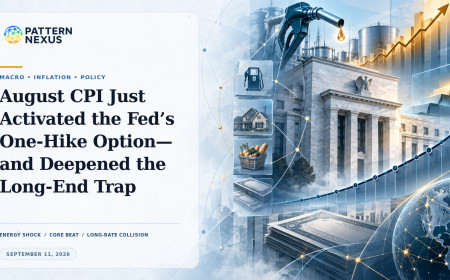
August CPI Just Activated the Fed’s One-Hike Option—and Deepened the Long-End Trap
August CPI rose 0.4% on the month and 3.4% from a year earlier, while core CPI rose a hotter-than-expected 0.3% even as its annual rate eas…
2 shared topics, 1 shared asset, same research avenue.
Two Economies, One Balance Sheet: The Unstable Barbell of 2026
Reserve support has returned, but real long rates, fiscal supply, and an AI-energy capital wave are splitting the U.S. economy between capi…
2 shared topics, 1 shared asset, same research avenue.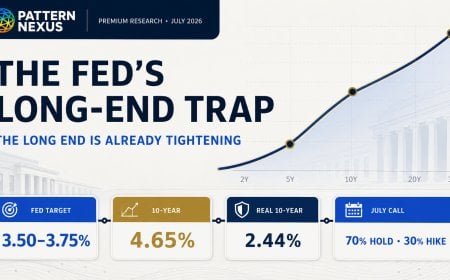
The Fed’s Long-End Trap: Why a 4.65% 10-Year Is Already Doing the Tightening
A full July 2026 data reconstruction of the Federal Reserve’s next policy path, showing how a 4.65% nominal 10-year, 2.44% real 10-year, Tr…
2 shared topics, 1 shared asset, same research avenue.
One System, Many Flags: Ukraine, Iran, North Korea and the Illusion of Separate Wars
The United States can arm Ukraine while temporarily easing pressure on Russian oil, convert stockpile transfers into new procurement, court…
4 shared topics.
Comments (0)
Security Check
Please complete the captcha to verify you are human.