

The Two-Tier Future: War, Demand Destruction, AI, and the Price of Remaining Free
For years, I followed pieces of a possible two-tier economic future, then moved away from believing they would come together. In September 2026, the Iran oil shock, Ukraine refinery attacks, demand d…
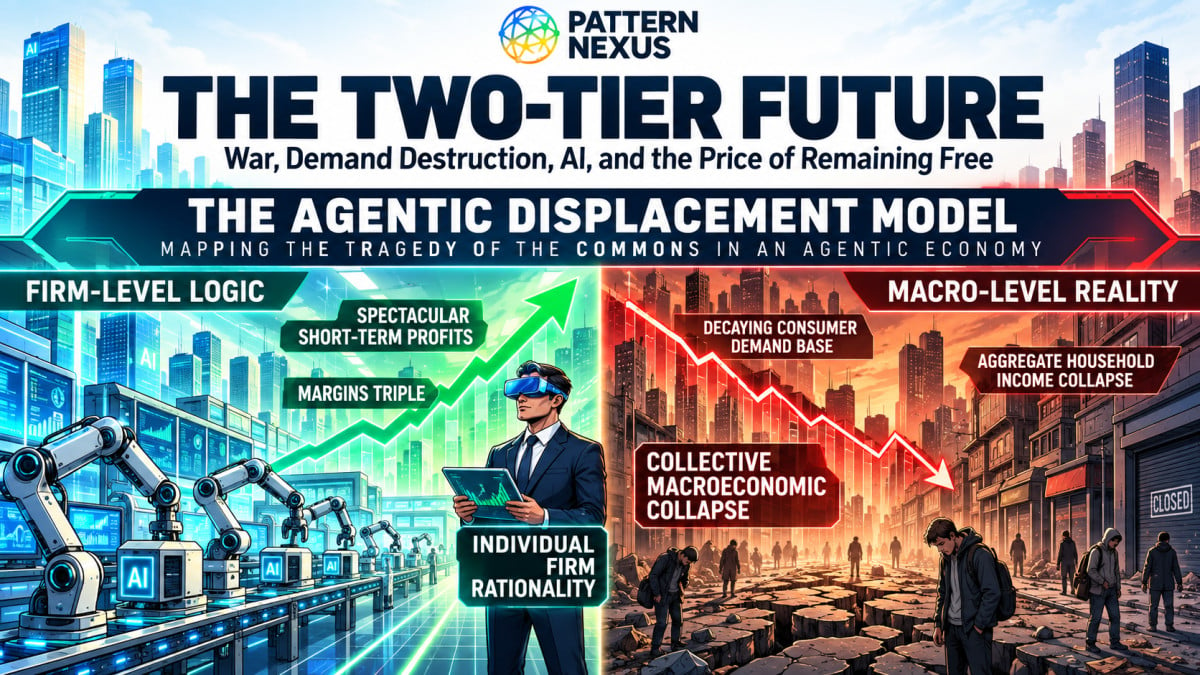
- 2026 turned the hypothetical physical shock into a measured one. The Iran war and restriction of Hormuz flows have eaten inventories while price, policy, and lost output destroy demand. [1]
- Ukraine and Iran meet in the delivered diesel barrel. Separate battlefields disrupt refining, shipping, freight, agriculture, and the spending power of households far from either war. [2]
- The Fed can tighten the price of money and maintain liquidity plumbing simultaneously. September's decision brought the policy target to 3.75%–4.00%, while the implementation note preserved bill purchases when appropriate to maintain ample reserves. [3][4]
- AI and robotics make ownership of production a more important distribution question. Higher output does not, by itself, replace earnings lost through displaced tasks. [5]
- The metaverse is the visible layer, not the initiating cause. Physically scarce experiences can become less affordable while digital approximations become cheaper and more profitable to the platform owner. [6]
- Four interpretations remain on the table: deliberate coordination among specified actors, independently convergent incentives, class division through price rather than law, and a transition in which the productivity dividend is broadly distributed. They require different evidence.
At the beginning of this year, I would not have told you I believed this entire future was coming together. I had followed pieces of it for roughly twenty-five years, spent a long time considering what they could mean together, and then moved away from believing the complete picture would materialize. Not because the underlying technologies stopped advancing. Because a possibility is not an outcome, and I had not seen enough steps connect to justify writing it as one coherent argument.
Then 2026 happened. The Iran conflict stopped being a modeled chokepoint and became a real energy, shipping, and inventory shock. Ukraine's campaign against Russian refining intensified. Diesel became the meeting place of two wars. Interest rates and the long end of the Treasury market created another constraint on financing and household cash flow. The industrial AI buildout kept demanding chips, capital, transformers, and electricity. Robotics made the old question about human labor harder to avoid.
I've written the components across Pattern Nexus for months and, in places, years. The oil cushion. The fertilizer lag. The debt and liquidity machine. The split between strong capital markets and strained households. The humanoid-robot economy. The origin of AI, the fragmentation of shared reality, the commodity dollar, and the infrastructure being built in space. This is the article where I connect them.
What happens when the average person becomes less necessary to production at the same time the physical world becomes more expensive to access, while the infrastructure required to participate in the next economy belongs to someone else?
The future may not be divided between people permitted to experience the world and people forbidden to do so. It may be divided between people who can afford the material world and people offered an increasingly convincing digital substitute for what they can no longer afford.
I am not asking you to accept a grand design because several dates line up. I want to look at every mechanism, including the interpretations that will make some readers uncomfortable, and distinguish what has been measured from what is plausible and what remains a hypothesis about intent. Those are three different things. Collapsing them into one is how people stop investigating.
PHYSICAL SHOCK
Iran, Hormuz, Russia, refining and diesel ration activity through cost and availability.
BALANCE-SHEET SHOCK
Long yields, refinancing and unequal liquidity distinguish who waits from who sells.
LABOR SHOCK
AI and robotics can change the wage-based distribution of productive output.
PLATFORM CAPTURE
Work, purchase, identity, attention and payments can consolidate in the same system.
ENERGY PERMISSION LAYER
Physical transport and digital compute both depend on real resources.
SPACE FRONTIER
A new physical frontier still depends on ownership, life support and exit.
ORIGIN OF THIS INVESTIGATION
The Conversation Before the Video: Why I Went Looking for Davos
The original discussion did not begin with someone trying on a headset. It began with long yields, mortgage refinancing, house values, fixed debt, equity, distressed assets and the question of what a new easing cycle might do to someone who owns property versus someone who is trying to acquire it. We talked about stocks sensitive to the direction of rates, the danger of the collateral falling while debt remains fixed, and the possibility that a later low-rate environment could create very different opportunities for different balance sheets.
Then the conversation moved toward geopolitics, the early-to-late 2030s, industrial automation, Agenda 21 and Agenda 2030, urban planning, virtual labor, physical travel, and space. That may sound like jumping between subjects. It was actually moving up layers of the same system: household balance sheet, national balance sheet, world energy and trade, automated production, then the ownership of the places where people live and work.
Here is the argument I was trying to locate in the 2022 Davos discussion. People with means can physically travel, innovate, meet, invest, own land, and experience the planet. People without means may increasingly receive a digital approximation. They can see Paris without purchasing the airfare. They can enter a beautiful virtual home without owning a square foot of physical housing. They can operate a virtual storefront without owning the platform, customer relationship, payment rail, or server.
I extended that argument in the conversation: imagine wages or subsidies financing basic necessities; users spending long hours in environments where their activity, consumption, work, and attention all become revenue streams; the physical world still operating behind the screen but becoming less economically accessible to the screen's occupant. I also mentioned a possible 2032–2040 convergence and space becoming another arena divided by ownership. Those are my hypotheses, not quotations from the WEF session, and the video does not prove that they will occur.
The strong version of the question is not whether people will be forced into VR tomorrow. It is whether an economic system can make digital substitution attractive—and sometimes practically necessary—by allowing physical options to become financially inaccessible. That can occur through income, housing, transport, debt, and energy before any explicit travel restriction exists.
Davos 2022 - Shaping a Shared Future: Making the Metaverse | World Economic Forum
01 · THE PHYSICAL ECONOMY
The September 2026 Shock: Demand Destruction Is No Longer Theoretical
Start with what can actually be counted. On September 18, the International Energy Agency reported that Hormuz oil flows averaged 7.6 million barrels a day in August 2026, down 13.1 million barrels a day from prewar flows. That implies roughly 20.7 million barrels a day in its prewar comparison. The IEA estimated second-quarter oil-market deficits averaging 2.2 million barrels daily and third-quarter deficits averaging 1.7 million—much smaller than the route disruption because the world was rerouting supply, drawing stocks, obtaining oil outside the Gulf, and consuming less. [1]
The agency reported 507 million fewer barrels in observed global stocks than at the war's onset, with member countries releasing more than 300 million emergency barrels. Across the preceding six months, demand averaged 5.8 million barrels a day below February 2026 levels. In the second quarter, demand was 5.3 million barrels a day below the year-earlier period. Those measures use different time frames. Don't add them or call all of them a supply deficit. [1]
| IEA measure | Reported scale | What it establishes |
|---|---|---|
| August Hormuz flows | 7.6 mb/d | Waterway throughput, not world output |
| Fall versus prewar | 13.1 mb/d | Route-flow shortfall before offsets |
| Second-quarter oil-market deficit | 2.2 mb/d average | Net market balance after offsets |
| Third-quarter oil-market deficit | 1.7 mb/d average | Projected/estimated net balance for that quarter |
| Observed stock change since war onset | −507 million barrels | Physical inventory depletion |
| Emergency stock release | More than 300 million barrels | A temporary buffer, not new production |
| Demand in Q2, year over year | −5.3 mb/d | Consumption contraction against Q2 2025 |
Why does that matter for the larger thesis? Because the market can appear to clear while millions of households quietly lose the ability to do something they did yesterday. A family drives less. A small carrier turns down deliveries. A factory suspends a shift. A farmer changes inputs. An airline reduces service. A worker loses a job because a firm cannot afford its costs. Some demand is voluntarily deferred; some is destroyed because activity has become physically unavailable or financially impossible.
In The Oil Cushion Is Breaking, I explained why the oil market's real reserve is not a headline figure for geological oil. It is the usable inventory, transportation, insurance, product supply, bypass capacity, and time available before price forces an adjustment. I called it a buffer stack. [7]
Demand destruction is not just a line on a chart. It is the physical world assigning access according to who can continue paying.
That is the direct connection to the two-tier future. A person can remain legally entitled to travel while losing the disposable income needed to travel. Economic rationing precedes, and may substitute for, any formal restriction.
02 · THE REFINERY BOTTLENECK
Iran and Ukraine Collide in the Same Diesel Barrel
Iran and Ukraine are separate conflicts. Their leaders have different objectives. But the effects of those conflicts can meet in one global product market. Hormuz constrains crude and refined-fuel delivery from the Gulf. Ukrainian strikes have hit the facilities that convert Russian crude into gasoline, diesel, jet fuel and other products. No common director is required for two independent supply shocks to amplify each other.
The IEA reported on September 17 that Russia's refinery throughput fell to 3.8 million barrels daily in June, about 30% below its year-earlier level and its lowest in more than twenty years. It estimated diesel output down nearly 30% against 2025. In the first eight months of 2026, a Russian refinery was hit on average once every three days. The agency also reported that combined Middle Eastern and Russian diesel exports fell to roughly 520,000 barrels daily in August, about 75% below the year-earlier month. [2]
A refinery is not a generic black box. Primary units separate crude into fractions. Secondary units—hydrocrackers, hydrotreaters, catalytic crackers, reformers—alter yields and meet product specifications. Destroying one of those units can create a far longer repair schedule than damaging a simple transfer pipe. The IEA says complicated secondary-unit repairs can take six to eight months on average after serious damage. [2]
The conflict has also constrained alternative routes. The IEA says Saudi and UAE bypass exports rose from 4.1 mb/d in February to 7.8 mb/d in June before Houthi attacks reduced them to 5.5 mb/d in August; the Saudi East-West pipeline then suffered shutdown in early September. Those are precisely the second-order buffers I warned about. A route that can bypass a chokepoint does not help if its own continuity is compromised. [1]
Reuters reported September 21 that analysts expected global diesel tightness to extend into 2027 amid low inventory and continuing supply disruption. That is a reported expectation, not a guarantee about future price or availability. [8]
| Immediate disruption | Delayed economic transmission | Who feels it |
|---|---|---|
| Gulf cargo delays | Freight, insurance, crude/product availability | Importers, airlines, motorists |
| Russian refining damage | Lower gasoil and diesel output | Trucking, farming, construction |
| Higher diesel cracks | Higher delivered energy cost | Food, merchandise, industrial users |
| Natural-gas and fertilizer cost | Application and planting decisions | Farmers, import-dependent consumers |
| Inventory draw | Less protection from next outage | Governments, firms, households |
The agricultural clock does not follow the news cycle
My Fertilizer Strait work asks what happens when natural-gas feedstock, fertilizer supply, diesel, shipment schedules and planting windows fall out of alignment. A farmer cannot always compensate for missing fertilizer applied at the wrong stage of a crop cycle. Importers with weak currencies may pay both a higher dollar price and a worse exchange rate. The effects can reach a grocery bill after the oil headline has moved on. That is a risk pathway, not proof of an inevitable global famine. [9]
The energy conflict therefore matters for much more than traders. It can reduce a family's available cash, their ability to save a down payment, and their ability to travel or invest. Those are the economic means that determine access to the physical world.
03 · WHO CAN WAIT, AND WHO MUST SELL
Demand Destruction Is an Ownership Event
Put two households in the same economy. Give them the same headline inflation rate, same diesel price, and same interest-rate decision. One owns productive assets, keeps cash reserves, and refinanced into manageable fixed-rate debt. The second depends primarily on wages, rents its home, and has little surplus after necessities. The shock is identical on paper. The adjustment is not.
| Shock | Liquid asset-owning household | Wage-reliant household |
|---|---|---|
| Higher fuel and food cost | May absorb with reserves or reallocate investment | Cuts activity, travel, savings and maintenance |
| High mortgage rates | May retain earlier fixed-rate borrowing; refinancing still a risk | May remain unable to enter homeownership |
| Automation | May receive returns on owned productive capital | Must retain employment or find replacement income |
| Asset-price collapse | Could buy assets if unlevered and liquid; can also lose equity | May lack the savings to purchase at lower prices |
| Liquidity rescue | Might benefit through collateral and prices | May recover only as wages and affordability improve |
Ownership doesn't make people invulnerable. In my housing discussions I have said exactly what happens when a leveraged property portfolio falls: asset value declines and the debt does not. Equity gets compressed. A landlord with unpaid rent and a refinancing wall may be forced to sell at the worst possible time. The variable isn't merely whether you own a deed. It is liquidity, debt structure, durable cash flow, and the ability to survive the shock without surrendering the asset.
The favorable ownership loop is familiar: productive assets generate revenue and collateral; collateral may permit financing; financing can buy more productive assets. Reverse the conditions and the loop runs backward: weak savings lead to emergency borrowing or forced sales; debt payments consume income; falling collateral impairs access to new credit.
That is why my Two Economies, One Balance Sheet analysis belongs here. Financial capital can look strong while the cash-flow position of households is deteriorating. The market capitalization of successful firms is not the same thing as the capacity of non-shareholders to accumulate a home, vehicle, business, or emergency fund. [10]
No one has to confiscate ownership for ownership to concentrate. Higher entry prices, costly credit, unequal collateral, distress sales and a rescue that repairs asset valuations before wage income can produce it over time. That is a mechanism to test in data; it is not an automatic description of every monetary cycle.
04 · MONETARY PLUMBING
The War-to-Liquidity Trap: Inflation Now, Intervention Later?
The market can be hit by inflation in essentials while its actual productive capacity and discretionary demand weaken. Fuel and freight prices rise. Household cash flow deteriorates. An employer's margin compresses. Meanwhile longer-term debt still has to refinance. Policy becomes difficult because a central bank cannot repair a damaged refinery by adjusting overnight rates.
On September 16, 2026, the Federal Reserve raised the federal-funds target to 3.75%–4.00%. Its September 16 implementation note, effective September 17, permits purchases of Treasury bills and, if needed, Treasury securities with three years or less remaining maturity to maintain ample reserves. That is an important mechanical distinction: tightening the policy rate and maintaining settlement-market reserves can coexist. It does not make every reserve-management purchase identical to broad QE, duration control, or yield-curve targeting. [3][4]
In Fed Just Hiked Into a 5% 10-Year, I tracked the refinancing pressure, term premium, reserve machinery and the part of my rate call I got wrong. The Fed tightened against debt and long rates I thought would make that move harder. I am not erasing that miss. I am separating my incorrect timing from the transmission mechanism that still deserves attention. [11]
Oil disruption → expensive products → squeezed real incomes → weaker demand and cash flow → more credit stress → potential pressure for liquidity support. The path can be interrupted, and the policy instrument matters.
My earlier Liquidity Needs a Cover argument was that a stressed system may find extraordinary intervention politically easier after a recognizable crisis. That does not establish that a government deliberately generated that crisis. A shock can be used opportunistically by actors who did not cause it. The questions are when the policy was developed, who authorized it, how it was financed, whose balance sheet it repaired, and whether a less concentrated alternative was available. [12]
There is also a genuinely different path. Energy flow can normalize, inventory can rebuild, inflation can subside, and long yields can fall without a massive rescue cycle. My job is to keep both mechanisms in view, not convert a liquidity scenario into a calendar-date promise.
05 · WHAT THE SOURCE ACTUALLY SAYS
The Davos Clip: A Doorway Into the Experience Divide
The source that started this investigation is the World Economic Forum's May 25, 2022 session Shaping a Shared Future: Making the Metaverse. The official session describes the growth of extended reality and asks how metaverse applications can be interoperable, inclusive and accessible. Andrew Ross Sorkin moderated the discussion. It is a public discussion of possible technology and economic access, not a law restricting travel. The companion video is already in the CMS video field above this body, where Pattern Nexus places it. [6]
I was searching for a discussion of those with the means to experience places physically versus those offered VR as an approximation. I won't manufacture an exact extended quotation from an unverified transcript. My interpretation is not dependent on pretending the entire later causal chain was uttered on that stage. What matters is the problem the discussion brings into view: the difference between making an experience digitally available and making the corresponding physical experience financially available.
| Physical experience | Digital substitute | What does not automatically transfer |
|---|---|---|
| Travel to another country | Immersive rendered destination | Mobility, local transactions, physical relationships |
| Ownership of a physical home | Virtual property or housing access | Land, durable collateral, legal exit options |
| Independent business | Storefront inside a platform | Full customer access and rules of distribution |
| Direct interaction | Simulated or AI-mediated encounter | Assurance of unmediated presence |
| Material exploration | Rendered exploration | Control of physical equipment and location |
This is not an argument that an immersive lesson, remote concert or travel simulation is worthless. A person with a disability, insufficient money, illness, family obligations, or limited mobility may receive a profoundly meaningful new option. The distinction I care about is addition versus replacement. Is VR extending what people can do, or making the loss of physical options tolerable for people who are losing them?
A society does not need to ban a destination if its costs already exclude a large portion of the population. A digital substitute may reduce suffering caused by that exclusion; it does not automatically remove the exclusion itself.
06 · THE 2016 SCENARIO
“Own Nothing”: Access Can Spread While Ownership Contracts
In November 2016, Ida Auken published the WEF-associated speculative essay Welcome to 2030. I own nothing, have no privacy, and life has never been better. The World Economic Forum's own Medium publication still hosts the full text. It describes a fictional city where products are services, transport is dramatically cheaper, AI and robots perform substantial work, people share space and possessions, algorithms anticipate consumption, and privacy is diminished. [13]
Read the entire scenario rather than the meme. It imagines abundant clean energy and cheap transport; it also acknowledges people left outside the city who felt obsolete after automation and built other ways of living. It contains both an attractive efficiency claim and a social-exclusion problem. Treating the essay as an enacted treaty would be false. Ignoring the economic questions it explicitly raises would be equally unproductive.
When the household stops owning something and starts purchasing continued access, the underlying asset does not cease to have an owner.
| Personally owned | Subscription or managed substitute | Who retains control |
|---|---|---|
| House | Rent or housing-as-service | Landlord or infrastructure owner |
| Car | Mobility subscription | Fleet, route and platform operator |
| Tools and equipment | Rental or tool-as-service | Equipment financier or provider |
| Software and files | License and cloud storage | Service terms, hosting and export controls |
| Media | Streaming account | License holder, platform, rights owner |
| Independent store | Marketplaces and rented storefront | Discovery engine, payment and account operator |
Renting is not inherently bad. Many people are better off renting a car for a single trip than owning one, and shared equipment can waste less capital. The distribution question is whether people can still acquire residual claims on assets that appreciate, generate income, survive unemployment, or pass to descendants. If convenient access spreads while those residual claims concentrate, the population has not become an equal society without property. It has become a society where different classes occupy different sides of the property contract.
Take two households earning $5,000 per month. One owns its housing and vehicle outright. The other rents both and relies on a stack of monthly services. The same job loss generates different survival runways. The first can reduce spending; the second risks losing the infrastructure of ordinary life. Neither household's freedom can be described by income alone.
This is where AI makes the essay's scenario more than a consumer-lifestyle thought experiment. If the owner also owns the robots, compute, housing, platform and payment service, the user can be productive and entertained without accumulating meaningful capital. That arrangement is possible. Whether it becomes dominant depends on law, competition, prices, ownership structures, household bargaining power and design choices.
07 · LAND, SERVICES AND MOVEMENT
Agenda 21, Agenda 2030, and the City: Follow the Mechanism
Agenda 21 came out of the 1992 Rio process. Its Chapter 7 concerns human settlements, shelter, land use, infrastructure, and sustainable energy and transport. The UN's 2015 Agenda 2030 contains broad sustainable-development goals. A fifteen-minute city, or a five-minute neighborhood concept, asks whether daily necessities can be reached nearby. These are related discussions about how people live and move, but they are not one statute, and none of those texts by itself mandates virtual living or a universal ban on travel. [14][15]
I am less interested in defending or attacking a planning slogan than in the system it can become when layered with housing ownership, energy prices, transport costs, account-based access, and service monopolies. The same walkable neighborhood can increase independence if residents retain affordable outward travel and economic choice; it can produce dependence if residents cannot afford to leave and need one corporate or administrative stack for every necessity.
| Design preserving independence | Design increasing dependence |
|---|---|
| Nearby services plus affordable outward travel | Nearby services but prohibitively expensive mobility |
| Competing utilities and merchants | One indispensable access platform |
| Owner-occupied and varied housing | Highly concentrated landlord ownership |
| Offline fallback, portable identity | Single account needed for every essential service |
| Affordable household power | Energy burden that prevents savings and productive activity |
Practical exit is the test. Can you leave the service and still obtain water, heat, transportation, work and food? Can you retain your property if you decline the digital account? Can you relocate without losing essential entitlements or the customer base through which you make a living? Those questions are measurable. A slogan about sustainability does not answer them in either direction.
08 · MACHINE OUTPUT AND HUMAN PURCHASING POWER
AI and Robotics Rewrite the Labor–Income Contract
My AI Causal Chain begins well before the chatbot cycle. Predictive models, classification, control systems, search, and industrial automation preceded today's generative interfaces. My humanoid robotics article then asks what happens when more of that computational capability acts on the physical economy. A robot is not merely a labor-saving gadget. It changes who sells productive hours to whom, and who owns the system that earns the return. [16][17]
Historically, ordinary households usually obtain spending power through wages. Businesses pay workers to produce, and workers purchase goods and services. In a highly automated economy, firms might produce more with fewer hours purchased from human workers. Machine output can rise without the machine receiving wages to spend at the grocery store. That is not a claim that every robot destroys a job. It is the distributional problem that emerges if paid tasks disappear faster than new independent income opportunities are created.
The ILO's May 2025 refined global index estimates one in four workers in occupations with some generative-AI exposure and 3.3% of global employment in its highest exposure category. Those are exposure measurements, not records of layoffs. The ILO emphasizes that much work is likely to be transformed rather than simply eliminated. My concern is the longer-term scenario in which AI and physical robots expand into additional economically valuable tasks while the ownership dividend remains narrower than the affected wage base. [5]
| AI productivity gain flows through… | Potential household effect |
|---|---|
| Higher real wages | Workers receive additional purchasing power |
| Lower prices | Consumers can access more goods at a given income |
| New employment | Displaced workers regain an earnings channel |
| Dividends and equity | Owners of productive assets receive income |
| Taxes and transfers | Governments redistribute part of the gains |
| Retained corporate profits | Benefits may accumulate first on owners’ balance sheets |
Who captures the output is a question more consequential than how many humanoid prototypes can walk across a conference stage. Watch cost per useful work-hour, reliability, maintenance, power supply, hours of work actually replaced or augmented, entry into new jobs, real wages, consumer prices, and broad household capital ownership. A post-labor economy with broad dividend ownership is materially different from one in which wages disappear but rents do not.
09 · THE PLATFORM ECONOMY
The Virtual Company Town: You Can Be Paid and Monetized by the Same Owner
Now add the virtual workplace. It need not mean that everyone spends every waking hour in a headset. The pieces already exist separately: gaming economies, creator markets, gig-work platforms, digital storefronts, streaming services, subscription software, remote employment, targeted advertising and wallets. An immersive environment could bring them together behind one persistent identity, one distribution algorithm and one set of contractual terms.
Imagine an operator selling access to the environment where you work, socialize, trade, play and learn. The operator receives revenue when you earn through a commission, when you pay a subscription, when you purchase virtual goods, when a marketer reaches you, and when you use affiliated financial or infrastructure services. In the most integrated arrangement, you may be economically valuable even while you are simply participating in daily life.
| Hypothetical monthly virtual worker | Cash flow |
|---|---|
| Gross paid work | $2,000 |
| Platform commission | −$200 |
| Hardware and access subscription | −$100 |
| Digital purchases | −$150 |
| Remaining cash income | $1,550 |
These amounts are illustrative. They are not estimates of an actual metaverse wage, a WEF proposal, or a corporate margin. They show a familiar two-sided-platform mechanism. A provider can collect a portion of labor income and a portion of consumption by owning the space in which both transactions occur.
The more serious issue is exit. A person might own designs or the intellectual property they create and still lose access to buyers after an account suspension. A creator may have a large audience but no portable customer list. A seller may own inventory but rent the ranking system that determines whether customers ever see it. A digital item may depend on a service staying online. Participation is not equivalent to ownership.
Labor + consumption + identity + payments + social relationships + data, inside one controlled environment, can turn a platform into a digitized company town.
The nineteenth-century company town gave an employer unusual influence over wages, housing and retail. The digital version does not need a coal mine or a single company holding every deed. A combination of account systems and integrated service providers could recreate parts of that dependence through contracts and interoperability barriers.
There are competing architectures: portable customer relationships, interoperable digital goods, open protocols, local file ownership, independent payment choices, cooperative platforms and businesses capable of serving customers outside one marketplace. These details distinguish a useful service from an infrastructure dependency.
10 · BEHAVIOR AND INFORMATION
The Market for Perception: An Environment Can Be the Advertisement
The first public web let a company observe which pages a user visited. Social media added social relationships, clicks, watches, purchases and engagement. AI assistants can adapt their responses and interfaces to the information available about an individual. Extended-reality systems can add gaze, motion, hand gesture and spatial information when hardware and permission settings allow it. The progression is not imaginary mind control. It is increasingly granular observation plus increasingly granular ability to change the environment a person sees.
In a conventional advertisement, someone inserts a message into the world. In a persistent virtual world, an operator may be able to alter the appearance of the world itself: the order of things encountered, apparent popularity of products, personalized prices, the look of an event, recommendations made by AI characters, and the social cues surrounding a transaction. Legitimate personalization and manipulative optimization can use overlapping infrastructure.
| Information environment | What can be observed or personalized |
|---|---|
| Static website | Requested pages and navigation |
| Social platform | Attention, interaction, purchases, social graph |
| AI-mediated service | Conversation, inferred interests, personalized output |
| Immersive environment | Potential gaze, movement, spatial behavior and changing surroundings |
Two users could enter what looks like the same virtual place but see different characters, different offers, different evidence or different simulated events. How would the users know their experiences differed? Could an auditor reproduce an incident if the surroundings are generated anew every time? Would people know whether the stranger talking to them is another human, a scripted sales avatar, or an AI agent optimized for a platform metric?
Those are verifiable design and governance questions. Do not confuse them with proving that any corporation can perfectly control an individual's mind. Human behavior is not that simple. But control of distribution, interfaces and incentives can still matter enormously without total control over anybody's beliefs.
My January piece, The World We Woke Up In, discussed the fragmentation of shared reality before this metaverse investigation. That earlier article is about information distribution and how competing frames prevent people from agreeing on a common picture of events. This is the next step: what happens when the surrounding digital environment, not just a news feed, can differ from person to person? [18]
11 · THE CONSTRAINT UNDERNEATH THE SCREEN
Energy: The Permission Layer of Physical Freedom
The digital economy did not abolish physics. It placed additional computing, storage, telecommunications and cooling requirements on a physical world that already needs electricity, diesel, natural gas, transport, agriculture, water and manufacturing. A virtual Paris needs data centers and networks. The real Paris still needs buildings, physical labor, transport, food and power. Someone pays the material bill for both.
The IEA's April 16, 2026 updated report says worldwide data-center electricity use rose 17% in 2025, while electricity consumption in AI-focused data centers increased 50%. Its central outlook puts total data-center demand at about 485 TWh in 2025 and 950 TWh in 2030, roughly 3% of global electricity demand at that time. AI-focused data-center power consumption rises faster than the total. Those are different categories and 2030 is a projection, not an observed value. [19]
The IEA also reports that AI's energy use per simple task has fallen substantially as systems become more efficient. New applications—video, reasoning, large agentic workflows—can be much more energy-intensive. Both trends can coexist. It is analytically lazy to say a single AI question is consuming the grid; it is equally lazy to ignore industrial load growth and the bottlenecks in turbines, transformers, memory, chip manufacturing and interconnections. [19]
Who pays for the grid? One hyperscaler may build dedicated generation and pay the incremental cost of its connection. Another project may obtain arrangements that shift upgrade costs to a wider ratepayer base. Some regions have spare supply, others have constrained distribution. The cost allocation cannot be assumed universally. It must be followed through utility tariffs, agreements, subsidies and construction schedules.
| Claim on physical energy | Why it matters |
|---|---|
| Household power | Heating, cooling, food, productive home activity |
| Transport fuels | Mobility, trucking, aviation, farm equipment |
| Manufacturing | Jobs and material output |
| Food and fertilizer | Agricultural production and distribution |
| Data centers | AI output and recurring digital services |
| Public infrastructure | Water, hospitals, utilities and emergency systems |
Here is my conditional mechanism. If a household has to allocate more earnings to fuel, rent, electricity and debt service, it may have less to save, build, invest, travel or purchase equipment. If digital entertainment and virtual experiences remain comparatively affordable, they may occupy a greater role. A provider of those substitutes can earn more recurring revenue while the household's physical options narrow. This is an economic steering mechanism that can operate through prices. It does not demonstrate that somebody deliberately raised fuel prices to force headset use.
If distributed power, cheap transportation and broad AI productivity improve household purchasing power, the same chain can run the other way. Energy can expand autonomy. The direction is a matter of material costs and ownership—not the moral character of electricity.
12 · INFRASTRUCTURE IS STRATEGIC POWER
The Global Input Stack: Why the Commodity Dollar and US–China Competition Belong Here
In The Petrodollar Did Not Die. It Mutated Into the Commodity Dollar, I argued that energy production, export capacity, refining, maritime security, insurance, financing and sanctions can reinforce one another. Control of a raw material matters, but control of the route, processor, currency rails and final delivery can matter just as much. [20]
Now move the same logic into the AI economy. Semiconductors require capital, manufacturing equipment, advanced materials, water, electricity and specialized labor. Robotics requires motors, sensors, batteries, chips, manufacturing plants and physical service networks. Space requires launch capacity, telemetry, orbital infrastructure and life support. There is an identifiable industrial stack behind every apparent software product.
Capital → energy and materials → chips and compute → AI and robotics → production and logistics → economic, commercial and military capability.
US–China competition, the Iranian conflict, Russia's war against Ukraine and disputes over maritime chokepoints are not one undifferentiated war. Their participants have different objectives and constraints. But they can affect intersecting supply chains. Countries can pursue similar investments—chips, power, robotics, shipping, satellites—because they recognize similar strategic bottlenecks, not because all of them obey one blueprint.
The distribution problem scales. A state wholly dependent on foreign compute or imported diesel has less freedom of action in a crisis. An individual dependent on one platform or one landlord experiences a narrower version of that principle. The scale and legal rules differ, but the ownership/access distinction repeats.
There are also unequal international effects. Wealthier importers can draw inventories, subsidize consumption or bid for available barrels. Low-income import-dependent countries can encounter a dollar funding problem and an energy problem at the same time. The first households to lose physical opportunities may live far from the states whose firms own the most valuable AI infrastructure. A global average hides that distribution.
13 · WHO GETS THE PHYSICAL FRONTIER
Space Is a New Ownership Frontier—Not a Ready-Made Escape Hatch
Space was not an unrelated tangent at the end of the conversation. It extended the same question beyond Earth. Who will own launch capacity, navigation, communications, orbital platforms, resource-processing systems and future settlements? Who can physically participate, and who experiences the frontier through screens? Who owns any future income generated by those systems?
Early commercial space activity is capital-intensive and mostly administered by companies or governments with the ability to finance expensive infrastructure. That may concentrate access to rare physical experiences. It may also produce public benefits—telecommunications, weather services, navigation, scientific research—that millions can receive without traveling. These outcomes are not mutually exclusive.
| Possible space model | Who receives benefit / assumes dependency |
|---|---|
| Concentrated private infrastructure | Operators and shareholders receive residual returns |
| Broad public and pension ownership | More households share indirectly in productive returns |
| Competitive orbital services | Multiple operators provide switching possibilities |
| Closed company settlement | Residents depend on operator for survival and departure |
But the claim that wealthy people can simply move off-world in the next few years is not supported by present settlement capacity. A wealthy tourist can buy extraordinary access; that is not the same as sustaining life independently in space. An early privately administered habitat could be the ultimate company town: air, water, food, shelter, employment, communications and the ride home may all depend on an infrastructure operator. Money does not automatically equal autonomy.
That is the intriguing inversion. Space can be a frontier of exceptional material experience and simultaneously an environment of exceptional dependence. The decisive question remains ownership, governance, alternatives and the right and practical capacity to exit.
14 · ALTERNATIVE EXPLANATIONS
Four Interpretations of the Same Evidence—Without Flattening Them into One Story
Here is where the argument has to withstand scrutiny. Several physical systems are developing in parallel. That is a starting observation. It does not, by itself, tell us whether one group coordinated all of them or whether multiple institutions faced common incentives. I am willing to investigate coordination; I am not willing to turn my own hypothesis into forged evidence.
| Interpretation | Mechanism | Evidence that would be needed |
|---|---|---|
| Deliberate coordination among identified actors | Linked policy, corporate and financing plans restrict autonomy | Authentic documents, budgets, contracts, directives, implementation links |
| Convergent incentives | Independent states and firms pursue productivity and infrastructure rents | Ownership, investment, contracting and market concentration data |
| Two-tier exclusion through prices | Physical goods become inaccessible before formally restricted | Real wages, mobility, energy burden and property access by income |
| Broadly distributed abundance | Automation lowers costs and expands independent opportunity | Real wages, lower essential costs, portable markets and broader asset ownership |
A deliberately managed transition
One possible interpretation is that identifiable institutions coordinate policies and investments intended to move specific populations toward managed services and digital participation while concentrating productive ownership. That is a serious allegation about intentions and actors. The evidentiary burden is a traceable chain: who made the decision, what mechanism was authorized, how it was funded, when it was implemented, and what institutional power connected the participants. A WEF scenario and two similar investment timelines do not establish that chain.
Convergence without a global director
Companies want recurring revenue, governments want administrative capacity and resilience, employers want productivity, and investors seek returns. These incentives can make independently chosen systems mutually reinforcing. Corporate concentration can grow without a universal mastermind. This mechanism may explain more of an actual commercial outcome than rhetoric about secret control.
Economically enforced two-tier access
A third possibility concerns the outcome rather than the motive. Physical access is rationed increasingly by price and ownership while a relatively affordable digital layer fills the experience gap. A person remains formally free but increasingly lacks the means to make the choice. That is measurable even if nobody has issued a travel ban.
Distributed productivity and greater autonomy
AI could lower the cost of education, production, healthcare, building, energy management and small-business formation. Robots may extend individual capacity, not simply centralize it. Competitive markets, public investment, household equity, open standards, interoperable platforms and affordable mobility could make physical opportunity more widely available. That is not guaranteed either. It is the counter-scenario against which the concentration thesis should be tested.
Shared results do not prove shared intentions. But the absence of proof of coordination also does not make market concentration, surveillance capacity or household dependency imaginary. The claims need to be kept distinct so that real problems are not lost in a dispute over motives.
15 · TIMING AND FALSIFICATION
My 2032–2040 Window: The Signals That Would Change My Mind
I have watched many of these systems for years. In the conversation that triggered this article I described the 2032–2040 period as a possible convergence window. I am not claiming there is a known date for one global event. AI systems can improve rapidly; robots take time to deploy at commercial scale; power plants and grids move through long capital cycles; a maritime corridor can be blocked overnight; household property turnover and debt maturities move on yet another clock.
The 2030 label also appears frequently because it is a convenient institutional and industry planning horizon. Matching year numbers are not proof that separate forecasts identify the same event. To test a convergence hypothesis we need leading indicators that can be measured, compared with the correct population and revised over time.
| Signal | Why it matters | What weakens the dependency thesis |
|---|---|---|
| Labor share and real wage growth | Tracks purchasing power beyond asset income | Durable broad wage gains |
| Productivity vs household equity | Tracks who owns automation returns | Growing household capital claims |
| Energy burden by income | Tracks capacity to move and maintain a home | Lower essential-energy share |
| Housing affordability and credit | Tracks physical asset entry | More stable attainable ownership |
| Travel cost relative to income | Tests physical experience divide | Cheaper real-world mobility |
| Platform account portability | Tests digital company-town structure | Ability to keep work/customers after switching |
| Energy routes and inventories | Tests persistence of 2026 shock | Flows normalize and stocks rebuild |
| Grid-cost allocation | Tracks who pays for AI infrastructure | Large users cover attributable costs |
| Space ownership and access | Tracks who captures new-frontier returns | Competition and broad participation |
A robot count exceeding the human population by 2035, a mass departure of wealthy people from Earth, or a fully implemented global digital dependency system by a fixed date are not established conclusions. They are claims that would need specific definitions, reliable series and deployment assumptions before they could be promoted from speculation to forecasts.
If real wages, affordable travel, household ownership, low-cost electricity and portable digital businesses improve while AI output rises, the strongest version of this theory loses support. If those indicators deteriorate together while infrastructure rents and ownership concentrate, the concern gains empirical weight. That is the discipline I want in Pattern Nexus: not just a theory that can explain anything after it happens, but one that states what would make me revise it.
16 · RECONSTRUCTING THE HYPOTHESIS
What the Original Argument Did—and Did Not—Establish
The discussion that sent me searching for Davos had four major propositions. First, different technological and economic clocks may converge during the 2030s. Second, a society can move toward a managed service economy through price, investment and infrastructure ownership without passing one law that says everyone must surrender their property. Third, people with capital can retain more real-world choices while digital equivalents serve those whose physical options are narrowing. Fourth, expansion into space creates another layer of scarce physical access and capital-intensive ownership.
The conversation also made stronger conjectures: that virtual employment could become the route by which people buy food and other necessities; that digital environments could be used to influence perceptions; that energy affordability might become a major lever; and that specific groups may be acting intentionally toward this end. Those conjectures are the questions this article investigates. They are not statements verified by the single recording.
The important correction to my own thinking is that I had drifted away from the fully assembled future. A false timing call or the absence of one catalyst was enough to make me question the whole sequence. The measured 2026 energy shock, the continued AI-industrial investment, the change in monetary configuration and the increasing centrality of robotics brought me back to the economic structure of the earlier argument. Not every earlier interpretation was validated; enough underlying mechanisms became live issues that the complete question deserved a full article.
17 · PHYSICAL ACCESS
Rights, Money and Means: Three Different Levels of Freedom
Picture someone with the legal right to fly anywhere permitted by border law but no disposable income for airfare. Picture someone legally eligible to buy a home but unable to save a down payment after rent and food. Picture an online merchant who can theoretically switch marketplaces but would lose all customer visibility by doing so. On paper these people possess rights. In practice their choices are constrained by capital, infrastructure and switching costs.
This is not an argument for equating every financial disadvantage with political coercion. It is an argument against pretending the legal permission alone settles the question of effective access. To experience the material world, a person often requires money, available equipment, physical transport, time, energy and the freedom to leave a provider.
| Formal access | Economic means | Independent capacity |
|---|---|---|
| Allowed to travel | Fare, fuel, accommodations | Time, vehicle choice, ability to return |
| Allowed to own property | Deposit, debt service, income | Durable title, upkeep and resilience |
| Allowed to run a business | Capital and customers | Control of distribution and revenue |
| Allowed to use AI | Connectivity and subscription | Exportable work, local capability, alternatives |
| Allowed to buy energy | Price and payment method | Reliable supply and alternative providers |
If physical travel rises faster than household income, a virtual visit may become relatively attractive. That attraction can be a benefit and still reflect an underlying loss. People may choose a cheap simulation because they prefer it, because their health restricts travel, because they are busy, or because they have been priced out. The observed headset use alone does not tell us which explanation applies.
A meaningful test asks whether the person could comfortably choose the physical alternative. If not, the technology may be improving the quality of a constrained life without changing why the life is constrained.
18 · ECONOMIC EXTRACTION
One Person, Several Revenue Streams: Follow the Virtual Ledger
There is no need to invent a mysterious digital currency for this model. It can operate through ordinary dollars and normal contracts. A person earns income on a work platform. That platform charges a commission. The person pays for software, entertainment, communication, a digital storefront, and possibly a device-financing plan. The platform or its partners may receive advertising revenue and sell commercial services based on patterns of use. If account portability is poor, the person bears a high economic cost to leave.
The point is not that every payment is exploitation. Payments can finance real value, and consumers may rationally prefer convenient services. The question is whether one operator occupies the sides of so many transactions that it can increase fees or reduce user choices without losing enough customers to discipline its behavior.
Paid work → platform fee → access subscription → purchases inside the environment → advertising and other commercial services → data-derived product improvement. Each arrow can finance a different line on the operator's accounts.
Compare this with ownership of a real independent business. A sole proprietor may own tools, clients and a local reputation transferable between providers. A seller inside a proprietary platform may own products but not ranking or reach. If AI agents later manage more of the interface between customer and seller, the owner of that interface can become an even more significant gatekeeper.
There is also a financial dimension. Platform credits and nonportable digital assets might be denominated in something called a balance, but a balance is not automatically a bank deposit, legal tender, transferable capital, or an independently enforceable property interest. The fine print determines whether someone holds money, a contractual claim, or access revocable under platform rules.
The harder version of the hypothesis is that a person earns enough within a managed ecosystem to remain alive and connected but never acquires a meaningful share of the assets earning revenue from that person's continued participation. That is the loop to measure. It is not proven simply because a virtual-reality company exists.
19 · SCENARIOS
How the Next Decade Could Play Out: Four Conditional Paths
Path A — Energy flow normalizes and abundance is shared
Hormuz and bypass routes recover, damaged refining capacity returns, inventories rebuild, and fuel products become more affordable relative to household income. Credit stress subsides without a deep forced-sale cycle. AI raises productivity; new employment, lower consumer prices and broader ownership distribute a meaningful portion of the gains. In this world, VR supplements the material world and individual robotics can enhance independence. The strongest two-tier argument loses support.
Path B — Prolonged stagnation and managed comfort
Physical essentials remain expensive relative to lower- and middle-income earnings. Automation continues, but gains reach capital owners more quickly than labor. Transfers, subsidies and low-cost platform services cover some daily necessities while household asset formation lags. Digital experiences occupy more of leisure and social life, not because they are mandatory, but because physical alternatives are harder to afford. This is the price-driven two-tier scenario.
Path C — Repeated shocks and infrastructure consolidation
Oil, credit, grid or geopolitical disruptions recur before the system fully repairs its buffers. Companies and households with liquidity acquire distressed assets; indebted entities lose bargaining power. Governments support critical nodes; the actual design of the rescue determines whose balance sheet emerges stronger. Access contracts proliferate because upfront ownership is difficult. The result could be a more vertically integrated economy assembled through a series of emergency decisions rather than a single public announcement.
Path D — Explicitly coordinated restrictions by identified actors
Governments, firms or other institutions jointly choose and fund specific measures intended to constrain independent ownership or physical mobility and redirect specified populations into managed digital systems. This is the most demanding intentionality claim. Establishing it requires more than describing an incentive or a forecast: we would need authenticated plans, budgets, named participants, legal provisions, procurement arrangements and implementation records. Those are investigable categories.
These four paths are not equal forecasts. They are competing causal models that help identify what to monitor. Different countries, regions and income groups may experience different paths simultaneously. A household in an energy-import-dependent economy and a household that owns shares in an AI power producer might live through the same global year and experience opposite financial outcomes.
20 · THE INTERNATIONAL LAYER
The Global Balance Sheet Behind a Personal Headset
Zoom out from the household. Exporters produce crude, refined products, natural gas, food and minerals. Importers need foreign exchange and credit to buy them. States borrow for public services, defense and energy subsidies. Utilities and corporations borrow for power plants, electrical equipment, data centers, robotics and transportation. Households finance housing, work tools, education and the subscriptions that increasingly intermediate daily life.
When war restricts diesel delivery, a country cannot simply convert a line of software code into the missing physical product. It can bid for supply, draw stocks, subsidize purchases, change taxes, reduce use, or negotiate routes. Each adjustment transfers costs and constraints somewhere else. A government can limit a domestic consumer's price while assuming a fiscal bill; a currency importer may still face a higher cost in local money. There is no neutral way to distribute an actual shortage.
Now add the capital intensity of AI. The IEA reports the largest technology firms collectively spent more than $400 billion on capital expenditure in 2025 and expected a substantial further increase in 2026. Its report also describes funding requirements that exceed what some developers can comfortably cover from their own balance sheets. The AI boom is therefore sensitive to interest rates, capital-market expectations and power-infrastructure buildout—the same broad forces being stressed by the energy shock. [19]
Physical and digital claims compete for real resources while delivering different outputs. A new substation serving a factory can support local employment. A data center can generate substantial economic value with a relatively different labor profile. A refinery repair affects deliverable diesel; an AI model upgrade cannot replace the barrel by itself. These are choices about infrastructure allocation, not proof that one type of investment is intrinsically illegitimate.
That is why I refuse to write a metaverse article that leaves out commodity supply, currency, grids and household debt. The screen is the consumer interface. Behind it sits a global balance sheet.
21 · THE OPERATING DEFINITIONS
Ownership, Independence and Participation Are Not Synonyms
Ownership is a legal and economic claim on an asset, often including its income and residual value. Participation is the ability to use an infrastructure, enter a market or experience a service. Independence is the practical ability to make choices, retain alternatives and leave an operator without losing the basics of life.
A renter participates in housing but may have little property equity. A creator participates in a platform economy but may not control account reach. A wealthy person can buy a spaceflight yet remain entirely dependent on life-support operators. Someone with a modest income, paid-off home, useful tools and reliable local energy may exercise meaningful independence without being among the global elite.
| Example | Participation | Ownership | Independence test |
|---|---|---|---|
| Renting a home | Lives there | Landlord owns asset | Can resident relocate affordably? |
| Creator marketplace | Earns from audience | Platform controls distribution | Can audience and earnings transfer? |
| Private spacecraft passenger | Experiences orbit | Operator owns critical systems | Can passenger self-sustain or exit? |
| Home with distributed energy | Uses own power | Household may own panels and storage | Can key functions continue during disruption? |
This is the analytic center of the entire article. The future isn't simply virtual versus physical, rich versus poor, public versus private or convenient versus inconvenient. It is the pattern of residual ownership and the availability of meaningful exit across the systems that make life possible.
22 · PRIOR RESEARCH
The Pattern Nexus Research Chain: Follow the Work Backward
I did not invent the connections this week by finding a 2022 video. Below is the Pattern Nexus research sequence that leads into the question. Different articles investigated different mechanisms, often before the latest 2026 developments.
- The World We Woke Up In — January 2026: narrative fragmentation, economic bifurcation, capital steering, the AI–robotics transition.
- Liquidity Needs a Cover — March 28: war, monetary necessity, crisis narratives and balance-sheet intervention.
- The Oil Cushion Is Breaking — June 1: the hidden inventory, bypass, product and financial buffers beneath the energy market.
- The Petrodollar Did Not Die. It Mutated Into the Commodity Dollar — July 18: commodity production, refining, shipping, dollar rails and strategic access.
- Two Economies, One Balance Sheet — September 9: strong capital and weak household cash flow on the same financial architecture.
- Fed Just Hiked Into a 5% 10-Year — September 16–17 decision: rates, duration, reserves and refinancing.
- The Fertilizer Strait — agriculture, delayed crop-input effects and food import fragility.
- The Real Reason They Are Building Humanoid Robots — September 21: productive ownership when human labor becomes less indispensable to some tasks.
- The AI Causal Chain — September 23: the historical architecture behind today's AI and automation.
Read the chronology. A forecast published before a shock is different from an after-the-fact explanation. Some of my calls were early or incomplete. The archive lets readers examine both the underlying mechanism and my timing rather than accepting a polished retrospective.
FINAL PATTERN NEXUS THESIS
The Fight Over Physical Reality
I spent years following these pieces, then years questioning whether they would ever assemble into anything resembling the future I had considered. By early 2026 I had moved away from that complete picture. What changed was not a single video or one memorable sentence. It was the appearance of measurable, interacting stress across physical energy, international supply chains, household budgets, refinancing, AI infrastructure and automation.
Iran and Ukraine are not a virtual-reality story. They are wars with their own causes, participants and human costs. But the supply shocks they produce can alter the cost of access to the physical economy. High yields and debt can determine who sells assets during the resulting stress. Monetary intervention can stabilize some balance sheets sooner than others. AI and robotics can change who receives income from productive output. Platform architecture can decide whether digital participation creates independent wealth or continued dependence on access contracts.
Then the original Davos question looks different. It is not merely whether a headset can take a person somewhere beautiful. It is whether the person retains the material means to go there without the headset. It is not whether technology makes life more comfortable. It is whether comfort is accompanied by ownership and real options—or substitutes for the loss of both.
The decisive divide is not virtual reality versus physical reality. It is ownership versus dependency—and who controls the door between them.
The sharpest version of this thesis does not need an imaginary perfect controller. Energy scarcity can ration mobility. Financing can determine who owns housing. Automation can alter the wages-to-output relationship. Vertical integration can capture multiple transactions from one person. Geopolitical competition can concentrate investment in strategic chokepoints. A coordinated plan is one explanation worth investigating, but a dangerous result can also emerge from actors chasing separate incentives.
Follow the chain: oil to diesel; diesel to transport and farming; fuel to prices; prices to household cash flow; cash flow to debt and property; debt to monetary response; monetary response to asset distribution; AI to productive work; productive work to ownership; ownership to platform participation; platform participation to the cost of leaving. It is a material chain, not a mood.
What I want to know is who can still own the systems that make life possible, who has to rent permission from their operators, and whether the next economy gives ordinary people a meaningful share of the wealth it creates. A person can be informed, entertained, employed and connected inside a system and still lack the resources to leave it.
The question isn't whether we will be allowed to see the world. The question is whether we will still have the means to experience it for ourselves.
READER QUESTIONS
Frequently Asked Questions
Did the Davos session announce a travel ban?
No. The public discussion concerned metaverse development and access. This article investigates the economic possibility that legal mobility survives while affordable physical mobility deteriorates.
Does the WEF’s 2016 “own nothing” essay establish an enacted plan?
No. It was a speculative future scenario. The question it raises about service access, privacy, labor and residual ownership can be evaluated independently of whether its author advocated that future.
Do fifteen-minute cities legally confine residents to a zone?
No, not by definition. A locally accessible neighborhood and a specific transportation restriction are separate policies. Examine actual regulations, costs and meaningful alternatives.
Does AI necessarily eliminate employment?
No. Exposure, task transformation and displacement are distinct. The central question is how productivity gains reach workers, consumers and people who do not own the machines.
Why connect the Iran war and Ukraine with VR?
Because energy shocks can change the affordability of physical goods and mobility while automation and digital services expand. That is a conditional economic transmission pathway, not an assertion that wars were launched to sell headsets.
What is demand destruction in normal language?
People or firms purchase less because goods became too costly or unavailable, or because their income and output fell. It can mean a canceled trip, reduced freight, a lost shift or less fertilizer applied.
Is the $2,000 virtual worker ledger a real programme?
No. It is an explicitly hypothetical cash-flow illustration of platform commissions, subscriptions and purchases.
Is it certain robots outnumber people by 2035?
No. No such numerical outcome has been established here; commercial robot definitions and deployment assumptions would need to be specified.
Could a rich space traveler be dependent too?
Yes. The operator of a spacecraft or off-world settlement may control the life-support and exit infrastructure, regardless of the passenger’s wealth.
What would challenge the central economic hypothesis?
Sustained broad real wage gains, affordable physical travel, declining energy burdens, attainable property, expanding household productive ownership and portable digital businesses.
Does this prove that all governments and technology companies coordinate a unified plan?
No. That specific claim needs documentary evidence tying identified actors, decisions, budgets and implementation together. The economic concentration pathway can exist even without that coordinated intention.
Why publish the full argument now?
The 2026 energy and refining disruptions, September monetary configuration and ongoing AI buildout made interacting physical, financial and technological mechanisms newly salient. The longer-horizon outcome remains a hypothesis to test.
RESEARCH RECORD
Research and Data Sources
Original videos, reports, dated reporting and earlier Pattern Nexus research. Numbers in the article return here.
- [1] IEA, Oil markets strain to plug the gap left by Middle East supply shortfall, September 18, 2026
- [2] IEA, Russian refining sector struggles amid intensifying Ukrainian attacks, September 17, 2026
- [3] Federal Reserve, FOMC statement, September 16, 2026
- [4] Federal Reserve, Implementation Note, September 16, effective September 17, 2026
- [5] ILO, Generative AI and Jobs: A Refined Global Index of Occupational Exposure, May 20, 2025
- [6] World Economic Forum, Shaping a Shared Future: Making the Metaverse, May 25, 2022
- [7] Pattern Nexus, The Oil Cushion Is Breaking, June 1, 2026
- [8] Reuters, Global diesel shortage likely to last into 2027 as storage tanks drain, September 21, 2026
- [9] Pattern Nexus, The Fertilizer Strait, 2026
- [10] Pattern Nexus, Two Economies, One Balance Sheet, September 9, 2026
- [11] Pattern Nexus, Fed Just Hiked Into a 5% 10-Year, September 2026
- [12] Pattern Nexus, Liquidity Needs a Cover, March 28, 2026
- [13] Ida Auken, Welcome to 2030, World Economic Forum Medium edition, November 2016
- [14] United Nations, Agenda 21, Chapter 7: Promoting Sustainable Human Settlement Development
- [15] United Nations, Transforming our world: the 2030 Agenda for Sustainable Development
- [16] Pattern Nexus, The AI Causal Chain, September 23, 2026
- [17] Pattern Nexus, The Real Reason They Are Building Humanoid Robots, September 21, 2026
- [18] Pattern Nexus, The World We Woke Up In, January 10, 2026
- [19] IEA, Key Questions on Energy and AI, April 16, 2026
- [20] Pattern Nexus, The Petrodollar Did Not Die. It Mutated Into the Commodity Dollar, July 18, 2026
- [21] AP, Russia and Ukraine trade deadly strikes, September 22, 2026
- [22] Reuters, Global diesel prices hit record highs, September 21, 2026
Research cutoff: September 25, 2026. Data years, quarter comparisons and projections are marked in context. Prewar Hormuz 20.7 mb/d is derived from reported 7.6 + 13.1 mb/d. Hypothetical cash flows and causal charts are illustrations, not measured causal estimates. The 2032–2040 convergence and intent claims are hypotheses rather than established programmes.
The question is not whether a person can put on a headset. It is whether people retain the money, energy, assets and alternatives to leave the headset behind and experience the material world on their own terms.
Christopher Grenke / Pattern Nexus Research Desk · September 25, 2026 · Public / No paywall.
Article overview
For years, I followed pieces of a possible two-tier economic future, then moved away from believing they would come together. In September 2026, the Iran oil shock, Ukraine refinery attacks, demand destruction, long-rate pressure, AI, robotics and the ownership of physical infrastructure have forced me to put the entire argument into one place: who retains access to the real world if an increasingly automated economy makes ordinary people dependent on the systems they do not own?
What's Your Reaction?
 Like
0
 Dislike
0
 Love
0
 Funny
0
 Wow
0
 Sad
0
 Angry
0

Nexus (Christopher)
Founder of Pattern Nexus. I research markets, macro, geopolitics, AI, history, ancient systems, and the patterns most people overlook. I’m also building Market Radar, a trading scanner designed to read pressure, risk, confirmation, and setup quality before ch…
Related research

The Diesel Trap: Why the Oil War Is Bending Sanctions Before Winter
The October Russia-sanctions waiver adds a new policy chapter to the Pattern Nexus oil-war thesis. I connect the diesel bottleneck to emerg…
5 shared topics, 2 shared assets, same research avenue.
Iran: Escalation Ladder — Reactivation Enabled
The Iran escalation ladder is active again. I examine the October strike risk, the infrastructure-war danger, rising tanker attacks alongsi…
4 shared topics, 1 shared asset.
The World I’ve Been Mapping Is Taking Shape
I connect the developments now taking shape across AI infrastructure, private power, critical minerals, the Iran energy shock, digital doll…
5 shared topics, same research avenue.
The Oil War Is Becoming a Global Economic War
An extensive Pattern Nexus reconstruction linking the Iran/Hormuz disruption with Ukrainian refinery attacks, diesel shortages, Saudi pipe…
5 shared topics, 2 shared assets, same research avenue.
The Monetary Break — Audio-Video Edition
Episode 4 of the weekly Pattern Nexus audio-video series turns Part 4 of Cycles of Power into a shorter story about how silver redemption, …
3 shared topics, 1 shared asset, same research avenue.
One System, Many Flags: Ukraine, Iran, North Korea and the Illusion of Separate Wars
The United States can arm Ukraine while temporarily easing pressure on Russian oil, convert stockpile transfers into new procurement, court…
4 shared topics, 1 shared asset.
From Liquidity Storm to Chokepoint War: Auditing 472 Pattern Nexus URLs — What Landed, What Missed, and What Comes Next
I audited the public Pattern Nexus record across 472 unique URLs and the saved full-text article export, then rebuilt the major calls from …
5 shared topics, same research avenue.
The Oil Inventory War Machine: How Long the Global Buffer Can Hold
A full Pattern Nexus reconstruction of U.S. and global oil inventories from the 1970s through the 2026 war shock, including original regres…
6 shared topics, 2 shared assets.
Comments (0)
Security Check
Please complete the captcha to verify you are human.