
They Found the Dead at Göbekli Tepe. Now the Story Is Changing.
New research published September 22, 2026 documents the first two preserved burial contexts at Göbekli Tepe, containing at least four individuals in PPNB contexts dated around 8700–8000 BCE. Pattern Nexus examines the graves, 928 other bone fragments, the earlier modified-skull evidence, postmortem damage, erosion and slope failure, the site's domestic activities, regional funerary practices and unresolved research questions.
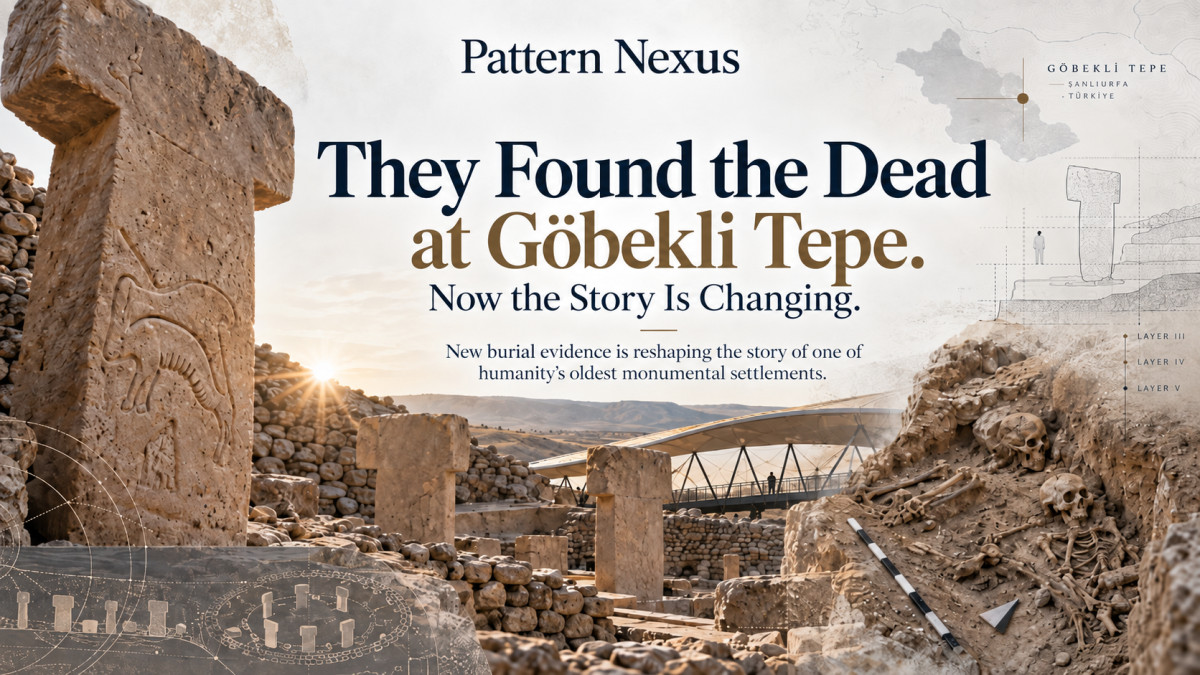
For thirty years, archaeologists have been finding human bones scattered through Göbekli Tepe’s monumental buildings. They had the bones. They had the pillars. What they did not have was a preserved burial that could show where some of those bones originally came from. Now they have two. And once you start connecting the burial evidence with the sediment, architecture, geology and other Neolithic settlements in the region, the story becomes much bigger than four ancient individuals.
Julia Gresky and Lee Clare published the new study on September 22, 2026. It identifies a collective grave containing at least three people and a separate burial containing a young adult. Both belong to Pre-Pottery Neolithic B archaeological contexts dated approximately 8700–8000 BCE—around 10,000 to 10,700 years ago. The paper does not supply a separate direct radiocarbon date for each skeleton.[1]
- Two burial contexts: the first preserved graves reported from Göbekli Tepe, not the first human bones found there.
- At least four people: three in a reused grave and one in a separate burial; a possible additional person is not excluded.
- 928 other fragments: the newer tally of mostly unrelated pieces recovered throughout the excavated settlement deposits, excluding the two burial contexts.
- A new causal explanation: some bones could have moved downhill from damaged burials into lower monumental buildings with the sediment surrounding them.
- A critical limitation: natural redeposition does not erase evidence for deliberate skull modification or other mortuary practices.
Here is the question that interests me: how much of what we have been calling a ritual deposit reflects what those people deliberately did, and how much reflects what happened to their settlement over the following ten thousand years? Those are two different causal chains. This study gives us a way to begin separating them.
I am going through the burials, the actual data, the earlier skull evidence, the regional archaeological record and the environmental processes. The labels matter: observed bone is not automatically evidence of ritual; a damaged skeleton is not automatically evidence of violence; and a plausible reconstruction is not the same thing as an excavated fact.
8700–8000 BCE is the archaeological date range of these contexts. It is not four individually calibrated radiocarbon measurements.
928 fragments do not equal 928 people. A single person can leave numerous fragments, and these have not all been assigned to individuals.
Some bones can be deliberately modified while other remains arrive in the same area through erosion. The evidence does not force a single explanation for every fragment.
01 · THE ACTUAL DISCOVERY
The discovery was published this week. The excavation happened years ago.
First, let’s get the reporting straight. The paper is First burials give insights into mortuary rites at Göbeklitepe, Early Neolithic Türkiye, published September 22, 2026, in PLOS ONE. The German Archaeological Institute announced the findings in September. The publication is new; the graves were not both dug up last Tuesday. One context was found in 2012 and completed in 2022. The other was found and excavated in 2017 during construction associated with a protective shelter over the site.[1][2]
Since systematic excavation began in 1995, archaeologists have recovered human remains from fill inside and between the special monumental buildings. The scattered nature of the bones made it difficult to establish exactly how the dead had originally been placed. Researchers could study the bones, but a recognizable grave gives you something different: a relationship between a person, a floor, a wall, a pit and the processes that happened afterward.
The new paper presents two preserved burial contexts, not two bones and not just two skulls. It therefore addresses the missing link between an original burial and the later fragments spread around the excavated mound.
02 · WHEN THESE PEOPLE LIVED
This is a 10,000-year-old question, not an 8,000-year-old one
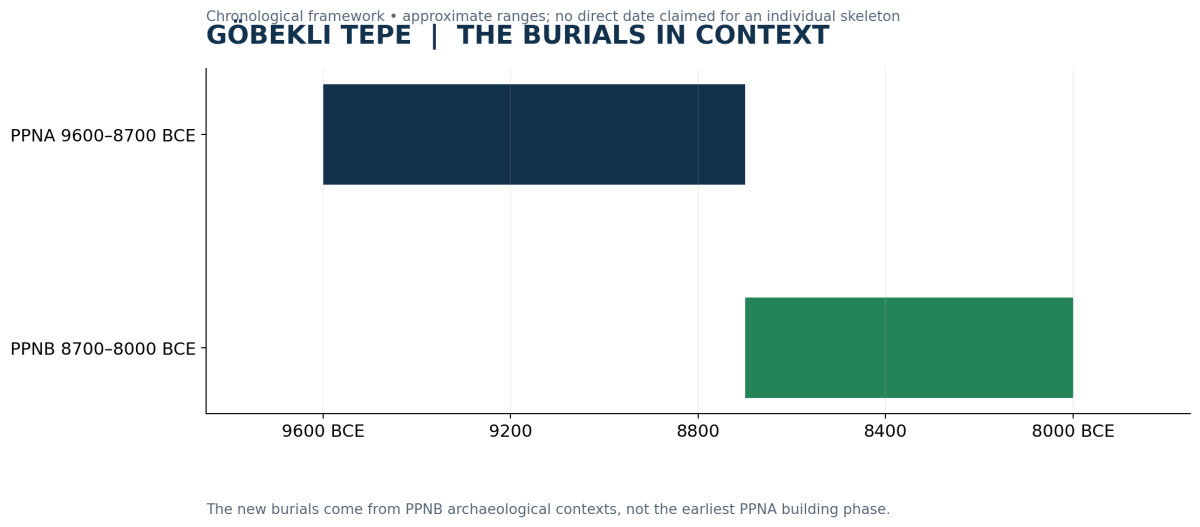
Göbekli Tepe lies about 15 kilometers northeast of Şanlıurfa in southeastern Türkiye, in the northern Fertile Crescent. The tell developed across roughly 1,600 years, from Pre-Pottery Neolithic A (about 9600–8700 BCE) into Early/Middle Pre-Pottery Neolithic B (about 8700–8000 BCE). Its T-shaped pillars and monumental enclosures are exceptional, but the site also contains later rectangular structures and evidence of daily activity.[1][7]
One common description of this news calls the skeletons “8,000 years old.” That mixes up the units. 8000 BCE is about 10,000 years before today. These burial contexts span 8700–8000 BCE, approximately 10,000–10,700 years ago. The range is wide for a reason: the paper locates the graves archaeologically but does not report a direct radiocarbon date for each named individual.
| Period | Approximate dates | Relevance |
|---|---|---|
| PPNA | 9600–8700 BCE | Early occupation and major monumental architecture. |
| Early/Middle PPNB | 8700–8000 BCE | Continued settlement and contexts containing the two reported burials. |
That also means these four people are not automatically the original builders of the earliest monuments. They may have been descendants or later residents. The source cannot establish their exact relationship to the original construction generation.
03 · THE COLLECTIVE GRAVE
Three people beneath a floor—and maybe a fourth
In 2017, work on drainage for the main excavation area exposed a kidney-shaped pit cut into the plaster floor of a rectangular PPNB building. Inside were the skeletal remains of at least three people. Skulls lay together toward the southeastern corner, postcranial bones occupied the middle, and some long bones were positioned to the west. This was not three untouched skeletons lying side by side.[1]
| Individual | Osteological assessment | Estimated age |
|---|---|---|
| 1 | Adult female | At least 35 years |
| 2 | Adult male | 20–30 years |
| 3 | Adolescent, provisionally assessed as female | 11–14 years |
| Possible additional person | Not established | A skull seems too mature for Individual 3; some foot bones differ |
Three crania, three mandibles and the skeletal inventory establish the minimum of three individuals. The question about a fourth comes from anatomy that does not match neatly, not a fourth complete skeleton. The adolescent sex assessment also comes with the normal limitations of osteological sex estimation before skeletal maturity.[1]
What is really interesting is the arrangement. At the lowest level, some elements of one left upper limb remained articulated on plaster. Small bones of hands and feet survived. The researchers interpret the grave as reused: earlier burials were moved within the confined pit when subsequent people were placed there. The final bone clusters may represent a sequence of funerary events rather than one moment of simultaneous death.
There were no observed cut marks, heat alterations or ochre traces on the bones in this grave. Rodent damage, mineral coverage and postmortem breakage were present. There is no basis here for announcing that these people were sacrificed or killed in a single violent event.[1]
04 · THE SINGLE BURIAL
A young adult buried beside Special Building A
The other burial was originally recognized in 2012, protected and left for later investigation, then excavated in 2022. The skeleton lay beside the eastern wall of a small space immediately west of Special Building A. The body was flexed on its left side and faced east. It rested on fist-sized stones rather than in a clearly defined burial pit.[1]
The principal postcranial skeleton and a mandibular fragment are consistent with a female aged approximately 20–30. But cranial material collected in 2012 appears to represent a male, and the boundary between upper fill and the original burial could not be reconstructed with certainty. Those cranial pieces may be from another person. It would be inaccurate to merge every bone found in that spot into one individual.
This grave matters for a very specific reason. Much of the body remained in its original position, yet the bones were extensively broken and altered. That means fragmentation can happen even where a body was not deliberately dismantled and scattered. An intact burial context does not mean an undamaged skeleton.
05 · THE ORIGINAL MYSTERY
928 fragments—and the danger of reading them as 928 people
Before this publication, the prevailing mystery was straightforward to state and difficult to solve. Human bones appeared in the deposits that filled Göbekli Tepe’s monumental buildings, but not in the orderly form of recognizable graves. The new paper says the broader assemblage, excluding the two burials, comprises 928 mostly unrelated human bone fragments. They represent males and females of multiple age categories.[1]
These are 928 fragments, not 928 dead people. The bones are mixed, often highly incomplete, and frequently lack original associations. Turning a fragment count into a death toll is not analysis. It is a category error.
The fragments occur with limestone rubble, animal remains and artifacts in places that underwent repeated construction, collapse, filling and other disturbance. Once the original context has been lost, you have to reconstruct how a bone got from the person to the layer where an archaeologist found it.
06 · THE SKULL EVIDENCE
The earlier skull findings did not disappear
In 2017, Gresky, Juliane Haelm and Clare published a separate study of modified crania. At that stage they reported 691 human fragments: 408 cranial and 283 from the rest of the skeleton. In other words, about 59% of that earlier sample consisted of skull fragments. These numbers belong to the 2017 sample; they must not be silently pasted onto the 2026 total of 928 fragments.[3]
More importantly, some skulls were deliberately altered. The 2017 research documented seven specially modified fragments attributable to three people, including deeply incised lines on skull vaults and a drilled perforation in one example. The 2026 paper says this distinctive deep-incision pattern has since been recognized from five individuals, although those modified remains cannot yet be securely assigned to one narrow architectural phase.[1][3]
That is physical evidence for intentional human treatment. The new explanation involving erosion is not a reason to dismiss it. Different bones can have different histories. Some may have come from disturbed graves; others may reflect selection, modification, deliberate repositioning or additional postmortem practices.
Archaeologists sometimes use the term “skull cult” for culturally patterned treatment of human skulls. That term does not prove modern-style worship, sacrifice or a particular theology. Interpretations involving ancestors, social identities or enemies are hypotheses about meaning. The modifications themselves are observations.
Then there is the iconography. Pillar 43 in Special Building D contains a headless human representation amid birds and other carved animals. The researchers also report that corvid bones appear at about four times the frequency observed at other contemporaneous sites nearby. They discuss exposure of the dead as one possible explanation; neither the animal imagery nor the bird bones alone proves an excarnation ritual.[1]
.jpg)
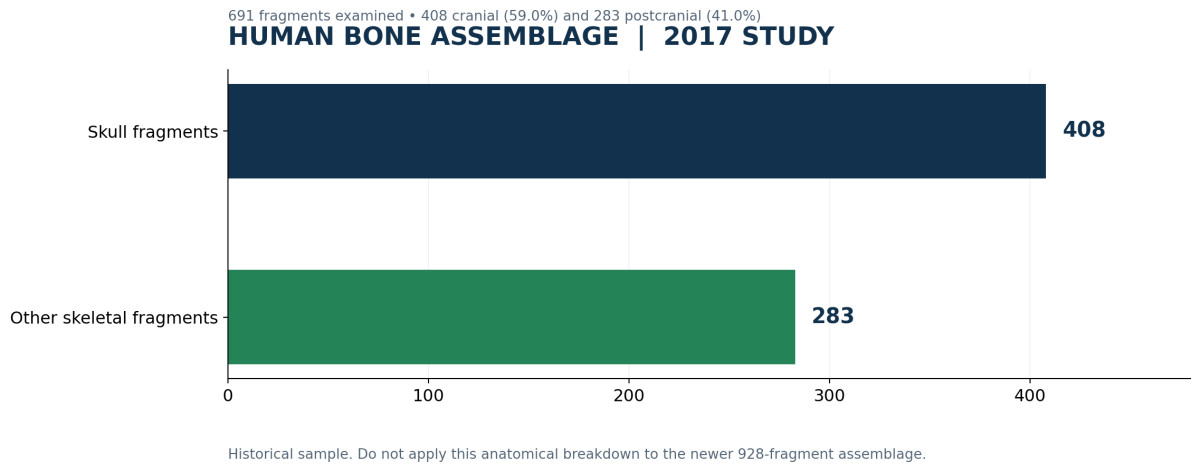
Do not combine the counts: 691 is the fragment total discussed in the 2017 skull paper; 928 is the expanded background assemblage described in 2026. Neither is an estimate of total burials or deaths.
07 · WHAT HAPPENED AFTER BURIAL
Minerals, pressure and time can produce a fragmented skeleton
The scientific discipline here is taphonomy: what happens to organic remains after death and how those changes affect the record we eventually excavate. This is where the preserved burials become useful as a comparison against the dispersed bones.
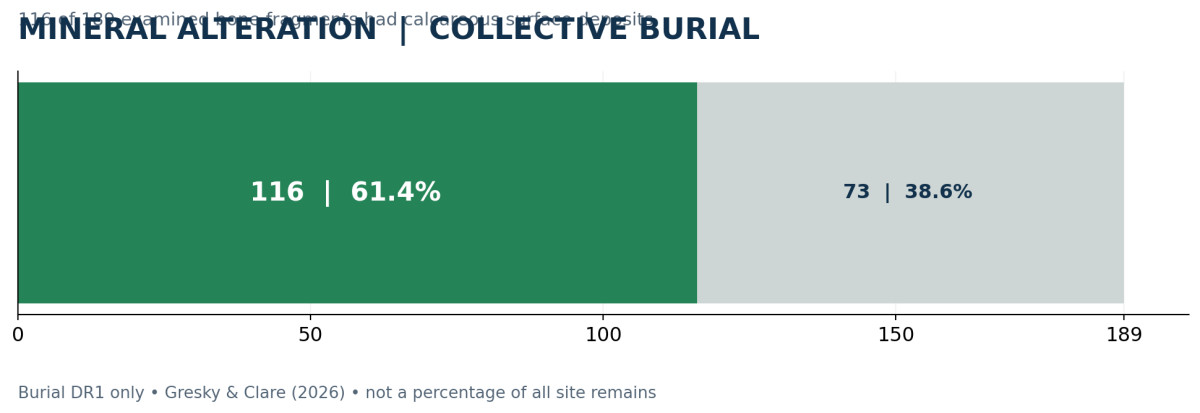
In the collective burial, 116 of 189 examined fragments—61.4%—showed calcareous deposits covering major portions of their surfaces. Some deposits fixed neighboring hand and forearm bones together. The authors also report severe postmortem fragmentation, pressure-related breaks and rodent gnawing. Not every smooth or spiral break could be assigned a single clear cause, which the paper states explicitly.[1]
The separate, largely in-position skeleton also showed broken shafts, missing long-bone ends and mineral deposits coating fracture edges. Those conditions supply a real-world example of the damage a buried skeleton can accumulate without requiring that somebody deliberately smashed the bones.
That does not prove all bone breaks everywhere on the mound were natural. It establishes a viable mechanism that researchers can test against individual fragments and their stratigraphic setting.
08 · HOW THE BONES REACHED THE MONUMENTS
The new hypothesis connects the burial floor to the slope
Now connect the observations. Göbekli Tepe is not a perfectly flat museum floor. The settlement developed on a mound with higher areas and lower depressions. Some monumental buildings stand in lower zones. Archaeological deposits accumulated uphill through generations of occupation and construction. The new study proposes that some higher deposits contained ordinary subfloor graves and later moved into lower areas through erosion and slope failure.[1]
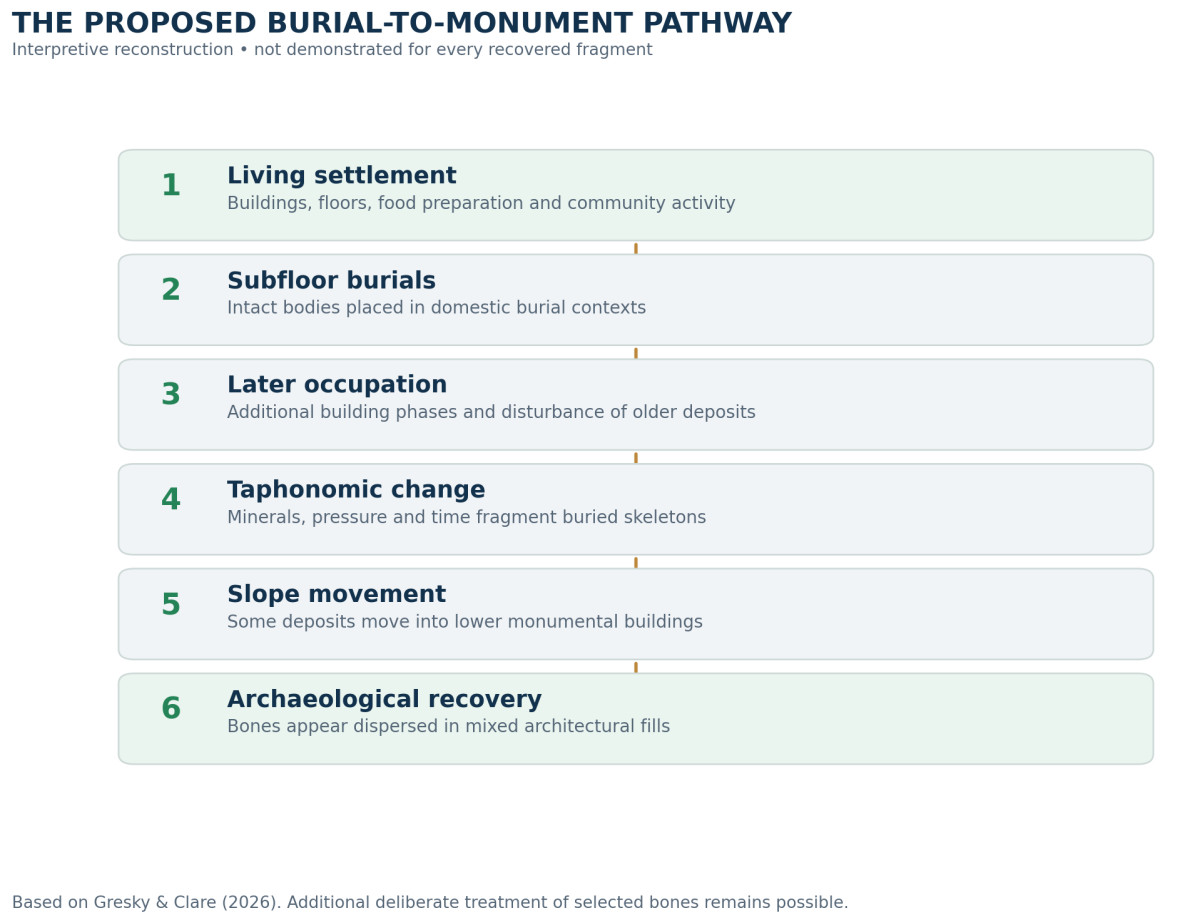
That offers a causal route: body buried beneath floor → later building phases and burial damage → fragmentation → sediment movement → bones mixed into monumental-building fill. A bone recovered next to a famous pillar might therefore have originated in a different building higher up.
We should be precise about the strength of this conclusion. The researchers can compare the type of bone damage, document the burials and evaluate the architecture and terrain. They have not proven a one-to-one route from every loose bone back to a specific lost grave. Their explanation is a substantial, testable reconstruction rather than a fully solved map of every individual.[1]
09 · DID THE ANCIENTS BURY THE BUILDINGS?
Intentional closure and natural infill are not the same process
Earlier descriptions of Göbekli Tepe frequently emphasized people intentionally backfilling monumental enclosures, sometimes interpreted as ritual closure. But archaeologists have increasingly examined whether erosion, slope movement, structural failure and later construction helped produce the fills. The burial paper cites that reappraisal because the explanation for the sediment also affects the explanation for bones inside it.[1]
Moritz Kinzel’s 2024 study of the site’s architecture and seismic effects identified several categories of disturbance: structural problems, deterioration, human intervention, landslides and earthquakes. It discusses multiple high-energy episodes and later redeposition of settlement material downhill. It does not show that a single earthquake destroyed the whole settlement, and it does not establish that no building was ever deliberately filled.[4]
Imagine excavating mixed soil inside a stone building. If you begin with the assumption that people intentionally dumped every layer there, a human fragment might look like a selected ritual deposit. If some of that material came down a slope after earlier habitation, your interpretation has to change. Not automatically to “nothing was ritual,” but to “we need to identify the origin of each deposit before assigning motive.”
10 · THE TEMPLE-ONLY MODEL CHANGES
The dead belong to a community, not just to the pillars
Göbekli Tepe became internationally famous through an influential model: hunter-gatherers built a monumental ceremonial complex before fully developed agriculture, and communal ritual may have helped reorganize social life. The monumental architecture remains extraordinary, but the simplistic version of an isolated temple with no surrounding lived community has been under revision for years.
A 2019 study led by Laura Dietrich analyzed more than 7,000 grinding-related artifacts, including handstones, slabs, pestles and mortars. It supplied evidence for substantial cereal processing and food-preparation activity around the buildings. The occupation also includes rectangular buildings and other features associated with everyday use.[5]
The two burials add the dead to that picture. A community that lives in a place often also marks, uses and remembers the place through its dead. These burials are direct evidence of burial contexts within the settlement.
But here is the chronology control again: both reported graves date to PPNB contexts. They do not independently describe the exact domestic organization of the earliest PPNA phase. They strengthen the wider settlement model without proving that every phase of the site operated identically.
11 · THE WIDER TAŞ TEPELER WORLD
Göbekli Tepe was never the only settlement doing unusual things
The Taş Tepeler region is essential here. Since 2021, expanded excavation in the Şanlıurfa area has increased the comparative record for early Neolithic architecture and mortuary behavior. The new paper brings Göbekli Tepe into dialogue with Karahantepe, Sefertepe, Sayburç and Çayönü rather than interpreting every fragment in isolation.[1]

| Site | Published comparison | Why it matters |
|---|---|---|
| Karahantepe | Approximately 70 human fragments, many cranial; some cutting, incising, scraping or burning. | Intentional modification exists within the broader monumental/domestic landscape. |
| Sefertepe | A skull incorporated into a plastered niche and a separate concentration containing at least 21 skulls. | Some mortuary deposits were deliberate and spatially organized. |
| Çayönü | Skull Building with large cranial assemblages in later phases and more complete bodies in earlier contexts. | Funerary customs could change within one settlement. |
| Sayburç | A domestic context with cranial and long-bone material from at least 19 individuals; some traces of burning. | Selected bones could be moved and concentrated in built spaces. |
What these comparisons show is diversity. Primary burial, reuse of graves, manipulation of skulls and later secondary deposition can all occur in the broader Neolithic world. The presence of one practice does not cancel the others. In fact, that diversity is exactly why the 2026 authors warn against treating redeposition as a universal explanation.[1]
12 · CLIMATE, EARTHQUAKES AND EROSION
The landscape is part of the archaeological story
There is another research chain I want to keep connected. Lee Clare’s April 2026 palaeoclimate paper places Göbekli Tepe inside the transition from the Younger Dryas to the Early Holocene and later short phases of climatic instability. These communities were changing their settlement and food systems while the environment around them was also changing.[6]
Combine that work with Kinzel’s architectural observations and the burial paper, and you can frame a geological question: did environmental and structural instability contribute to moving burial-bearing deposits from one part of the settlement into another? Rainfall, slope pressure and earthquakes are possible elements in that explanation; the papers do not establish one all-explaining catastrophe.
The difference matters. “An earthquake killed these four people and buried the temples” would be a dramatic sentence. It would also be unsupported by these findings. The data support a more interesting investigation into repeated occupation, changing topography, building repair, sediment movement and the long afterlife of a settlement.[1][4][6]
The causal chain: the lives and funerary choices of Neolithic people formed one set of deposits. Geological and environmental processes modified and relocated some of those deposits. The excavation record is the intersection of both.
13 · WHAT WE DO NOT KNOW
Four human beings are not yet four complete biographies
There is an understandable temptation to ask whether these people were relatives, rulers, builders, victims of a disaster or members of a forgotten population. The paper does not establish those answers. It is an osteological and taphonomic analysis, not a published genetic genealogy, isotope-based life history or forensic cause-of-death report.
| Question | Evidence as of September 25, 2026 |
|---|---|
| Are there preserved burial contexts at Göbekli Tepe? | Yes. Two are described in the paper. |
| How many individuals? | At least four across the two contexts; more may be represented. |
| Is cause of death known? | No. |
| Are they related? | Not established in this study. |
| Were they sacrificed? | Not established; collective burial showed no observed cut marks or burning. |
| Do we have direct radiocarbon dates for every skeleton? | Not reported in this paper; dates are contextual. |
| Do we have published ancestry profiles for these individuals? | Not in this study. |
| Were these the first monument builders? | Not established; the burials belong to later PPNB contexts. |
| Did erosion move all the scattered bones? | Proposed for some remains, not demonstrated for each fragment. |
A distinction I would like people to get used to: the more unusual a claim, the more important it becomes to ask exactly which instrument, sample and archaeological context would establish it.
14 · THE NEXT RESEARCH TESTS
What would actually move the story forward?
There are several obvious next steps. Direct radiocarbon dates, where suitable material survives, could narrow the grave chronology. Ancient DNA, if recoverable, might test biological relationships between the people buried together and the wider population history of Neolithic Southwest Asia. Neither result is in the newly published study.
More excavation could identify additional graves upslope. Spatial and stratigraphic analysis of loose bones could test whether their distribution matches specific erosion pathways. Microscopic study might separate damage caused by humans from damage caused by burial pressure, minerals and animals. Comparing deliberately modified crania with the newly preserved burial population could establish whether distinct treatments cluster by time, place or individual.
Those tests would help answer the real question: which remains record what the inhabitants did, and which record what happened later to the places where they lived?
15 · THE PATTERN NEXUS LENS
The ancient world left us evidence. It did not leave us an explanation key.
This is what makes the discovery so interesting to me. People tend to look at Göbekli Tepe and jump straight to the finished structure: enormous pillars, animals cut into stone, circles on a hill and a story about the people who somehow organized all of this before the cities we are familiar with. I get that. It is extraordinary.
But a system does not consist only of its most impressive objects. It consists of people obtaining food, building shelter, coordinating work, raising children, managing death, replacing buildings, moving stone, dealing with the weather and changing the landscape by living on it for generations. The monumental pillars are one part of that system, not a substitute for it.
Then time adds another layer. Floors crack. Walls fail. Minerals enter bone. Sediment moves. A grave that was meaningful in one building ends up as fragments inside a different building. Ten thousand years later, we find the fragments beside a pillar and start interpreting the pillar as the reason the bones are there. Sometimes it might be. Other times the landscape brought the bones there.
That is the shift: stop treating the excavation as a frozen snapshot and start reconstructing the processes that produced it. The evidence for skull modification remains. The evidence for burial beneath floors is now stronger. The evidence for a broader settlement has been accumulating for years. Geological research gives us a plausible way those systems became mixed in the ground.
Göbekli Tepe remains an extraordinary site of early monumental architecture. The new research makes the people around those monuments more visible—and gives us a better way to distinguish their choices from the changes imposed by time.
16 · FAQ
Questions people are going to ask
Did they just find human remains at Göbekli Tepe for the first time?
No. Scattered bones have been documented for decades. The new study describes the first two preserved burial contexts and analyzes their implications.
Are the skeletons 8,000 years old?
The contexts date approximately 8700–8000 BCE, or roughly 10,000–10,700 years ago. An 8000 BCE date is not an age of 8,000 years.
How many people were buried?
At least three in the collective grave and one young adult in the other. A possible fourth person in the collective context is discussed, so the full minimum across the two contexts is four.
Were they murdered or sacrificed?
The study does not establish a cause of death or evidence for sacrifice. No observed cut marks, burning or ochre were reported on the collective burial bones.
Does this disprove the skull cult evidence?
No. Modified crania are documented in earlier research. The new taphonomic model may explain some loose fragments, not every intentional modification.
Were they the people who originally erected the pillars?
That is not established. The graves date to later PPNB contexts, whereas major site occupation and construction began earlier.
Has ancient DNA from these four people identified their ancestry?
No genetic ancestry result for these four individuals is presented in this study.
Why were bones found inside monumental buildings?
The authors propose that burial-bearing deposits from higher structures could have moved downslope into lower monumental buildings. Deliberate handling of selected bones may also have occurred.
SOURCES
Research and data sources
The source numbers are cited inline. Primary scientific publications carry the factual weight; the geological and climate papers provide context, not a claim of proven cause of death.
- Gresky, J. & Clare, L. (2026). “First burials give insights into mortuary rites at Göbeklitepe, Early Neolithic Türkiye.” PLOS ONE, 21(9), e0358979. Read source ↗
- German Archaeological Institute (September 2026). “New publication: Human remains and burial practices at Göbeklitepe.” Read source ↗
- Gresky, J., Haelm, J. & Clare, L. (2017). “Modified human crania from Göbekli Tepe provide evidence for a new form of Neolithic skull cult.” Science Advances, 3(6), e1700564. Read source ↗
- Kinzel, M. (2024). “Shaking up the Neolithic—Tracing seismic impact at Neolithic Göbekli Tepe/Southeast-Türkiye.” Archaeological Research in Asia, 40, 100560. Read source ↗
- Dietrich, L. et al. (2019). “Cereal processing at Early Neolithic Göbekli Tepe, southeastern Turkey.” PLOS ONE, 14(5), e0215214. Read source ↗
- Clare, L. (2026). “Göbeklitepe in Palaeoclimate Context: Human Responses to Climate Change in the Upper Tigris and Euphrates Basins from the Younger Dryas to the Early Holocene.” Heritage, 9(5), 179. Read source ↗
- UNESCO World Heritage Centre. “Göbekli Tepe.” Read source ↗
Image credits: Scientific figures 1–4 are reproduced from Gresky & Clare (2026), PLOS ONE, CC BY 4.0. The excavation-area image is reproduced from Dietrich et al. (2019), PLOS ONE, CC BY 4.0, photograph credited to E. Küçük / DAI. Original figure-panel credits and source links are retained in captions and linked figures. Original Pattern Nexus charts are derived from the cited research. Pillar 43 photograph: Sue Fleckney, CC BY-SA 2.0; Karahantepe photograph: Vincent Vega, CC BY-SA 4.0, both via Wikimedia Commons, with credit and license links in the corresponding captions.
Evidence note: Dates are approximate archaeological context dates. Fragment totals count fragments, not individuals. Proposed redeposition is an interpretation for some material, not proof that all fragments shared one origin.
Pattern Nexus closing note: We are not looking at a new civilization discovered underneath Göbekli Tepe. We are looking at a better reconstruction of the people, burial practices, settlement layers and natural processes that produced the archaeological record we already knew was there.
What's Your Reaction?
 Like
0
Like
0
 Dislike
0
Dislike
0
 Love
0
Love
0
 Funny
0
Funny
0
 Wow
0
Wow
0
 Sad
0
Sad
0
 Angry
0
Angry
0

Founder of Pattern Nexus. I research markets, macro, geopolitics, AI, history, ancient systems, and the patterns most people overlook. I’m also building Market Radar, a trading scanner designed to read pressure, risk, confirmation, and setup quality before chasing a move. Pattern Nexus is where I connect the dots between data, history, technology, and the bigger system playing out around us.






Comments (0)