
Greenland Wasn't Sold. The Arctic Control Plane Was Rewritten.
Greenland wasn't sold or annexed. The September 22, 2026 U.S.–Denmark–Greenland security agreement expands Pituffik, provides for defense areas at Narsarsuaq and Mestersvig, establishes broad U.S. military access, limits non-NATO military presence and sensitive foreign investments, and seeks continuity even if Greenland becomes independent. Pattern Nexus places the signed treaty inside its earlier Monroe Doctrine and Arctic control-plane coverage—and separates what was signed from what remains to be approved, funded and built.
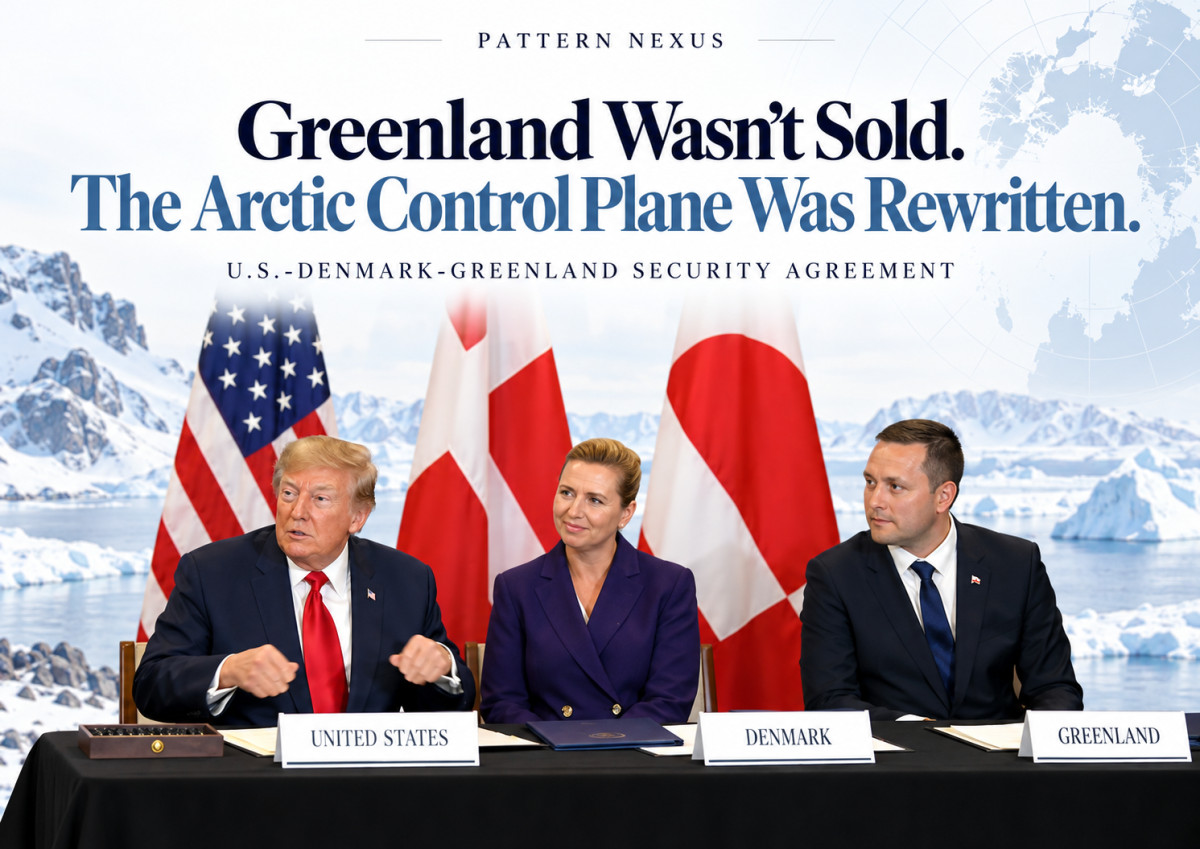
Greenland was not sold, annexed, or transferred to the United States. The September 22 treaty does something different: it expands the U.S. military operating map while keeping Denmark’s territorial sovereignty and Greenland’s right to self-determination in the text. The agreement amends the 1951 defense framework. It authorizes expansion at Pituffik, provides for additional U.S. defense areas at Narsarsuaq and Mestersvig, broadens movement through Greenlandic land, airspace and territorial waters, restricts non-NATO military installations, and puts sensitive foreign investment under security screening. It has no scheduled expiration, but has not yet entered into force: Danish and Greenlandic parliamentary procedures must be completed first.[1][2]
- The actual instrument: a trilateral supplement to the 1951 U.S.–Denmark defense agreement, not a treaty selling Greenland or a Compact of Free Association.
- The military geometry: Pituffik in the northwest, Narsarsuaq in the south, and Mestersvig on the eastern coast; the operational specifications for the additional areas still require mutual agreement.
- The mobile layer: U.S. aircraft, vessels, armed forces and vehicles gain defined movement and access rights, including overflight, landing and undersea access under Article VI.
- The denial layer: non-NATO states cannot establish their own military installations or persistent military presence without the parties agreeing otherwise. Sensitive investments face a separate, qualified restriction—not a blanket prohibition on every Chinese or Russian commercial transaction.
- The political layer: Denmark retains sovereignty; Greenland’s right to self-determination is reaffirmed; the treaty attempts to preserve the defense arrangement if Greenland eventually becomes independent.
- The unannounced layer: no public troop count, construction timetable, full budget, site plans, completed Golden Dome architecture, or U.S. ownership of mineral deposits appears in the signed text.
The question I have been asking since January: Does Washington need to own an Arctic island to obtain the sensors, basing, overflight, investment screening and strategic exclusion rights it wants? The September agreement supplies a detailed legal route for several of those functions while leaving the sovereignty question formally where it was. That is the distinction behind this entire report.
Watch the embedded video with the treaty text in front of you. I am going to walk through the public statements, the actual agreement, the original Pattern Nexus framework, the military mechanics, the economic and Greenlandic constraints, and the implementation decisions that will tell us how much becomes operational reality. I am treating a signed right differently from a built base, a proposed system differently from an installed system, and a security veto differently from a mineral ownership deed.
The legal owner of the territory and the state operating its defense infrastructure are not necessarily the same actor. Keep both columns visible.
Pituffik is a sensor node. South and east-coast access can support a wider logistics and operating network. The agreement grants room to develop that network; the final missions are not yet published.
The defense-area clause and the sensitive-investment clause are different controls. One regulates foreign military presence; the other filters specified forms of control, influence and access to non-public information.
A treaty without a termination date is durable on paper. Parliamentary approval, site agreements, environmental work, contracting and physical construction determine its actual footprint.
01 · WHAT HAPPENED
September 22 is a treaty day, not just another Trump announcement
On September 18, President Trump announced that the United States had reached an agreement with Denmark and Greenland over Greenland’s security. At that point the full language was not public and Danish officials emphasized that the process was not finished. On September 22, Trump, Danish Prime Minister Mette Frederiksen and Greenlandic Prime Minister Jens-Frederik Nielsen signed the trilateral instrument on the sidelines of the UN General Assembly in New York. The text was subsequently published by the White House and the Danish foreign ministry.[1][2][3]
These are separate events. September 18 was the announced breakthrough. September 22 supplied the wording. The treaty’s Article XII then gives us the next legal checkpoint: entry into force occurs when Denmark, together with Greenland, completes the necessary parliamentary procedures and notifies the United States by diplomatic note. Signed is not the same as in force. Authorized in principle is not the same as an operating runway or a fielded interceptor.[1]
The January crisis is the backstory. Trump pushed for acquisition; Greenlandic and Danish leaders rejected a transfer of sovereignty; Washington threatened economic pressure; European allies objected; and the Davos discussion shifted the public argument toward a security framework rather than annexation. The September document gives that framework substance. It cannot erase the earlier threats or automatically repair trust. Nielsen explicitly raised the need to rebuild trust after signing.[3][4]
The accurate status as of this article: signed trilateral agreement; full terms public; parliamentary procedures and detailed implementation outstanding. The island remains within the Kingdom of Denmark.
02 · THE LEADERS ON THE RECORD
The signing ceremony and UN remarks: listen to what each government says the deal is
Before we get any further into the military map, we need to address the actual public remarks. The September 22 signing event in New York was not a detailed technical briefing on every article of the treaty. It was prepared remarks by the three heads of government, followed by a brief attempt by reporters to ask questions as the event ended. Trump also described the deal in his separate address to the UN General Assembly earlier that day. Those are two related public appearances, but they are not one continuous press conference. The full ceremony transcript and the UN speech allow us to distinguish what each leader emphasized from what the document legally provides.[15][16]
That matters because the leaders did not all describe the same thing in the same way. They agreed to one signed instrument, but their public emphasis tells you which parts of the bargain each government needs its own people to understand. And for readers following the embedded video, the most revealing moments are not only the ceremonial thanks. They are the differences between the American security-control language, the Danish NATO-and-sovereignty language, and Greenland's insistence on being an actual party to the arrangement.
Trump: permanent security authority, two new bases, and the American continent
Trump opened the signing event by framing the agreement as a long-running American objective that had finally reached a negotiated outcome. He talked about an enduring relationship with Denmark and Greenland and described the arrangement as beneficial to the United States, Europe and Greenland. Those remarks alone were relatively brief. The more specific operational claims came in his UN General Assembly speech, where he described the deal as giving Washington permanent control over security and other needs, said the United States would begin developing a large military presence, and announced two major bases. He also described restrictions on adversarial military presence and sensitive investment as requiring American approval.[15][16]
Now put the speech beside the treaty. Article IV names Narsarsuaq and Mestersvig as additional defense areas, permits modernization at Pituffik, and sets out procedures for future areas. Article VI gives defined American military-access rights. Articles IX and X address non-NATO military activity and sensitive investment. Article XI has no fixed expiration date. Those are substantive provisions that explain why Trump is calling it a permanent security arrangement. But a presidential announcement that two major bases will be built is not a disclosed construction contract, a final site plan, an appropriated budget or a confirmation that either new defense area is operational today.[1]
There is also an important difference in the investment language. Trump presented the restrictions publicly as a strong American approval power. Under Article X, Greenland is to achieve the objective through its investment-screening laws in close cooperation with Danish authorities, with consultation involving U.S. authorities and other partners. The covered investor categories, sensitive sectors and agreed exceptions matter. I would not rewrite that as Washington acquiring sole legal authority over every Greenlandic commercial transaction. Political shorthand and the actual legal mechanism are different things.[1][16]
Frederiksen: an American presence inside an allied defense structure
Denmark's prime minister spent much of her remarks establishing that this is a continuation of the defense relationship created after World War II and formalized in 1951. She described an enlarged and enduring arrangement, agreed with Trump's concern about rival military encroachment, and linked preventing outside control or significant influence to more allied presence in the Arctic. Her emphasis was not that Denmark had conveyed Greenland to Washington. It was that Denmark, Greenland and the United States were strengthening deterrence together, with the NATO alliance central to how the new military presence is supposed to operate.[15]
She also expressly returned to Danish sovereignty, territorial integrity and Greenlandic self-determination. Her government repeated those points in its written statement following the signing. That is not a small qualifier to put in a footnote. It is part of the negotiated political and legal structure: Denmark accepted an expanded U.S. military role while stating that the Kingdom's territorial title remains intact. The treaty preamble reinforces the same distinction.[17][1]
Here is the PN connection: the framework now couples stronger American operating rights with Danish participation and a broader NATO role. Those are not mutually exclusive. A country may retain sovereignty while agreeing that an ally can use specified territory for collective defense. The open question is how much real infrastructure, spending and day-to-day activity will eventually sit behind those permissions. The signing remarks establish the shared policy direction; they do not supply that missing implementation ledger.
Nielsen: Greenland is at the table, not an object on the table
Greenland's prime minister put the island's participation at the center of his remarks. He described the agreement as bringing the 1951 defense structure into 2026 and noted that Greenland was now sitting and signing at the same table. His formulation is worth hearing in the video: "not only an agreement about us, it is an agreement with us." He connected that point to Greenlanders' livelihoods, rights and development, then affirmed Greenland's place in the Western alliance and the significance of North American and transatlantic security.[15]
His remarks complicate the simplistic version of the story from either direction. It would be wrong to describe Greenland as territory transferred by Denmark without Greenlandic representation at this event. It would also be wrong to assume that one leader's signature settles every future community, land-use, environmental and independence debate. Greenland is a self-governing political actor whose prime minister signed this text. Its population, parliament, institutions and laws remain relevant to implementation. Article XII still requires the necessary parliamentary procedures before entry into force.[1][17]
The question at the end that did not receive a direct answer
As the signing event ended, reporters asked Trump how he viewed the result given that the United States had not obtained ownership of Greenland. They also asked about people in Greenland who had feared acquisition and pressed whether the ownership question was now off the table. Trump offered a short expression of goodwill toward Greenlanders and praised their prime minister, but did not directly answer the ownership question before the event concluded. The transcript and contemporaneous reporting support describing the question as unanswered at that event—not claiming that he answered yes, not claiming that he announced a new seizure plan, and not treating silence as proof of either intention.[15][3]
The governing fact today remains the signed instrument. It affirms Danish sovereignty and Greenland's self-determination and does not sell or annex the territory. A later change to that status would require its own decisions and legal basis. It cannot be inferred from the closing exchange at a signing ceremony.[1]
The no-cost claim: a press line is not a military budget
The White House's September 22 release also characterized the deal as coming at no cost to American taxpayers. That is a claim about the agreement as presented by the administration, not a published accounting of every future runway, radar upgrade, fuel shipment, installation or personnel billet. The text calls for Greenlandic sourcing of defense-area goods and services to the maximum feasible extent; it does not provide a fully funded multiyear construction and sustainment plan. If the U.S. starts spending on major new facilities, those appropriations and contracts will tell us the actual fiscal footprint.[4][1]
Read the video against the document: Trump talks about durable American defense access and large new bases. Frederiksen talks about collective NATO deterrence and Danish sovereignty. Nielsen talks about Greenlandic participation, rights and continued alliance commitment. The agreement contains elements of all three accounts. It does not convert every expansive statement at the microphones into a completed base, a sole U.S. investment veto or a sale of Greenland.
Video and transcript checkpoints
| Public record | What to listen for | What to compare it against |
|---|---|---|
| UN address, roughly 25:20–27:30 | Trump's northern-frontier framing, permanent security language, adversarial presence, sensitive investment and two proposed bases. | Treaty Articles IV, IX, X and XI. |
| Signing event, approximately 0:00–1:50 | Trump's longstanding-goal and relationship framing. | The instrument is a defense amendment rather than a purchase. |
| Signing event, approximately 1:50–5:30 | Frederiksen on 1951, deterrence, adversaries, NATO, sovereignty and Greenlandic self-determination. | Preamble and Articles II, VIII, IX and X. |
| Signing event, approximately 5:30–11:45 | Nielsen on Greenland's seat at the table, livelihoods, self-government and alliance commitment. | Preamble, local-contracting provision, Articles XI and XII. |
| End of signing event, approximately 11:45–12:15 | Reporters asking about ownership and Greenlanders' concerns; no direct answer on whether the acquisition idea is abandoned. | The signed treaty does not transfer title. |
Timing note: These are approximate markers from the publicly available transcripts for the separate UN address and signing event, not a claim that the reader's embedded upload combines both in that order. The complete source recordings and transcripts are linked below.[15][16][18]
02 · THE PRIOR RECORD
I have been separating ownership from operational control since January
Readers who have followed my work will recognize the framework. In Greenland as a Control Plane, published January 6, I separated four layers: security, fiscal support, infrastructure and legitimacy. I treated a Compact of Free Association as a reported possible path, not an executed arrangement. The question was whether Washington could secure a lasting defense position and economic relationship without making Greenland a U.S. state. That article also put Pituffik and the polar geometry ahead of the usual rare-earth headline.[10]
On January 17, in Greenland, the Board of Peace, and the Fracturing Order, I placed the dispute inside a wider change in governance: territorial leverage, defense access, infrastructure finance and dollar-system incentives. The January 21 update described the emerging alternative to an outright sovereignty transfer as an embedded defense architecture. The specific September clauses did not exist publicly then; today we can test that framework against a signed document instead of treating an earlier interpretation as proof.[11]
This matters for the record. My January COFA discussion was a conditional model. The September instrument is not COFA. Nor does the signed agreement give the United States every economic lever I discussed as a possible future extension. It does formalize substantial defense and access rights and a separate screening mechanism for sensitive foreign investments. The fiscal question remains linked to Denmark and Greenland, rather than replaced by a published U.S. block-grant structure.
There is also a difference between recognizing a structural direction and claiming every possible endpoint has happened. Greenland was not acquired. The resulting agreement is a negotiated security instrument that creates both U.S. access rights and express commitments to Greenlandic society, Danish territorial integrity and mutual procedures. That is what the document says, regardless of what any party calls the outcome politically.
03 · THE HEMISPHERIC MAP
Greenland is the northern end of the 2025–26 U.S. strategy, not an isolated real-estate project
My December 7 New Monroe Doctrine article identified the sequence: geography, systems, and rails. In plain English: control access to strategically important locations, protect industrial and resource supply chains, and retain influence over the infrastructure through which finance, information, energy and military power move. That was my synthesis of the administration’s 2025 National Security Strategy, not a claim that every financial tool appears inside the Greenland treaty.[12]
The primary documents are unusually explicit. The 2025 National Security Strategy calls for denying non-hemispheric competitors threatening capabilities and control of strategically vital assets in the hemisphere. The January 2026 National Defense Strategy identifies Greenland alongside the Panama Canal and Gulf of America as terrain where Washington seeks assured military and commercial access. Those are administration policy statements; they explain the administration’s stated strategic logic, not universal agreement about how such a policy should operate.[5][6]
The relevant map has a southern and northern end. Panama is about transit and gateway permissions. The Caribbean and Venezuela involve maritime routes, energy exports and the external systems that let resources reach a market. Greenland is about polar air-and-space geometry, the northern maritime approaches and access to strategic territory that sits between North America and the North Atlantic. They are different countries, different legal circumstances and different kinds of leverage. The connection is the type of infrastructure Washington is prioritizing, not an assertion that every local event was centrally choreographed.
There is another distinction worth making. Geography does not put Denmark outside NATO, and the Arctic is not governed exclusively by a U.S. reading of the Monroe Doctrine. Danish, Greenlandic and allied institutions retain their own interests and legal authority. The September instrument is therefore a specific bargain among parties, not unilateral application of a U.S. strategic slogan to another people’s territory.
04 · READ THE AGREEMENT
The clauses that actually change the operating system
Start with the preamble. It reaffirms the Kingdom of Denmark’s sovereignty and territorial integrity and recognizes Greenlanders’ right to self-determination. It also acknowledges the United States’ historic security role and says the parties share an interest in American military access, including for a Golden Dome defense system. Both sets of commitments are in the same document.[1]
| Provision | What the text does | What it does not establish |
|---|---|---|
| Articles I–II | Frames the arrangement around collective defense, Greenlandic benefits and stronger NATO Arctic engagement. | Does not transfer sovereignty or install a NATO headquarters by itself. |
| Article IV | Allows Pituffik expansion and additional defense areas at Narsarsuaq and Mestersvig; provides a pathway to propose more. | Does not publish completed base designs or grant automatic approval for every later site. |
| Article V | Creates accelerated review of proposed unmanned installations outside defense areas. | Does not declare that unmanned systems are already deployed at named new sites. |
| Article VI | Sets broad access, overflight, landing, movement and undersea provisions, subject to its stated terms and mutual arrangements. | Does not abolish Greenlandic interests or remove the Permanent Committee’s implementation role. |
| Article VII | Addresses adjacent-area security, threatening construction or changes of use, and counterespionage cooperation. | Does not hand Washington unrestricted zoning power everywhere in Greenland. |
| Article VIII | Commits Denmark to continue strengthening its own multi-domain Arctic posture. | Does not substitute the U.S. military for every Danish responsibility. |
| Articles IX–X | Limits non-NATO military basing and specifies sensitive foreign investment restrictions and screening. | Does not create a blanket ban on all non-NATO commerce or a general U.S. mining concession. |
| Articles XI–XII | No fixed end date; addresses independence continuity; requires parliamentary procedures for entry into force. | Does not mean the agreement was already operative the instant leaders signed it. |
The rest of the story comes from how those legal rights intersect with the existing 1951 defense arrangement, the 1991 memorandum, the 2004 Igaliku agreement and the contracting provisions amended in 2020. This is an addition to an established stack of agreements. That is why the operational detail matters more than a simplified headline about a single new treaty.[1][7]
05 · THE PHYSICAL FOOTPRINT
Pituffik, Narsarsuaq and Mestersvig: why the site names matter
Pituffik Space Base is the existing northern node. Located in northwestern Greenland and formerly known as Thule, it operates inside U.S. missile-warning, missile-defense-support and space-domain-awareness networks. The 12th Space Warning Squadron operates an upgraded early-warning radar that contributes to warnings and assessments of intercontinental and sea-launched ballistic missile threats. Pituffik also supports satellite tracking and control-network functions. Article IV now allows the United States to modernize and expand its activities there. That is authorization to plan more than a maintenance-only presence, though the precise upgrade list is not public in this treaty.[8][1]
Narsarsuaq is the southern position and the site of a former U.S. Cold War airbase. A southern airfield offers a different geometry from Pituffik: access toward the North Atlantic and a potential logistics entry point for people, cargo and aviation support. The agreement names it as an additional U.S. defense area. I am not labeling it a completed bomber base, tanker hub or interceptor site; those would require actual mission design, infrastructure and approval details.
Mestersvig, on Greenland’s eastern side, is the other named additional defense area. It has been used by Danish forces, including the Sirius Dog Sled Patrol. An east-coast position creates a possible support point for surveillance, Arctic mobility and operations facing the Greenland Sea and North Atlantic approaches. Again, possible military utility is not a published equipment list. The treaty identifies the site and the right to establish the area subject to further agreed modalities and technical details.[3][1]
| Location | Confirmed state on September 22 | Functional question to track |
|---|---|---|
| Pituffik · northwest | Existing U.S. space base; modernization and expansion authorized. | Which radar, satellite-support, communications and defense capabilities receive funded upgrades? |
| Narsarsuaq · south | Additional U.S. defense area allowed in principle, with details to be agreed. | What airfield, cargo, fuel, runway, housing and all-weather capacity will be specified? |
| Mestersvig · east | Additional U.S. defense area allowed in principle, with details to be agreed. | What access, surveillance, logistics and seasonal-versus-permanent posture will be specified? |
The change is not simply a second and third pin on Google Maps. It creates the legal possibility of a distributed network instead of relying on one American defense area. Distributing infrastructure can add resilience and reach, but it also creates expensive logistics, environmental, staffing and sustainment obligations in some of the planet’s least forgiving operating conditions.
06 · THE MISSILE DEFENSE LAYER
Golden Dome makes Greenland a continental architecture question
Do not underread the preamble. It expressly discusses American access for the defense of the North Atlantic Treaty area, Greenland and the American continent, including through the establishment of a Golden Dome defense system. The administration’s 2025 National Security Strategy and 2026 National Defense Strategy both treat next-generation homeland missile defense as a priority. This is the bridge between the Greenland document and the broader U.S. continental-defense agenda.[1][5][6]
Missile defense is a chain, not one object. Detection comes first. Then track quality, identification, command-and-control, decision time and, where applicable, interceptors. Geography sets the warning window. A northern radar or sensor can have strategic value even if no interceptor is placed next to it. Pituffik already contributes to the missile-warning and space-surveillance portion of that chain; any future Golden Dome integration would have to be assessed by its actual sensors, data links and command architecture, not by the name alone.[8]
When we draw the map from North America over the pole and toward the North Atlantic, Greenland is not peripheral. It sits along approaches relevant to certain long-range missile and air/space tracking problems. That makes robust communications, protected sensing and distributed access meaningful to Washington’s stated defense planning. But the document does not identify interceptor batteries, their number, the engineering architecture, a defended-area calculation or the cost of a Greenlandic Golden Dome segment. Claiming the completed system is there would outrun the evidence.
What would materially change the picture: appropriations tied to Pituffik sensors, published construction solicitations, satellite-control upgrades, new command-and-control integration, or site-specific missile-defense systems. The treaty makes such work easier to pursue. It does not tell us which package will be bought.
07 · THE MOBILE LAYER
Article VI may matter as much as the bases
People tend to count military power by counting buildings. Article VI is about movement. It gives U.S. public vessels, aircraft, armed forces and vehicles access and transit rights between defense areas through Greenland by land, air and sea, including territorial waters. It also addresses American aircraft flying over and landing across Greenland and American public vessels moving undersea in territorial waters, except as mutually agreed. Additional surface-vessel access is tied to what the parties agree is required by the military situation or other agreed purposes.[1]
This is a major operational distinction. A radar by itself is a node. A radar, an airfield, a coastal support area and an agreed transit corridor are the beginnings of a network. An aircraft can reposition; ships can access relevant waters; logistics can move between locations; and the military can plan against a legal operating framework rather than negotiate every basic route anew. The document still requires that these rights be exercised with respect for Greenlandic society, including hunting, fishing and cultural activities, and it provides for regular consideration through the Permanent Committee.
Article V is another one to watch. Denmark and Greenland agree to accelerated review of requests for unmanned military installations outside formal defense areas. Think of the categories this could eventually cover: remote sensors, communications equipment, monitoring and support systems. That is an illustration of capability types, not a disclosure that any specific undisclosed sensor or drone system has been approved.
Then Article VII adds a perimeter-security layer. The United States may raise concerns about construction or changes of use near a defense area when it believes they threaten security. The parties are to determine any response together. That creates a consultative influence mechanism around military nodes, not unlimited unilateral U.S. control over the island’s zoning or civilian economy.
08 · THE DENIAL LAYER
Article IX excludes non-NATO military installations; Article X narrows sensitive investment
These two provisions should not be blurred. Article IX says non-NATO states cannot set up their own manned or unmanned military installations or maintain a persistent military-force presence in Greenland unless the parties agree otherwise. That is a defense restriction. It is not worded as a declaration that all foreign civilian visitors or ships are banned.[1]
Article X addresses a separate problem: foreign states and investors outside NATO, NATO-partner or EU categories gaining control, significant influence, or access to non-public information that could threaten national security or public order in particularly sensitive sectors. The definition of sensitive sectors includes critical infrastructure and resource extraction. The text also includes an exception where the parties agree that an activity would not pose the identified threat. Greenland, working with Danish authorities, is responsible for applying investment-screening law, with consultation involving the United States and other relevant partners.[1]
This is where the control-system framework becomes very literal. It is a mechanism to ask not just who owns a project, but who can influence it and see sensitive information. A port operator, communications contractor, mineral investor and military base are different legal objects, but in security planning they may intersect through access, data and logistics. Article X gives the parties a filter at that intersection.
There are limits. The text does not name a list of prohibited corporations, automatic blanket bans on China and Russia across all sectors, or exclusive U.S. rights to buy Greenlandic minerals. Nor does it make Washington the sole domestic licensing authority. The U.S. has a consultation role in the published mechanism. The treaty’s exceptions and implementing laws are material, especially if a proposed investor’s ownership structure or project purpose is disputed.
09 · THE LEGITIMACY LAYER
Greenland is not an empty square on somebody else’s map
Greenland has a people, self-government institutions, its own political arguments about independence, and interests that are not reducible to a Washington-versus-Copenhagen negotiation. The agreement was signed by Greenland’s prime minister as well as Denmark’s. Its preamble explicitly recognizes Greenlandic self-determination under international law and points to the 2009 Self-Government Act’s independence procedure. It also records protections for the environment and for hunting, fishing and other cultural and social activities.[1]
As the leaders’ signing remarks show, Denmark and Greenland describe the new arrangement as compatible with continued Danish territorial integrity and Greenlandic self-determination, while Trump describes it more expansively as lasting American control over Greenland’s security interests. Those political descriptions emphasize different aspects of the same agreement. The legal text is the common reference point: it supplies significant U.S. defense rights, preserves sovereignty language and requires cooperative processes.[3][4]
Article XI deserves serious attention. It says the agreement has no end date and may be amended by mutual consent. If Greenland becomes independent, Denmark and Greenland undertake to ensure that the new state remains within NATO, including an application for membership if necessary, and assumes the relevant defense obligations. That is an attempt to make the defense framework survive a potential constitutional change. It does not announce independence, guarantee automatic NATO accession or cancel Greenlanders’ self-determination rights. Those issues require their own legal and political processes.[1]
The political risk is equally concrete. Any implementation that is experienced locally as imposed, environmentally damaging or economically one-sided can affect the consent and trust needed to operate a long-term security partnership. Nielsen spoke after signing about rebuilding trust. That is not decorative language; local acceptance can affect planning, permitting, contracting and the durability of the relationship.[3]
10 · THE FISCAL LAYER
Denmark has not handed the budget over to Washington
Back in January I wrote that Greenlandic independence was a fiscal question before it was a flag question. The September defense treaty is not a published U.S. fiscal replacement program. It contains no COFA-style block grant and no fully costed transfer of Greenlandic public finance to Washington. Whatever its security implications, we should not pretend the economic contract I explored as one hypothetical pathway has been signed.
Denmark and Greenland have meanwhile continued their own economic negotiations. On September 15, the Danish finance ministry announced a separate 1.2 billion Danish-krone investment package for 2026–2029. It covers initiatives including assistance for financially vulnerable residents, water and power infrastructure, health-related support, airport operations and preparatory work on regional transport and port projects. This is a Danish–Greenlandic economic agreement, not the price of the September 22 U.S. defense treaty and not a secret payment for basing rights.[9]
Article IV also establishes a procurement principle: U.S. contracts for goods and services associated with defense areas are to go to Greenlandic sources to the maximum extent possible, taking capability and feasibility into account. The parties plan to update their 2020 diplomatic notes accordingly. This creates a local economic-benefit pathway, not a guarantee that every contract will be awarded locally regardless of capacity, price or security requirements.[1]
Watch the physical cost structure. An Arctic base is not just a construction line item. It needs heating, fuel, runway maintenance, roads or specialized transport, communications, emergency response, waste management, skilled staff and an expensive supply chain. No published treaty dollar amount can substitute for an actual construction budget and long-term sustainment schedule. The White House described the deal in its public messaging as coming at no cost to American taxpayers, but the treaty does not publish a financing plan establishing that every future installation, upgrade or operation will have zero U.S. budgetary cost.[4][1]
11 · THE RESOURCE LAYER
Security screening is not mineral ownership
Greenland’s rare earths and other mineral resources are relevant to long-run defense and industrial supply chains. China’s position in rare-earth processing is an important reason Western governments seek alternative suppliers. But resource opportunity does not make every Arctic military clause a mining contract. Reuters’ September 22 treaty explainer specifically notes that the agreement does not settle U.S. mining investment or access terms. It restricts certain sensitive investments by outsiders; it does not give U.S. companies title to deposits, guaranteed offtake or automatic permission to extract them.[2][13]
In practical terms, a mine still needs a viable ore body, finance, energy, environmental permissions, transport, processing capacity and customers. Even a politically favored project can fail economically if those pieces do not connect. Some Greenland-linked rare-earth stocks reacted strongly to the announcement, but a stock-market reaction is evidence of investor expectations, not proof that a new mineral concession has been granted.[14]
The useful bridge to the PN framework is narrower and more defensible: a stable defense and allied-investment environment may influence which projects can attract capital and infrastructure. Screening may alter the set of eligible counterparties. Military access can create some shared transport opportunities, but military facilities are not automatically open commercial corridors. Specific project agreements and Greenlandic licensing decisions will establish what changes for mining in practice.
12 · THE ALLIANCE LAYER
The deal sits inside NATO, not outside it
Article II supports stronger NATO Arctic engagement through planning, presence, exercises and joint intelligence gathering. Article VIII commits Denmark to enhance its own posture across land, sea, air and space. The agreement therefore has both an American expansion component and an allied-burden-sharing component. Those can reinforce one another, but they are not identical to NATO collectively approving every future U.S. installation.[1]
This is the key institutional tension carried from January: European allies opposed coercive acquisition but also recognize Arctic security requirements. A trilateral, consent-based defense amendment can create a path for additional military capacity without changing Greenland’s ownership. Yet it does not automatically erase the political damage caused by earlier threats. Reuters quoted a University of Copenhagen political scientist warning that the arrangement might become a platform for pressure over further concessions; that is an attributed concern, not a clause of the agreement or a settled future outcome.[3]
There is a second NATO question around Greenlandic independence. Article XI seeks continuity of NATO membership and defense obligations, but NATO accession is governed by its own treaty and procedures. A commitment written by the three signatories is an important political and legal undertaking among them; it is not the same thing as an independent Greenland already being admitted through a completed alliance accession process.
13 · THE LONG MEMORY
Washington has operated from Greenland before. The new part is the updated network and political contract
The United States maintained a much larger military footprint in Greenland during the Cold War. Pituffik is the surviving active U.S. base; earlier American defense areas included installations that later closed or changed purpose. The Danish foreign ministry describes the presence as governed by the 1951 agreement and successive amendments. The September agreement names Narsarsuaq and Mestersvig as additional defense areas, connecting present-day plans to sites with historical military uses.[7][3]
The strategic problem has changed with technology. Cold War thinking stressed bomber routes, early warning and northern approaches. Today the stack also includes satellites, space-domain awareness, resilient communications, undersea movement, advanced missile threats and a contested industrial supply chain. Do not mistake a return to familiar geography for an identical return to the old force structure. The treaty does not recreate every former base or publish a plan for Cold War troop levels.
History also supplies a caution about land use, environmental liabilities and communities affected by military operations. Those questions are not secondary simply because a base matters to continental defense. The 1991 and 2004 arrangements referenced in the new treaty, together with the agreement’s social and environmental language, are part of the implementation constraints that will determine what can be built and how the relationship holds together.
14 · THE OPERATING SEQUENCE
What the military and the three governments have to do after the signatures
Here is the sequence to track. First, the Danish and Greenlandic parliamentary processes must be completed and the required diplomatic note delivered. Second, the parties must negotiate the technical modalities for Narsarsuaq and Mestersvig. Third, any further defense-area proposal must specify location, scope, size, activities and mitigation measures and go through the Permanent Committee. If that committee cannot agree within 90 days, the question escalates to deputy-minister and then ministerial consultation. That is an escalation procedure for talks, not an automatic approval clock.[1]
On the American side, practical preparations can include site surveys, engineering assessments, airfield requirements, communications and power planning, security and access plans, contracting, logistics, environmental reviews and choices about personnel and equipment. I am describing what a military construction and deployment program would have to resolve, not reporting that every listed contract has already been issued.
For Pituffik, the tell is exactly which modernization program moves through procurement and fielding. For Narsarsuaq, watch aviation and cargo specifications. For Mestersvig, watch whether the final plan emphasizes access, monitoring, maintenance, logistics or a different defined mission. For unmanned installations, look for formal requests and the accelerated review. For Golden Dome, watch funded integration and actual deployment decisions rather than a generic speech about a missile shield.
The unknowns are sizeable. Reuters reports that the text does not specify troop numbers or deployment timelines. No construction schedule, comprehensive site map or final cost ledger appears in the published agreement. That means the legally available footprint and the physically built footprint can diverge for years, and readers should not confuse one with the other.[2]
15 · THE MONITORING FRAMEWORK
What would confirm a bigger U.S. footprint—and what would constrain it
I am not attaching an invented certainty percentage to a treaty signed hours ago. We have document-level evidence of rights and obligations, not completed operational data. These are conditional implementation paths that readers can audit.
| If we observe… | It would establish… | It would not, by itself, establish… |
|---|---|---|
| Parliamentary approvals and diplomatic note | The agreement has entered into force under Article XII. | That all bases have been built. |
| Agreed Narsarsuaq/Mestersvig plans | Specific approved functions and construction scope. | Automatic approval of additional future defense areas. |
| Pituffik procurement and installation | A measurable increase in a known defense capability. | The full Golden Dome system is finished. |
| New U.S. mission-specific budget lines | Actual U.S. fiscal commitment to named work. | A wholesale U.S. takeover of Greenlandic public finances. |
| Investment-screening decisions | How Article X is applied to real projects. | Exclusive U.S. ownership of the targeted assets. |
| Greenlandic contract awards | How the local-sourcing provision works in practice. | That every local social and environmental concern is resolved. |
| Additional defense-area proposals | Washington or another party seeks a larger formal footprint. | Approval without the required mutual process. |
The corresponding constraints are not mysteries either: parliamentary refusal or delay; disagreement on site scope; public opposition; Arctic engineering and staffing costs; environmental requirements; inadequate infrastructure; procurement problems; and conflict between local economic priorities and military needs. The agreement contains procedures precisely because these issues have to be managed rather than assumed away.
17 · PATTERN NEXUS LENS
What this changes in the model
The September treaty brings the northern end of the U.S. operating map into sharper legal focus. My framework has always separated ownership from the mechanisms that make ownership consequential. A state can hold title to a territory while another state has agreed military rights there. A government can license minerals while allied investment screening narrows potential counterparties. A radar can matter to continental defense without its base becoming sovereign U.S. land. Different levers; different legal owners; interacting operational effects.
That is exactly why the terms matter. Denmark retains the sovereignty layer. Greenland retains its recognized self-determination claim and participates in the agreement. The United States receives specified defense, movement and consultation rights. NATO remains the alliance frame. Sensitive projects receive a screening mechanism. Fiscal support and mining rights are not transferred wholesale. Compressing all that into “America bought Greenland” would be false. Compressing it into “nothing changed because the flag stayed Danish” would also miss the new legal authorities.
For the broader hemispheric thesis, this document illustrates one way a strategic state can seek more durable control over access and denial without a territorial sale. In Panama, the mechanism to study is gateway and operator permission. In Venezuela, it is access to export, shipping, finance and political legitimacy. In Greenland, it is the mix of base rights, sensors, transit, sensitive-investment screening and independence continuity. The resemblance is analytical: strategic control is often a stack, not a flag. It does not make these cases legally or morally interchangeable.
The final judgment about implementation belongs to the evidence we have not received yet: parliamentary decisions, precise site agreements, budgets, contractors, equipment and actual operating posture. Those will show what this treaty becomes on the ground. In the meantime, the signed language is substantive enough to move the Greenland discussion beyond the imaginary real-estate map and onto the defense and infrastructure map where it belongs.
My closing framework: watch who retains legal title, who approves military presence, who can move through the territory, who operates the warning network, who can stop a sensitive investment, who pays for the buildout, and whose consent makes it sustainable. Greenland’s September agreement is one of the clearest recent documents for seeing those layers written down separately.
FAQ
What did the three leaders actually say at the signing ceremony?
Trump emphasized long-term American security cooperation and the completion of a longstanding objective. Frederiksen emphasized allied deterrence, continued Danish sovereignty and a greater NATO role. Nielsen emphasized Greenland's direct participation, rights, livelihoods and commitment to the Western alliance. Trump separately said at the UN that the United States would develop two major bases. The ceremony ended without a direct answer to reporters' question about whether the acquisition idea was off the table.[15][16]
Did Trump buy or annex Greenland?
No. The signed agreement reaffirms Danish territorial integrity and Greenlandic self-determination. It expands military and security arrangements; it does not transfer title to the United States.[1]
Is the agreement already legally in force?
It was signed September 22. Article XII requires completion of Danish and Greenlandic parliamentary procedures and a subsequent diplomatic note for entry into force.[1]
What happened to the proposed COFA arrangement?
COFA was a previously reported option and a subject of the January PN model. This signed instrument instead amends the existing U.S.–Denmark defense arrangements. No COFA appears in the published agreement.[1][10]
Where are the additional U.S. sites?
Narsarsuaq in the south and Mestersvig on the eastern side; Pituffik in the northwest is the existing base authorized for modernization and expanded activity. Details for the additional defense areas still require mutual agreement.[1]
Will the United States have unlimited submarine rights?
Article VI grants public vessels broad undersea access and movement in territorial waters, except as mutually agreed, while other vessel access provisions and implementation processes contain additional conditions. Read the whole article rather than substituting “unlimited” for the treaty’s exact terms.[1]
Has a full Golden Dome system been approved and installed there?
The agreement acknowledges Golden Dome as a defense purpose for access. It does not publish a finished architecture, interceptor count or deployment schedule.[1]
Does Greenland have to stay in NATO if it becomes independent?
The signatories commit to arranging continued NATO status and assumption of defense obligations on independence. Any necessary independent-state NATO application remains subject to applicable alliance procedures.[1]
Can China still invest in Greenland?
The new text restricts specified forms of control, significant influence and sensitive-information access by covered investors in particularly sensitive sectors, with qualifications and an agreed exception mechanism. It is not worded as a ban on every transaction by every Chinese national or firm.[1]
Did the agreement give American firms Greenland’s rare earths?
No general mining concession, mineral ownership transfer or guaranteed offtake appears in the treaty. Any commercial project needs its own legal, financial and operational arrangements.[2]
How many U.S. troops and what construction budget?
Neither is specified in the public agreement. The military footprint has to be established through subsequent implementation, appropriations and contracting.[2]
Sources
Primary treaty text comes first. News reporting, official strategic and military documentation, Greenland/Danish financial material, and original Pattern Nexus articles follow. Inline reference numbers link here.
- [1] The White House, full signed U.S.–Denmark–Greenland agreement amending the 1951 Defense Agreement, September 22, 2026; see especially preamble and Articles IV–XII.
- [2] Reuters, What is in the U.S.–Greenland–Denmark security deal?, September 22, 2026; article draws on Denmark’s published agreement.
- [3] Reuters, U.S., Greenland, Denmark sign deal in bid to end Arctic standoff, September 22, 2026; signatory statements and political context.
- [4] The White House, President Trump Inks Historic Arctic Security Agreement, September 22, 2026; administration characterization, distinguished from treaty obligations.
- [5] The White House, 2025 National Security Strategy, Western Hemisphere section and homeland defense priorities.
- [6] U.S. Department of Defense, 2026 National Defense Strategy, January 23, 2026; named emphasis on Greenland, Panama and the homeland.
- [7] Danish Ministry of Foreign Affairs, U.S. military presence in Greenland and the 1951 defense framework; see also Denmark’s official treaty publication and language versions.
- [8] U.S. Space Force, 12th Space Warning Squadron mission facts and Pituffik unit overview.
- [9] Danish Ministry of Finance, Denmark and Naalakkersuisut agree DKK 1.2 billion in initiatives and investments, September 15, 2026. Separate from the U.S. defense treaty.
- [10] Pattern Nexus, Greenland as a Control Plane: COFA Talk, Arctic Basing, and the Real Levers, January 6, 2026.
- [11] Pattern Nexus, Greenland, the Board of Peace, and the Fracturing Order, January 17, 2026, including January 21 update.
- [12] Pattern Nexus, The New Monroe Doctrine, December 7, 2025.
- [13] Reuters, Rare earths force Trump to be less hostile before Xi summit, September 21, 2026; mineral supply-chain context, not a Greenland treaty provision.
- [14] Business Insider, American rare-earth mining stocks react to Greenland deal, September 2026; market expectations, not confirmation of mineral rights.
- [15] Roll Call Factba.se, full attributed transcript of the trilateral signing remarks and brief closing questions, September 22, 2026; see also the White House signing-event video.
- [16] Roll Call Factba.se, Trump's UN General Assembly address, September 22, 2026, approximately 25:20–27:30 on Greenland, security access and proposed bases.
- [17] Prime Minister's Office, Kingdom of Denmark, Agreement between Greenland, Denmark and the United States, September 22, 2026, English official statement on sovereignty, self-determination and parliamentary procedures.
- [18] White House, official September 22 trilateral signing video; the White House separately hosts a longer signing-event video.
The territory, the operating rights, the fiscal backstop, the resource licenses and the alliance arrangements are distinct parts of one system. Follow each one separately before deciding what a headline about “control” really means.
Christopher Grenke / Pattern Nexus Research Desk · September 22, 2026 · Updated after signing remarks
What's Your Reaction?
 Like
0
Like
0
 Dislike
0
Dislike
0
 Love
0
Love
0
 Funny
0
Funny
0
 Wow
0
Wow
0
 Sad
0
Sad
0
 Angry
0
Angry
0

Founder of Pattern Nexus. I research markets, macro, geopolitics, AI, history, ancient systems, and the patterns most people overlook. I’m also building Market Radar, a trading scanner designed to read pressure, risk, confirmation, and setup quality before chasing a move. Pattern Nexus is where I connect the dots between data, history, technology, and the bigger system playing out around us.



Comments (0)