
The World We Woke Up In: January 2026 and the End of Shared Reality
Ten days into 2026, narrative and reality have decoupled. This briefing maps the structural signals—energy repricing, state-corporate capital steering, agentic AI + robotics, and job-market decoupling—and explains why societies bifurcate when they fail to adapt.
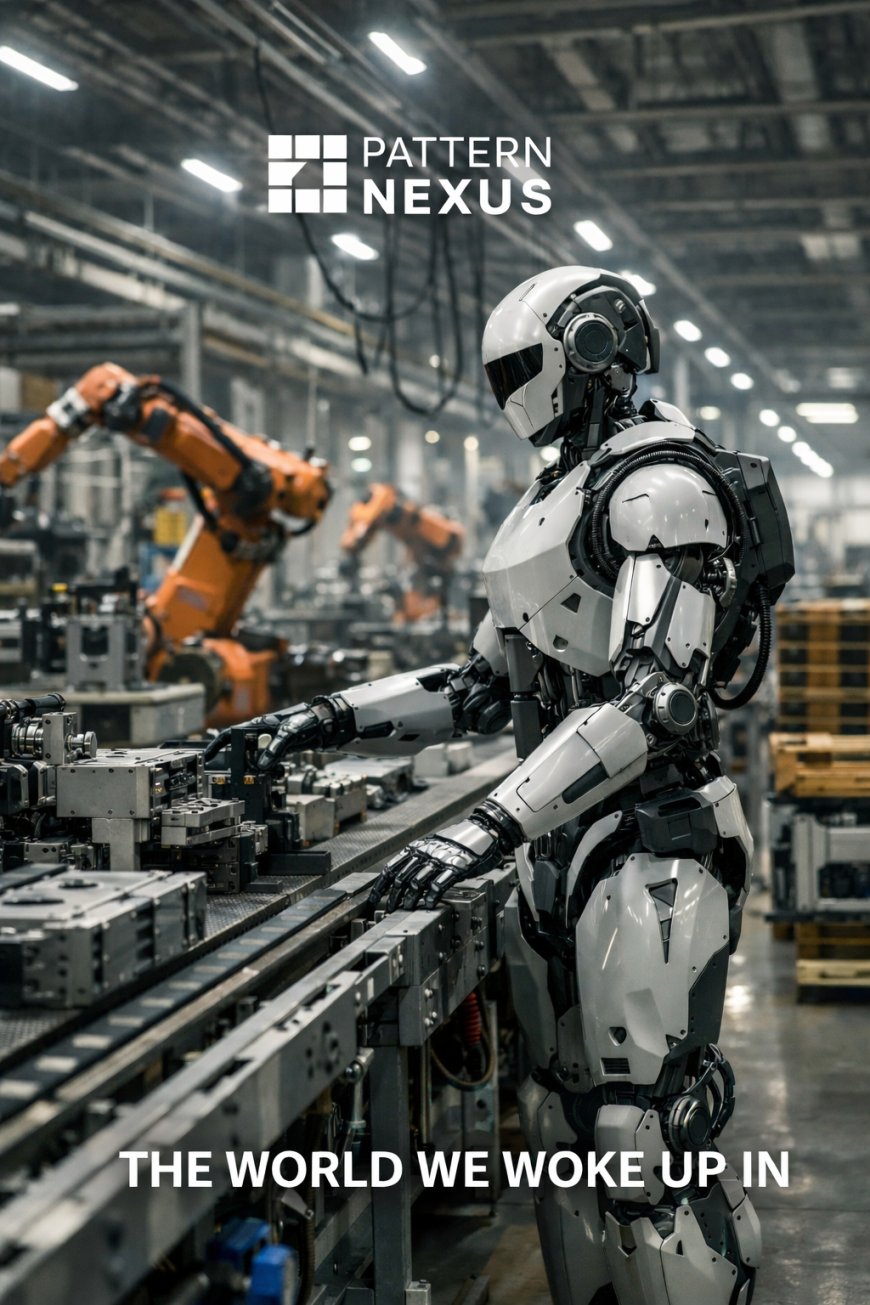


The economy is repricing bottlenecks, not “demand.” Electricity, compute, and strategic supply chains are becoming the new constraint layer.
Risk: “Jobless expansion” becomes socially destabilizing when narrative systems convince the public that opportunity should still behave like 1990–2015.
The new strategic unit is the fused state–corporate apparatus executing policy through balance sheets, not speeches.
Shared Reality Collapses
The most consequential change visible in early 2026 is not a geopolitical event or a market move. It is the collapse of shared reality. The public sphere no longer primarily transmits facts; it transmits frames. Incentive systems reward certainty, identity alignment, and emotional activation. As a result, “truth” becomes whatever survives inside a distribution engine optimized for engagement rather than accuracy.
This produces an epistemic fracture: populations fragment into parallel interpretive regimes that cannot reconcile because they are not debating the same world. Coordination fails upstream. Institutions increasingly communicate strategically because strategic communication becomes a survival trait. In a fractured reality environment, persuasion is treated as governance.
When narrative becomes the interface between institutions and the public, perception management becomes a control surface. The population does not need to be convinced of a policy’s mechanics—only guided into a frame that makes the policy feel inevitable or righteous.
Macro Signals Break Legacy Intuition
As shared reality fragments, the material layer keeps operating under physics, scarcity, and capital allocation. The problem is that most mental models were trained on a consumer-abundance era. Those heuristics increasingly fail in a provisioning era where bottlenecks matter more than narratives.
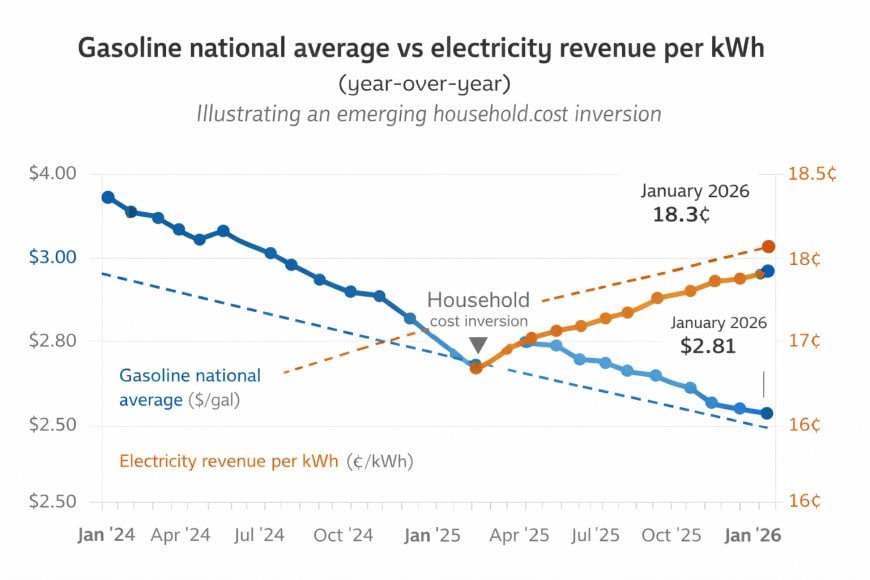
Early January data already demonstrates how legacy intuition breaks: gasoline can sit near multi-year lows while electricity pricing continues to rise year-over-year. The surface story becomes confusing because the system is repricing constraints. A modern economy’s “fuel” is increasingly power plus compute, not just liquid hydrocarbons.
- Constraint repricing: electricity load growth, grid capex cycles, and utility rate-base dynamics push costs in directions that don’t match consumer-era expectations.
- Hedge behavior: metals and commodity positioning increasingly reflect risk and strategic provisioning more than simple cyclical demand.
- Interpretive failure: when the public expects one variable to govern the system (gas), and the system shifts to another (electricity), confusion becomes permanent.
The State–Corporate Merge Goes Operational
The “public versus private” distinction increasingly functions as a legal wrapper rather than an explanatory model of power. The operational reality is a fused state–corporate apparatus: governments steer through capital structure, and corporations execute strategic objectives through throughput.
This is not a theoretical argument. Equity positions, subsidy architectures, strategic procurement, and balance-sheet execution have become standard tools of industrial posture. A clean January example is the use of the housing-finance channel as policy plumbing: purchasing or directing purchases of mortgage-backed securities to influence spreads and affordability without labeling the mechanism as legacy QE.
Balance sheets are governance tools. When a system can compress spreads or redirect capital flows through intermediaries, it can generate outcomes while avoiding the political cost of naming the mechanism.
Agentic AI and Embodied Automation
AI as “a better tool” is a legacy framing. Agentic AI changes the economic actor. Agents are not merely generative output systems; they are task owners that initiate, plan, execute, and iterate across workflows. This shifts automation from assistance to substitution at the coordination layer.
The coordination layer is where much of modern employment sits: routing information, managing exceptions, scheduling, monitoring, follow-ups, approvals, reporting, and cross-team alignment. When agents compress these functions, organizations do not simply get “more productive.” They get structurally thinner.
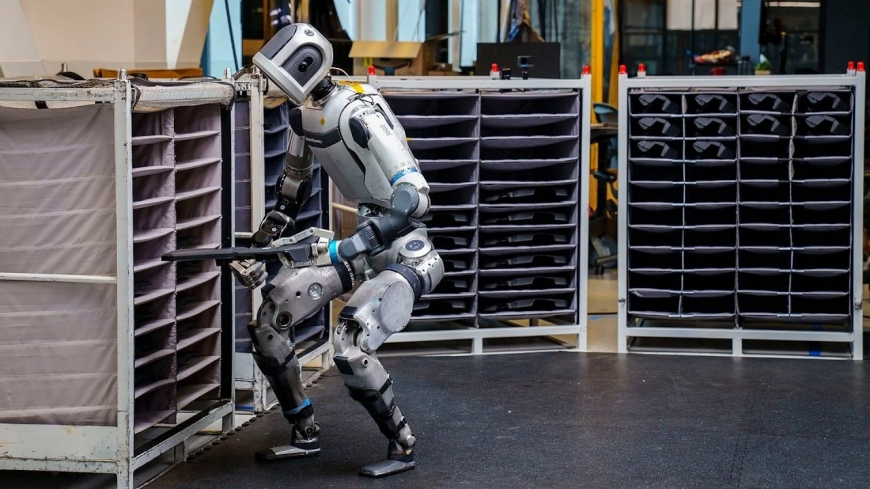
Robotics matters because it dissolves the boundary between digital work and physical work. In prior phases, automation was largely trapped in screens. In the next phase, automation moves through space. That transition tends to propagate slowly, then everywhere, then irreversibly, because it becomes infrastructure.
Employment Decoupling Becomes a Regime
A central macro outcome of the AI–capital transition is decoupling: growth and asset support can persist while hiring stalls. This does not require a recession. It requires that productivity be purchased through capital (automation, software, compute) instead of labor.
When that occurs, the labor market shifts into a low-hire, low-fire stasis. Headline unemployment can remain stable while opportunity degrades. The lived experience becomes: “The world looks strong on the surface, but pathways feel narrower.” That feeling is not psychological. It is structural.
- Jobless expansion dynamic: output and equity resilience can coexist with weak payroll gains when productivity rises without proportional hiring.
- Middle-layer fragility: coordination roles become the first compression targets as agents take over routing and exception handling.
- Winner–loser polarization: owners of scalable systems (capital, automation, leverage, IP) capture disproportionate upside while wage pathways narrow.
The destabilizer is not weak hiring by itself. The destabilizer is weak hiring inside a narrative environment that insists the old opportunity model still applies, and blames individuals when the system has changed.
Bifurcation and Forced Adaptation
The dominant split of the next decade is not ideological. It is adaptive. Two cohorts form in every operating-system transition: one that integrates into the new stack, and one that defends the old stack. This is not a moral judgment. It is a selection mechanism.
Systems reward those who update. Systems punish those who do not, not out of malice, but out of throughput. A society anchored to legacy narratives will increasingly exclude itself from future prosperity because it cannot operationalize participation in the new regime.
Forced adaptation is a historical constant. Agricultural transitions displaced hunter-gatherers. Industrial transitions displaced agrarian labor. Digital transitions displaced clerical strata. The AI–robotics transition displaces coordination labor and increasingly touches physical labor. Each phase produces a cohort that experiences the future as opportunity and a cohort that experiences the future as theft.
Signals Dashboard
The goal is not to track every headline. The goal is to watch the system’s constraint indicators and policy plumbing. The following signals tend to reveal the architecture layer before it becomes socially obvious.
- Energy constraint: electricity price trends, utility capex plans, load growth narratives, and rate-case cadence.
- Housing plumbing: MBS spread behavior, policy-driven purchases, and the transmission channel from spreads to affordability.
- Labor decoupling: payroll growth versus productivity narratives, “low-hire, low-fire” commentary, and sector-level hiring compression.
- Agentic adoption: corporate deployments framed as agents executing workflows (not just copilots generating text).
- Robotics scaling: announcements that explicitly shift from prototype to product and from demo to industrial integration.
Preparation is not ideological alignment. Preparation is model alignment. Track bottlenecks, track control channels, and track whether productivity is being bought with capital instead of labor.
Pattern Nexus Lens
The simplest way to interpret early 2026 is to separate the spectacle layer from the architecture layer.
The spectacle layer is loud: narrative conflict, identity warfare, moral theater, and frame competition. It consumes attention but does not govern constraints. The architecture layer is quiet but decisive: energy, compute, supply chains, capital steering, and institutional throughput. It governs what is possible.
In this regime, the state–corporate apparatus behaves like a control system. It adjusts spreads, funds strategic capacity, buys influence through balance sheets, and accelerates automation because automation is competitive advantage. The human layer experiences this as disorientation because the public narrative is rarely allowed to describe the control system honestly.
The defining split is adaptivity. Those who align with constraints and control channels participate in the future. Those who live inside narrative-only models become spectators inside the same timeline.
FAQ
Is this a political argument?
No. It is a systems argument. Politics is part of the spectacle layer. The article focuses on the architecture layer: bottlenecks, capital steering, policy plumbing, and automation’s effect on labor and opportunity.
Why do markets and household costs feel contradictory?
Because the system is repricing constraints. When the bottleneck shifts (toward electricity, compute, strategic materials), legacy intuition trained on consumer-era signals fails. Confusion is the symptom of an outdated model, not “randomness.”
What is the practical implication for everyday decision-making?
Treat adaptation as a structural requirement. Focus on skills, assets, and positioning that integrate with the new stack: energy-aware thinking, automation literacy, workflow leverage, and realistic expectations about labor-market decoupling.
Sources
These sources support the factual anchors referenced in this article (energy pricing signals, housing plumbing actions, agentic AI framing, robotics production signals, and labor market decoupling).
- AAA Newsroom (Jan 8, 2026): U.S. gas national average around $2.81
- U.S. EIA Electricity Monthly Update: revenues per kWh and year-over-year change (Oct 2025)
- Reuters (Jan 10, 2026): Bessent on MBS buys matching Fed run-off
- Reuters (Jan 9, 2026): FHFA-directed $200B MBS purchase plan
- Microsoft News (Jan 8, 2026): Agentic AI capabilities and intelligent automation framing
- Boston Dynamics (Jan 5, 2026): Product version of electric Atlas unveiled at CES
- Hyundai (CES 2026): AI robotics strategy and industrial roadmap
- Reuters (Jan 9, 2026): December 2025 payrolls and “jobless expansion” framing
- Intel IR (Aug 22, 2025): Government equity stake agreement (industrial policy through capital structure)
What's Your Reaction?
 Like
2
Like
2
 Dislike
1
Dislike
1
 Love
1
Love
1
 Funny
0
Funny
0
 Wow
1
Wow
1
 Sad
0
Sad
0
 Angry
0
Angry
0

Founder of Pattern Nexus. I research markets, macro, geopolitics, AI, history, ancient systems, and the patterns most people overlook. I’m also building Market Radar, a trading scanner designed to read pressure, risk, confirmation, and setup quality before chasing a move. Pattern Nexus is where I connect the dots between data, history, technology, and the bigger system playing out around us.


















Comments (0)