
ECB Financial-Stability Warning: Why Near-Zero CISS Is Dangerous
The ECB just issued a financial-stability warning while its systemic stress index (CISS) sits near zero. This report breaks down what the ECB really sees, how bank–nonbank linkages, dollar funding, stablecoins and sovereign risk fit together, and why this “calm” looks like the pre-fracture phase of the next global liquidity cycle.
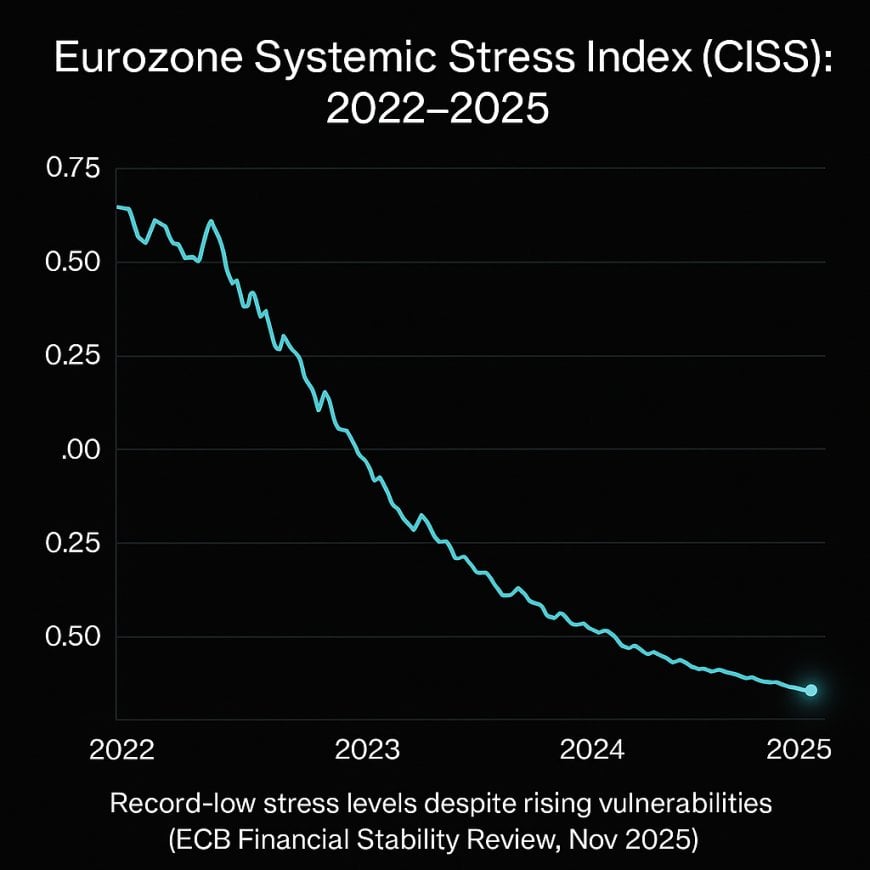

The ECB is warning about “elevated” vulnerabilities at the exact moment its systemic stress gauge shows near-perfect calm.
The Setup: A Warning in the Quietest Part of the Cycle
On November 26, 2025, the European Central Bank (ECB) released its latest Financial Stability Review (FSR). In the press conference and summary, they were blunt:
“Current market pricing and subdued volatility seem out of sync with persistently elevated vulnerabilities and uncertainties. Stretched valuations and extreme market concentration, particularly in US technology and AI-related firms, heighten the risk of sharp repricing.”
— ECB Financial Stability Review, November 2025
At the same time, their own Composite Indicator of Systemic Stress (CISS) — a 15-component index that tracks stress across money markets, bonds, equities, banks, and FX — has collapsed from roughly 0.7+ in late 2022 down to around 0.02, effectively signaling “no systemic stress” at all.
That pairing is the story:
- Subdued volatility and confident pricing on the surface.
- Central-bank-level concern underneath about elevated vulnerabilities and “unprecedentedly high” risk of shocks.
This is exactly the configuration that tends to show up in the late stage of a liquidity cycle: when stress gauges look perfect because everyone has been forced into the same trades, the same duration profile, the same tech winners — and the same belief that central banks will always catch the fall.
The Paradox
The closer systemic stress gets to zero, the more “safe” investors feel — and the more leverage, duration, and liquidity mismatch they quietly accumulate. That’s why all the truly dangerous moments in modern finance have emerged from periods of maximum calm.
What the CISS Actually Measures (and Why Zero Is Not Safe)
The CISS (Composite Indicator of Systemic Stress) is the ECB’s in-house barometer of financial stress. It’s not a single market index — it’s a portfolio of signals.
The Five Sub-Markets
The index aggregates stress across five key segments:
- Money markets – short-term interbank rates, spreads, and funding stress.
- Bond markets – sovereign and corporate spreads and volatility.
- Equity markets – volatility, drawdowns, and correlation spikes.
- Financial intermediaries – bank equity performance, CDS, funding spreads.
- Foreign exchange – FX volatility and disorderly moves in the euro.
Each of these segments contains multiple indicators, such as yield spreads, implied volatilities, and credit default swap premia. The innovation in CISS is not just the components, but how they are combined: it gives more weight to stress that is system-wide and correlated, not just localized to one market.
How the Scale Works
CISS is normalized roughly between 0 and 1:
- 0.0 – 0.1: Near-zero systemic stress. Calm, tight spreads, low volatility.
- 0.1 – 0.3: Normal range. Local tremors, but nothing systemic.
- 0.3 – 0.5: Elevated stress. Significant repricing across assets.
- 0.5+: Crisis-like episodes (euro crisis, GFC-type phases).
Recent values in late 2025 have hovered near the floor — around 0.02 — after peaking near 0.7 during the energy and bond-market turmoil of 2022.
Why Near-Zero Readings Are Historically Dangerous
If you overlay CISS with major market events, a pattern emerges:
- Late 1990s: CISS falls to low levels before the dot-com bust.
- Mid-2000s: CISS compresses ahead of the subprime and GFC eruption.
- 2017–2018: Very low stress readings precede the “volmageddon” VIX spike and euro-area wobbles.
- 2021: Low stress before the inflation shock, bond crash, and energy crisis.
Extreme calm often signals that:
- Volatility has been mechanically suppressed.
- Carry trades and leverage are crowded.
- Liquidity mismatches in non-banks are growing but invisible.
- Everyone is leaning the same way in duration and factor exposure.
Key Insight
High CISS levels tell you a crisis is already happening. Very low CISS levels — paired with central-bank warnings — tell you the next phase of the liquidity cycle is loading in the background.
Inside the ECB’s 2025 Financial Stability Review
The November 2025 FSR is the ECB’s attempt to put words around a paradoxical landscape: seemingly calm markets, but a thick cluster of underlying vulnerabilities.
The ECB’s Core Messages
- “Current market pricing and subdued volatility seem out of sync with persistently elevated vulnerabilities and uncertainties.”
- Stretched valuations in increasingly concentrated asset markets (especially US tech and AI-related firms) raise the risk of sharp price adjustments.
- Fiscal challenges in some advanced economies (including euro-area members) could test investor confidence in sovereign debt markets.
- Elevated geopolitical and trade uncertainty, especially around tariffs, could reshape the euro-area financial-stability landscape.
- Non-bank financial institutions (NBFIs) carry significant liquidity-mismatch risks that could boomerang back on banks in a shock.
At the same time, the ECB stresses that euro-area banks appear resilient on paper, backed by EU-wide stress tests: they’re “adequately capitalised to withstand severe shocks,” with strong profitability and ample buffers — at least in baseline scenarios.
“Unprecedentedly High” Risk of Shocks
The ECB also frames the world as being in an era where the global risk of shocks is “unprecedentedly high.” Not because one single risk dominates, but because:
- Geopolitical tensions and shifting trade policies can morph quickly.
- Climate and nature-related risks show up as supply shocks and insurance losses.
- Demographic and productivity headwinds squeeze fiscal space.
- Technological disruptions can destabilize labor markets and capital allocation.
The message is simple: the tails are fatter than usual, and they overlap. A “single shock” model is no longer enough. The ECB is explicitly worried about multi-shock scenarios.
Bank–Nonbank Linkages: The Hidden Web
One of the most important additions in the 2025 FSR is a deeper focus on linkages between banks and non-bank financial intermediaries (NBFIs). This is the plumbing that turns localized problems into system-wide events.
The ECB flags several channels:
- NBFIs provide short-term wholesale funding to banks via repos, deposits, and debt purchases.
- Banks lend to and invest in leveraged non-bank entities — funds, SPVs, PE structures.
- Many of these non-banks run liquidity mismatches (offering daily liquidity against illiquid assets).
The ECB’s implicit question is: what happens if a major nonbank faces a run or forced liquidation? Funding can disappear overnight, collateral can be dumped, and reputational risk can spill back into the banking system. The FSR doesn’t name specific firms, but the direction of concern is clear: the bank–NBFI nexus is a transmission belt for shocks.
Multi-Shock Stress Testing: Are Banks Prepared?
The ECB also signals a shift in how supervisors think about stress: they’re moving from “single-factor” stress tests (e.g., just interest-rate risk) toward multi-shock scenarios that combine:
- Rate shocks and yield-curve moves
- Credit losses and spread blowouts
- Climate and catastrophe-related losses
- Geopolitical and trade/ tariff shocks
The unanswered question is whether existing capital and liquidity buffers are sufficient when several of these stresses hit at once. The ECB is basically saying: “We’re not fully convinced, so we’re recalibrating the scenarios.”
Sovereign Debt and Fiscal Pressure
Finally, the FSR calls out sovereign-debt risk as a slow-burning but critical pressure point:
- Some countries face rising debt-to-GDP ratios.
- Defense, energy, and social spending are all climbing.
- Markets are increasingly sensitive to perceived fiscal slippage.
The ECB doesn’t publish a hit list, but the implication is obvious: if yields spike in a few vulnerable sovereigns, the shock will propagate through:
- Bank balance sheets (via sovereign bond holdings)
- Investment funds and pension portfolios
- Collateral chains in repo and derivatives markets
In other words: sovereign stress is not a separate problem — it is fused into the plumbing that the CISS is supposed to capture.
Translation
The ECB is not saying “panic now.” It is saying: “This apparently safe environment is exactly the one that breeds the kind of fragility we fear the most — particularly where banks, non-banks, stablecoins, and sovereigns all intersect.”
“Stretched” Tech Valuations, FOMO, and AI Euphoria
One of the most explicit parts of the FSR is the warning about US technology and AI-linked stocks. The ECB calls out “stretched” valuations driven by investor fear of missing out on the AI boom.
Concentration Risk
Market-cap and index weighting data show that:
- A small cluster of US mega-cap tech and AI names now dominate global equity benchmarks.
- Passive flows and benchmark-hugging strategies mechanically direct new capital into those same names.
- This creates a self-reinforcing “rich get richer” loop as long as prices rise.
The ECB doesn’t allege a classic dot-com bubble — it acknowledges better fundamentals today — but stresses that current pricing embeds a very narrow distribution of AI outcomes. If AI adoption, profitability, or regulation disappoints, the repricing could be sharp.
Why This Matters for Systemic Stress
In systemic-risk terms, concentration in a handful of names means:
- Benchmarks, passive funds, and derivatives markets all key off the same securities.
- Any volatility shock in those names propagates through options hedging and vol-control mandates.
- Risk-parity and leveraged strategies can be forced into “sell everything” mode when correlations spike.
That’s why the CISS can look calm — until it doesn’t. Once these crowded trades flip, the index jumps not because the risk suddenly appears from nowhere, but because the hidden correlation structure is exposed in a single move.
The Dollar Squeeze, Stablecoins, and Cross-Border Fragility
Under the surface, the ECB is also worried about dollar funding, stablecoins, and cross-border liquidity channels.
Euro-Area Banks and the Dollar
The FSR and related communications highlight that euro-area banks carry large US-dollar books — in loans, securities, and derivatives — and rely on:
- FX swaps to synthetically obtain dollars,
- Repo markets and short-term wholesale funding,
- Central bank swap lines in extreme scenarios.
The ECB’s message is that banks with significant dollar exposures should hold more capital and liquidity buffers than they think they need. A dollar squeeze — whether from market stress, geopolitical tensions, or policy shifts — would hit those institutions hardest.
In other words: offshore dollars are not a free lunch. They are a tail risk that can reprice very quickly.
Stablecoins as a Parallel Dollar Plumbing
The FSR also highlights the rapid growth of stablecoins:
- Stablecoin market cap in the hundreds of billions.
- Most centralized crypto trades routed through dollar-pegged tokens.
- Major issuers holding large portfolios of short-term US Treasuries.
The ECB’s concerns are layered:
- Bank funding risk: if households and firms increasingly hold “cash” as tokenized dollars rather than bank deposits, traditional funding bases shrink and become more volatile.
- Fire-sale risk: a run on a major stablecoin would force issuers to dump Treasuries or other safe assets quickly, potentially spilling over into rates and liquidity in core markets.
- Jurisdictional risk: if a stablecoin is co-issued by EU and non-EU entities, a global run may concentrate redemption pressure on the EU-regulated part of the structure.
This is where our Pattern Nexus thesis intersects cleanly with the ECB: stablecoins and tokenized Treasuries are not just a crypto sideshow. They are becoming a shadow dollar plumbing system — a Eurodollar 2.0 layer that sits partially outside traditional regulation, but still feeds back into it.
Pattern Nexus Note
The ECB is effectively validating the idea that the global reserve system is evolving, not ending. Dollar demand is migrating from bank balance sheets into tokenized collateral rails, and the ECB is now openly worried about how that migration interacts with bank funding and sovereign bond markets.
How This Fits the Global Liquidity Cycle
If you strip away the acronyms and diplomatic phrasing, the ECB is describing a world deep into the late phase of a liquidity cycle:
- Post-crisis QE and fiscal surges flooded the system with liquidity (2020–2022).
- QT, rate hikes, and energy shocks chewed through some of that cushion (2022–2023).
- Markets adapted by crowding into a narrow set of “safe growth” trades — US tech, AI, mega-caps, and high-quality duration.
- Volatility sold, carry harvested, spreads compressed.
- CISS falls toward zero as the plumbing appears stable again.
But underneath:
- ON RRP in the US has drained, pushing the system closer to the reserve floor.
- Euro-area sovereign curves are carrying unrealized losses from the bond selloff.
- Non-bank leverage and liquidity mismatch remain elevated.
- Dollar funding, tariffs, and geopolitics create additional fracture lines.
- Stablecoin and tokenized-collateral growth is rerouting parts of the dollar plumbing.
This is the “fracture zone” heading into what I’ve been calling the QE-2026 window — the next plausible point at which central banks will be forced back toward accommodation, not because they want to, but because the system’s structure leaves them no choice.
Recession as Trigger, Not Story
From a Pattern Nexus perspective, the recession is not the main character; it’s the trigger that justifies the next liquidity wave. The ECB’s warning tells you that the trigger conditions are being quietly prepared in the background while everyone is still debating whether “soft landing” narratives are true.
Pattern Nexus View: Calm as a Liquidity Warning Signal
So what does this actually mean in the Pattern Nexus framework?
The Calm-Stress Inversion
The key inversion is this:
- High CISS = realized stress. You’re already in the fire.
- Very low CISS + explicit ECB warning = pre-fracture zone. The kindling is stacked, the air is dry, and policymakers are scanning for sparks.
The November 2025 FSR effectively states: “Stress looks low, but vulnerabilities remain elevated and the global shock-probability distribution is fattening.” That is a direct contradiction of the market’s pricing of risk, which is still heavily tilted toward “AI-driven soft landing forever.”
Cross-Connecting the Signals
Combine the ECB’s message with three other Pattern Nexus pillars:
- US Liquidity Composite Index (LCI) — showing markets tracking liquidity flows (QT, TGA, RRP, WALCL) far more than they track inflation or wages.
- Tokenized-dollar superstructure — stablecoins and tokenized Treasuries evolving into a new offshore dollar plumbing layer.
- QE-2026 thesis — the expectation that structural funding and collateral stress will force central banks back toward net liquidity provision within roughly the next cycle window.
The ECB warning slots into that grid as a confirming node:
- They see the same misalignment between volatility, valuations, and structural risk.
- They are already nudging banks toward higher buffers and better dollar contingency planning.
- They are openly acknowledging that market calm is at odds with their internal risk maps.
What This Is Not
It’s not:
- A prediction that “everything will blow up tomorrow.”
- A call that “the dollar is finished” (in fact, the opposite: dollar funding remains central).
- A statement that banks are currently on the brink of collapse.
It is:
- A recognition that tail-risk frequencies are rising.
- A warning that valuation euphoria and suppressed volatility are unsustainable in the face of those tails.
- A signal that policymakers are mentally preparing for the next intervention, not celebrating victory.
Pattern Nexus Framework: Where This Sits in the Macro Cosmogony
Inside the broader Pattern Nexus “macro cosmogony” map, this ECB episode lives at the intersection of three subsystems:
- The Liquidity Cycle Layer – ON RRP, TGA, QT/QE, LCI.
- The Collateral & Plumbing Layer – Treasuries, euro sovereigns, FX swaps, stablecoins.
- The Narrative & Valuation Layer – AI euphoria, soft-landing consensus, risk premia.
Liquidity Cycle Layer
In our Liquidity Composite Index work, we've shown that:
- Equities, housing, gold, and even CPI track composite liquidity far more tightly than they track inflation or wages.
- Major regime shifts (2000, 2008, 2020, 2022) correspond to inflection points in that liquidity series.
The ECB’s discomfort with “subdued volatility” is a recognition that liquidity conditions are again approaching the edge of the envelope — not because policy is easy, but because everyone has optimized around the last set of shocks.
Collateral & Plumbing Layer
On the plumbing side:
- Dollar exposure of euro-area banks + potential tariff and geopolitical shocks = vulnerability to dollar funding stress.
- Stablecoins + tokenized Treasuries = a parallel dollar collateral system outside traditional regulatory perimeters.
- Euro-area sovereigns with stretched fiscal positions = potential flashpoints in bond markets.
- Bank–NBFI linkages = the network that turns local stress into system-wide contagion.
These are exactly the channels through which a modest repricing in tech or AI expectations can escalate into:
- Margin calls → collateral haircuts → forced deleveraging.
- Liquidity runs in non-bank funds or stablecoins.
- Cross-currency and cross-border funding strains.
Narrative & Valuation Layer
The ECB’s focus on FOMO-driven valuations isn’t just moralizing; it’s about how narratives compress risk premia:
- “AI will fix everything” → discounts macro and geopolitical risk.
- “Soft landing is locked in” → reduces perceived need for hedging.
- “Central banks will always step in” → encourages leverage and duration risk.
When those narratives meet a shock — tariffs, political risk, a growth miss, a regulation surprise in AI, or a misstep in monetary policy — the repricing can be sudden. That’s when CISS spikes, spreads gap out, and the liquidity cycle flips into its next phase.
Pattern Nexus Synthesis
The ECB’s November 2025 warning is not a random headline — it is a formal acknowledgement from inside the system that the current state of apparent calm is structurally unstable. In the Pattern Nexus framework, this is one more tile locking into place on the path toward the next global liquidity reset — likely in the mid-decade QE-2026 window.
Open ECB Questions & the Macro Watchlist
The ECB hasn’t just made statements — it has raised its own questions. These are the loose threads that matter most if you’re trying to see around the next corner.
The ECB’s Unanswered Questions
- How fragile are bank–NBFI linkages in a real stress?
We know the channels; we don’t know the thresholds. At what point do redemptions in funds translate into funding runs for banks? - How deep is the exposure to stablecoins and private markets?
The ECB can estimate, but they don’t fully disclose the breakdown. The opacity of private assets and off-balance-sheet vehicles is a feature, not a bug. - Are current stress-test scenarios too polite?
Multi-shock scenarios are coming, but we don’t yet know how extreme they’ll be. Will they really model simultaneous rate, credit, climate, and geopolitical shocks — or just marginal tweaks? - Which sovereigns are the weakest link?
The FSR talks about fiscal challenges, but doesn’t name and shame. The actual contagion path will depend on which countries face rising yields and how fast. - Where is the tipping point from “calm” to “stress”?
The CISS tells you after the fact. What combination of events flips the switch is still an open question, even for the ECB.
The Pattern Nexus Watchlist
To make this operational, here is a simple Pattern Nexus watch grid — the signals that matter if you want to know when this “calm” starts to crack:
| Watchpoint | What to Monitor | Why It Matters |
|---|---|---|
| NBFI Liquidity | Repo spreads, fund outflows, gating of redemptions, NAV discounts | Shows whether non-banks are starting to feel a run or asset/liability mismatch. |
| Dollar Funding for Euro Banks | FX swap basis, cross-currency basis, dollar repo rates, bank commentary | Reveals dollar squeeze risk that can force asset sales or trigger swap-line usage. |
| Euro Sovereign Spreads | Spread of periphery vs. core (e.g., BTP–Bund, OAT–Bund), CDS moves | Signals whether fiscal concerns are morphing into bond-market stress. |
| Tech / AI Mega-Cap Volatility | Single-name and index vol, earnings misses, guidance cuts | Because these names anchor benchmarks, a shock here cascades across risk assets. |
| Stablecoin Flows | Stablecoin market caps, large redemption days, depegging events | A run here forces Treasury sales and tests the shadow dollar plumbing. |
| Liquidity Composite Index (LCI) | Combined US/EU liquidity metrics (WALCL, TGA, RRP, SRF, EU QE/QT pace) | Tracks the true “breathing” of the system; major inflections flag cycle turns. |
| ECB & Fed Communication Shift | Language on “financial stability,” “market functioning,” and “liquidity operations” | Forward guidance about when and how they plan to re-open the liquidity spigots. |
How to Use This
This isn’t a doom list. It’s a dashboard. The point isn’t to predict the exact date of a break — it’s to map which fault lines are shifting, and how that lines up with the next movement in the global liquidity cycle.
FAQ: The ECB’s Calm-Phase Warning
1. What is the ECB’s Composite Indicator of Systemic Stress (CISS)?
The CISS is a composite index the ECB uses to measure systemic financial stress in the euro area. It combines around 15 indicators across money markets, bond markets, equity markets, financial intermediaries, and foreign exchange. The index gives more weight to stress that is correlated across markets, which is what makes it a “systemic” gauge rather than just a volatility meter.
2. Why is a near-zero CISS reading potentially dangerous?
A very low CISS reading means spreads are tight and volatility is subdued across the system. That feels safe, but historically these periods coincide with maximum leverage, crowded carry trades, and aggressive duration or factor bets. When everyone is positioned the same way, it only takes a small shock to trigger a rapid, system-wide repricing. Calm is often the phase where fragility is quietly built.
3. What exactly did the ECB warn about in the latest Financial Stability Review?
The ECB warned that market pricing and low volatility are “out of sync” with elevated vulnerabilities. It highlighted stretched tech and AI valuations, increased market concentration, bank–nonbank linkages, liquidity mismatches in non-bank financial institutions, sovereign-debt and fiscal pressures, and “unprecedentedly high” global shock risk due to geopolitics, climate, and structural changes.
4. How do bank–nonbank financial linkages increase systemic risk?
Banks rely on non-banks for wholesale funding, while non-banks often rely on banks for credit and market access. Many non-bank vehicles offer daily liquidity while holding illiquid assets, which creates run risk. If a large non-bank experiences stress, it can pull funding from banks, force fire-sales of collateral, and spark a feedback loop where problems in the “shadow” sector spill into the regulated banking system.
5. Where do stablecoins and tokenized Treasuries fit into this picture?
Stablecoins and tokenized Treasuries form a parallel dollar-based funding and collateral system, largely outside traditional banking. The ECB is worried that large shifts between bank deposits and tokenized “cash” could destabilize bank funding, and that a run on a major stablecoin could trigger rapid sales of Treasuries or other safe assets. In the Pattern Nexus framework, this is the emerging Eurodollar 2.0 layer of the global liquidity system.
6. How does this relate to the Pattern Nexus liquidity-cycle and QE-2026 thesis?
In the Pattern Nexus view, markets track composite liquidity flows, not CPI or wages. The ECB’s warning during a near-zero CISS phase is a classic late-cycle signal: structural vulnerabilities are high even though volatility is low. That configuration typically precedes a recessionary trigger and, eventually, a renewed wave of liquidity support. The ECB’s language effectively reinforces the idea that we are in the “pre-fracture” zone heading into a probable QE-style intervention window around mid-decade.
7. What should informed observers watch next?
Key signals include: liquidity conditions and outflows in non-bank funds; the FX-swap and cross-currency basis for euro-area banks’ dollar funding; spreads on weaker euro-area sovereigns; volatility and earnings surprises in mega-cap tech and AI names; stablecoin market caps and de-pegging events; and changes in ECB/Fed language around “market functioning” and “liquidity operations.” Together, those tell you when calm is starting to crack.
Sources & Further Reading
- European Central Bank – Financial Stability Review (Latest Edition)
- European Central Bank – Composite Indicator of Systemic Stress (CISS) Data
- European Central Bank – Press releases on financial stability and macroprudential policy
- European Central Bank – Financial Stability Review – November 2025 (overview of risks, NBFIs, sovereigns, and valuations)
- Financial Times – “FOMO is driving ‘stretched’ US tech valuations, ECB warns”
- Bloomberg – “ECB warns high valuations boost financial-stability risks”
- Reuters – “Euro zone banks with dollar exposure need more buffers, ECB says”
- ECB / BIS speeches on non-bank financial intermediation and systemic risk – selected speeches and remarks
- Pattern Nexus – Liquidity Composite Index & QE-2026 framework (internal research series)
آپ کا ردعمل کیا ہے؟
 پسند کریں
0
پسند کریں
0
 نہ پسند
0
نہ پسند
0
 محبت
0
محبت
0
 مزاحیہ
0
مزاحیہ
0
 واہ
0
واہ
0
 اداس
0
اداس
0
 غصہ
0
غصہ
0

Founder of Pattern Nexus. I research markets, macro, geopolitics, AI, history, ancient systems, and the patterns most people overlook. I’m also building Market Radar, a trading scanner designed to read pressure, risk, confirmation, and setup quality before chasing a move. Pattern Nexus is where I connect the dots between data, history, technology, and the bigger system playing out around us.

















تبصرے (0)