
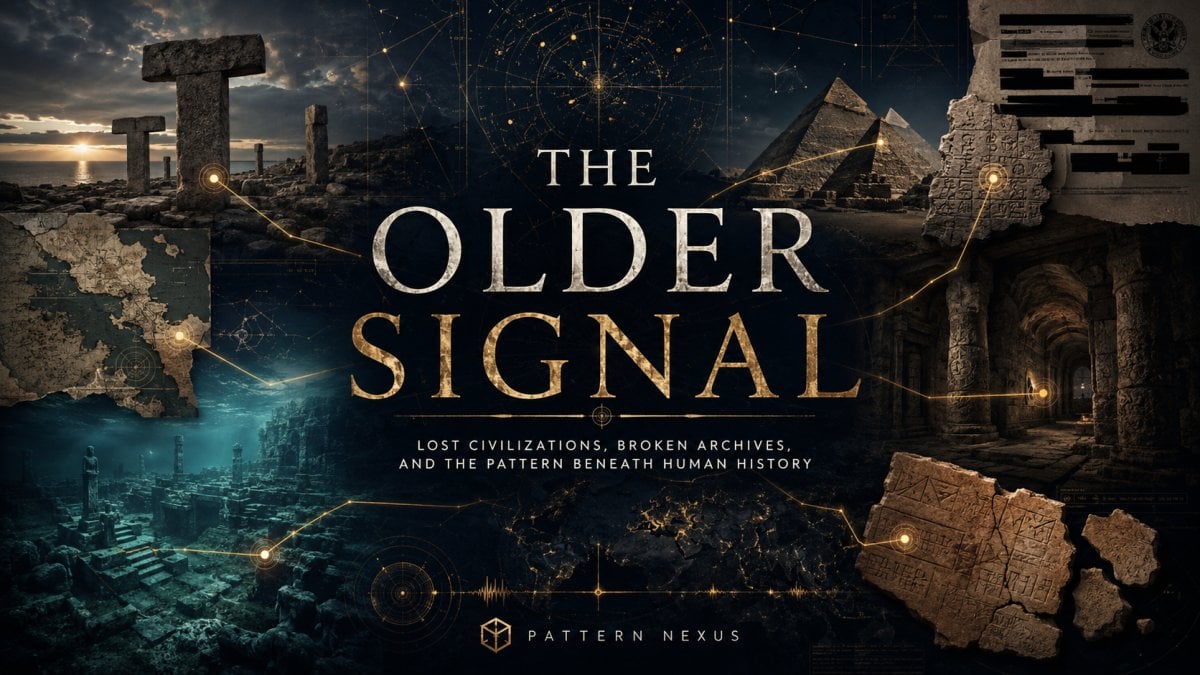
The Older Signal: Lost Civilizations, Broken Archives, and the Pattern Beneath Human History
A Pattern Nexus three-level research article mapping deep-time human capability, lost archives, drowned coastlines, megalithic architecture, ancient astronomy, undeciphered scripts, UAP secrecy, invention secrecy, and the recurring pattern of civilizational amnesia.
Listen to the full narrative version of this article.
This audio edition combines the Reader-Friendly, Non-Technical Advanced, and Technical Advanced versions into one continuous Pattern Nexus narrative.
▶ Listen on SpeechifyFull audio narration generated from the complete Pattern Nexus article body.
This article is not built around one magic artifact. That is the mistake people keep making with this subject. They pick the London Hammer, or the Coso artifact, or a strange map, or a pyramid measurement, or a UFO file, or a Tesla story, or a water-car death, and then they try to make the entire question live or die on that one object. That is not my argument. My argument is the pattern.
The pattern is that the human archive keeps breaking in the same direction. The public timeline keeps moving backward. The simple version of the Americas keeps collapsing. Jungle cities turn out to be larger. Drowned coastlines turn out to matter. Underground structures keep showing up where the written record is thin. Scripts survive after the reading chain dies. AI starts pulling text out of blackened scrolls and damaged inscriptions. Governments classify sensor data, aerospace files, patent applications, and national-security technology. The ancient archive is damaged by flood, fire, conquest, decay, and lost language. The modern archive is damaged by classification, redaction, corporate secrecy, funding pressure, stigma, and platform control.
That is the older signal: not one clean proof, but the repeated shape of missing knowledge. Some nodes are hard archaeology. Some are disputed. Some are folklore. Some are probably wrong. Fine. But the whole field cannot be dismissed by debunking one weak node. The pattern keeps returning across archaeology, mythology, energy, aerospace, ancient astronomy, underground construction, maps, gold obsession, UAP secrecy, free-energy lore, anti-gravity rumors, and cyclical-history memory.
I am not claiming one answer. I am leaving the possibility field open: lost human civilization, repeated collapse, ancient contact, seed-race memory, Mars/Venus origin myths, simulation cycles, or something stranger than all of those. The discipline here is not to make every anomaly true. The discipline is to stop pretending the pattern is not there.
The artifact is not one object. The artifact is the pattern.
What I am actually saying.
I am not interested in writing the safe little version of this where everything gets reduced to preservation bias and then everyone pretends the question is settled. Preservation bias is real. Contamination is real. Bad internet claims are real. Misdated artifacts are real. But none of that explains why the same missing-knowledge shape keeps appearing across so many different layers of the human story.
What bothers me is the repetition. At first the public mental model was civilization in the neat textbook window: a few thousand years, then the Ice Age edge, then older symbolic behavior, then older tool systems, then older humans, then older wooden structures, then older underground construction, then older North American presence, then larger hidden jungle cities, then AI recovering text nobody could read. Every time the tools get better, the past gets less simple.
Then the strange nodes start stacking up around the hard nodes. London Hammer. Coso. Baghdad Battery. Dendera. Michigan copper. Alleged Egyptian finds in America. Baalbek. Longyou. Derinkuyu. Malta. Göbekli Tepe. Karahan Tepe. Cahokia. Serpent Mound. Poverty Point. Nasca. Maya and Inca alignments. Ancient maps. Antarctica narratives. Arctic narratives. Rongorongo. Indus signs. Linear A. Herculaneum scrolls. AI epigraphy. UAP files. Tesla stories. Water-car deaths. Anti-gravity rumors. Patent secrecy. Gold obsession. Cyclical time. Pandemic echoes. The list gets stupidly large, and that is the point: the subject is not one mystery. It is a network.
The normal move is to break the network into isolated claims and make each claim fight alone. That is how the signal gets killed. Pattern Nexus reads it the other way. Keep the whole board visible. Separate confidence levels. Call hard evidence hard evidence. Call disputed claims disputed. Call folklore folklore. But do not erase the network just because parts of the network are messy. Messiness is exactly what a broken archive looks like.
Human history is not a clean line from primitive ignorance to modern intelligence. It is a broken archive of repeated rises, collapses, migrations, drowned coastlines, burned libraries, destroyed codices, buried structures, erased Indigenous knowledge, sacred astronomy, damaged scripts, lost metallurgy, myth-compressed technical memory, strategic secrecy, and institutional narrative control.
The official public story has already moved because it had to. Humans are older than earlier models allowed. Early construction is older than expected. The Americas are older than the old Clovis-first public model allowed. Jungle civilizations are larger than surface archaeology showed. Underground structures are more extensive than the written record explains. Ancient astronomy was more mathematical than the public story admits. AI is recovering texts that were unreadable for centuries. LiDAR is revealing cities that were invisible from the ground. Underwater archaeology is reopening drowned shelf archives. UAP disclosure fights show that sensor data and aerospace anomalies can sit behind classification walls for decades. Patent secrecy law shows that strategic invention suppression is not imaginary.
The strongest thesis is not that every famous anomaly is automatically true. The strongest thesis is that every domain keeps producing the same kind of anomaly: older capability, missing archives, institutional delay, strategic secrecy, mythic residue, and later technological rediscovery. That is the pattern.
The artifact is not one object. The artifact is the pattern.
This is not one artifact. This is the same missing-knowledge pattern showing up everywhere.
The story starts with a simple problem: human history does not behave like a clean timeline. It behaves like a damaged archive. Some pages are burned. Some are underwater. Some are buried under jungle. Some are locked in temple systems. Some were destroyed by conquest. Some were copied into myth because that was the only storage format left. Some are sitting in museum drawers with labels that are probably too confident. Some are behind classification walls. Some are inside private corporate systems. Some are in languages nobody can read. Some are literally inside blackened scrolls that machines are only now beginning to open.
That is why I do not buy the narrow framing. The issue is not whether one hammer proves dinosaurs and humans lived together. The issue is not whether one spark plug in a concretion rewrites geology. The issue is not whether one pyramid measurement proves a global priest-science civilization. Those are individual nodes. The bigger issue is that human history keeps producing the same kind of fracture: a capability appears, the record breaks, the explanation gets simplified, and then later tools reopen the wound.
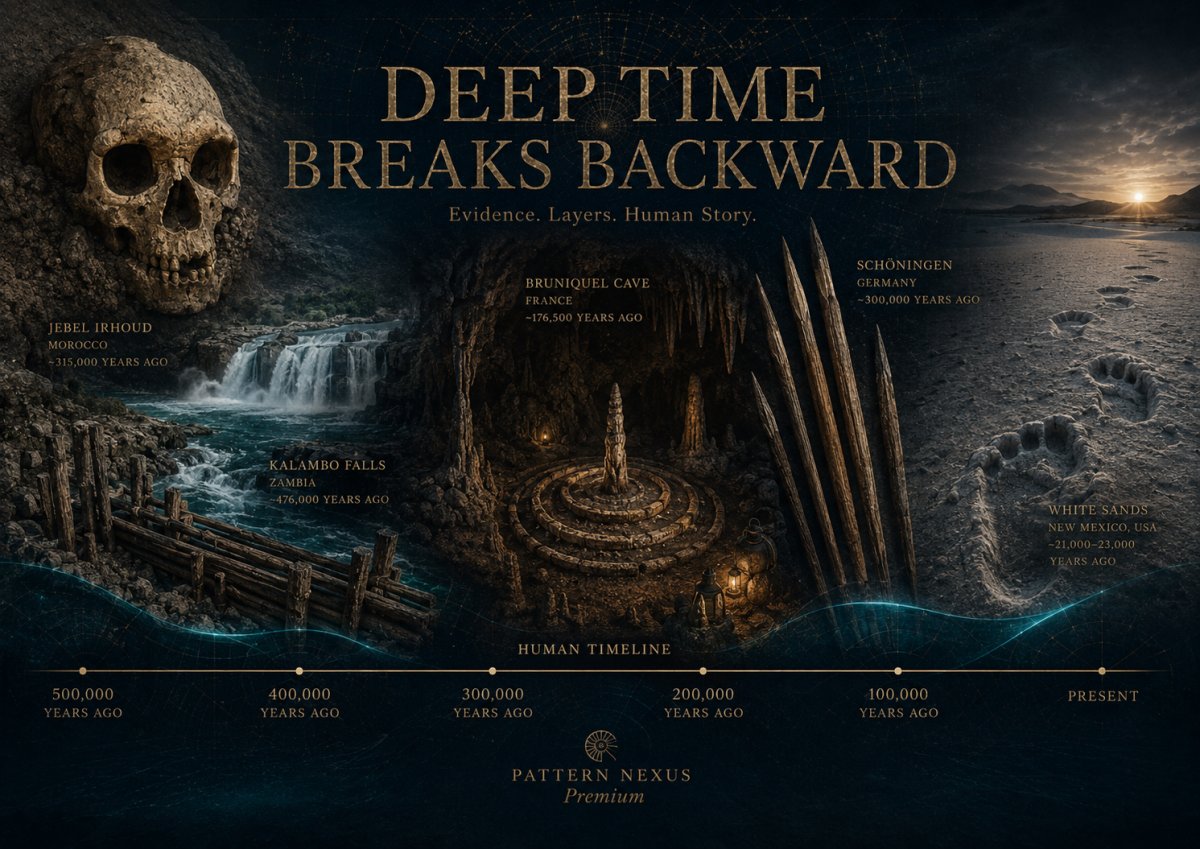
Deep time does it. The older the evidence gets, the more the clean staircase fails. People and human relatives were making, planning, building, burning, arranging, migrating, adapting, and remembering earlier than the public model usually carries in its head. That does not automatically mean there was a 500,000-year-old empire. It means the archive is biased, and the bias usually makes the past look dumber than it was.
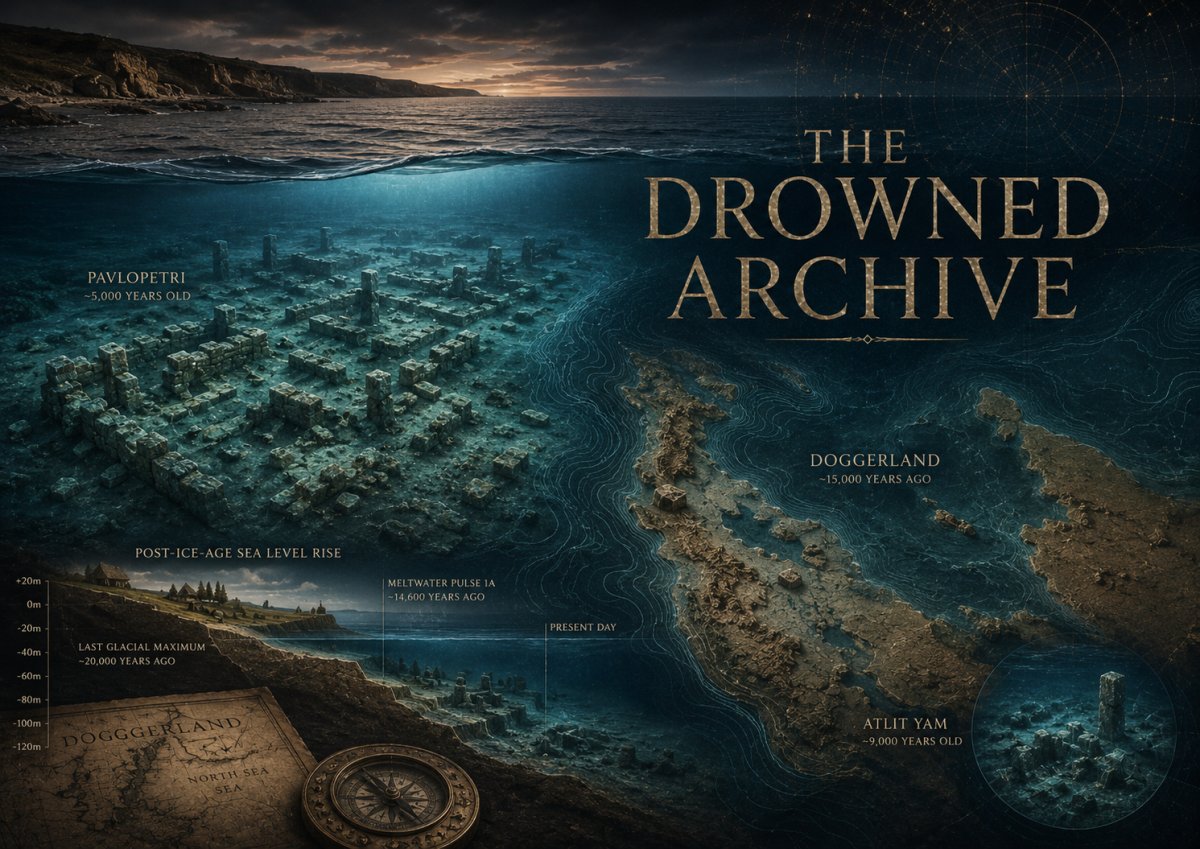
Coastlines do it. Early people would have lived along water, rivers, shelves, estuaries, bays, and drowned plains. Then the ocean moved. So if there were older settlement systems, exchange routes, ritual sites, ports, markers, or coastal knowledge networks, the exact places most likely to matter are now among the hardest places to recover. Doggerland is not fantasy. It is proof of concept. Land can become seafloor. Human landscapes can vanish under water and then get treated as absence.
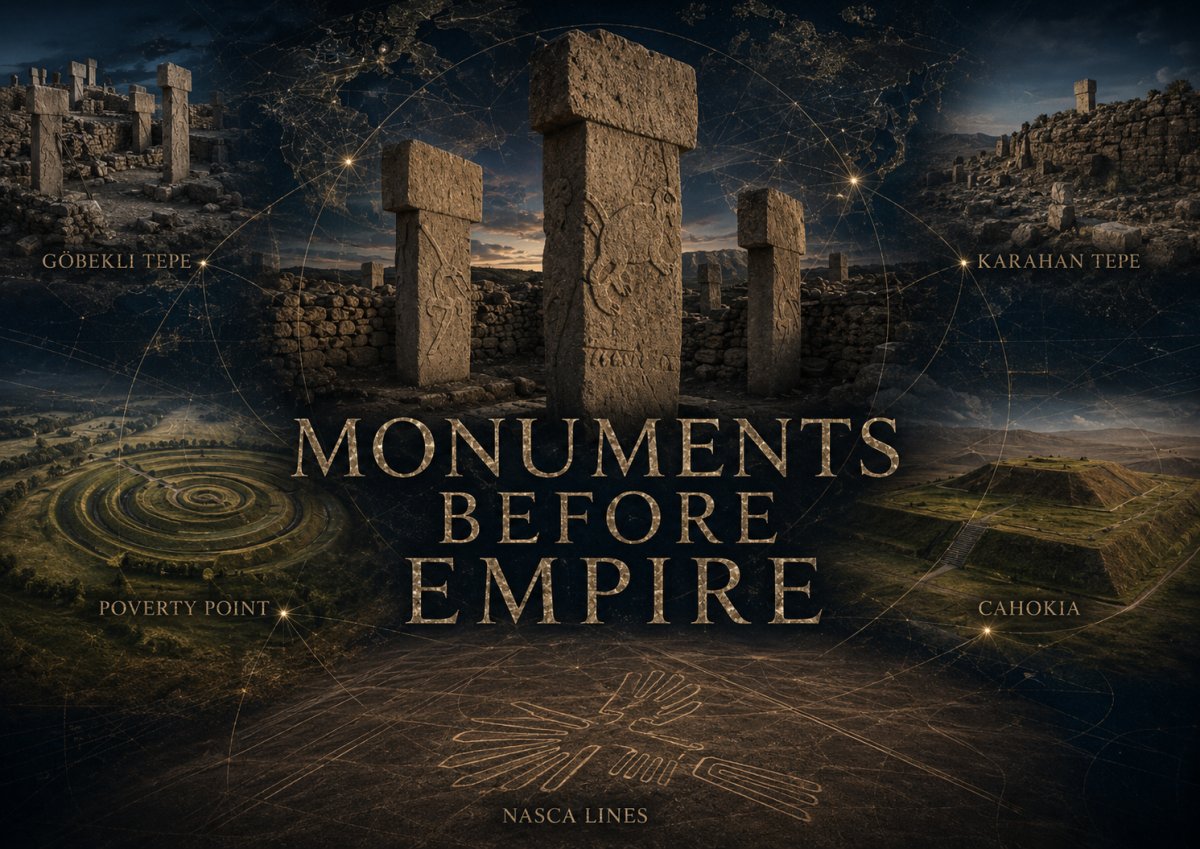
Monuments do it. Göbekli Tepe, Karahan Tepe, Poverty Point, Cahokia, Nasca, Baalbek, Giza, Stonehenge, and the wider megalithic field are not all the same thing. They do not need to be the same thing. What matters is that ancient people repeatedly turned stone, earth, horizon, labor, scale, and geometry into memory systems. They built ideas into landscapes. Modern people keep assuming intelligence has to look like glass towers and circuit boards. Older intelligence often looked like orientation, calendar, story, ritual, stone, geometry, and long-term social coordination.
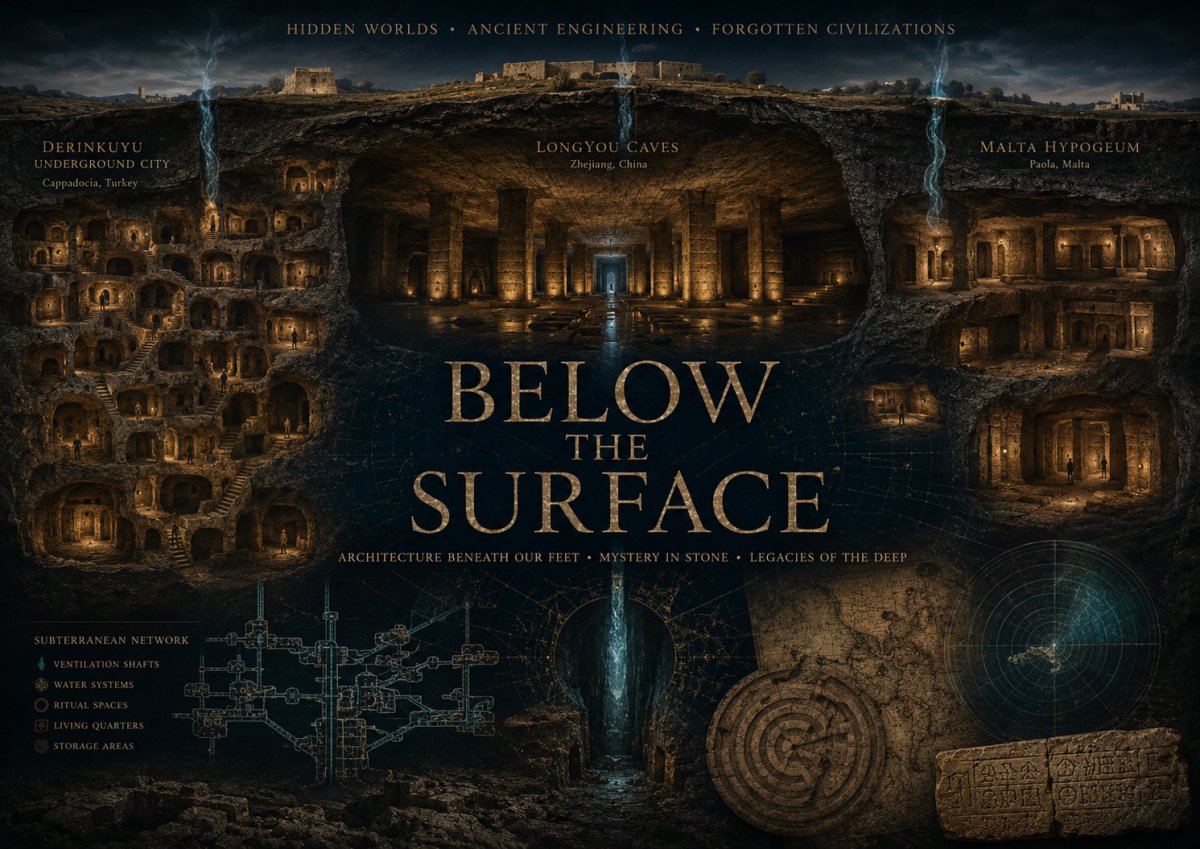
The underground world does it too. Derinkuyu, Longyou, Malta’s Hypogeum, cave sanctuaries, tunnel systems, quarry voids, and buried chambers show that the ancient record is not only what sits on the surface. Some of the most important structures were hidden, defensive, ritual, acoustic, storage-based, or survival-based. Below the surface is where the written record thins out and the physical record starts speaking louder.
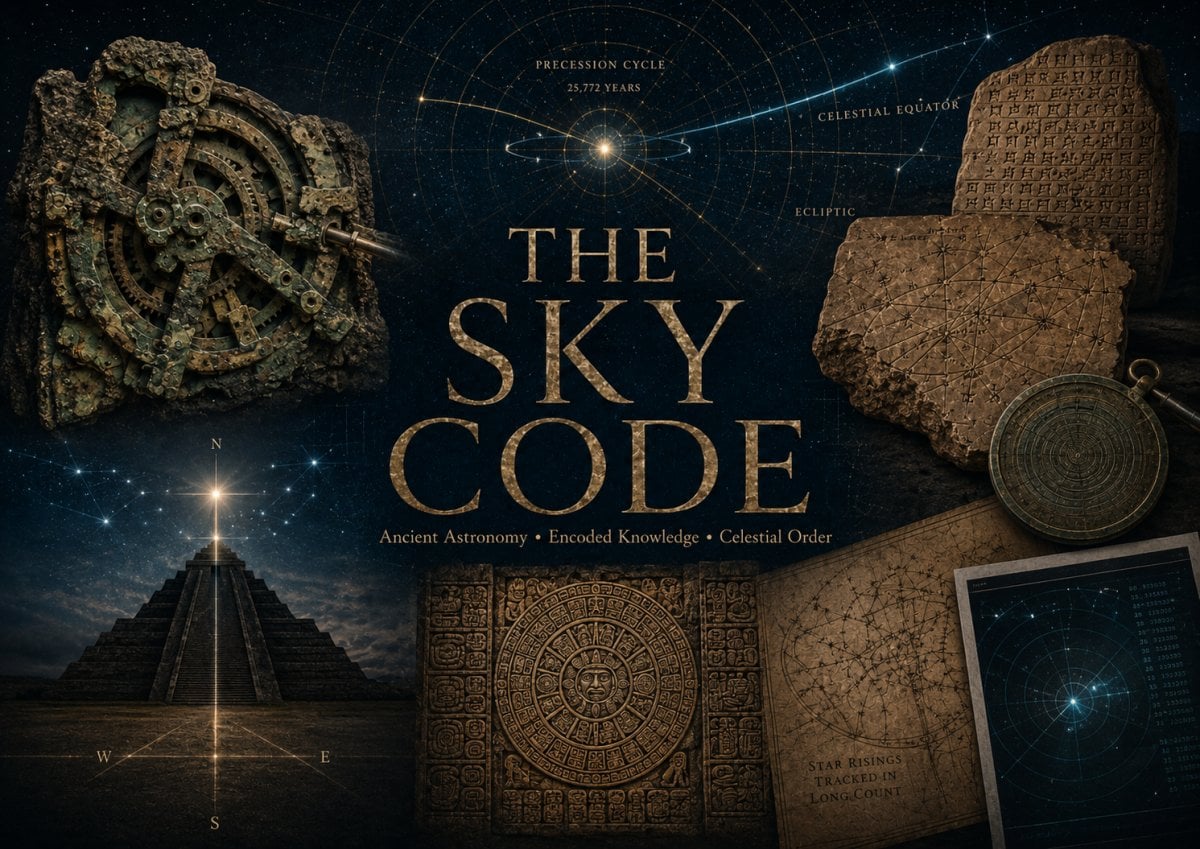
The sky-code layer is where this becomes harder to dismiss as primitive accident. Ancient astronomy is not just people looking up and making myths. It is cycles, calendars, alignments, eclipses, horizon points, planetary periods, seasonal timing, precession claims, and machine-like tracking systems such as Antikythera. Whether every proposed alignment is correct or not, the broad pattern is real: ancient societies treated the sky as a data archive. They encoded time into architecture, ceremony, agriculture, kingship, and myth.
Then the modern layer rhymes with the ancient one. UAP files. Redacted sensor data. Classified aerospace programs. Patent secrecy. National-security invention restrictions. Corporate control over energy systems. Tesla/free-energy lore. Water-car death stories. Anti-gravity rumors. Scientists and inventors disappearing from public clarity when the technology gets too close to power. I am not saying every story is proven. I am saying suppression is not imaginary. The only honest dispute is scope.
That is the spine of the article. The past gets simplified. The archive breaks. Power controls knowledge. Tools later recover fragments. The public story adjusts only after it has to. The official model keeps pretending the current map is the map, and then the ground moves again.
The point is not to say “aliens did it” and stop thinking. The point is to keep the possibility field open. Maybe this is lost human civilization. Maybe it is repeated collapse. Maybe it is contact. Maybe it is seed-race memory. Maybe Mars and Venus myths are distorted origin memory. Maybe cyclical time is a better model than linear progress. Maybe simulation language is just the modern way to describe recurrence the ancients already recognized. Maybe most of it is human, and that would still be strange enough.
The pattern does not need one forced answer. It only has to show why the question refuses to die.
Deep-Time Capability
Wood, caves, spears, fire, footprints, and symbolic behavior push human capability backward.
Drowned Coastlines
Sea-level rise erased the exact environments early humans preferred: coasts, rivers, estuaries, shelves.
Monuments Before Empire
Göbekli Tepe, Poverty Point, Cahokia, Nasca, and similar nodes show architecture as memory and coordination.
Below the Surface
Underground cities, caves, hypogea, and engineered voids show hidden architecture that the written record often thins out.
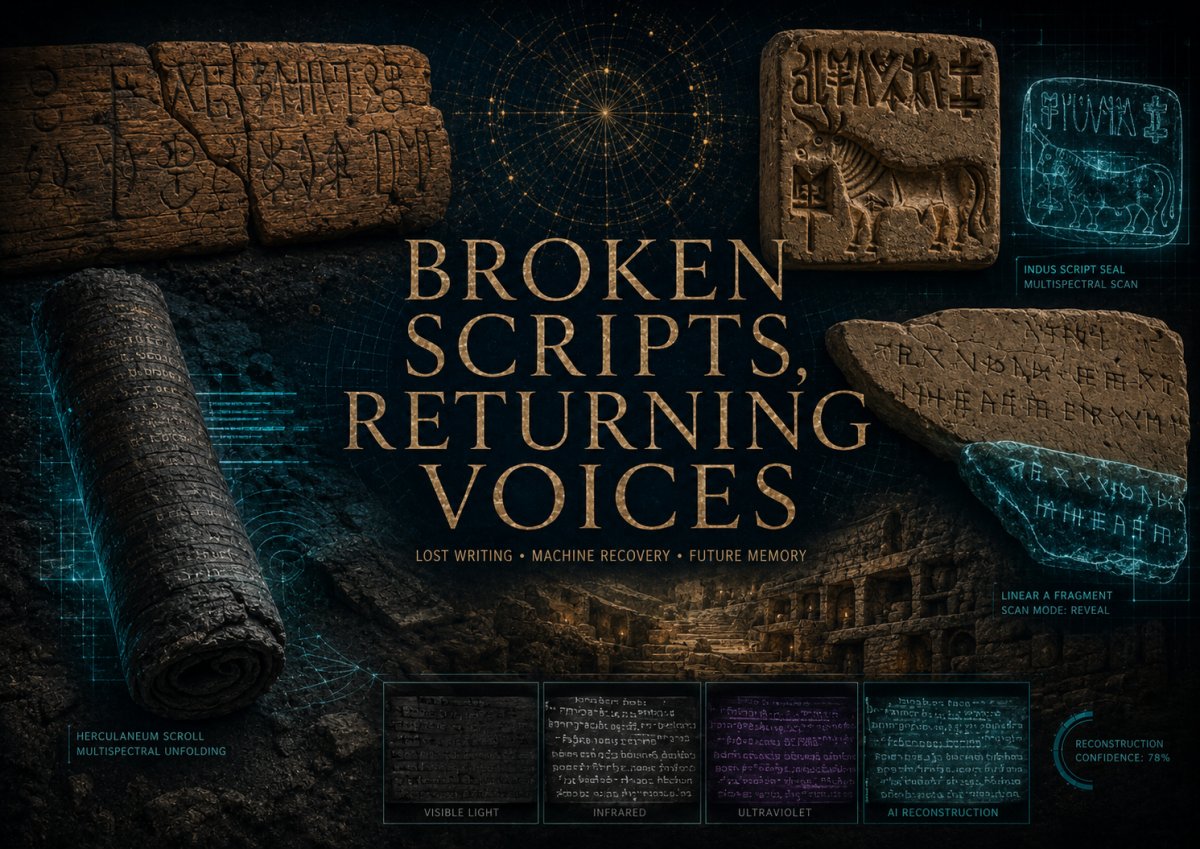
Broken Archives
Scripts, maps, scrolls, tablets, myths, and oral histories can survive after their operating systems die.
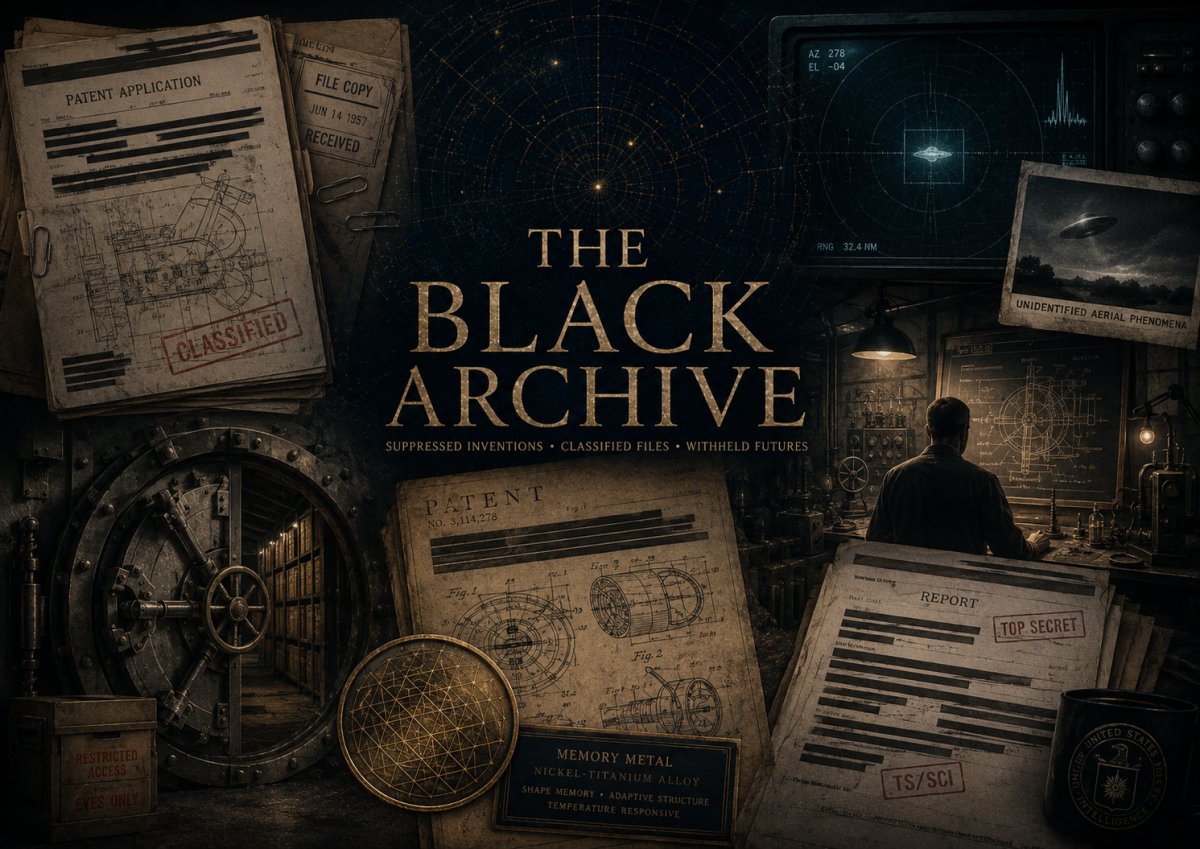
Modern Black Archive
Patent secrecy, defense classification, UAP files, and institutional filters prove suppression is a mechanism; the dispute is scope.
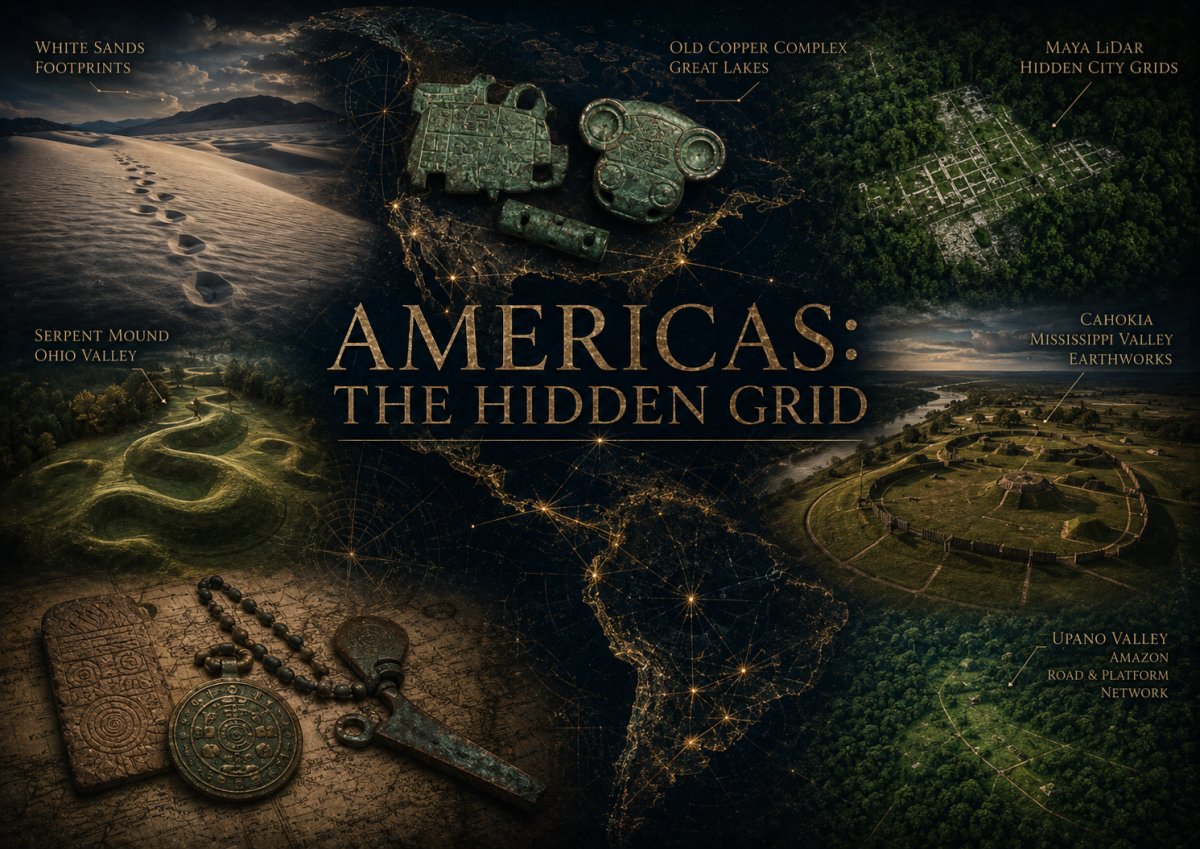
The signal moves through nine connected visual layers.
Each visual layer marks a different part of the older-signal map: the title thesis, deep time, monuments before empire, drowned coastlines, underground infrastructure, sky-code systems, the hidden Americas, broken scripts, and the modern black archive.
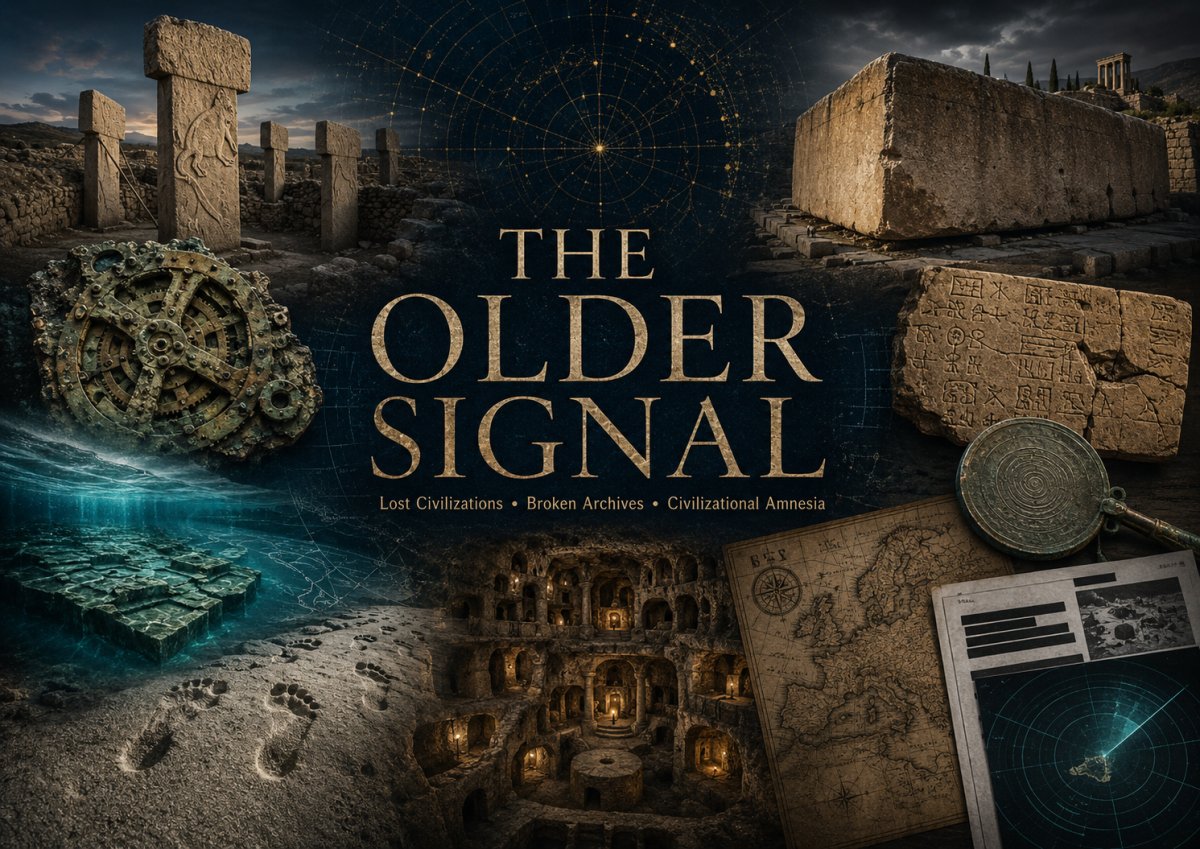
This is the anomaly-network argument.
The starting premise is that human civilization and human knowledge may be far older, stranger, more cyclic, and more controlled than the normal public story allows. That does not mean every single anomaly is declared factual. It means the pattern map refuses to erase anomaly clusters just because they are inconvenient.
The map includes deep-time human capability, 50,000-year-plus civilization questions, megalithic construction, underground enigmas, Baalbek, China’s engineered caves and quarry sites, earthworks in Illinois and the wider Midwest, Michigan copper, ancient maps, Arctic and Antarctic mystery narratives, Mayan/Aztec/Inca alignments, pyramids and precession claims, Rongorongo and broken scripts, AI-deciphered archives, UAP and space secrecy, gold obsession, Tesla and suppressed-power narratives, water-car death lore, anti-gravity rumors, recurring pandemic/social-control patterns, and the larger possibility field: aliens, seed race, Mars/Venus origin memory, simulation cycles, or something stranger than all of those.
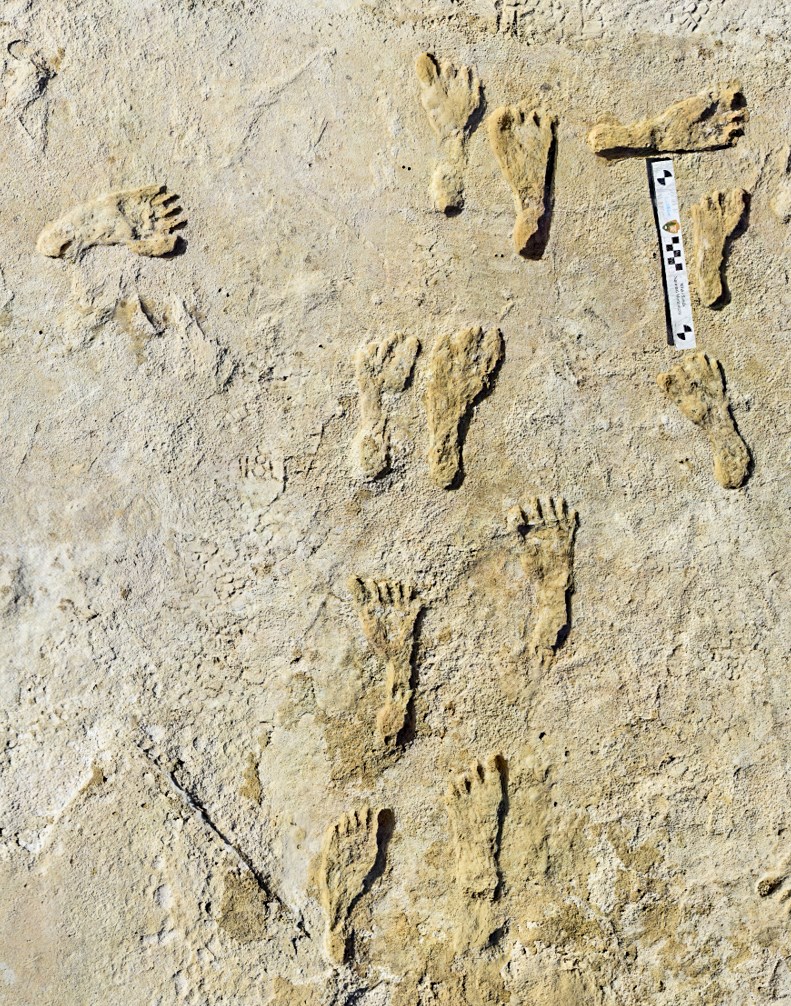
The point is not to pretend the London Hammer, the Coso artifact, Michigan copper-to-Egypt claims, alleged Egyptian finds in America, ancient maps, anti-gravity stories, or free-energy legends all carry the same weight as White Sands footprints, Kalambo Falls wood, Bruniquel Cave, Göbekli Tepe, Cahokia, Doggerland, Herculaneum scroll recovery, or government patent secrecy. They do not. The point is that even after separating the hard nodes from the disputed nodes, the same signal remains: age expansion, missing records, controlled knowledge, strange technical memory, and later rediscovery.
The article’s discipline is not “debunk first.” Its discipline is: keep the whole pattern on the board, separate confidence levels where useful, and ask why the same kind of missing knowledge keeps appearing across archaeology, mythology, technology, intelligence, energy, and modern institutional behavior.
The artifact is not one object. The artifact is the pattern.
This subject feels insane because the archive is insane. You can spend years collecting one node at a time and still not reach the edge of it: Mayan timing systems, Inca roads, Aztec cosmology, North American earthworks, Illinois and Michigan anomalies, Great Lakes copper, Egyptian-contact claims, ancient maps, Arctic and Antarctic stories, pyramids, precession, underground cities, China’s carved caves and quarry stones, drowned coastlines, broken scripts, vanished source chains, UAP secrecy, black-budget aerospace, Tesla, gold, energy suppression, anti-gravity rumors, and the same civilizational loops repeating like a program under stress.
If this were only one topic, it would be easy to dismiss. But it is not one topic. It is archaeology, geology, mythology, astronomy, intelligence, energy, patents, empire, archives, language, and memory all touching the same nerve: knowledge does not move cleanly through time. It gets controlled. It gets destroyed. It gets buried. It gets rewritten. It gets laughed out of the room. Then later, some new tool opens a piece of it and everyone quietly moves the boundary line.
That is why the article keeps the uncomfortable pieces on the board. Not because every piece has the same evidentiary weight. Not because every rumor is fact. Because the network is the evidence that something about the public human story is too clean, too linear, and too confident.
Choose Your Reading Level
Pick the version that matches how deep you want to go.
Reader-Friendly Version: Here is the actual argument.
The easy way to kill this subject is to make it about one object. The London Hammer. The Coso artifact. The Baghdad Battery. A strange map. A pyramid measurement. A rumor about a cave. A dead inventor. A UAP file. One node gets attacked, and then people act like the whole pattern disappears.
That is not what I am saying. I am saying the same structure keeps showing up across too many places. The human timeline moves backward. The archive gets damaged. The coastline disappears. The jungle hides cities. The underground record is bigger than the written record. The sky gets encoded into monuments. Scripts survive after no one can read them. Modern governments classify technology and sensor data. Energy stories get buried in rumor, death, ridicule, and secrecy. Civilizations repeat cycles like they are running the same pressure script again and again.
Some of this is hard evidence. Some of it is disputed. Some of it is probably wrong. That does not bother me. A damaged archive is supposed to look messy. What bothers me is the confidence people use when they act like the mess means nothing.
The public version of history wants a neat staircase: primitive people, agriculture, cities, writing, empire, science, modernity. The older signal looks more like a looped and damaged file system: rises, collapses, drowned shelves, burned libraries, missing scripts, buried structures, oral memory, myth compression, controlled technology, and rediscovery by better tools.
The question is not whether one artifact proves everything. The question is why every layer of the archive keeps producing the same kind of missing piece.
The timeline keeps failing in the same direction.
Every few decades the floor drops. Humans are older. Tool use is older. Wood construction is older. Underground construction is older. People were in places earlier than they were supposed to be. The Americas timeline keeps shifting. Jungle cities turn out to be larger. The archive keeps expanding when new tools look harder.
That does not prove every extreme claim. It does something more important: it shows that the official public model is not a finished map. It is a moving target. And the movement is almost always backward into older complexity.

The ancients did not need to look modern to be advanced.
Modern people think complexity has to look like our world: skyscrapers, power grids, documents, factories, airports, phones. That bias ruins the conversation. A civilization can preserve sky knowledge without telescopes. It can navigate oceans without GPS. It can carry law in memory instead of paper. It can make a landscape into a calendar. It can build ritual architecture that outlives the society that built it.
That is the part people miss. The ancients were not primitive because they did not build like us. They were operating inside a different technological stack: stone, sky, season, memory, myth, water, gold, symbol, and place.
The best evidence may be exactly where we cannot easily see it.
Doggerland is not fantasy. It was land, and now it is sea. That one fact should change the whole conversation. If whole human landscapes can disappear beneath shallow water, then the lack of visible surface ruins does not close the case.
The same logic applies globally: Sundaland, Beringia, Sahul shelves, Persian Gulf lowlands, drowned coasts around India, the Mediterranean, the Black Sea, and river-mouth worlds that would have been prime human territory. The archive is not missing only because someone hid it. A massive piece of it drowned.

The underground world is not a side note.
Deep underground structures are expensive. People do not casually hollow out chambers, carve passages, cut ventilation, build storage, shape ritual space, and create hidden systems unless those systems matter. Refuge, initiation, water, burial, defense, astronomy, sound, and survival can all live underground.
The weird part is not that underground sites exist. The weird part is how often the built record is louder than the written explanation. The stone is there. The chamber is there. The labor is there. The manual is gone.

The ancients were tracking cycles larger than one lifetime.
You do not get serious sky knowledge from one person staring upward for a few nights. Long-cycle astronomy requires memory. It requires watchers, record-keepers, priests, navigators, builders, or some other institution that preserves observations across generations.
That is why pyramid alignments, precession claims, Maya calendars, Babylonian astronomy, Antikythera, and landscape monuments matter together. Even when one claim is disputed, the larger pattern remains: ancient cultures treated the sky as a system, not as random lights.

The Americas were never the simple blank space the public story made them.
The old public model underrated the Americas for a long time. Then the evidence kept breaking it: earlier footprints, larger earthworks, more complex mound systems, copper networks, jungle cities, Amazonian infrastructure, and entire landscapes that only appear when LiDAR strips the trees away.
This is where the Michigan copper question belongs. The Egypt connection is disputed. Fine. But do not let the disputed claim erase the real node: the Great Lakes had ancient copper extraction and copper-working traditions. The real pattern is already big enough.
.jpg)
The archive can survive and still be lost.
A tablet can survive. A scroll can survive. A glyph can survive. A map can survive. But if the reading chain dies, the meaning is gone. That is what makes AI recovery and multispectral imaging so important. We are not only finding new ruins. We are reopening dead archives.
That means the past is not finished. It is not even fully translated. Some of the old world is still locked inside damaged text, carbonized scrolls, unread scripts, broken oral chains, and symbols we do not know how to read anymore.
Suppression is not imaginary. The fight is over scale.
The government does not need to admit aliens for the secrecy pattern to matter. Patent secrecy exists. Defense classification exists. UAP sensor data has been hidden, redacted, delayed, and stigmatized. Corporate secrecy exists. Black-budget research exists. Strategic technology is not treated like open public knowledge.
That does not prove every water-car story or anti-gravity rumor. But it proves the mechanism. Knowledge can be controlled when it touches power. Once that is admitted in the modern world, the ancient archive starts looking different too. Maybe not one global conspiracy. Maybe layers: natural erasure, cultural destruction, priestly secrecy, colonial rewriting, academic gatekeeping, and modern classification.
The clean story is this: we are not looking at one mystery. We are looking at a damaged human archive. Some evidence drowned. Some burned. Some rotted. Some was buried. Some was looted. Some was rewritten. Some became myth. Some is still classified. Some is sitting in museums under the wrong label. Some is unreadable until machines recover it.
The official public story is not evil just because it is incomplete. But it is incomplete. And when every new tool makes the old world older, larger, stranger, and more connected, the reasonable position is not blind belief. It is pressure. Keep the whole board visible. Stop pretending the pattern is not there.
The artifact is not one object. The artifact is the pattern.


Show the places. Do not just name-drop them.
This atlas puts the physical weirdness directly on the page: pillars, underground corridors, gears, geoglyphs, mounds, map fragments, and temple-scale stone.
How the pattern map separates facts, disputes, folklore, and hypothesis space.
| Evidence class | Representative nodes | How to use it |
|---|---|---|
| Hard physical / dated | Kalambo, Bruniquel, White Sands, Göbekli, Poverty Point | Use as core pillars; these are not folklore nodes. |
| Established monument systems | Cahokia, Nasca, Malta, Giza, Stonehenge, Baalbek | Use to show scale, measurement, ritual design, and organized labor. |
| Remote-sensing corrections | Maya LiDAR, Upano Valley, Amazon geoglyphs, Nasca AI | Use to show the tools were too weak, not that nothing was there. |
| Underwater / drowned archive | Doggerland, Pavlopetri, Atlit Yam, submerged shelves | Use as preservation-bias mechanism. |
| Broken writing systems | Rongorongo, Linear A, Indus, Maya codices, Herculaneum scrolls | Use as archive-loss mechanism. |
| Modern secrecy mechanisms | Invention Secrecy Act, FAS secrecy orders, NASA UAP, defense classification | Use as modern proof that suppression mechanisms exist. |
| Disputed / folklore signals | London Hammer, Coso artifact, Dendera Light, Grand Canyon cave, water-car lore | Use only as signal map, not as proof pillar. |
| Speculative hypothesis space | Mars, Venus, seed race, simulation, nonhuman intervention | Use as possible interpretation space after the evidence stack is mapped. |
What the images reveal
Göbekli Tepe
T-shaped pillars and circular enclosures force a better model of pre-urban coordination. This is the site that breaks the lazy “hunter-gatherers did nothing complex” public story.
Baalbek
The Lebanon site does not prove anti-gravity. It proves that ancient engineering ambition sometimes exceeded ordinary utility and chose scale as a power language.
Derinkuyu
Cappadocia’s underground-city architecture shows refuge, storage, ventilation, defense, and hidden built-world logic below the surface record.
Antikythera Mechanism
The geared astronomical device makes the ancient sky-code mechanical. It is one of the cleanest examples of forgotten technical sophistication.
Nasca Lines
The desert becomes a symbolic surface, a ground-drawn archive, and now an AI-assisted discovery field with hundreds of additional figures.
Cahokia / Monks Mound
Illinois is not a side note. Cahokia was a major Mississippian urban center with monumental earthwork geometry and regional influence.
Piri Reis Map
The map is not treated as proof of Antarctica claims. It works as a map-palimpsest node: later documents can preserve older source traditions.
Giza Pyramid Complex
Giza is not needed as a cartoon mystery. It matters because monumental geometry, orientation, kingship, measurement, and sky religion converge in stone.
Stonehenge
Stonehenge belongs to the wider pattern of architecture being used as memory, ritual clock, horizon instrument, and political landscape.
Rongorongo
The tablets symbolize the archive problem: signs can survive after the reading community, priesthood, or training chain disappears.
Poverty Point
The Louisiana earthwork complex was created by a non-state society and remained an earthwork achievement in North America for thousands of years.
Ħal Saflieni Hypogeum
Malta’s underground Neolithic complex shows ritual descent, acoustics, burial, carved chambers, and a hidden architecture of memory.
Source base by evidence function
The source base is evidence-tiered. Hard archaeology and primary institutional sources carry the spine; disputed anomaly nodes remain in the signal map as pattern material, not single-point proof.
- UNESCO — Göbekli Tepe
- Nature — Kalambo Falls structural wood
- Nature — Bruniquel Cave Neanderthal constructions
- UNESCO — Monumental Earthworks of Poverty Point
- UNESCO — Cahokia Mounds
- UNESCO — Lines and Geoglyphs of Nasca and Palpa
- UNESCO — Ħal Saflieni Hypogeum
- Science — Upano Valley Amazonian urbanism
- Science — White Sands footprints
- Science — Babylonian mathematical astronomy
- Nature — Antikythera mechanism research
- NASA — UAP research page
- Cornell LII — 35 U.S.C. § 181 invention secrecy
- Federation of American Scientists — Invention secrecy
- Vesuvius Challenge
- University of Nottingham — Pavlopetri underwater archaeology
- Library of Congress — Piri Reis map reference
- Canadian Museum of History — Bluefish Caves context
- Cambridge Radiocarbon — Old Copper Complex dating
- Britannica — Rongorongo
- Britannica — Baghdad Battery
- World History Encyclopedia — Dendera Light relief
- National Park Service — Grand Canyon archaeology
The artifact is the pattern.
The public story says the past is mostly solved and only the details remain. The Pattern Nexus read says the opposite: the past is a damaged dataset, and the most important missing material may be exactly the material least likely to survive.
The older signal is not one out-of-place object. It is the repeated failure of the official public model to explain the full scale, age, complexity, suppression, rediscovery, and mythic compression of human knowledge systems.
Some anomalies are weak. Some are disputed. Some are probably wrong. But the hard pattern remains: every time the tools improve, the ancient world gets older, bigger, denser, smarter, and less simple.
The modern layer matters because suppression is not just an ancient-history claim.
The point is not that every water-car story, every Tesla legend, every anti-gravity rumor, every scientist disappearance, or every UAP claim is automatically proven. The point is that modern society already contains working mechanisms for suppression: patent secrecy, classified aerospace programs, compartmentalized sensor data, intelligence redaction, corporate control of energy systems, institutional funding pressure, reputational gatekeeping, and algorithmic visibility control.
That is why the old archive and the modern archive rhyme. Ancient records disappear through flood, fire, conquest, decay, priestly secrecy, colonial destruction, and script loss. Modern records disappear through classification, redaction, trade secrecy, national-security restrictions, official stigma, and platform filtering. Different tools. Same pattern: knowledge becomes controlled when it touches power.
The cycle layer matters too. 1918 and COVID-era masking do not prove a literal simulation by themselves, but they do show that human institutions repeat behavior under repeated pressure. Plague returns. War returns. censorship fights return. panic returns. official contradiction returns. public distrust returns. Ancient cyclical time may not have been primitive superstition. It may have been a recognition that civilizations run loops larger than one lifetime.
What's Your Reaction?
 Like
0
Like
0
 Dislike
0
Dislike
0
 Love
0
Love
0
 Funny
0
Funny
0
 Wow
0
Wow
0
 Sad
0
Sad
0
 Angry
0
Angry
0

Founder of Pattern Nexus. I research markets, macro, geopolitics, AI, history, ancient systems, and the patterns most people overlook. I’m also building Market Radar, a trading scanner designed to read pressure, risk, confirmation, and setup quality before chasing a move. Pattern Nexus is where I connect the dots between data, history, technology, and the bigger system playing out around us.






Comments (0)