
The Great Pyramid Math Frame: The Ratio Stack Nobody Should Hand-Wave Away
The Great Pyramid argument is strongest when the math comes first. Using the common reconstructed dimensions of 280 royal cubits high and 440 royal cubits per base side, the structure produces a repeatable ratio stack: 22/7 as a pi approximation, the 14:11 slope ratio, a golden-ratio face relationship, a 43,200 Earth-scale comparison, and the Moon-Earth 11:3 number family. This does not automatically prove every theory attached to the pyramid, but it does show why the geometry should not be casually dismissed.
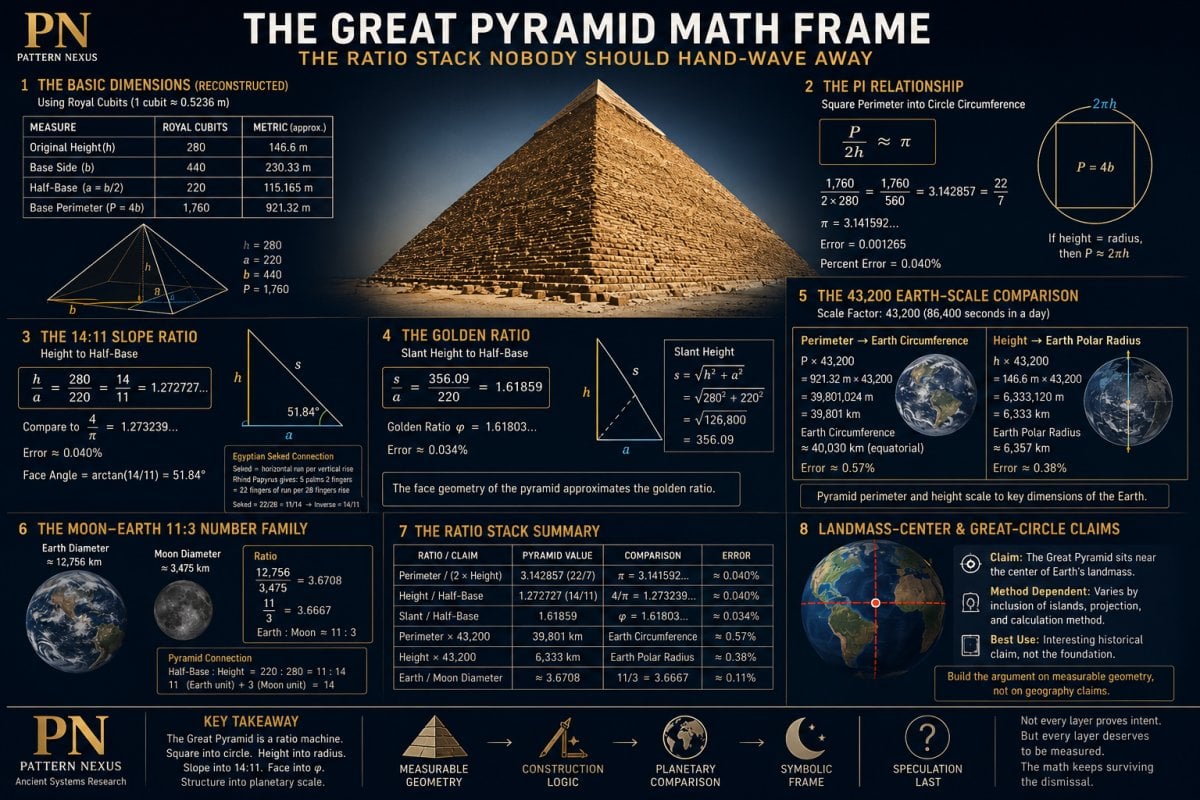
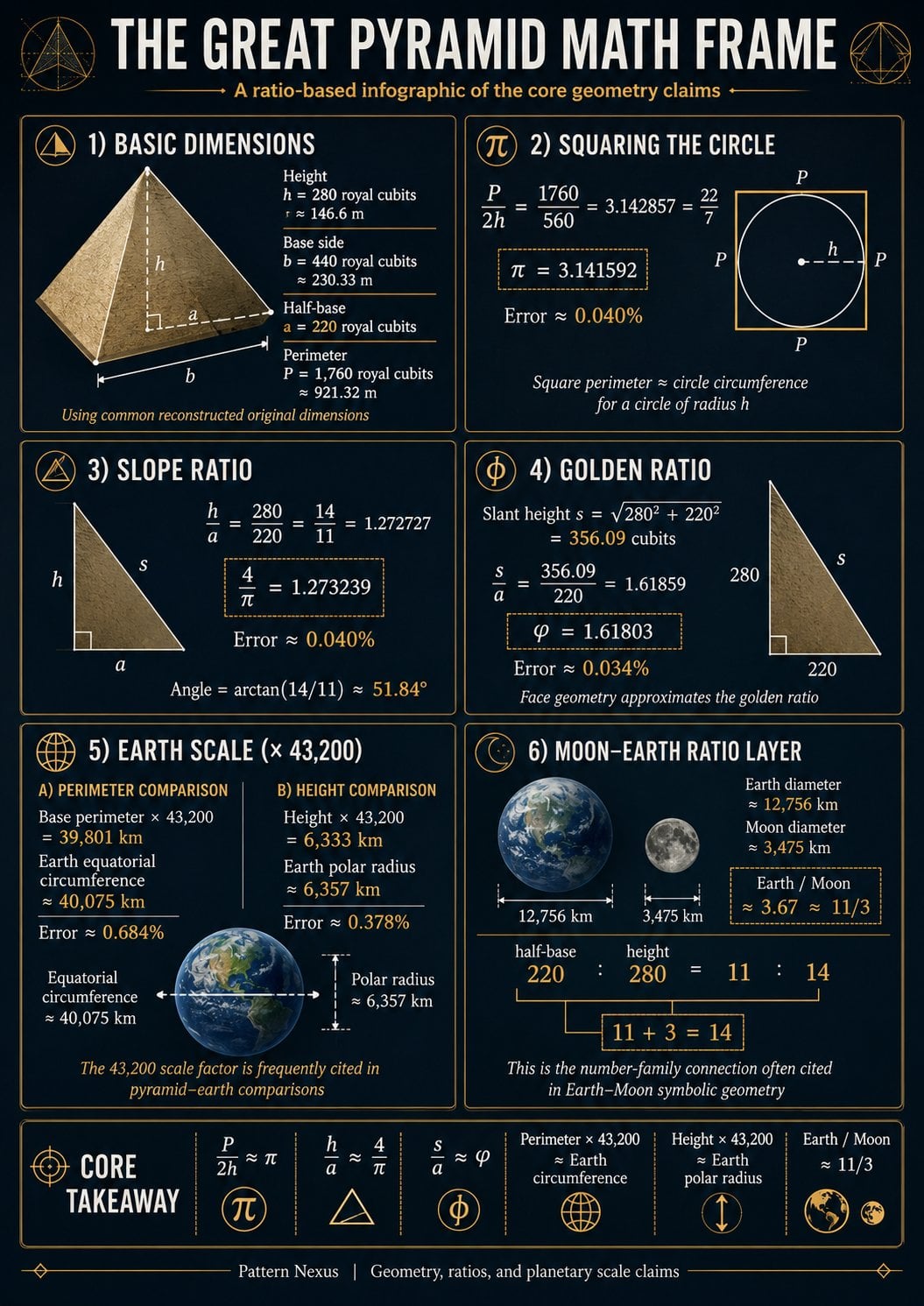
The Great Pyramid math claim gets weak when people lead with mystery and skip the numbers. The cleaner frame is simple: using the common reconstructed dimensions of 280 royal cubits in height and 440 royal cubits per base side, the pyramid produces a repeatable ratio stack. The base perimeter divided by twice the height gives 22/7, an approximation of π. The height-to-half-base ratio reduces to 14:11, which is extremely close to 4/π. The slant height divided by the half-base lands close to the golden ratio. Then the 43,200 scaling comparison puts the pyramid perimeter near Earth’s circumference and the height near Earth’s polar radius. None of that automatically proves intent. But pretending the ratios are not there is also lazy.
The pyramid argument is strongest when it is disciplined: measurable ratio first, interpretation second, speculation last.
The math exists. Builder intent is the disputed part. Do not let either side collapse those into the same claim.
A single ratio can be coincidence. A stacked ratio system is harder to hand-wave, even if the final explanation remains open.
The numbers have to come first
The problem with most Great Pyramid arguments is that they are presented backward.
People start with the conclusion. They start with mystery, hidden knowledge, lost civilization, alien engineering, ancient energy systems, or some symbolic claim that may or may not be true. Then they throw a few numbers at the wall and expect everyone to accept the whole thing as one package.
That is not how this should be framed.
The clean version starts with the math. Nothing else.
What are the reconstructed dimensions? What ratios do those dimensions generate? How close are those ratios to known mathematical or planetary values? What is the error? Which parts are direct geometry? Which parts are later symbolic comparison? Which parts are speculation?
That separation matters because the math is not all the same category.
The perimeter-to-height relationship comes straight out of the pyramid’s basic dimensions. The 14:11 slope ratio also comes straight out of the pyramid’s dimensions. The golden-ratio face relationship comes from the right-triangle geometry of the face. The 43,200 Earth-scale comparison is a scaling claim. The Moon-Earth ratio layer is a number-family comparison. The landmass-center claim is a geographic claim and is much more method-dependent.
Those should not all be treated as equally hard evidence. But they also should not be thrown away together just because the topic attracts sloppy arguments.
Measurable geometry first. Error calculation second. Design-intent debate third. Symbolic interpretation fourth. Speculation last.
The basic dimensions
The common reconstructed dimensions of the Great Pyramid are approximately 280 royal cubits in original height and 440 royal cubits along each base side. In metric terms, the original height is usually given around 146.6 to 147 meters, and each base side around 230 to 230.33 meters. Britannica gives the broad public reference as about 147 meters original height and about 230 meters per base side. Other technical discussions commonly use 280 cubits high and 440 cubits per side.
For the math frame, define the terms:
| Measure | Symbol | Royal cubits | Approx. metric |
|---|---|---|---|
| Original height | h | 280 | ≈ 146.6 m |
| Base side | b | 440 | ≈ 230.33 m |
| Half-base | a | 220 | ≈ 115.165 m |
| Base perimeter | P | 1,760 | ≈ 921.32 m |
So the base frame is:
h = 280 royal cubits
b = 440 royal cubits
a = b / 2 = 220 royal cubits
P = 4b = 1,760 royal cubits
That is the starting point. From here the ratios become unavoidable.
The π relationship: square perimeter into circle circumference
The first major ratio is the perimeter-to-height relationship.
Use this formula:
P / 2h ≈ π
Insert the pyramid values:
1,760 / (2 × 280)
= 1,760 / 560
= 3.142857
= 22 / 7
Actual π is:
π = 3.141592...
Error:
3.142857 - 3.141592 = 0.001265

0.001265 / 3.141592 ≈ 0.0004025

Error ≈ 0.040%
This is the clean “squaring the circle” layer.
It means the square base perimeter is approximately equal to the circumference of a circle whose radius is the pyramid height:
P ≈ 2πh
That does not require pretending the Egyptians wrote π the way we write it now. The mathematical relationship is there either way. The debate is whether it was intentional, emergent from construction practice, or a consequence of the seked slope system.
The Great Pyramid’s base perimeter behaves like circle circumference when the pyramid height is treated as radius. That is the math. Intent is the next question, not the first one.
The 14:11 slope ratio
The next layer is the slope ratio.
Use the height and half-base:
h / a = 280 / 220
Reduce it:
280 / 220 = 14 / 11 = 1.272727...
Now compare that to:
4 / π = 1.273239...
Error:
1.273239 - 1.272727 = 0.000512

0.000512 / 1.273239 ≈ 0.000402

Error ≈ 0.040%
This matters because it is the same error neighborhood as the 22/7 π approximation.
The face angle follows directly:
angle = arctan(h / a)
angle = arctan(14 / 11)
angle ≈ 51.84°
This is also where the Egyptian engineering explanation enters. Ancient Egyptian pyramid slope was described with the seked, meaning horizontal run per vertical cubit rise. The Rhind Mathematical Papyrus includes pyramid problems that deal with calculating the seked. Since one cubit equals seven palms and one palm equals four fingers, one cubit equals 28 fingers. A seked of five palms and two fingers equals 22 fingers of run per 28 fingers of rise:
5 palms + 2 fingers
= 5 × 4 + 2
= 22 fingers

1 cubit = 7 palms = 28 fingers

seked = 22 / 28 = 11 / 14

slope = inverse = 14 / 11
That gives a grounded construction pathway for the same geometry. It means the π relationship may not have come from a modern-style abstract π obsession. It may have come from a practical Egyptian slope rule that happened to generate a strong π approximation.
That does not kill the pattern. It makes the pattern more interesting because now we are not looking at just one ratio. We are looking at a construction system that naturally generates several of them.
The golden ratio face geometry
Now calculate the slant height of the pyramid face.
Let:
s = slant height
h = 280
a = 220
Use the right-triangle relation:
s = √(h² + a²)
Insert the numbers:
s = √(280² + 220²)
s = √(78,400 + 48,400)
s = √126,800
s ≈ 356.09
Now compare slant height to half-base:
s / a = 356.09 / 220 = 1.61859
The golden ratio is:
φ = 1.61803...
Error:
1.61859 - 1.61803 = 0.00056

0.00056 / 1.61803 ≈ 0.000346

Error ≈ 0.034%
So the face geometry approximates the golden ratio.
Again, do not overstate it. This does not prove that the builders intentionally encoded the golden ratio as a philosophical constant. The better version is cleaner:
A pyramid designed around the 14:11 slope relationship also produces a face geometry very close to φ.
That is the Pattern Nexus move. One ratio generates another. The structure is not interesting because one number can be found. It is interesting because the chosen dimensional frame keeps producing a family of ratios.
The 43,200 Earth-scale comparison
The 43,200 layer is different. This is no longer just internal pyramid geometry. This is a scale comparison between the pyramid and Earth.
Use the metric values:
height ≈ 146.6 m
base side ≈ 230.33 m
base perimeter ≈ 921.32 m
The scale factor commonly used in this comparison is:
43,200
The symbolic reason this number gets attention is that:
43,200 × 2 = 86,400
86,400 seconds = 1 day
Now scale the base perimeter:
921.32 m × 43,200 = 39,801,024 m
39,801,024 m = 39,801 km
NASA’s Earth-Moon comparison page lists Earth’s equatorial circumference at approximately 40,030.2 km.
40,030.2 - 39,801 = 229.2 km

229.2 / 40,030.2 ≈ 0.00573

Error ≈ 0.573%
If using the more common equatorial circumference figure of about 40,075 km, the error is around 0.684%.
Now scale the pyramid height:
146.6 m × 43,200 = 6,333,120 m
6,333,120 m = 6,333 km
Earth’s polar radius is commonly given around 6,357 km.
6,357 - 6,333 = 24 km

24 / 6,357 ≈ 0.00378

Error ≈ 0.378%
So the Earth-scale frame is:
Base perimeter × 43,200 ≈ Earth circumference

Height × 43,200 ≈ Earth polar radius
This does not prove the pyramid was intentionally designed as a scale model of Earth. But it does explain why the argument has survived for so long. The values are close enough that the comparison cannot be dismissed by pretending it is numerically empty.
The 43,200 comparison is not exact proof of intent. It is a scale relationship that lands within a small error band using the same structure that already produces the π and φ ratio stack.
The Moon-Earth 11:3 number family
The Moon-Earth layer is another category. It is not as direct as the pyramid’s own perimeter and height math. It is a proportional comparison between the pyramid’s number family and the Earth-Moon size relationship.
NASA lists the Moon’s equatorial radius at about 1,737.5 km and Earth’s equatorial radius at about 6,371 km.
Double those for diameter:
Moon diameter ≈ 1,737.5 × 2 = 3,475 km

Earth diameter ≈ 6,371 × 2 = 12,742 km
Using the commonly cited equatorial diameter near 12,756 km for Earth, the Earth-to-Moon diameter comparison is:
12,756 / 3,475 ≈ 3.6708
Now compare that to:
11 / 3 = 3.6667
So the symbolic approximation is:
Earth : Moon ≈ 11 : 3
Now return to the pyramid’s own geometry:
half-base : height = 220 : 280

220 : 280 = 11 : 14
The connection people point to is:
Earth unit = 11
Moon unit = 3
Combined frame = 11 + 3 = 14
So the pyramid’s 11:14 half-base-to-height relationship echoes the Earth-Moon symbolic number family:
Pyramid: 11 : 14
Earth-Moon frame: 11 + 3 = 14
This is where the Vitruvian-style circle-square comparisons usually enter the conversation. The idea is not that Leonardo proves the pyramid. The idea is that circle-square-body-Earth-Moon diagrams repeatedly return to the same geometric problem: how to represent curved celestial proportion inside square terrestrial measure.
That is a symbolic layer. Treat it as symbolic. But do not ignore the number-family echo.
Landmass-center and great-circle claims
The landmass-center claim is the weakest part if it is overstated.
There is a long history of pyramid theorists arguing that the Great Pyramid sits in a special geographic position relative to Earth’s land distribution. Some versions claim it is near the center of the world’s landmass. Others claim it lies on an unusually long land-crossing great-circle path.
The problem is that geographic-center claims depend heavily on method. Are islands included? Is the calculation done on a globe or a projection? Are we measuring land area centroid, maximum land-connectedness, antipodal distribution, or the longest great circle passing through land? Small definition changes move the result.
So the correct PN framing is:
The landmass claim is historically interesting but method-dependent. Do not build the argument on it. Build the argument on the measurable pyramid geometry first.
That matters because the ratio stack does not need the landmass claim to work.
The core math already stands without it:
P / 2h ≈ π
h / a ≈ 4 / π
s / a ≈ φ
perimeter × 43,200 ≈ Earth circumference
height × 43,200 ≈ Earth polar radius
Earth / Moon ≈ 11 / 3
That is the real frame.
Pattern Nexus Lens
The pyramid argument only works when it is separated into layers.
Layer one is direct geometry. That includes the 280-cubit height, 440-cubit base side, 1,760-cubit perimeter, 22/7 perimeter-to-height result, 14:11 slope ratio, and φ-like slant-face relationship.
Layer two is construction logic. The Egyptian seked system gives a practical pathway for why a 14:11 slope could exist without needing modern π notation. That matters. It means the math may be embedded through building practice, not necessarily through abstract symbolic expression.
Layer three is planetary comparison. The 43,200 scaling frame places the pyramid’s perimeter near Earth circumference and its height near Earth polar radius. That is not exact, and it is not proof by itself. But it is a real comparison with a measurable error band.
Layer four is symbolic number family. The Earth-Moon 11:3 relationship and the pyramid’s 11:14 half-base-to-height frame are not the same type of evidence as the direct pyramid math. But they are part of the larger proportional echo.
Layer five is speculation. Photon holograms, crystal geometry overlays, cubing the sphere, energy into matter, and ancient field systems belong here unless the math is shown clearly and separately.
That is the actual PN framework:
Do not lead with mystery.
Lead with the ratio stack.

Do not claim intent before showing geometry.
Show geometry first.

Do not flatten every claim into proof.
Rank the claims by evidentiary strength.
The modern world keeps asking how they moved the stones. That question matters. But it may not be the only question.
The better question is this:
Why does this object keep translating square into circle, height into radius, slope into 14:11, face geometry into φ, and structure into planetary-scale comparison?
That does not prove every theory attached to the pyramid.
But it does prove the discussion should not be dismissed with a shrug.
The Great Pyramid is a ratio machine. That is the cleanest statement. Not a tomb-only explanation. Not a magic-only explanation. A ratio machine sitting in stone.
Sources
- Britannica — Great Pyramid of Giza overview and approximate height/base dimensions
- British Museum — Rhind Mathematical Papyrus and Egyptian pyramid geometry problems
- NASA Science — Earth and Moon comparison values, radius and circumference
- University of Washington Mathematics — Pi and the Great Pyramid, 14:11 slope, seked discussion
- Springer / Nexus Network Journal — The Design of the Great Pyramid of Khufu and disputed design-intent theories
Closing Note
This is the cleaner argument.
The Great Pyramid does not need fake certainty to be strange. The ratios are already strong enough to force the question.
Perimeter into circle. Height into radius. Slope into 14:11. Face into φ. Scale into Earth comparison. Number family into Earth-Moon proportion.
Not every layer proves intent.
But every layer deserves to be separated, measured, and placed in the correct order.
The Great Pyramid is not interesting because people call it mysterious. It is interesting because the math keeps surviving the dismissal.
Frequently Asked Questions
What's Your Reaction?
 Like
0
Like
0
 Dislike
0
Dislike
0
 Love
0
Love
0
 Funny
0
Funny
0
 Wow
0
Wow
0
 Sad
0
Sad
0
 Angry
0
Angry
0

Founder of Pattern Nexus. I research markets, macro, geopolitics, AI, history, ancient systems, and the patterns most people overlook. I’m also building Market Radar, a trading scanner designed to read pressure, risk, confirmation, and setup quality before chasing a move. Pattern Nexus is where I connect the dots between data, history, technology, and the bigger system playing out around us.






Comments (0)