
Peak Insanity: Pure Speculation on a World That No Longer Organizes Itself
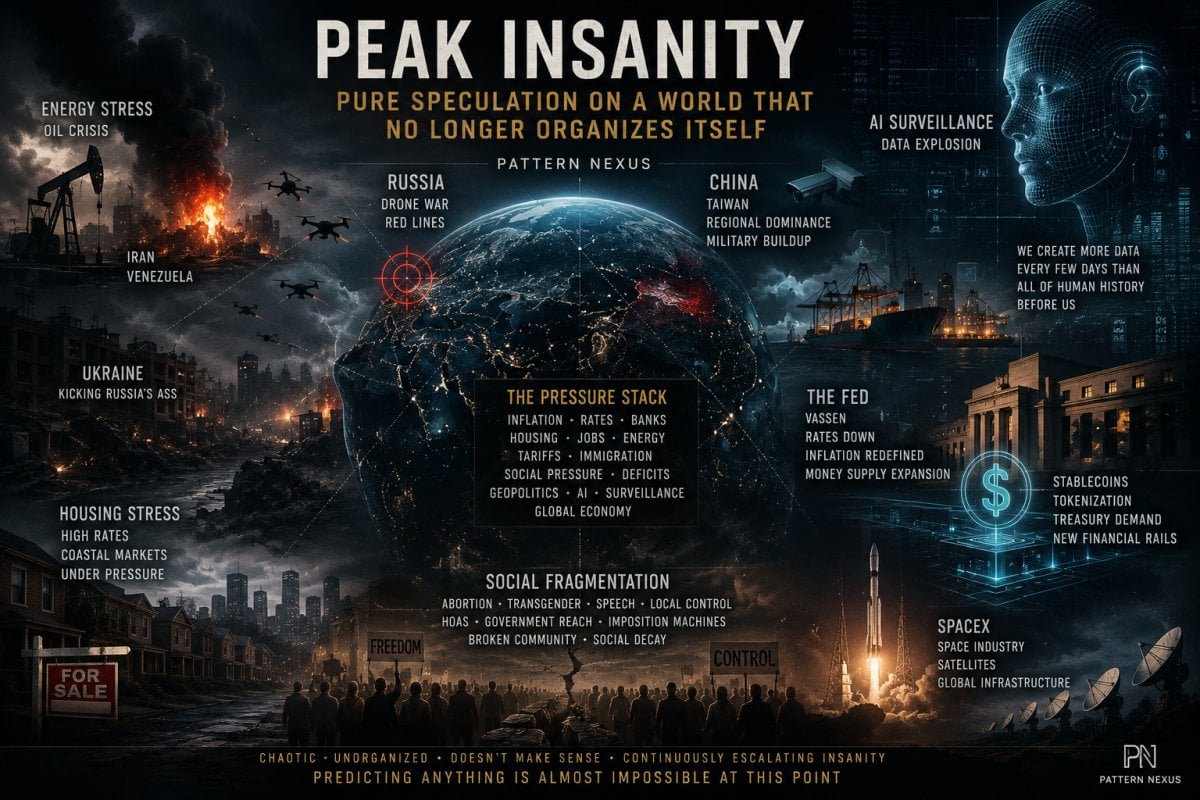
This is not a prediction article. It is not a clean thesis. It is a speculative Pattern Nexus thought-run through the pressure stack building across 2026: Venezuela, Iran, oil, banks, inflation, rates, Russia, Ukraine, China, AI, energy, surveillance, social fragmentation, and the possibility that the modern world has entered a period where the pattern itself is chaotic escalation.
I am just going to run through a bunch of thoughts. I am not going to come to any hard conclusions. I am not going to try to punch you down one specific path. I am not going to pretend this is a clean forecast with a neat little bow on it.
What do they
call this?
Pure speculation, if you will.
Let’s ride.
2026 starts off mostly optimistic. January rolls in, and then we get Venezuela. Then Iran. Then the oil crisis. Then stress in the banking industry. Then stress in CRAs. Then inflation pressures. Rate pressures. Geopolitical pressures. China pressures. Tariff pressures. Social pressures. Immigration pressures.
It just goes on and on.
I do not even know where to stop anymore, because that is kind of the point. The system does not feel like it is moving through one crisis. It feels like every system is being pressured at the same time, from different directions, with no clean organizing principle holding it together.
We are in housing stress. High rates. Coastal markets under stress. Consumers under stress. AI pressure in the job market. The AI buildout itself. Energy stress. Military-industrial buildup. The ever-expanding federal budget deficit. The global economy. Japan. Australia. Europe. The EU.
And then Ukraine is starting to kick Russia’s ass in a way that most people still are not mentally processing. Just the other day, Ukraine bombed Moscow extensively with drones.
That is not a small thing.
We talk about these events like they are just another headline, another data point, another thing to scroll past. But when you actually step back and look at the pattern, a nuclear-armed superpower is having its infrastructure hit by drones, repeatedly, in its own territory.
That is not a normal geopolitical condition. That is a dangerous pressure point.
Energy
Oil crisis pressure, shipping pressure, energy security, and the cost of powering the AI buildout all feed into the same system.
Rates
Inflation pressures, rate pressures, debt-service pressure, and central-bank pressure are all stacked on top of each other.
War
Iran, Russia, Ukraine, China, Taiwan, military buildup, drones, and escalation risk are all part of the same geopolitical pressure field.
AI
AI is pressuring jobs, energy, data centers, surveillance, military systems, and the entire structure of the future economy.
Money
The system needs more base money, more Treasury demand, more stablecoin rails, more tokenized collateral, and more mechanisms to keep funding itself.
Society
Social fragmentation, broken communities, local control fights, cultural fights, and institutional distrust are all accelerating together.
At what point do we have a Russian red line crossed?
At what point does maximum humiliation occur?
At what point does Russia reach the conclusion that it has no choice but to apply maximum pressure, even up to a small tactical nuclear weapon, if they deem it necessary for their survival?
I am not saying that is going to happen. I am not predicting that. I am not hoping for that. I am not even saying it is likely.
I am saying that at some point, you have to look at the actual pressure on the system.
Their country and infrastructure are being devastated by drones, and we just keep ignoring what is actually happening. This is a real threat. A nuclear-armed superpower is having its infrastructure decimated by drones.
Regardless of how you feel about the Ukraine war, who started it, what side you believe is ultimately responsible, or what moral framework you want to apply to it, I am not going to debate that with you.
I do not actually care in this article.
What I care about is the pressure structure.
At some point, either Russia capitulates, comes to a deal, and ends the war, which does not seem likely right now, or they have to change strategies. They have to stop playing the same game. They have to stop operating under the same restraint pattern they have used so far in how they deploy their weaponry.
That is the realistic possibility.
Dangerous? Yes.
Could it come out of nowhere? Yes.
Highly unlikely? Also yes.
But highly unlikely is not the same as impossible, and this is the problem with the current world. We keep stacking highly unlikely events on top of highly unlikely events until one of them stops being theoretical.
As I said, this is going to be very unorganized.
We are going to jump around. It is going to be hard to follow in places. I will try to clean it up when it is presented, but it will still be messy because that is the format I am going with here.
The point is not to make a perfectly polished argument.
The point is to show the pressure field.
Cuba is still a question mark. Venezuela is still a question mark. The Caribbean pressure zone has not really been resolved.
But that is only the American perspective. That is how we look at it from our side of the board. We look south. We look at energy. We look at migration. We look at political pressure. We look at military positioning. We look at influence.
But that is not the whole board.
Because while America is looking through the American lens, China is looking through the Chinese lens.
Let’s look at the Chinese perspective.
They have a weapons buildout. They have economic stress. They have housing pressures. They have youth who are not excited about the future. They have Taiwan issues. They have issues with Vietnam. They are trying to secure dominance over their region.
And honestly, they are not wrong to do so from their own strategic perspective.
The American perspective is containment. The American perspective is that China must be checked, boxed in, contained, surrounded, and prevented from dominating its region.
But the realistic perspective is that China is a global superpower. It should have more autonomy in its own region. It should be recognized and acknowledged as a major power, not treated like some secondary actor that has to accept permanent American military control over the waters around it.
America wants to continue the colonization and military dominance model of controlling all the waters of the world under the freedom-of-navigation doctrine.
From the American side, that doctrine is framed as open seas, open commerce, global stability, and rules-based order.
From the Chinese side, it is a threat.
So China responds. China builds its military. China builds ports. China builds ships. China builds missile systems. China builds redundancy. China builds influence networks. China prepares for the world it believes America is forcing it to prepare for.
These geopolitical issues will continue to play out in the future.
And AI will build into this.
At some point, some AI system may attack a different AI system in the future without any human intervention because it feels threatened, or because its objective structure determines that it is the only option to win.
That sounds crazy until it does not.
Because that is where we are going. Autonomous systems, military systems, surveillance systems, cyber systems, financial systems, logistics systems, and predictive systems are all being tied together.
All of these are possibilities.
This is all going on at the same time.
You have SpaceX. You have the buildout of the space industry, which I have covered extensively.
This is not separate from the rest of it either.
Space is not just rockets and inspiration videos. Space is communication, military positioning, surveillance, orbital infrastructure, data movement, AI infrastructure, satellite networks, missile detection, targeting, redundancy, and the next layer of strategic control.
Everything is layering on top of everything else.
Energy connects to AI. AI connects to defense. Defense connects to space. Space connects to communications. Communications connect to surveillance. Surveillance connects to finance. Finance connects to government funding. Government funding connects back to debt, deficits, rates, and inflation.
It is all one system.
That is why prediction is getting harder.
What else do we have going on?
We have Kevin Warsh, the new Fed chair, positioned to make billions of dollars from his position.
Everybody thinks he is going to raise rates.
He is not going to raise rates.
Trump gave him the okay to not do anything this time, but he is going to cut rates. He is already talking about changing the way inflation is measured. They are slowly abandoning the 2% inflation target.
This is all happening.
This is all predicted.
They do not care about inflation in the way the public thinks they care about inflation.
They need to expand the money supply.
That is all that matters to them.
They need an ever-expanding money supply so they can monetize the debt and keep growing the pool of base money. That allows them to continue borrowing more, funding themselves, and extending the system further into the future.
It is really simple once you strip away the language.
They need more mechanisms to cause more money to flow into U.S. Treasuries.
Stablecoins are part of that.
Tokenization is part of that.
The tokenization of all assets is part of that.
I have written about this extensively. The whole infrastructure is being built in real time. It is not theoretical anymore. The financial rails are being rewritten while everyone argues about the surface-level politics.
They need new pipes.
They need new collateral.
They need new Treasury buyers.
They need new liquidity mechanisms.
They need a bigger base-money pool.
That is the game.
Then we have the AI resistance that I covered and pushed into before it became obvious.
I said people would push back.
I wrote about the futurist versus the pastist. Again, all of this is happening in real time, right before our eyes.
The pastist does not stop the future. The pastist redirects the future. The resistance does not kill the buildout. It changes the route. If public infrastructure blocks it, private infrastructure builds around it. If the grid becomes the bottleneck, private power becomes the answer. If people push back against data centers, the capital does not disappear. It routes around them.
And the public still pays for it one way or another.
The integration of AI and surveillance into our daily lives is ever-increasing through automobiles, roads, cell phones, computer networks, cameras, financial rails, digital identity, and every other system we inhabit.
All the data we are creating is feeding this.
We create more data every few days than humanity created through almost all of prior history. Soon, it will be every couple of hours. We will create more data, more text, more written language, more video, more behavioral signal, more machine-generated output than all of human history combined up until that moment.
Then we will double it.
Then double it again.
Then double it again.
And again.
And again.
Until there is so much data that we do not have the computational power or the energy to actually sort it all.
But we are still going to keep creating it. We are going to keep storing it. We are going to keep trying to advance compute power, energy systems, chips, data centers, and AI models fast enough to make use of it.
And the next layer is obvious.
Real-time monitoring of video feeds across the world. Real-time prediction. Real-time social scoring. Real-time threat detection. Real-time movement monitoring. Real-time financial risk rating. Real-time behavioral mapping.
Monitoring society. Rating people. Assigning threat levels. Predicting actions. Flagging deviations. Building profiles.
All of this is happening in real time.
You cannot get away from it because the infrastructure and the societal push for it have already been created.
Then you have all the social issues going on throughout society.
Abortion. Transgender issues. Immigration. Speech. Schools. Whether I can play loud music. Whether I can plant that bush in my front yard. Whether my car reports me. Whether my phone tracks me. Whether my neighborhood organization decides what is acceptable. Whether my local government decides what is allowed. Whether the state steps in. Whether the federal government steps in.
We have governmental reach in every sector of society.
Some people like it.
Some people are opposed to it.
But the people who want control often do not need direct authority anymore. They do not need to personally own power. They just need access to a power mechanism.
They use government organizations, local organizations, HOAs, zoning boards, school boards, small government groups, corporate policy systems, platform rules, and institutional channels to enforce their ideologies on others.
Whether those ideologies are correct or not is not what I am debating here.
I am saying it is still the imposition of someone’s beliefs onto other people because they found a power mechanism to do it.
That is the pattern.
Power does not always show up as a dictator standing on a balcony. Sometimes it shows up as a form. A policy. A complaint. A meeting. A committee. A rule change. A permit denial. A reporting system. A moderation label. A neighborhood restriction. A compliance office.
That is how fragmented society starts governing itself through small control nodes everywhere.
All of these social fragmentations are happening in real time.
That is what I am trying to get at.
This is not just about Russia. It is not just about China. It is not just about Iran. It is not just about the Fed. It is not just about AI. It is not just about social issues. It is not just about housing. It is not just about rates. It is not just about immigration. It is not just about energy.
It is the fact that all of these systems are fragmenting, pressurizing, and accelerating at the same time.
That is why society feels chaotic.
That is why things feel unorganized.
That is why normal prediction feels almost impossible.
The pattern of society itself does not feel stable anymore. It feels like a system constantly reacting to its own reactions.
One pressure creates another pressure. One solution creates another problem. One policy creates a workaround. One workaround creates a new industry. One industry creates a new risk. One risk creates a new surveillance layer. One surveillance layer creates more resistance. The resistance creates more control. The control creates more fragmentation.
That is the loop.
That is the part I keep seeing.
I guess this is part of why I have not really been publishing as much lately.
I am trying to organize all of this, and I think predicting anything is almost impossible at this point.
Not because nothing can be predicted.
Some things can be predicted.
The money supply expansion can be predicted. The AI buildout can be predicted. The energy stress can be predicted. The surveillance integration can be predicted. The social fragmentation can be predicted. The geopolitical pressure can be predicted.
But the event path?
That is where it gets messy.
The exact spark is almost impossible to know.
Does it come from Russia? Iran? China? The Fed? A bank? A drone? A market break? An AI failure? A cyber event? A political shock? A social rupture? An energy shock? A liquidity event?
I do not know.
I do not want to speculate too hard on one single outcome anymore, because the point is not one outcome.
The point is the pressure stack.
The point is that the system itself looks chaotic, unorganized, and increasingly unable to make sense of its own acceleration.
So I want your opinion.
Make a comment below. Add to this. Tell me what I am missing. Tell me where you think the pressure is actually building. Tell me if you think this is just noise, or if you can feel the same pattern too.
This is just my thoughts.
Pure speculation, if you will.
Frequently Asked Questions
What's Your Reaction?
 Like
0
Like
0
 Dislike
0
Dislike
0
 Love
0
Love
0
 Funny
0
Funny
0
 Wow
0
Wow
0
 Sad
0
Sad
0
 Angry
0
Angry
0

Founder of Pattern Nexus. I research markets, macro, geopolitics, AI, history, ancient systems, and the patterns most people overlook. I’m also building Market Radar, a trading scanner designed to read pressure, risk, confirmation, and setup quality before chasing a move. Pattern Nexus is where I connect the dots between data, history, technology, and the bigger system playing out around us.
Comments (2)