
The First AI Age — Pattern Nexus Audio-Video Edition
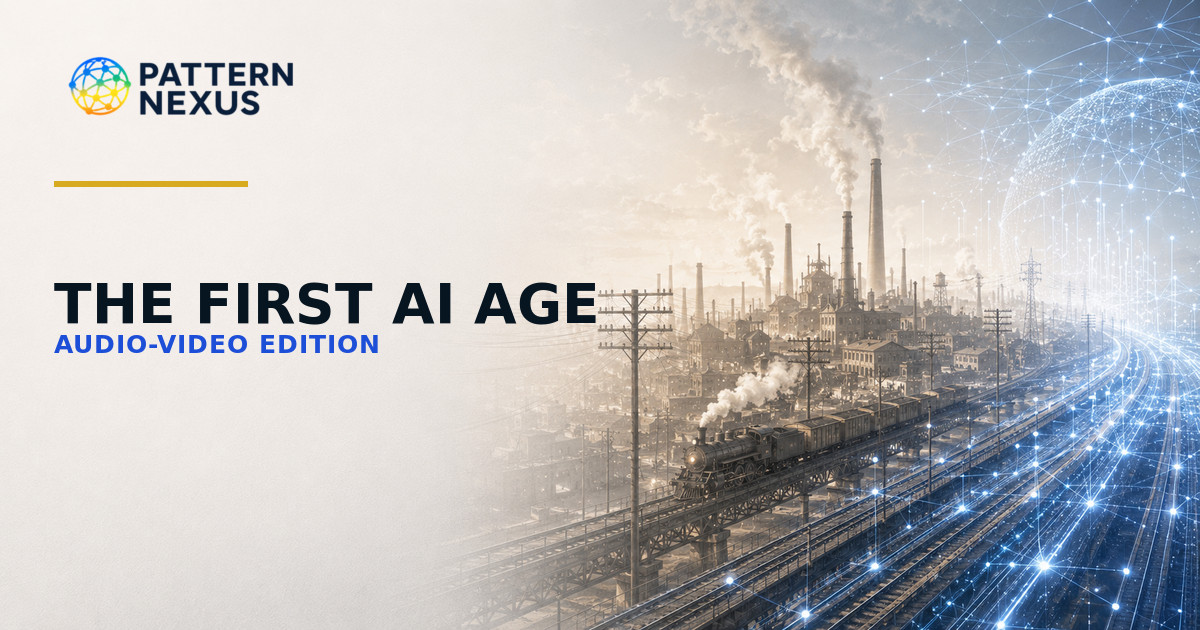
The first weekly Pattern Nexus audio-video turns the 1870–1914 industrial supercycle into a concise narrated story—and shows why the AI, data-center, energy, and liquidity buildout of 2025–2035 rhymes with it.
About this episode
- Between 1870 and 1914, a new industrial system formed. Steel, railroads, telegraphs, electricity, fossil energy, and global capital fused into one infrastructure supercycle.
- It was the original AI age without silicon. The technology was different, but the system followed a recognizable pattern.
- The same structure is visible today. General-purpose breakthroughs, infrastructure spending, rising energy demand, new financial plumbing, concentrated wealth, social strain, and institutional resets are returning in a modern form.
- This episode connects the two eras. It links the earlier supercycle to chips, AI models, data centers, power corridors, nuclear energy, stablecoins, and tokenized finance.
The technologies changed. The underlying pattern did not. Industrial breakthroughs create new infrastructure, new concentrations of power, and new financial systems before institutions fully understand what has been built.
The audio-video is the condensed narrative. The original article contains the complete Pattern Nexus framework, historical detail, and sources.
The first AI age did not require artificial intelligence
Between 1870 and 1914, a cluster of general-purpose technologies reorganized production, communication, energy, finance, and state power. No single invention caused the transformation. The decisive change came from the way the systems connected.
Today’s AI buildout follows the same architecture. Compute requires energy. Models require data centers. Data centers require grids, transmission, cooling, capital, and political permission. Financial systems evolve around the infrastructure, while wealth and control concentrate around the owners of the new bottlenecks.
Read the full original article
The audio-video is the condensed narrative. The original article contains the full Pattern Nexus framework, historical detail, and sources.
Preview, subscribe, or get the book
The book expands the framework behind this story. Start with the free preview, unlock the complete digital edition directly from Pattern Nexus, choose a subscription, or buy the ebook or hardcover from Lulu.
Free Preview
Direct Digital Edition
Direct Hardcover
Subscriptions
Lulu Ebook
Lulu Hardcover
Pattern Nexus publishes independent research and commentary for informational and educational purposes.
What's Your Reaction?
 Like
0
Like
0
 Dislike
0
Dislike
0
 Love
0
Love
0
 Funny
0
Funny
0
 Wow
0
Wow
0
 Sad
0
Sad
0
 Angry
0
Angry
0

Founder of Pattern Nexus. I research markets, macro, geopolitics, AI, history, ancient systems, and the patterns most people overlook. I’m also building Market Radar, a trading scanner designed to read pressure, risk, confirmation, and setup quality before chasing a move. Pattern Nexus is where I connect the dots between data, history, technology, and the bigger system playing out around us.
Comments (0)