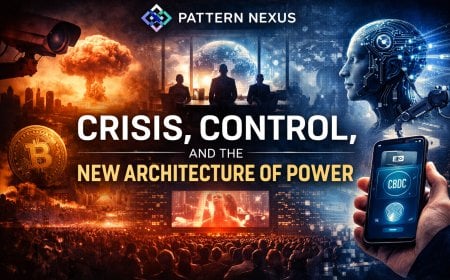
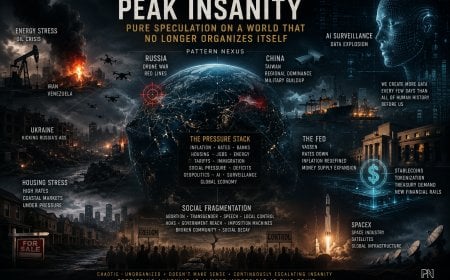
The 2026 System Pressure Poll: Where Are America and the World Actually Going?

This is not another left-versus-right approval poll. The Pattern Nexus System Pressure Poll examines the deeper structures shaping current events: war, energy, shipping corridors, debt, interest rates, tariffs, artificial intelligence, surveillance, housing, automation, institutional trust, and the emerging global order. The daily headlines are downstream. The objective is to identify which systems people believe are actually driving events—and where those systems are taking the United States and the rest of the world.

Jul 24, 2026 - 21:49
Updated: 3 days ago
0

1. What is the real center of gravity in the U.S.–Iran conflict? (Update You can't vote I have a CSS override breaking the page cant find it. )

Look beyond the individual strikes and official statements. Which system-level objective matters most?

0%
Preventing Iran from developing a nuclear weapon
0%
Controlling energy routes and strategic shipping corridors
0%
Weakening Iran’s regional military and political network
0%
Forcing regime change or internal restructuring
0%
Protecting U.S. credibility and regional alliances
0%
There is no single objective—the conflict has become self-sustaining
Total Votes: 0

2. Should Congress formally authorize continued U.S. military operations against Iran?

Regardless of party, should a prolonged military campaign require a direct congressional vote?

Yes—Congress should vote immediately
0%
Yes—but authorization should be limited in scope and duration
0%
Only if additional U.S. forces are deployed
0%
No—the president already has sufficient authority
0%
No—the United States should end the operation instead
0%
Unsure
0%
Total Votes: 0

3. What is the most likely outcome of the current Iran conflict?

Which path appears most probable once the military, economic, diplomatic, and energy pressures interact?

A negotiated settlement and monitored nuclear agreement
0%
A prolonged air and naval campaign without a ground invasion
0%
A wider regional war involving additional countries
0%
Internal political change inside Iran
0%
A temporary ceasefire followed by another round of conflict
0%
A direct confrontation involving China or Russia
0%
Total Votes: 0

4. If Middle Eastern energy and shipping disruption continues, what breaks first?

Modern economies depend on energy, insurance, shipping, credit, and liquidity operating together.

Oil and household energy affordability
0%
Inflation and consumer purchasing power
0%
Bond markets and interest-rate expectations
0%
International shipping and supply chains
0%
Gulf-state political and economic stability
0%
Nothing breaks—the system absorbs the shock
0%
Total Votes: 0

5. What role are the Gulf states becoming inside the U.S.-led system?

Saudi Arabia, the UAE, Qatar, Bahrain, and other Gulf states are increasingly central to energy, defense, finance, technology, and infrastructure.

Stable long-term strategic allies
0%
Regional extensions of American economic and military power
0%
Independent powers balancing the United States, China, and Russia
0%
Financial and energy partners whose loyalty depends on incentives
0%
Future competitors building their own power center
0%
A mixture of all these roles
0%
Total Votes: 0

6. How will China and Russia most likely respond to an expanding U.S. war in the Middle East?

Their response may be indirect, economic, diplomatic, technological, or military.

Avoid direct involvement and let the United States absorb the cost
0%
Supply Iran indirectly without entering the conflict
0%
Use the conflict to expand their influence elsewhere
0%
Act as diplomatic brokers
0%
Challenge the United States more directly
0%
China and Russia will respond differently from one another
0%
Total Votes: 0

7. What are U.S. tariffs actually accomplishing?

Are tariffs rebuilding domestic production, restructuring supply chains, raising consumer prices, or serving primarily as negotiating leverage?

Rebuilding American industry
0%
Creating leverage for better trade agreements
0%
Accelerating economic separation from China
0%
Acting as a hidden tax on American consumers
0%
Protecting politically connected industries
0%
Producing mixed results that will take years to evaluate
0%
Total Votes: 0

8. What is the greatest threat to the U.S. economy over the next two years?

Which pressure has the greatest potential to trigger a broader economic or financial break?

War-driven energy inflation
0%
Federal debt and rising interest expense
0%
High interest rates and tightening credit
0%
Consumer weakness and labor-market deterioration
0%
An AI and technology investment bubble
0%
Housing and commercial real-estate stress
0%
A global trade or supply-chain shock
0%
Total Votes: 0

9. What should the Federal Reserve do next?

The Fed must balance inflation, debt-service costs, employment, market stability, and the Treasury market.

Cut interest rates to support growth and debt markets
0%
Hold rates steady and wait for clearer data
0%
Raise rates to contain inflation
0%
Restart large-scale liquidity support or quantitative easing
0%
Use yield-curve control to suppress long-term borrowing costs
0%
The Fed has no good option left
0%
Total Votes: 0

10. How will the United States ultimately deal with its national debt?

The debt problem cannot be separated from interest rates, productivity, inflation, taxation, entitlement spending, and monetary policy.

Economic growth and AI-driven productivity
0%
Higher long-term inflation
0%
Major spending and entitlement reform
0%
Higher taxes across multiple income levels
0%
Federal Reserve balance-sheet expansion
0%
Financial repression and controlled interest rates
0%
A monetary restructuring or partial default
0%
Total Votes: 0

11. What is the AI infrastructure boom primarily becoming?

AI now connects computing, energy, water, land, finance, national security, employment, and surveillance.

The next major productivity revolution
0%
A strategic national infrastructure buildout
0%
A speculative investment bubble
0%
A new layer of corporate and government surveillance
0%
A private takeover of public energy and utility capacity
0%
All of the above at the same time
0%
Total Votes: 0

12. Who should pay for grid, water, and infrastructure upgrades required by large data centers?

Communities may receive investment and jobs, but they may also absorb utility, land, water, and infrastructure costs.

The data-center companies
0%
Utility ratepayers
0%
Federal and state governments
0%
Local governments offering development incentives
0%
Costs should be divided through public-private agreements
0%
Projects should be rejected when infrastructure cannot support them
0%
Total Votes: 0

13. What will be the largest social effect of AI and automation?

The largest change may not be technological. It may involve wages, employment, ownership, education, or political power.

Higher productivity and rising living standards
0%
Large-scale displacement of white-collar workers
0%
Large-scale displacement of physical labor
0%
Greater wealth concentration
0%
Shorter workweeks and new forms of employment
0%
Universal basic income or an AI productivity dividend
0%
A deeper division between owners and non-owners
0%
Total Votes: 0

14. How much AI-enabled surveillance should Americans accept in exchange for security?

Facial recognition, predictive systems, automated monitoring, drones, and connected databases may increase safety while also expanding institutional control.

Broad use is acceptable when it improves public safety
0%
Use should require warrants and strict legal limits
0%
Real-time biometric surveillance should be prohibited
0%
Independent oversight should approve every major system
0%
Government surveillance is the threat, not corporate surveillance
0%
Corporate and government surveillance are becoming the same system
0%
The surveillance state is already too advanced to reverse
0%
Total Votes: 0

15. Is the movement of people and investment toward the American interior a lasting shift?

Housing affordability, industrial expansion, energy access, insurance costs, remote work, and data-center construction may be redirecting population and capital.

Yes—the Midwest and interior are entering a long-term growth cycle
0%
Yes—but only a small number of cities will benefit
0%
It is mainly a temporary affordability migration
0%
Remote work is the primary driver
0%
Climate and insurance costs are pushing people inland
0%
Coastal markets will regain their dominance
0%
No major structural migration is occurring
0%
Total Votes: 0

16. Which institution currently deserves the least public trust?

Institutional legitimacy affects whether the population accepts economic, military, technological, and political decisions.

The presidency and executive branch
0%
Congress
0%
The courts
0%
The Federal Reserve and major financial institutions
0%
Corporate media
0%
Big technology companies
0%
Intelligence and national-security agencies
0%
None of them deserve meaningful trust
0%
Total Votes: 0

17. What is the deepest driver of current global instability?

Political personalities matter, but they operate inside larger systems that shape their available choices.

Competition for energy and natural resources
0%
Debt, liquidity, and the global financial system
0%
Technological disruption
0%
Demographic decline and aging populations
0%
Competition between national and corporate power centers
0%
Ideological and cultural fragmentation
0%
The decline of institutional legitimacy
0%
Several systems are breaking simultaneously
0%
Total Votes: 0

18. What will the global order look like by 2030?

Which system is most likely to emerge from the current military, financial, technological, demographic, and political realignment?

Renewed American global dominance
0%
A U.S.-led alliance bloc competing with rival blocs
0%
A genuinely multipolar world
0%
A China-centered economic order
0%
Fragmented regional power systems
0%
Corporate and technological networks more powerful than governments
0%
Corporate and technological networks more powerful than governments A major financial reset changes the entire structure
0%
The existing system survives with only minor changes
0%
Total Votes: 0
Support Independent Pattern Nexus Research
Deep macro plumbing, liquidity mechanics, and system analysis. No sponsors. No paywalls.
Support Pattern Nexus
Independent macro research and system-level analysis. No sponsors. No paywalls.

What's Your Reaction?

Like Like 0
Dislike Dislike 0
Love Love 0
Funny Funny 0
Wow Wow 0
Sad Sad 0
Angry Angry 0
Nexus (Christopher)

Founder of Pattern Nexus. I research markets, macro, geopolitics, AI, history, ancient systems, and the patterns most people overlook. I’m also building Market Radar, a trading scanner designed to read pressure, risk, confirmation, and setup quality before chasing a move. Pattern Nexus is where I connect the dots between data, history, technology, and the bigger system playing out around us.
Comments (0)

User