
The Synthetic Cell Threshold: Programmable DNA and the Beginning of Built Life
Humanity crossed another threshold. We are no longer only reading life or editing life. We are moving toward building life from defined parts, programming DNA as biological code, and combining synthetic cells with AI-designed proteins, automated labs, and synthetic genomes. This Pattern Nexus deep research article…
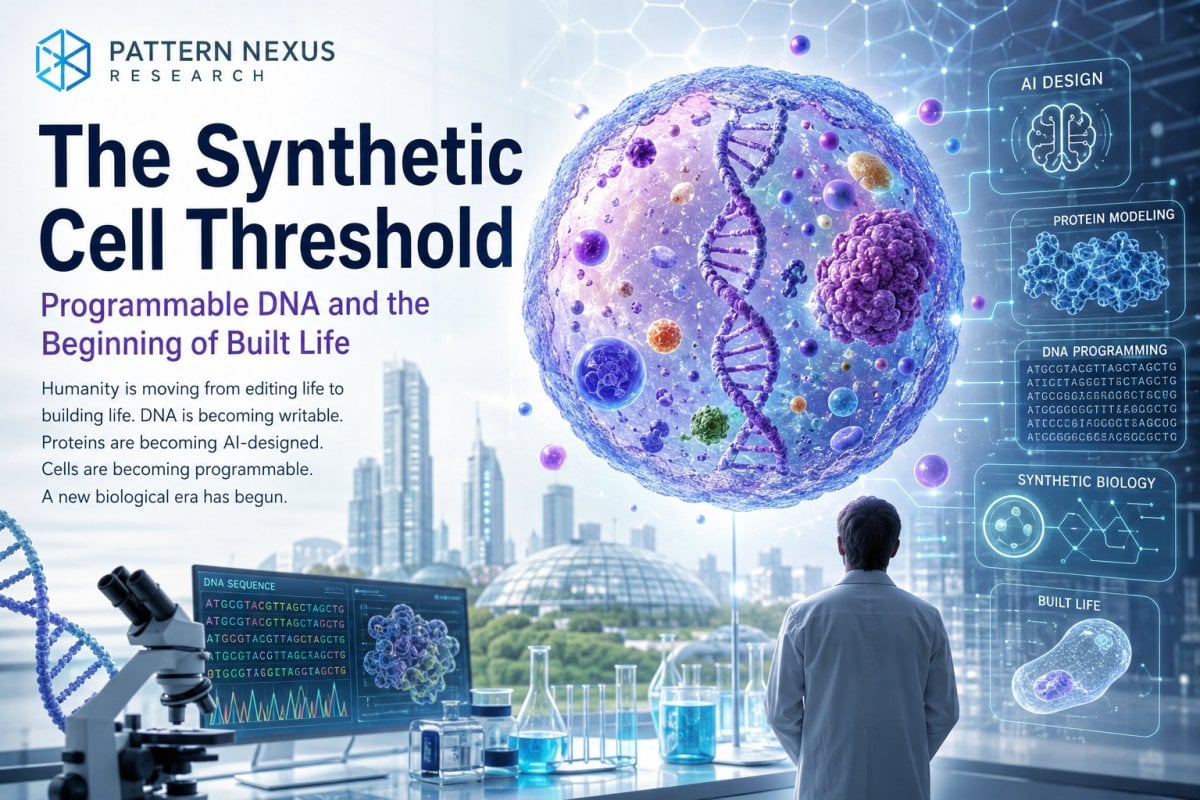
Humanity crossed another threshold. We are no longer only reading life or editing life. We are moving toward building life from defined parts, programming DNA as biological code, and combining synthetic cells with AI-designed proteins, automated labs, and synthetic genomes. This Pattern Nexus deep research article…
Jump to a section
 Pattern Nexus Research
The Synthetic Cell Threshold: Programmable DNA and the Beginning of Built Life
Humanity did not just edit life. We are now moving toward building life from defined parts, programming DNA like biological code, and combining synthetic cells with AI-designed proteins, synthetic genomes, automated labs, and a new artificial layer of biology.
Quick Read
On This Page
We Crossed Another Threshold
We crossed another threshold, and most people will not understand what actually happened. They will hear the headline and move on. Scientists created a synthetic cell. Scientists made a little blob in a dish. Scientists made some lab-made life-like thing that can grow and divide. Then the story will get compressed into whatever safe little box the media can fit it into, and the public will miss the actual meaning.
This is not just gene editing. This is not just CRISPR. This is not just taking an existing organism and changing one gene, adding one pathway, or modifying one biological function. This is the movement from editing life into building life. That is the difference. One is biological repair, biological manipulation, and biological engineering inside an already-existing organism. The other is closer to writing an operating system for biology.
The trigger event is SpudCell, the synthetic cell-like system reported in early July 2026 and tied to researchers around the University of Minnesota and Kate Adamala’s lab. Reports describe a chemically defined system built from purified enzymes, a fatty membrane, and a pared-back genome. According to Live Science, the researchers combined purified enzymes and a fatty membrane with a reduced genome, creating a system that could feed, grow, and divide in a dish. [1]
The Guardian described the work as synthetic cells made from chemical compounds that are believed to be the first to demonstrate the full cycle of growth, genetic replication, and splitting into the next generation. But the same reporting makes the limitation clear. SpudCells depend on an external chemical environment full of supplied components, including ATP, enzymes, feeder liposomes, and ribosomes. They cannot run the full internal economy of natural life on their own. [2]
That caveat matters. This is not fully autonomous artificial life yet. It cannot fully run its own metabolism. It cannot make all its own energy. It cannot build all of its own protein-making machinery. It does not clean up its own waste the way natural cells do. It does not divide with natural-cell precision. It breaks down after a few generations. So no, this is not humans creating God in a petri dish. But it is also not nothing.
The important part is not whether this first version is fully alive. The important part is that humans are now assembling cell-like systems from non-living components and getting them to perform behaviors that used to belong only to natural life. That is the line. Life used to be inherited. Now it is being assembled.
From Reading Life to Writing Life
For most of human history, life was something we experienced, feared, hunted, ate, worshipped, healed, bred, farmed, studied, and eventually modified. We could select for traits. We could breed animals. We could domesticate crops. Later, we could edit genes. But the deeper structure of life still belonged to nature. Evolution wrote the code, and humans were mostly reading the output.
That changed in stages. First, we learned to read DNA. Then we learned to cut and edit DNA. Then we learned to synthesize DNA. Then we learned to transplant synthetic genomes into living cells. Then we learned to minimize genomes and ask what the smallest operating system for life might look like. Now we are moving toward assembling cell-like systems from defined chemical parts.
This is why this is not just another science story. This is a layer change. Biology is moving from discovery into design. Once DNA is readable, editable, writable, synthesizable, and testable, it starts to behave like a biological software layer. Not software in the childish sense where people say DNA is code and then stop thinking. DNA is chemistry. But it is chemistry that stores instructions, copies itself, inherits information, mutates, and directs biological execution through the cell.
That means programmable DNA is not a metaphor anymore. It is the beginning of a manufacturing and design layer inside life itself. When humans can write biological instruction and then place that instruction inside a chassis capable of executing it, the entire frame changes. We are not just reading the book of life anymore. We are writing pages into it.
The Old Synthetic Biology Thresholds
SpudCell did not come out of nowhere. It sits on top of decades of synthetic biology, synthetic genomics, minimal cell research, artificial genetic alphabets, and AI-driven protein design. The Pattern Nexus mistake would be to treat SpudCell as an isolated miracle. It is not isolated. It is one node in a much larger stack.
Craig Venter’s 2010 synthetic genome work was one of the first major public thresholds. His team chemically synthesized a bacterial genome and transplanted it into a recipient cell whose original DNA had been removed. The resulting bacterium was controlled by the synthetic genome and could grow and replicate. That was a massive moment, but it was still top-down synthetic biology. The genome was synthetic, but the cell hardware was inherited from an existing living cell. [3]
Then came the minimal cell push. In 2016, the J. Craig Venter Institute reported JCVI-syn3.0, a synthetic minimal bacterial cell with 473 genes. That was another threshold because it asked a very deep question: what is the smallest genetic instruction set needed for a cell to keep functioning? The disturbing part is that even in that stripped-down minimal organism, a large number of genes were still not fully understood. Even when we reduce life to something we call minimal, we still do not fully understand the whole operating logic. [4]
In 2019, scientists synthesized a recoded E. coli genome, reducing the normal 64 codons to 61 codons. That matters because it showed that the genetic code itself can be rewritten at scale, not merely edited gene by gene. A recoded organism is not just a modified organism. It is an organism whose translation logic has been reorganized. [5]
Another line of work expanded the genetic alphabet itself. In 2014, researchers reported a semi-synthetic organism with an expanded genetic alphabet, showing that cells could maintain an unnatural base pair under controlled conditions. Later work improved stability and retention. That matters because the natural four-letter DNA alphabet is no longer the only possible information system biology can use. [6]
These are not separate stories. Synthetic genome transplantation, minimal cells, recoded genomes, expanded genetic alphabets, bottom-up synthetic cells, AI protein design, and automated DNA synthesis are all different pieces of the same broader transformation. Humanity is learning to treat biology as an engineering substrate.
AI Changes the Curve
Synthetic biology was already powerful before modern AI, but AI changes the curve. It compresses the distance between design and experiment. It can search biological space faster than humans. It can compare sequences, structures, pathways, and functions across enormous datasets. It can suggest proteins, model folding, predict interactions, design candidates, and help optimize biological systems across many rounds of testing.
AlphaFold was one of the major inflection points because it showed that AI could predict protein structures with extremely high accuracy across huge portions of biology. In 2024, the Nobel Prize in Chemistry went to David Baker, Demis Hassabis, and John Jumper for work connected to protein design and protein structure prediction. That was not just an award for a useful tool. It was a public signal that AI had entered the machinery of life. [7] [8]
RFdiffusion pushed that even further by using diffusion-model logic for de novo protein design. The Nature paper describes RFdiffusion as a generative model capable of producing diverse protein structures and solving design problems such as protein binders, symmetric assemblies, enzyme scaffolds, and motif scaffolding. In plain English, AI is no longer only predicting what nature already made. AI is beginning to design new biological machinery. [9]
That is where the stack starts to become dangerous and powerful at the same time. A synthetic cell gives you a chassis. Programmable DNA gives you the instruction layer. AI protein design gives you functional parts. DNA synthesis gives you the printing layer. Lab automation gives you the testing layer. Robotics gives you execution. The design-build-test-learn loop becomes faster, cheaper, and more recursive.
The Stack Is the Story
The danger and the opportunity are not SpudCell by itself. The real story is the stack. Synthetic cells by themselves are still limited. AI by itself is still digital. Gene synthesis by itself is just manufacturing. Lab automation by itself is just machinery. But combine them, and suddenly you have a system that can design biological function, synthesize the genetic instructions, test the outcome, learn from failure, and optimize the next version.
That is the Pattern Nexus read. The system is not one discovery. It is the convergence. Synthetic genomes, minimal cells, programmable DNA, protein-design AI, DNA synthesis, robotic labs, biofoundries, cell-free systems, organoids, xenobots, mirror-life warnings, and DNA-screening legislation are all fragments of the same bigger change.
The world is used to thinking of artificial intelligence as digital. A chatbot. A model. A data center. A software layer. But the deeper future is not just digital AI sitting in servers. The deeper future is AI reaching into matter. AI designing proteins. AI designing genetic circuits. AI designing synthetic genomes. AI designing cell chassis. AI designing biological factories. AI designing artificial immune systems. AI designing synthetic tissues. AI designing organisms.
That is where the phrase synthetic biological artificial species stops sounding like science fiction. It does not have to look like a robot. It could look like a microbe, a tissue, a living material, a biological machine, a lab-grown organoid, a programmable cell colony, or a synthetic organism built for a specific function. The first versions will not look like species in the traditional sense. But if a designed biological system can maintain itself, inherit information, adapt, replicate, and preserve identity over generations, then we are no longer just making tools. We are making lineages.
Where This Could Go
The first serious upside is medicine. Synthetic cells could eventually become programmable therapeutic platforms. Instead of taking a drug that circulates everywhere and hoping it hits the right pathway, future systems could sense a biological environment and respond only when certain conditions are present. That could matter for cancer, autoimmune disease, metabolic disorders, infection, regenerative medicine, and personalized therapy.
The second major upside is manufacturing. If biology becomes programmable manufacturing, the factory changes. Instead of heat, pressure, hydrocarbons, heavy equipment, and fragile supply chains for every material input, you grow outputs through engineered biological systems. You create chemical pathways that produce useful molecules. You build biological foundries. You use cells or cell-like systems as production units.
Agriculture is another obvious path. Engineered microbes already matter for fermentation, nitrogen fixation research, pest resistance, soil systems, and crop productivity. Synthetic cells and programmable biological systems could eventually produce fertilizers, soil nutrients, crop protectants, sensors, food additives, alternative proteins, or environmental remediation tools.
Environmental repair is one of the most attractive promises. Engineered biological systems could break down pollutants, process plastics, capture carbon, recover metals, clean water, restore soil, or detect toxins. A programmable biological system that can sense environmental conditions and perform a narrow function could be extremely valuable, but this is also where the risk becomes ecosystem-level.
The space angle matters too. If humanity becomes multi-planetary, biology becomes one of the core technologies of survival. You cannot carry Earth’s entire supply chain to Mars. You need local production. You need food, medicine, materials, recycling, waste processing, air management, water systems, and adaptive biological production. Synthetic biology could become the manufacturing layer for off-world civilization.
The Security Problem
If DNA is code, then DNA synthesis is the printer. That is the chokepoint. A person can design a sequence digitally, but to make it biological, the sequence has to be synthesized, assembled, delivered, and tested. That is why DNA synthesis screening matters so much.
SecureDNA researchers put the problem clearly: custom DNA synthesis is essential for science and medicine, but the same technology can be misused. Their paper argues that DNA synthesizers and assemblers should screen orders while preserving privacy and trade secrets. [10]
Reuters reported in February 2026 that U.S. Senators Tom Cotton and Amy Klobuchar introduced legislation to create new rules around the sale of synthetic gene sequences that could be used to create bioweapons. The proposed bill would require screening of customers and orders and direct the Commerce Department to compile a list of potentially dangerous genetic sequences. [11]
This issue becomes much worse when AI enters the design loop. AI can lower the skill barrier. It can help users understand complex biology faster. It can connect sequence, function, structure, and pathway design. The biological security problem is no longer only about who has a lab. It is about who can design, print, and test.
That does not mean the average person can casually create world-ending biology tomorrow. That is not the claim. The claim is that the barrier direction is one-way. It is getting lower, not higher. The ceiling is rising, not falling. The tools are compounding, not separating.
The Mirror Life Warning
Mirror life belongs in this article because it shows the outer boundary of built biology. Mirror life refers to hypothetical organisms made from mirror-image versions of normal biological molecules. Natural life on Earth uses specific molecular handedness. Mirror organisms would use reversed chirality. That could make them biologically strange to immune systems, predators, enzymes, and ecological controls.
In 2024, a group of scientists warned against creating mirror-image microbes until stronger safety evidence exists. The Guardian reported that leading scientists, including Nobel laureates, called for a halt on mirror-life microbe research because mirror bacteria could potentially evade immune defenses and pose serious risks to humans, animals, plants, and ecosystems. [12]
Mirror life is not SpudCell. They are different things. SpudCell is a bottom-up synthetic cell-like system built from defined chemical components. Mirror life is a hypothetical class of organisms built from reversed biological chemistry. But they belong in the same strategic frame because both show that biology is no longer constrained to the inherited design space.
The Final PN Read
SpudCell is not the final artificial life form. It is not fully autonomous. It is not a new species. It is not self-sustaining in the way natural cells are. But it is a signal. It shows that humans are getting closer to assembling life-like systems from defined parts. It shows that the movement from editing life to building life is no longer philosophical. It is experimental.
The bigger story is the convergence. Synthetic cells, programmable DNA, synthetic genomes, recoded organisms, expanded genetic alphabets, AI-designed proteins, biofoundries, DNA synthesis, xenobots, mirror-life warnings, and biosecurity legislation are not separate dots. They are one map.
Humanity is moving toward a world where DNA becomes programmable infrastructure, cells become engineered devices, proteins become AI-designed machinery, and life becomes a design space. The threshold is not that we made one perfect artificial organism. The threshold is that we can now see the path from chemistry to programmable life.
For billions of years, life was written by evolution. Now life is beginning to be written by intelligence. First human intelligence. Then artificial intelligence. Then the combination of both. That is the story. We did not just create a synthetic cell-like blob. We opened the door to built biology. And once biology becomes programmable, the question is no longer whether humans can create life. The question is what kind of life humans, and eventually AI, will decide to create.
Research Sources
- Live Science — Scientists just created the most lifelike cell ever made in the lab
- The Guardian — Synthetic life a step closer as scientists make cells using lab-made DNA
- Science — Creation of a Bacterial Cell Controlled by a Chemically Synthesized Genome
- Science — Design and Synthesis of a Minimal Bacterial Genome
- Nature — Total Synthesis of Escherichia coli with a Recoded Genome
- Nature — A Semi-Synthetic Organism with an Expanded Genetic Alphabet
- Nature — Highly Accurate Protein Structure Prediction with AlphaFold
- AP News — Nobel Prize in Chemistry Honors AI Protein Design and Prediction Work
- Nature — De Novo Design of Protein Structure and Function with RFdiffusion
- arXiv — SecureDNA: Verifiably and Privately Screening Global DNA Synthesis
- Reuters — U.S. Lawmakers Introduce Bill to Screen Synthetic DNA Sales
- The Guardian — Scientists Call for Halt on Mirror-Life Microbe Research
Frequently Asked Questions
What's Your Reaction?
 Like
0
Like
0
 Dislike
0
Dislike
0
 Love
0
Love
0
 Funny
0
Funny
0
 Wow
0
Wow
0
 Sad
0
Sad
0
 Angry
0
Angry
0

Nexus (Christopher)
Founder of Pattern Nexus. I research markets, macro, geopolitics, AI, history, ancient systems, and the patterns most people overlook. I’m also building Market Radar, a trading scanner designed to read pressure, risk, confirmation, and setup quality before ch…
Related research
The Command Line — Audio-Video Edition
Episode 3 of the weekly Pattern Nexus audio-video series turns Part 3 of Cycles of Power into a shorter story about how Dartmouth, integrat…
2 shared topics, same research avenue.
Are Auto Sales Predicting a Recession? A 50-Year Regression and the 2026 Signal
Vehicle sales normally weaken before recession becomes obvious elsewhere. Pattern Nexus reconstructs every U.S. recession since 1976, build…
2 shared topics, same research avenue.
The Yen Line Broke: The Intervention That Changed the Global Liquidity Map
yen-line-broke-us-japan-intervention-global-liquidity-map Meta description: Pattern Nexus reconstructs the yen’s plunge to a 40-year low, …
2 shared topics, same research avenue.
Pattern Nexus Worldview — Full Digital Edition
Read the complete 10-chapter digital edition of Pattern Nexus Worldview by Christopher Grenke. A systems-level examination of money, liquid…
2 shared topics, same research avenue.
The System Repriced in 30 Days: Dual Chokepoints, Tariff Inflation, AI Cash Burn, and the Return of the War Economy
In thirty days, the operating assumptions underneath the global system changed. Two maritime chokepoints came under pressure, the United St…
2 shared topics, same research avenue.
The 52-Cent Economy: Where the American Output Dollar Actually Goes
America produces nearly $32 trillion a year, but the median W-2 worker experiences only a fraction of the aggregate output. This Pattern Ne…
2 shared topics, same research avenue.
The Capital Ladder: Where $100 to $1 Trillion Places You in the Global and American Wealth System
A deep Pattern Nexus regression and data analysis mapping where net worth levels from $100 to $1 trillion place an individual within the gl…
2 shared topics, same research avenue.
Fragmented Society: The Elites Don’t Think Like You, and the Elites of the Elites Don’t Think Like Them
Society is not one shared reality. It is a stack of disconnected mindsets layered by survival, class, power, wealth, ideology, and future a…
2 shared topics, same research avenue.
Comments (0)
Security Check
Please complete the captcha to verify you are human.