

Dow Sets Record High as Gold Plunges; Nikkei Surges Amid Diverging Global Forces – Oct 21, 2025 Market Wrap
On October 21, 2025, the Dow closed at a record high while gold pulled back sharply from all-time highs. Japan’s Nikkei surged on optimism around new leadership, but China’s property market slump and Argentina’s peso crisis highlight diverging global forces. Here’s the full market wrap.
On October 21, 2025, the Dow closed at a record high while gold pulled back sharply from all-time highs. Japan’s Nikkei surged on optimism around new leadership, but China’s property market slump and Argentina’s peso crisis highlight diverging global forces. Here’s the full market wrap.
Jump to a section
Dow Sets Record High as Gold Plunges; Nikkei Surges Amid Diverging Global Forces – Oct 21, 2025 Market Wrap
U.S. stocks closed mixed on October 21, 2025, with the Dow Jones Industrial Average hitting a record high even as the S&P 500 hovered near its peak and the Nasdaq softened slightly. A sharp reversal in gold prices – after recent all-time highs – highlighted shifting investor sentiment. Globally, Japan’s Nikkei index extended its rally to a record on optimism over new leadership, in stark contrast to China where a deepening property slump continued to weigh on markets. In currencies, an unprecedented U.S. intervention to prop up Argentina’s peso underscored geopolitical undercurrents. We break down the day’s key market drivers, from earnings-fueled U.S. gains and safe-haven retreats to central bank outlooks and international economic headwinds.
U.S. Markets: Dow Climbs to Record as S&P Near High and Nasdaq Eases
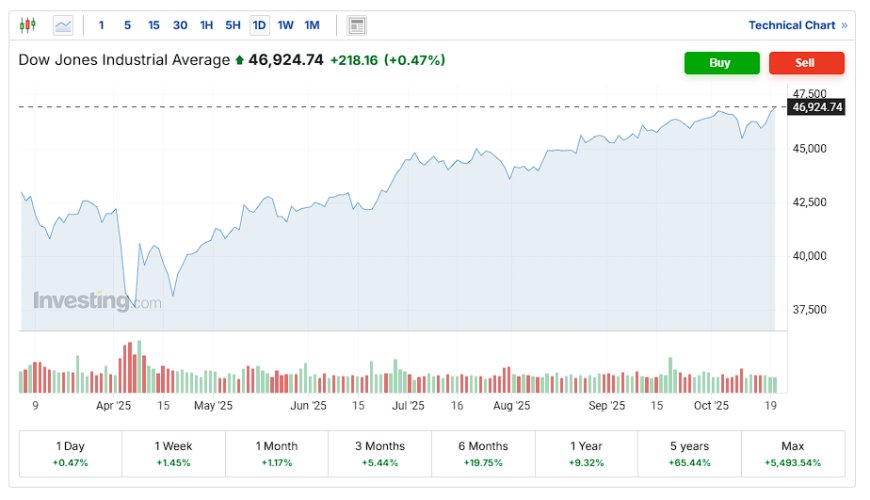
Blue-Chip Record: The Dow Jones Industrial Average led the market, rising about 0.5% to close at 46,924.74 – marking a new all-time closing high. Solid earnings reports from industrial and consumer giants boosted the blue-chip index. Notably, shares of 3M and Coca-Cola jumped 7.7% and 4% respectively after upbeat results and forecasts, helping drive the Dow’s record finish. In contrast, the broader S&P 500 ended essentially flat at 6,735.35 (just shy of its own record territory), while the tech-heavy Nasdaq Composite ticked down 0.16% to 22,953.67. Weakness in high-growth and semiconductor stocks weighed on the Nasdaq, reflecting a modest pullback after its recent run-up.
Earnings Momentum vs. Valuation Caution: Robust Q3 earnings have been a tailwind – about 87% of S&P 500 companies reporting so far have beaten forecasts – yet stock reactions were muted. Analysts note that with major indexes hovering near record highs and valuations stretched, even positive surprises are only cautiously rewarded. This cautious undertone kept the S&P 500 in check despite generally upbeat corporate news. Still, pockets of enthusiasm shone through: along with industrials, aerospace & defense stocks rallied after firms like Lockheed Martin and Northrop Grumman raised forecasts amid strong demand. On the flip side, extended-trade disappointments (e.g. Netflix sliding on a miss) and profit-taking in tech tempered the Nasdaq’s performance.
Macro Signals: Tuesday was the 21st day of a U.S. government shutdown, adding a layer of uncertainty, though there were hopeful signs out of Washington that a resolution could be near. Meanwhile, investors are already looking ahead to central bank moves. With inflation showing signs of cooling, the Federal Reserve is widely expected to continue easing – a Reuters poll indicates the Fed is likely to implement two more 0.25% rate cuts by year-end. Treasury yields have indeed been pulling back; the 10-year yield dipped below 4.0% for the first time since spring, reflecting bets on Fed accommodation. Lower yields and the prospect of an end to the Fed’s tightening cycle have underpinned equity valuations, even as caution lingers. Finally, on the trade front, President Donald Trump struck an optimistic tone, saying he expects to reach a “really fair” trade deal with China’s President Xi Jinping and downplaying tensions over Taiwan. That hopeful outlook on U.S.-China relations lent some support to market sentiment, with a high-stakes Trump–Xi meeting scheduled for next week in South Korea on investors’ watch list.
Gold: Sharp Correction After Record Highs
All-Time Highs to 5% Plunge: The price of gold whipsawed dramatically, suffering a sharp correction after its meteoric rise to record levels. On Monday gold had spiked to nearly $4,381 per ounce, an all-time high, capping a rally fueled by safe-haven demand. But by Tuesday, the trend abruptly reversed – spot gold plunged about 5.3% to around $4,124 an ounce, its steepest one-day drop in over three years. This pullback – the largest daily percentage fall since August 2020 – broke gold’s upward momentum and shaved roughly $250 off its price in a single session.
Profit-Taking and Drivers: The sudden dive in gold was largely attributed to investors locking in profits after the metal’s spectacular year-to-date gains. Even after Tuesday’s drop, gold prices remain about 60% higher for the year, thanks to a year-long surge underpinned by global economic uncertainty, inflation hedging, and geopolitical risks. However, the rally’s intensity left gold vulnerable to a quick reversal. Analysts noted that an easing of immediate fears – from tentative progress on U.S. budget talks to hopes of a U.S.-China trade thaw – may have lessened the appeal of defensive assets like gold. Citi Research, for instance, suggested that resolution of the U.S. government shutdown and trade issues could prompt a consolidation in gold prices in the coming weeks. The precious metal’s stumble also coincided with a modest uptick in the U.S. dollar and a pullback in volatility, hinting at a shift towards a more “risk-on” stance among some investors. Importantly, gold’s drop dragged down mining stocks as well – the Philadelphia Gold/Silver Index fell sharply, mirroring the decline in bullion. While gold is still up over 50% year-to-date, Tuesday’s correction serves as a reminder of its short-term volatility even in a supportive macro environment.
Implications and Outlook: The question now is whether gold’s retreat is a healthy correction or a sign of a broader trend reversal. Market watchers will be examining factors like real interest rates and safe-haven demand. If upcoming economic data (once the government reopens) show moderating inflation and steady growth, gold could face further pressure as investors rotate toward risk assets. On the other hand, any resurgence of uncertainty – such as setbacks in the geopolitical arena or delayed central bank easing – may renew the bid for gold. For now, the metal’s breakneck rally has been checked, injecting a dose of caution into what had been a one-way trade. How gold behaves in the coming days could signal whether investors’ psyche is tilting more toward confidence or caution as we approach year-end.
Global Picture: Nikkei Soars on Leadership Optimism vs. China Dragged by Property Gloom
Tokyo’s Record Run: Japan’s stock market extended its bullish tear, with the Nikkei 225 index climbing to fresh record heights. The Nikkei jumped as much as 1.5% intraday and went on to close 0.3% higher at an unprecedented 49,316.06. This marked another record closing high for the index, which has been on a weeks-long rally. Driving the optimism was the formal election of Sanae Takaichi as Japan’s first female Prime Minister – a leadership change that investors perceive as market-friendly. Takaichi is considered a fiscal dove, and her rise gave birth to what traders dub the “Takaichi trade”: a bet on Japanese equities and a weaker yen in anticipation of looser fiscal policy and continued easy money. Indeed, as Takaichi’s victory was confirmed, Japan’s government bond yields fell and the yen weakened to around ¥151.3 per U.S. dollar, near multi-decade lows. The prospect of greater fiscal spending and pro-growth reforms under the new administration lifted Japanese consumer and tech stocks, helping the Nikkei outpace other markets. Investors are now watching for Takaichi’s cabinet appointments (such as the finance minister pick) for clues to her economic agenda. For now, Japan’s political changing-of-the-guard has injected fresh confidence into Tokyo’s markets, pushing the Nikkei to levels not seen before.
China’s Property Slump Weighs: In stark contrast to Japan’s exuberance, China’s markets remain constrained by a deepening property-sector crisis that is acting as a persistent drag on the economy. New data released this week showed Chinese new home prices fell by 0.4% in September – the fastest monthly drop in 11 months – highlighting the worsening slump in real estate. Home prices are now down over 2% from a year ago, and declines were recorded in 63 of 70 major cities, a broad-based retreat. This ongoing real estate downturn, which began in 2021 with a string of developer defaults, has severely undermined consumer confidence and spending in China. Once a key engine of growth, the property sector’s woes have turned it into a significant economic drag for China. Third-quarter Chinese GDP growth slowed to 4.6%, missing expectations, as the property malaise and lingering trade tensions weighed on activity.
Policy and Market Impact: Chinese equity indices have lagged global peers amid these headwinds. The benchmark CSI 300 index and Hong Kong’s Hang Seng have been choppy, with property and bank stocks under pressure whenever bad news from developers surfaces. Investors had hoped for a big bang stimulus from Beijing, but the response so far has been incremental. Policymakers have rolled out dozens of measures – from mortgage rate cuts to relaxed home-buying curbs – to try to stabilize the housing market. Yet, the impact has been limited, and analysts warn it could take at least another year for sentiment to truly turn around. The IMF and others are urging China to “step up” support for the sector to prevent further spillover to consumption and growth. For global investors, China’s struggles are a counterweight to the optimism elsewhere. Notably, while Japan’s Nikkei and many Western indexes are at or near record highs, China’s stock benchmarks are far below their peaks, reflecting the divergent fortunes. The property slump remains the single biggest risk hanging over China’s outlook – and by extension a risk factor for commodity markets and companies tied to Chinese demand. Any signs of more aggressive easing or a bottoming in home prices could be a catalyst for Chinese stocks, but absent that, China is likely to continue underperforming even as the world’s other major markets rally.
FX & Geopolitics: U.S. Intervenes to Prop Up Argentina’s Peso
Unprecedented U.S. Support: In an unusual turn of events, the United States government stepped directly into foreign exchange markets to support an emerging-market currency – specifically, Argentina’s peso. The U.S. Treasury confirmed it conducted a series of dollar–peso interventions in mid-October, marking the first known unilateral U.S. FX intervention on behalf of another country’s currency in modern history. On October 9, and again on Oct 15–16, the Treasury sold U.S. dollars and bought Argentine pesos in the open market, as part of a broader package to shore up Argentina’s ailing economy. This extraordinary step – essentially deploying U.S. taxpayer funds to buy a foreign currency – breaks with decades of U.S. policy. Previously, U.S. support for struggling emerging markets was limited to loans, credit lines, or swap agreements, not outright currency purchases.
Motives – Allies and Influence: The move comes as Argentina’s new President, Javier Milei, battles a severe financial crisis marked by 120%+ inflation and collapsing confidence in the peso. Milei, a libertarian populist, is a close ideological ally of U.S. President Donald Trump, and the Trump administration appears intent on bolstering his government. Indeed, President Trump hinted that U.S. help would not continue if Milei’s party didn’t fare well in upcoming midterm elections, tying aid to Argentina’s political trajectory. Beyond personal politics, strategic considerations are likely at play. Argentina boasts large reserves of lithium, copper and other critical minerals, and China has been increasing its influence there. By propping up Argentina’s economy (including a new $20 billion U.S. currency swap line), Washington may be aiming to dilute Beijing’s influence in the region. In essence, the U.S. is extending a financial lifeline to a friendly government, hoping to stabilize a key South American nation and keep it in the U.S. geopolitical orbit.
Market Reaction and Risks: Thus far, the impact on the peso has been modest at best. Despite multiple rounds of U.S. intervention, Argentina’s peso briefly sank to record lows in unofficial markets, as domestic investors continued to sell pesos for dollars. By Tuesday, the black-market peso was trading near 1,540 per dollar, reflecting persistent depreciation pressures. Analysts have characterized the U.S.’s direct peso-buying as “unusually risky” — essentially trying to backstop a currency that many see as fundamentally overvalued given Argentina’s dwindling reserves and lack of confidence. There is no precedent for sustained success in such an intervention absent underlying reforms. The International Monetary Fund welcomed the U.S. support as helping stabilize markets, but also emphasized Argentina must implement sound policies (to curb inflation and build reserves) for any rescue to stick. For investors, the episode is a reminder of Argentina’s chronic volatility, but also a signal that the U.S. is willing to actively engage in emerging markets in new ways. Emerging-market currency watchers will be monitoring if the U.S. Treasury continues to intervene in coming weeks and whether this sets any precedent for similar actions elsewhere, or if it remains a one-off tied to Argentina’s unique situation.
Macro Backdrop: IMF Upgrades Growth Outlook Amid Cautious Optimism
IMF Sees Resilience – With Risks: In the background of these market moves, the International Monetary Fund released updated global economic forecasts that reflect a tempered optimism. The IMF slightly raised its projection for 2025 global GDP growth to 3.2%, up from a 3.0% forecast in July. It cited more resilient output than expected, despite shocks like tariffs and tighter financial conditions earlier in the year. Robust consumer spending in the U.S. and Europe, an investment boom in AI-related sectors, and better-than-feared impacts from U.S. trade tariffs all contributed to the improved outlook. Notably, major economies have proven “agile” – businesses rerouted supply chains and central banks adjusted policy to cushion blows, according to the IMF’s report. However, the Fund was clear that the situation is “not as bad as feared, but worse than we need,” implying growth remains below ideal levels. It also warned of significant downside risks: chief among them, a renewed U.S.-China trade war. President Trump’s recent threats to impose sweeping 100% tariffs on Chinese goods (in retaliation for China’s export curbs on critical minerals) could, if enacted, deal a serious blow to the global outlook. IMF models suggest a major tariff escalation would cut world growth by several tenths of a percent in the coming years, underscoring how fragile the recovery is to policy shocks.
Investor Sentiment & Rates: Broadly, the macro backdrop as of late October 2025 is one of cautious optimism. Equity markets near record highs and narrowing credit spreads indicate that investors have been relatively sanguine about recession risks. The upgraded growth forecasts support that optimism. Yet, under the surface, there is recognition of cross-currents: high global public debt and still-elevated inflation (in certain regions) limit policymakers’ flexibility. Central banks are at a pivotal juncture. In the U.S., as noted, markets are anticipating rate cuts to continue into early 2026, given softer labor data and the drag from the protracted government shutdown. In Europe, however, the ECB has signaled it is not ready to cut rates yet, as core inflation remains above target – a divergence that has contributed to a stronger dollar lately. Long-term interest rates have eased off recent highs in the U.S., providing relief to stocks, but any reversal in that trend could quickly test equity valuations. Additionally, it’s still earnings season, and while results have been largely positive, outlooks for 2026 will be crucial. Companies’ commentary on consumer demand, pricing power, and margins will inform whether the economic resilience can continue. With the Middle East tensions and other geopolitical flare-ups also in the mix, investors appear to be balancing FOMO (fear of missing out on further gains) with FOSI (fear of staying invested) at these elevated market levels. As a result, we’re seeing a churn below the surface – money rotating between sectors (e.g., into defensives like utilities one day, into cyclicals the next) as the market searches for direction.
Earnings and the Consumer: The U.S. consumer – a linchpin of global growth – remains in focus. Thus far, consumer spending has held up better than expected into the fall, and corporate earnings from consumer-facing companies (from Coca-Cola to airlines) have reflected surprising resilience. However, there are questions about sustainability as student loan payments resume and excess savings from the pandemic era dwindle. The IMF’s report actually credited fiscal stimulus (such as U.S. tax cuts and Japan’s wage growth) for supporting demand in 2025. Going forward, absent new stimulus, that support will fade – meaning private-sector momentum must carry the torch. Any indication in upcoming earnings calls that consumers are tightening belts (perhaps due to higher borrowing costs or economic anxiety) would quickly reverberate through markets. Conversely, if holiday season forecasts come in strong, it could reinforce the soft-landing narrative. In short, the macro landscape is one of a delicate balance: growth is reasonably good and inflation is improving, but confidence could be tested by policy missteps or external shocks. That dynamic is keeping investors on their toes.
Market Reaction and Risks: Thus far, the impact on the peso has been modest at best. Despite multiple rounds of U.S. intervention, Argentina’s peso briefly sank to record lows in unofficial markets, as domestic investors continued to sell pesos for dollars. By Tuesday, the black-market peso was trading near 1,540 per dollar, reflecting persistent depreciation pressures. Analysts have characterized the U.S.’s direct peso-buying as “unusually risky” – essentially trying to backstop a currency that many see as fundamentally overvalued given Argentina’s dwindling reserves and lack of confidence. There is no precedent for sustained success in such an intervention absent underlying reforms. The International Monetary Fund welcomed the U.S. support as helping stabilize markets, but also emphasized Argentina must implement sound policies (to curb inflation and build reserves) for any rescue to stick. For investors, the episode is a reminder of Argentina’s chronic volatility, but also a signal that the U.S. is willing to actively engage in emerging markets in new ways. Emerging-market currency watchers will be monitoring if the U.S. Treasury continues to intervene in coming weeks and whether this sets any precedent for similar actions elsewhere, or if it remains a one-off tied to Argentina’s unique situation.
Sources:
- Reuters – Wall Street ends mixed as earnings lift the Dow (Oct 21, 2025)
- Reuters – Stocks mostly flat but earnings a positive; gold drops 5% (Oct 21, 2025)
- Reuters – Nikkei extends record rally as Japan makes history with first female PM (Oct 21, 2025)
- Reuters – China's new home prices fall at fastest pace in 11 months (Oct 21, 2025)
- Reuters – Trump sets head-scratching FX intervention precedence in Argentina (Commentary, Oct 22, 2025)
- Reuters – IMF lifts growth outlook on more benign tariffs as revived US-China trade war looms (Oct 14, 2025)
- Investopedia – Markets News, Oct. 21, 2025: Dow Closes at Record; Gold Dives After Setting New High (Oct 21, 2025)
- Bloomberg – Argentina Peso Sinks to Record as Traders Brush Off US Aid (Oct 21, 2025)
What's Your Reaction?
 Like
0
Like
0
 Dislike
0
Dislike
0
 Love
0
Love
0
 Funny
0
Funny
0
 Wow
0
Wow
0
 Sad
0
Sad
0
 Angry
0
Angry
0

Nexus (Christopher)
Founder of Pattern Nexus. I research markets, macro, geopolitics, AI, history, ancient systems, and the patterns most people overlook. I’m also building Market Radar, a trading scanner designed to read pressure, risk, confirmation, and setup quality before ch…
Related research

Pattern Nexus Macro Archive: 328 Timestamped Articles, October 2025–July 2026
A guided public index of 328 timestamped Pattern Nexus articles covering Federal Reserve liquidity, interest rates, the dollar, gold and si…
1 shared topic, 3 shared assets.
Gold Was Right. The 10-Year Was Early. The War Premium Changed the Rate Path.
The original Pattern Nexus gold call hit the structural move: gold was not just trading inflation, it was repricing liquidity, policy failu…
2 shared topics, 2 shared assets, same research avenue.
Mar 12, 2026 Market Wrap (Late Print): DXY 100, Brent 100+, VIX 27, and Why I’m Watching SPY for Another Flush
The “index optics” crowd can keep coping. Today the plumbing talked: VIX +12%, Brent back over $100, DXY camped at 100, and yields still el…
3 shared topics, 1 shared asset, same research avenue.
Mar 5, 2026 Market Wrap (8:40 PM): VIX Won’t Relax, Gold Leads, and the Hormuz “Control Valve” Stays Partially Closed
Indexes tried to hold together, but the hedges kept talking: VIX stayed bid, gold/silver stayed firm, and the Gulf shipping/insurance layer…
4 shared topics, 3 shared assets, same research avenue.
Mar 2, 2026 Market Wrap (8:52 PM): Oil Risk Premium, VIX Wake-Up, and De-Escalation Getting Priced Too Early
Equities held together, but VIX jumped, oil stayed bid, and metals kept acting like uncertainty hedges. My read: the market is pricing fast…
3 shared topics, 2 shared assets, same research avenue.
Feb 26, 2026 Tape: Nvidia Blinks, Tariff Chaos Returns, and the Curve Quietly Flattens
Tech sold off even after Nvidia “beat,” VIX woke up, tariffs re-entered the equation, and the yield curve steepened. Here’s the systems-lev…
2 shared topics, 3 shared assets, same research avenue.
Feb 18, 2026 Tape: AI Bid, Oil Risk Premium
The Feb 18 tape was clean: tech/AI led equities higher, VIX bled, oil carried a visible geopolitical risk premium, and the UST curve steepe…
2 shared topics, 3 shared assets, same research avenue.
Market Wrap: Dow 50K, Metals Cool, Yields Whip (Feb 11, 2026)
Feb 11, 2026 market wrap plus an 11-day rewind: Dow tags 50,000, metals cool after the late-Jan vertical and violent margin-driven unwind, …
3 shared topics, 3 shared assets, same research avenue.
Comments (0)
Security Check
Please complete the captcha to verify you are human.