
AI Isn’t a Bubble — It’s a Monetary-Industrial Engine
The AI boom is not dot-com 2.0. It’s a monetary flywheel that turns equity into data centers, power infrastructure, collateral, and new credit — triggering a real-world industrial cycle unprecedented in modern finance.
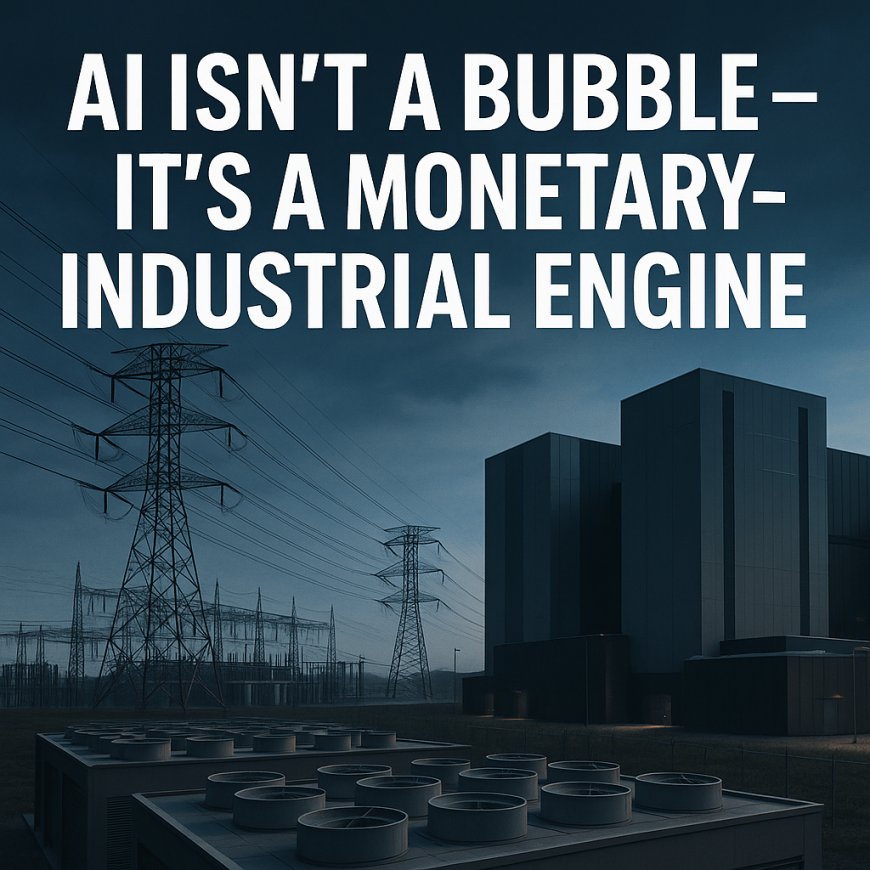
AI Isn’t a Bubble — It’s a Monetary-Industrial Engine
Dot-com built websites. AI builds cities of compute — data centers, power, copper, steel, transformers, land, and long-cycle capex that turns into collateral and new credit. This isn’t speculative mania. It’s an industrial monetary regime shift.
Thesis
Everyone is arguing about whether AI is a bubble. That frame is too small. The right question is: What happens when equity valuations force a decade of real-world capital formation? AI capex is not just spend — it is collateral creation. The cycle converts market value into hard assets that can be financed, refinanced, and levered into new credit. That’s a monetary engine, not a meme trade.
Where dot-com produced paper wealth, the AI cycle produces data centers, substations, transmission, generation, cooling, and industrial supply chains. You can’t margin-call concrete. You finance it, depreciate it, and operate it — or repurpose it to adjacent demand (cloud, enterprise, defense, simulation).
See also: Macro & Markets · Systems & Patterns · Geopolitics · Wealth & Real Estate
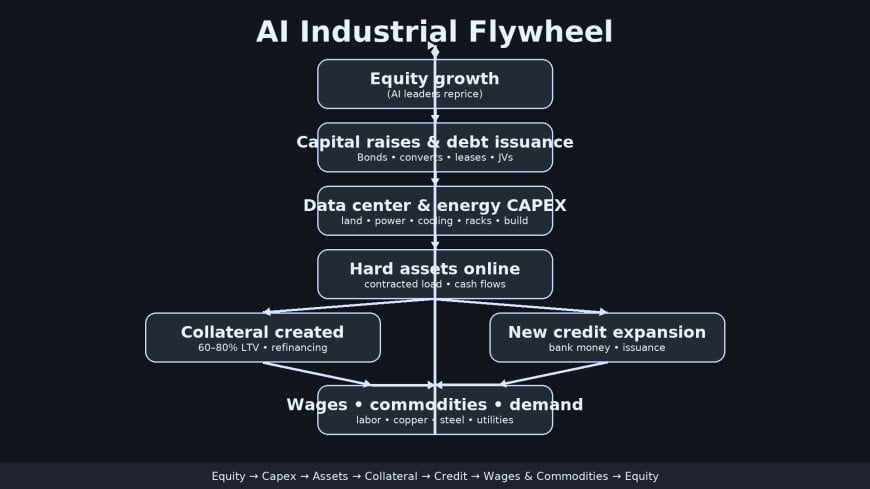
The AI Industrial Flywheel
- Equity Ignition: Platform leaders and chip vendors reprice on expected cash flows → board-level mandate to secure compute & power.
- Capital Raises & Debt Issuance: Bonds, convertibles, leases, JV/SPV structures → capex envelopes scale into the hundreds of billions.
- Data Center & Energy Capex: Land, power, substations, interconnects, generators, cooling, racks, buildings — multi-year buildouts.
- Hard Assets Come Online: Physical plants with contractual offtake (cloud, inference, training, sovereign/defense), yielding cash flows.
- Collateralization: Facilities are financeable; typical project finance structures support ~60–80% debt at stabilization.
- New Credit Expansion: Collateral → refinancing → new issuance → additional greenfield/brownfield projects.
- Wages & Commodities: Labor, copper, steel, concrete, transformers, turbines, HVAC, EPC margins → income & demand feedback.
- Loop-Back: Revenues + assets + policy support → sustain equity premiums → repeat the cycle at larger scale.
Why This Isn’t Dot-Com 2.0
- Physical footprint: AI demands power-dense facilities and grid upgrades; dot-com mostly deployed software.
- Capex duration: Multi-year construction cycles with long-lived assets vs. short product cycles.
- Collateral base: Hard assets can be pledged, refinanced, and rolled; websites cannot.
- Policy alignment: National AI & industrial policy, onshoring, and energy security create tailwinds.
- Repurpose ability: If AI growth pauses, capacity is redeployable to cloud/enterprise/defense workloads.
Capital Plumbing & Leverage
In practice, hyperscale and JV vehicles mix equity, construction debt, term debt, equipment leases, and tax-advantaged structures. Stabilized assets with contracted load can support ~60–80% debt depending on credit quality, utilization, and rate environment. That leverage multiplies equity and manufactures new money via bank credit — the monetary flywheel that most “bubble” takes miss.
Rule of Thumb: Every $1 of equity that completes a stabilized facility can pull $1.5–$4 of debt capacity over the asset’s life, depending on DSCR, tenor, and sponsor strength. That’s how equity valuations convert into real economy activity.
Physical Constraints: Power, Copper, Transformers
Power: Global data center electricity demand is on track to roughly double this decade, driven by AI workloads. Utilities are planning major capex to deliver generation and interconnection. Queue congestion and siting are now strategic variables.
Transformers: Large power transformers face multi-year lead times with documented supply constraints, making substation buildouts pacing items for many campuses.
Copper & Materials: The energy transition + grid expansion + DC buildout intensify copper demand across generation, transmission, and facility wiring — pushing long-cycle investment needs higher.
Macro & Markets Implications
- Liquidity Structure Shifts: Collateral-backed capex absorbs and then emits credit into wages, materials, and services.
- Commodities: Structural bid for copper, steel, concrete, turbines, and high-spec electrical gear.
- Rates & Term Premium: Heavy issuance + long-cycle capex can pressure term premia while supporting real-economy income.
- Regional Industrial Policy: Power-rich, permitting-friendly regions gain; constrained grids pay premiums.
- Resilience of the Cycle: Even with equity drawdowns, the installed base persists and cash-flows — the cycle is stickier than dot-com.
Related reading: Nexus Reports · Reverse Repo Trap · Gold, Liquidity, Real Rates
Sources
- IEA — Energy & AI: Data centre electricity demand to ~945 TWh by 2030
- IEA — Electricity 2024: Analysis and forecast to 2026 (PDF)
- Reuters — Microsoft plans ~$80B for AI-enabled data centers in FY2025
- Reuters — Citigroup: AI infrastructure spend could top $2.8T by 2029
- DataCenterDynamics — Meta signals notably larger AI capex in 2026
- Washington Post — Hyperscaler AI capex as a macro driver (2025)
- US DOE — Large Power Transformer Resilience Report: 36–60 month lead times (PDF)
- CISA/NIAC — Critical shortage of power transformers: rising lead times (PDF)
- IEA — Copper: transition-driven demand outlook
- S&P Global (IHS) — The Future of Copper (PDF)
- Norton Rose Fulbright — Data center financing structures (US volumes)
- Pivotal180 — Project finance structures for data centers
What's Your Reaction?
 Like
0
Like
0
 Dislike
0
Dislike
0
 Love
0
Love
0
 Funny
0
Funny
0
 Wow
0
Wow
0
 Sad
0
Sad
0
 Angry
0
Angry
0

Founder of Pattern Nexus. I research markets, macro, geopolitics, AI, history, ancient systems, and the patterns most people overlook. I’m also building Market Radar, a trading scanner designed to read pressure, risk, confirmation, and setup quality before chasing a move. Pattern Nexus is where I connect the dots between data, history, technology, and the bigger system playing out around us.













Comments (0)