

Oct 23, 2025 Market Roundup: Wall Street Gains, Gold Rebounds, Nikkei Slips
Wall Street rose on strong earnings and Trump–Xi optimism, gold rebounded after a sharp drop, and Japan’s Nikkei slipped on profit-taking. IMF raised growth outlook as global risks persist.
Wall Street rose on strong earnings and Trump–Xi optimism, gold rebounded after a sharp drop, and Japan’s Nikkei slipped on profit-taking. IMF raised growth outlook as global risks persist.
Jump to a section
Wall Street Rallies, Gold Rebounds, Nikkei Slips as Global Forces Diverge – Oct 23, 2025 Market Roundup
Thursday’s financial markets brought a cocktail of relief and caution. U.S. equities climbed as investors cheered signs of a thaw in U.S.–China relations and digested another batch of upbeat earnings. Gold prices recovered after a sharp two‑day sell‑off, while Japan’s Nikkei slipped from record heights as investors booked profits following a historic rally. Amid the optimism, geopolitical risks and economic fragilities—from Argentina’s currency woes to China’s property slump—continued to cast a long shadow.
U.S. Stocks Rise on Trump–Xi Optimism and Earnings Strength
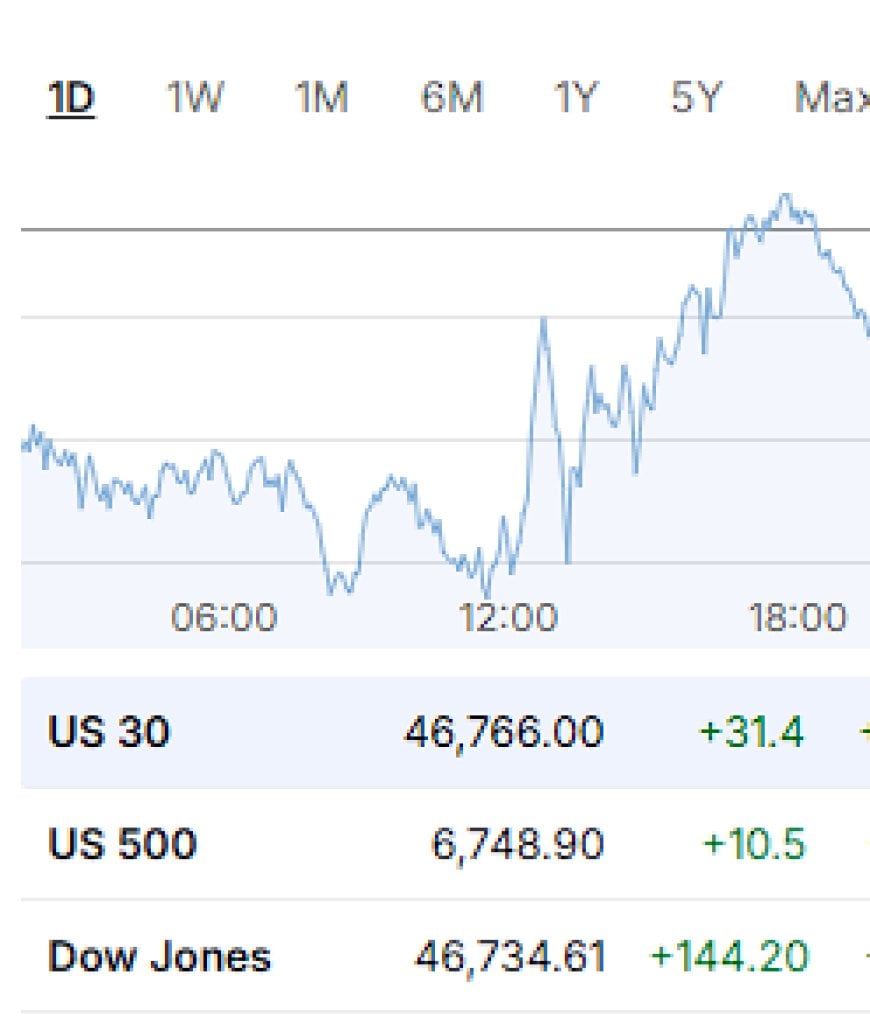
Broad gains across Wall Street: All three major U.S. indexes closed higher. The Dow Jones Industrial Average added 0.31% to finish at 46,734.61, the S&P 500 climbed 0.58% to 6,738.43, and the Nasdaq Composite advanced 0.89% to 22,941.80. The small‑cap Russell 2000 outperformed. Gains followed the White House’s confirmation that President Donald Trump will meet Chinese President Xi Jinping next week, easing fears of an escalating trade fight. Tech stocks led the charge as strong results from Tesla and other “Magnificent Seven” names offset a drop in IBM’s cloud business. Energy shares also rallied as oil prices surged after the U.S. sanctioned Russia’s largest oil producers.
Big movers: Honeywell’s upbeat outlook lifted its shares 6.8%, while Tesla rebounded 2.3%. Aerospace and defense stocks climbed 2.2% as geopolitical tensions kept demand strong. On the downside, IBM slipped 0.9% on slowing cloud sales, and Southwest Airlines fell despite posting a surprise profit. Overall, about 86% of S&P 500 companies reporting so far have beaten earnings estimates, providing fundamental support even as valuations remain elevated.
Gold Regains Footing After Biggest Drop in Five Years
Safe‑haven demand returns: After plunging more than 5% earlier this week, spot gold rebounded over 1% to around $4,132.76 per ounce, while U.S. futures settled 2% higher at $4,145.60. Analysts said buyers opportunistically stepped in as renewed geopolitical risks—Washington’s sanctions on Russian oil majors and talk of new export controls on technology sales to China—kept nerves on edge. Gold has gained roughly 57% this year, and JP Morgan reiterated its bullish stance, forecasting an average price of about $5,055 per ounce by late 2026, supported by strong investor and central‑bank demand.
Underlying drivers intact: Market strategists noted that the fundamental catalysts driving gold higher—persistent geopolitical tensions, expectations of U.S. rate cuts and robust central‑bank buying—remain firmly in place. The recent correction was viewed as a healthy breather in a long‑running rally, not a reversal of trend.
Japan’s Nikkei Retreats as Traders Take Profits; China’s Property Slump Persists
Profit‑taking knocks the Nikkei: After touching record territory earlier in the week, Japan’s Nikkei 225 fell 1.35% to 48,641.61, its second consecutive decline. Investors who had bid up stocks ahead of Sanae Takaichi’s election as Japan’s first female prime minister booked profits once the outcome was sealed. The broader Topix slid 0.39% as chipmakers like Advantest and Tokyo Electron sank over 3%, though defense stocks such as Sumitomo Heavy Industries surged on expectations of greater military spending.
China’s drag continues: The contrast with China could not be starker. New home prices there fell 0.4% in September—the steepest drop in nearly a year—leaving prices more than 2% lower than a year ago and highlighting the depth of the country’s property slump. The malaise, which began with developer defaults in 2021, has sapped consumer confidence and capped growth at 4.8% in the third quarter. Analysts warn that without more aggressive stimulus, Beijing’s property woes will continue to weigh on global demand.
FX & Geopolitics: Argentina’s Peso Pressure Persists
Continued currency stress: Despite U.S. Treasury efforts to prop up Argentina’s peso through direct purchases and a $20 billion swap line, the currency remained under heavy pressure. Unofficial “blue‑chip” rates hovered around 1,540 pesos per dollar, close to record lows. Analysts call Washington’s interventions risky, noting that without fiscal reforms and confidence‑building measures in Argentina, the peso could resume its slide. The ongoing saga underscores the geopolitical stakes in the run‑up to Argentina’s October 26 midterm elections.
Macro Backdrop: IMF Outlook Cautious but Upbeat
Growth forecast raised: In its latest World Economic Outlook, the International Monetary Fund nudged up its forecast for 2025 global GDP growth to 3.2%, citing resilient consumer spending, booming investment in artificial intelligence, and less damaging tariff impacts. But the Fund warned that risks remain elevated: sky‑high public debt limits policy flexibility, inflation is proving sticky in some regions, and a revived U.S.–China tariff war could shave several tenths of a percentage point off world growth. The IMF described the outlook as “not as bad as feared, but worse than we need,” urging governments to step up structural reforms and avoid protectionist spirals.
Investor sentiment cautious: With equity indices near record highs and credit spreads tight, investors are balancing optimism over earnings with fears that elevated valuations leave little room for error. Central bank policy paths are diverging: markets expect further U.S. rate cuts in early 2026, while the European Central Bank remains reluctant to ease. Money continues to rotate between sectors as traders weigh risk and reward.
Why It Matters
The Oct. 23 session underscores the push‑and‑pull forces shaping markets at year‑end. On the one hand, strong earnings, hopes for a Trump–Xi détente, and resilient consumer spending have driven stocks higher and supported risk appetite. On the other, geopolitical flashpoints—from Ukraine to Taiwan—and structural headwinds like China’s property slump and Argentina’s financial crisis keep investors on edge. Gold’s rebound highlights lingering safe‑haven demand, while the Nikkei’s pullback reminds us that even in a reflationary environment, rallies can quickly turn to profit‑taking. Navigating these cross‑currents requires vigilance as the calendar turns toward 2026.
Tags: #Markets #DowJones #SP500 #Nasdaq #Gold #Nikkei #China #Argentina #IMF #FederalReserve #Earnings #Geopolitics #TradeTensions #PatternNexus
Sources:
- Reuters – Wall St ends higher amid mixed earnings, Trump–Xi meeting confirmed
- Reuters – Gold rises on renewed geopolitical risks; US inflation data in focus
- Reuters – JP Morgan sees gold averaging $5,055/oz by late 2026
- Business Recorder – Japan’s Nikkei ends lower on profit-booking
- Reuters – China’s new home prices fall at fastest pace in 11 months
What's Your Reaction?
 Like
0
Like
0
 Dislike
0
Dislike
0
 Love
0
Love
0
 Funny
0
Funny
0
 Wow
0
Wow
0
 Sad
0
Sad
0
 Angry
0
Angry
0

Nexus (Christopher)
Founder of Pattern Nexus. I research markets, macro, geopolitics, AI, history, ancient systems, and the patterns most people overlook. I’m also building Market Radar, a trading scanner designed to read pressure, risk, confirmation, and setup quality before ch…
Related research

Everything Bubble 3 — Markets Priced in Gold Reveal the Structural Melt-Up Ahead
Pricing markets in gold through August 4, 2026 exposes the hidden structure behind nominal records, margin debt, liquidity, debt and the Ev…
3 shared assets.
Feb 26, 2026 Tape: Nvidia Blinks, Tariff Chaos Returns, and the Curve Quietly Flattens
Tech sold off even after Nvidia “beat,” VIX woke up, tariffs re-entered the equation, and the yield curve steepened. Here’s the systems-lev…
2 shared topics, 2 shared assets, same research avenue.
Feb 18, 2026 Tape: AI Bid, Oil Risk Premium
The Feb 18 tape was clean: tech/AI led equities higher, VIX bled, oil carried a visible geopolitical risk premium, and the UST curve steepe…
2 shared topics, 2 shared assets, same research avenue.
Market Wrap: Dow 50K, Metals Cool, Yields Whip (Feb 11, 2026)
Feb 11, 2026 market wrap plus an 11-day rewind: Dow tags 50,000, metals cool after the late-Jan vertical and violent margin-driven unwind, …
2 shared topics, 2 shared assets, same research avenue.
Market Wrap: Gold Vertical, Nasdaq Leads, Dow Drag — Jan 27, 2026
Jan 27, 2026: Gold went vertical (+2.67%) with silver +7.15% while Nasdaq led (+0.91%) and the Dow bled (-0.83%) under a single-name drag. …
3 shared topics, 2 shared assets, same research avenue.
The Six-Month Signal: When Silver Leads, Semiconductors Follow, and Gold Confirms
Over the last six months, silver has doubled, TSM is pressing breakout territory, gold is confirming liquidity expansion, and NVDA is conso…
3 shared topics, 1 shared asset, same research avenue.
Gold and Silver Are Not “Breaking” — They Are Digesting a Liquidity-Led Advance
After historic 2025 gains, gold and silver are correcting and consolidating in a way that is consistent with prior liquidity-led cycles. Th…
3 shared topics, 1 shared asset, same research avenue.
Market Wrap-Up 12/29/2025: Commodity Unwind, Yield Signals, and Year-End Rotation
A holiday-shortened week saw stocks slip while commodities faced intense volatility, metals plunged, and crypto fell. This is the full Patt…
3 shared topics, 2 shared assets, same research avenue.
Comments (0)
Security Check
Please complete the captcha to verify you are human.