

Gold’s Use-Case Explodes: Why 8+ Billion Humans and 2-4 Billion More Going Digital Boosts Gold’s Repricing
We aren’t returning to a gold standard — we’re entering a world where gold’s role expands in a digital civilization. With 8 billion + people today and billions more coming online, gold’s value as both monetary ballast and physical substrate is accelerating.
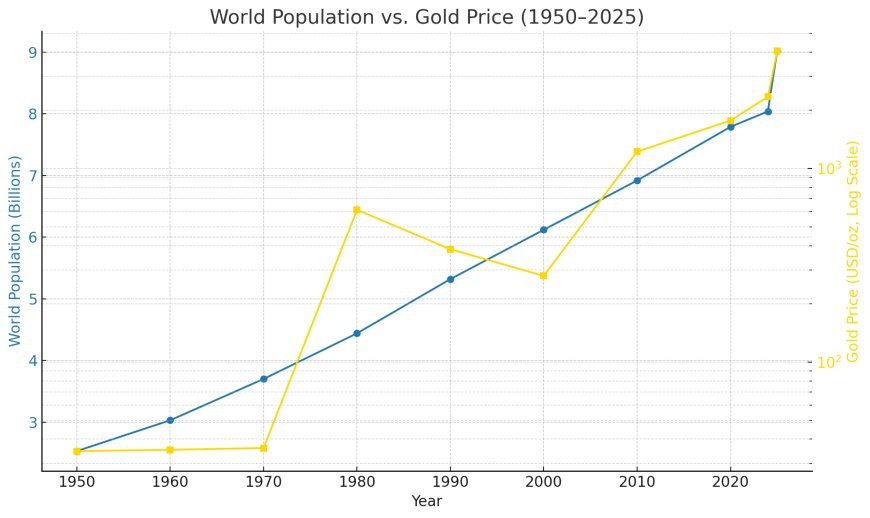
We aren’t returning to a gold standard — we’re entering a world where gold’s role expands in a digital civilization. With 8 billion + people today and billions more coming online, gold’s value as both monetary ballast and physical substrate is accelerating.
Jump to a section
📈 Humanity Expands — Why Gold’s Use-Case Grows Even Faster
According to the United Nations World Population Prospects 2024, the global population is estimated at about 8.2 billion in 2024 and is projected to reach roughly 10.3 billion by the 2080s. Meanwhile, real-time tracking from Worldometer estimates the world’s population at approximately 8.25 billion as of October 2025. Even Pew Research Center notes that although growth is slowing, the absolute number of humans joining the digital economy each year remains historically unprecedented.
This means that global population estimates may already be under-counting reality — especially in regions where birth registration and census coverage lag behind connectivity growth. If we are functionally at or near 9 billion people today, then humanity’s demand curve for money, energy, and materials is already beyond what legacy models anticipate. That directly impacts gold’s role — because gold’s use-case isn’t static; it expands with every new layer of civilization.
| Year | World Population (billions, UN est.) | Gold Price (USD/oz, annual or current) |
|---|---|---|
| 1950 | 2.53 | 34.72 |
| 1960 | 3.03 | 35.27 |
| 1970 | 3.70 | 36.02 |
| 1980 | 4.44 | 612.56 |
| 1990 | 5.32 | 383.51 |
| 2000 | 6.12 | 279.11 |
| 2010 | 6.92 | 1,224.52 |
| 2020 | 7.79 | 1,769.64 |
| 2024 | 8.04 | 2,350 |
| 2025 | 9.02 (low-projection) | 4,050 (today) |
🌍 Digital Civilization + Billions Coming Online = More Demand, More Scarcity
Roughly 2 to 4 billion people are still not fully connected to the internet or global banking system. As connectivity spreads across Africa, South Asia, and Latin America, each newly connected human adds measurable pressure on global infrastructure: more data centres, servers, satellites, power grids, and AI compute. Every byte created in the digital economy has a physical cost — metals, energy, and minerals — and gold sits at the intersection of those systems.
Gold’s use-case now spans far beyond investment or central-bank reserves:
- Precision electronics and quantum-level computing hardware
- Low-resistance contacts in advanced AI data-centre wiring
- High-reliability components in satellites and aerospace
- Reserve asset for sovereigns hedging digital-fiat volatility
---
⚙️ Why We Are Not Returning to a Gold Standard — But We Are Escalating Gold’s Role
There’s a misconception that rising gold prices mean the world is drifting back toward a gold standard. That’s not what’s happening. In truth, gold’s surge signals a system too large and too digital to be anchored by any single monetary base. Instead, gold’s function is evolving from “backing money” to benchmarking the integrity of value itself. It’s the physical ruler against which synthetic liquidity measures its decay.
---
🔮 Growth Potential: The “X^^” Repricing
If humanity today is approaching 9 billion people — and another 2–4 billion are about to join the digital economy — then gold’s use-case and scarcity narrative enter a new phase of compounding growth. More people online means exponentially more computation, storage, and data — all powered by metals, energy, and finite materials. Gold, as both a monetary ballast and technological substrate, scales with civilization itself.
That’s an X^^ growth dynamic — exponential expansion layered on exponential connectivity. Every terabyte processed, every AI model trained, and every satellite launched deepens the world’s dependence on physical scarcity. Gold’s repricing isn’t about nostalgia for the old standard; it’s the market recalibrating for the real cost of existence in the digital age.
---
🧩 The Real Standard Is Scarcity
In a century dominated by code, gold remains the immutable constant. It doesn’t promise a return to the past; it confirms the physics of the present. As 9 billion + humans connect, create, and compute, the value of gold rises not because of nostalgia — but because it still represents the one thing civilization can’t print, clone, or simulate: finite matter.
Related Reading:
The Calm Before the Liquidity Storm: QE 2026
The Fed’s October Pivot and the Digital Dollar Frontier
What's Your Reaction?
 Like
0
Like
0
 Dislike
0
Dislike
0
 Love
0
Love
0
 Funny
0
Funny
0
 Wow
0
Wow
0
 Sad
0
Sad
0
 Angry
0
Angry
0

Pattern
Related research

From Liquidity Storm to Chokepoint War: Auditing 472 Pattern Nexus URLs — What Landed, What Missed, and What Comes Next
I audited the public Pattern Nexus record across 472 unique URLs and the saved full-text article export, then rebuilt the major calls from …
1 shared topic, 2 shared assets.
Pattern Nexus Macro Archive: 328 Timestamped Articles, October 2025–July 2026
A guided public index of 328 timestamped Pattern Nexus articles covering Federal Reserve liquidity, interest rates, the dollar, gold and si…
1 shared topic, 2 shared assets.
Gold Was Right. The 10-Year Was Early. The War Premium Changed the Rate Path.
The original Pattern Nexus gold call hit the structural move: gold was not just trading inflation, it was repricing liquidity, policy failu…
1 shared topic, 2 shared assets.
Dow Sets Record High as Gold Plunges; Nikkei Surges Amid Diverging Global Forces – Oct 21, 2025 Market Wrap
On October 21, 2025, the Dow closed at a record high while gold pulled back sharply from all-time highs. Japan’s Nikkei surged on optimism …
1 shared topic, 2 shared assets.
Stone Money on Yap: When the Ledger Is the Island
On Yap, massive stone disks called rai functioned as money even when they never moved. Ownership moved through public consensus, proving mo…
2 shared topics, same research avenue.
Digital Sovereignty and the Global Race for Central‑Bank Digital Currencies
CBDCs are moving from pilot to policy as states race to defend monetary sovereignty, shape cross-border rails, and set the rules of program…
2 shared topics, same research avenue.
Comments (0)
Security Check
Please complete the captcha to verify you are human.