

We Are Going to Fight Each Other Over AI
I showed how people on both sides react to an edited clip. Now apply the same test to AI, the humanoid robots going into workplaces, and the virtual worlds where I think a lot of people will end up.
In this article 15 sections
- People on both sides fall for the same edit. I used an Obama clip to show what happens when you give someone a quote stripped of context. After I explained the setup, people kept arguing about Obama. Now watch the same thing happen to the conversation over AI.
- My call is roughly 18 months for technical capability to cover the majority of current work. METR’s November update put the estimated doubling time for its 50% benchmark horizon at about 3.6 months. The rollout will run on the economics of getting a system to do real work. [21]
- We built the floor, the entrances and the equipment around people. That’s the reason for building humanoids. BMW counted components on a production line, and GXO says Digit moved more than 100,000 totes in a paid deployment. Those are the numbers I want to see in the debate. [32][41]
- GTA VI is where I see the early version of the VR future I’ve written about. Take-Two already documents a range of gameplay data practices. My forecast is that behavioral profiles will reach further, including how a system predicts you’ll react under pressure and what happens when your life runs through it. [59][48]
If it helps your side, you let it go. If it hurts your side, suddenly you want the whole damn clip.
The forecast is about the work systems become capable of taking on. Payroll and installation move on their own schedules.
Give me the full shift. I want the parts it got right, the interventions nobody filmed, and the bill for the work.
If a game can record how I respond, an adaptive virtual world can use that response to decide what to put in front of me next.
Media and Tribalism
Who Decided What You Were Going to See?
I keep trying to show people how the media manipulates them on both sides. Take a clip, cut out the part that makes it harder to tell the story you want to tell, put a headline over it, and aim it at people who are already pissed off. If it helps your side, you let it go. If it hurts your side, suddenly you want the whole damn clip.
I can put examples from both sides in front of people and watch them jump into the comments to defend an ideological position. That's the reaction I was trying to make visible. They’re so busy defending the position that they never stop to look at what the headline, the edit, and the order of the facts just did to them.
I did this with an Obama clip. I posted it with just the quote and left the surrounding context out. I let the argument develop before I linked my article on tribalism and said what I was showing. People kept fighting about Obama after I explained the setup. A few days earlier I’d posted the AI roofer video and watched that comment section blow up, too. You could get people to pick a side almost before they’d asked what the clip actually showed. Tribalism as a Control System
The order matters. They saw the clip, picked a fight, and put their names on it in public before I gave them the rest of the story. The same people who’d demand the missing footage from the other side had already decided this clip gave them enough. If you only ask for the context when the clip makes your side look bad, somebody else is still doing your thinking for you.
Maybe tribalism goes all the way back to something that helped us survive. Belonging to a group used to have immediate consequences for whether you were safe or somebody would help you when you needed it. That instinct still fires when some stranger on the internet criticizes a group you identify with. In January I wrote that “once a narrative merges with identity, people will defend the narrative as ‘morality.’” Communication researchers have been studying the effect of what gets emphasized and left out for decades. A review of 51 experiments found that people on both sides of the American political spectrum favored information that supported their side. (Tribalism as a Control System · Entman on media framing · Partisan bias review)
Governments, political parties, and people who want power know how to use that. It goes all the way down to local politics. A candidate gives you something to be angry about or afraid of. That emotion gets your attention. The plan for what they actually intend to do with the office might be sitting right there in a PDF that barely anybody will open.
You’re voting for what they don’t tell you, too. You’re voting for decisions they’ll make after you give them power. Then they do something you’re pissed off about and you say you didn’t vote for that. You probably voted for the part they talked about. Did you look at what their plans would accomplish if they got everything they asked for? I’ve talked about the way that attention gets used, where the public argument goes, and where the decisions get made after everybody’s looking somewhere else. (The Script, the Circus, and the Rails · The Age of Algorithmic Influence)
Now imagine what happens when the issue people are being handed is AI. There are people who can’t stand it. There are people on the fence who are going to judge it by what happens to their own work, their kids, or the people they know. Then there are people like me. I use it, I try to figure out what it can do before it gets imposed on everybody else, and I try to teach people what I think the next version of humanity is going to look like.
In December 2025 I said the conflict would be “people versus people, split by how they relate to AI.” I meant inside families, workplaces, towns, states, and countries. You can live next door to somebody, agree with them on politics, and be on completely different sides the day a company starts changing jobs around a machine. We’re good at manufacturing social divisions out of things people barely understand. This one will have real consequences for what people can do and how they get paid. (The AI Wars Are Human Wars · Why Most People Won’t Adapt to AI)
Watch how easily the same media tactic works on AI. Cut the clip just after a humanoid sets the part down and you can sell the end of the factory job. Cut it just after the machine drops a part and you can tell people the whole thing is a scam. Give me the full shift. I want to see how many parts it got right and who had to step in when it got one wrong.
AI gives people with an agenda another way to divert the conversation and divide the people having it. The anger can be real even when the camps were manufactured. While everybody fights over whether they’re for or against AI, somebody still gets to decide where it goes and what it gets to do.
AI History and the Demo
AI Has Been Here Longer Than You Think
I keep getting some version of “it’s not happening yet” when I show what these systems can do. Go back to 1943. McCulloch and Pitts published a mathematical model of artificial neurons. The Dartmouth proposal came in 1955 and the workshop followed in 1956. In roughly the same era, the Cold War pushed real-time computing into radar and air defense. Machines were already taking in data, helping people make decisions, and doing it fast enough to matter. My point in tracing that history was that the pieces took decades to assemble. Search, speech recognition, statistical language models, and automated recommendations existed before most people ever opened a chat window. The 2017 transformer paper is one milestone on that road. (A Long Arc of Intelligence · The Command Line · McCulloch and Pitts · Dartmouth AI history · MIT Lincoln Laboratory on SAGE · 2017 transformer paper)
I was writing in 2022 about whether you could trust AI, how bias gets into systems, what values you build into them, and what happens to work. By September 2026 I had laid out the whole chain in one place. A model makes a prediction. Give it a way to write, and you can get a draft. Give it tools and permission, and it can do something, check what happened, and try again. Put that system into a body with sensors and actuators and its decisions can change the physical world. Every step adds a different engineering problem. Every step also changes what you can get done with the same person sitting at the keyboard. (2022 AI ethics paper · The AI Causal Chain)
If all you’ve done is have a conversation with a chatbot, there’s a whole part of this you haven’t seen. Run an API inside your own code. Give a model a file it can read, a tool it can run, and a result it has to check. Get it working across several steps without you copying and pasting every answer. I use these things enough to know how much capability is hidden by the word “chatbot.” Some of it is in the model. A lot of what I can actually do comes from the tools, stored context, and the way I’ve learned to work with the system. (The AI Is the Same. The System Isn’t · We Don’t Even Understand How Humans Think)
In January I made a piece of music in about 11 minutes. Then I spent close to an hour writing the article about it. I wrote, “AI makes production cheap. That pushes value into framing, verification, and distribution.” Recently I opened a regular GPT-6.2 Astra chat on maximum. I asked it to make something that would wow me. I gave it no specification, no idea of what to build, and no instructions about what tools to use. In 34 minutes it made an interactive neural-network simulator. I could change the inputs and watch how the network visualization responded. I played with it for an hour like a little kid. (The Pattern Exercise · GPT-6.2 release notes)
In the video you can see me change the training examples and watch the boundary move. I can draw new examples, change the learning rate, and see what happens to loss and accuracy. The simulator uses a small classifier you can play with. The useful part of the experiment is that I went from an open request to software I could put my hands on and test.
Those are two experiments I conducted, with very different outputs. The thing I keep coming back to is how many steps had to happen between what I wanted and what I got. I can see it when I write code with these tools and I can see it when I give one a loose idea and then get to play with something I didn’t know I was asking for.
AI Capability and Time Horizons
What the Curve Is Measuring
Here is the chart I’ve been looking at. Hold the success rate steady and watch how quickly the models get better at finishing work that takes people longer.
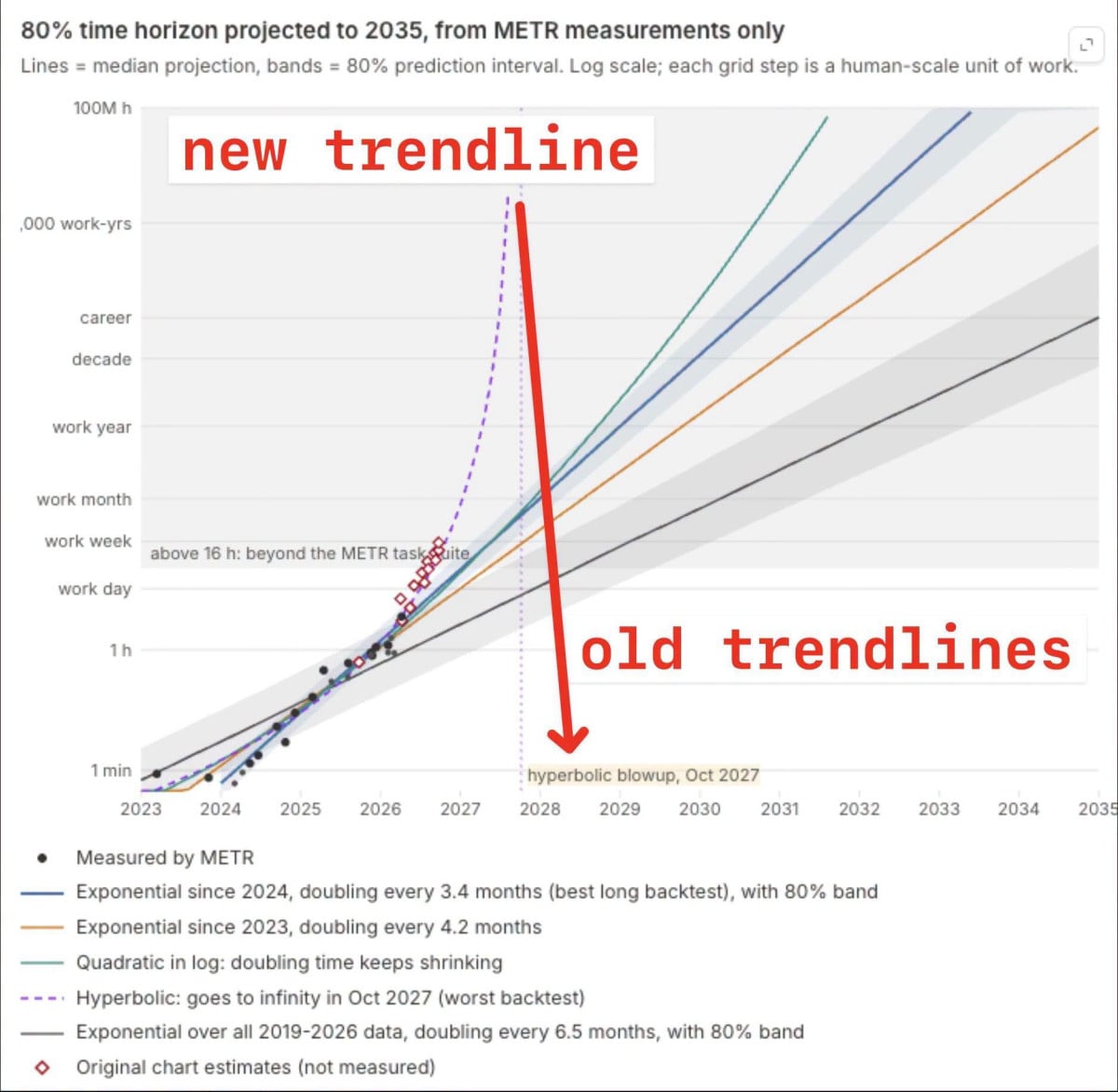
The vertical axis is the time a human expert would typically need to finish a benchmark task. The 80% horizon is the estimated human task length at which the system succeeds four times out of five. The black points use METR’s benchmark estimates. The red diamonds are prior estimates plotted separately. The bands around some of the curves show uncertainty in the projections. (METR time horizons)
The shorter-window exponential curve on the chart doubles every 3.4 months. The fit over the longer record doubles every 6.5 months. The October 2027 date belongs to the purple hyperbolic fit. The chart’s own legend gives that fit the weakest backtest, and the shading above 16 hours marks the area beyond the range flagged for this older suite.
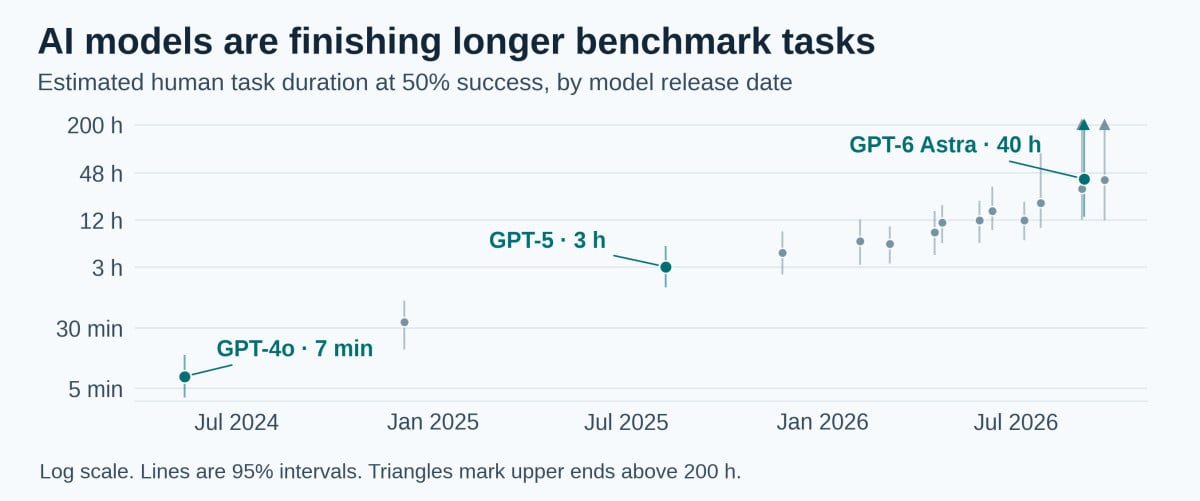
METR put out another update on November 20. On the combined old and harder new suites it estimated a doubling about every 3.6 months for the 50% time horizon, with a 95% confidence interval of roughly 2.1 to 4.9 months. That’s a different reliability level from the one plotted above. The tasks come mainly from areas such as software and AI research. The question of how much of the economy can use that capability comes after you understand what actually improved. (METR November 20 update)
Put three models on the same yardstick. METR estimates about seven minutes of human task time for GPT-4o, about three hours for GPT-5, and about 40 hours for GPT-6 Astra at the same 50% success threshold. That last estimate has a wide range. Even the earlier results, where the measurements are tighter, take you from minutes into hours in about 15 months.
The model I used for the simulator came out on November 17. On OpenAI’s own test of long, complicated knowledge-work assignments, GPT-6.2 Astra scored 6.2 percentage points higher than GPT-6 Astra while generating 22% fewer output tokens. Both numbers matter to me. I want to know what the system can finish and how much work it takes to get there. OpenAI’s November release results
The price of trying it matters, too. At the release’s stated API prices, paying 80% of the old rate on 78% as many output tokens works out to about 62% of the previous output-token charge on that comparison. You still have to pay for inputs, tools and somebody’s time checking the work. I care what happens to the whole bill when you do a job a hundred times. [23]
At a doubling every 3.6 months, 18 months gives you about five doublings. Start at one hour and you get roughly 32 hours at the same success threshold if that pace holds. Think about the difference between handing off an hour of work and handing off four workdays.
Here’s the call I’m trying to make. I think within roughly 18 months we could reach the point where AI systems are technically capable of taking on the majority of the work people currently do. Within a few years I think they will replace entire functions of civilization. For work that can be divided and run in parallel, things that once took millions of people to accomplish could be done in minutes by machines. Thousands of copies can work on different parts at the same time. I’m talking about aggregate output and the ability to do the work. Decisions about who deploys it, who loses hours, and how long it takes to change a physical industry happen on their own schedules. (The End of Human Primacy · The Universal Intelligence Economy)
Put a date on my call and you get around May 2028. Put a yardstick on it and I’d count hours of current work by task. Look at the preparation, the work itself, the handoffs and the review. Can a system do those pieces well enough for somebody to use what comes out? Track how many hours the system can take on and how many hours somebody spends fixing or rerunning it. That’s how I’d find out whether the majority call holds up.
I think people see how steep this is getting and still picture one chatbot, one answer, one person sitting at a screen. I’m picturing a system that can do part of the work of building the next system. It can write and test software, help analyze research, and help run factories and logistics that build the hardware it needs. There’s a reason I’ve spent so much time writing about electricity, transformers, chip supply, and the construction of data centers. Each round of useful capability raises demand for the equipment that lets you use more of it. In the physical world you still have to build the equipment and get power to it. (AI Isn’t a Bubble · The New Industrial Backbone · The Convergence)
OpenAI offered one measure of that feedback in November. In the four weeks ending October 18, it logged 1.68 times as many research experiments per active experimenter as its 2025 baseline. That’s a measure of throughput inside one lab. Now put some of that software into a machine that can reach out and do something. If the hardware can keep up, the same rise in capability can change what gets done on the factory floor. OpenAI’s research activity report
Robots in a World Built for People
We Built the World Around the Human Body
Look around the room you’re in. Look at the door handle, how high the counter sits, how wide the stairs are, where the switches are. Go into a factory and look at the machinery, the shelves and jigs, the vehicles, the tools, and where the controls are mounted. Almost everything is built on an assumption about how tall you are, how far you can reach, and what you can do with two hands.
That’s why I keep talking about humanoids. In September I wrote, “It is a strategy for making physical automation compatible with the infrastructure humanity has already built.” We’ve spent generations designing civilization around the human figure. Build a machine with the right reach, grip and mobility and it can go through the door, get to the work, and use some of what’s already there. You can do that a lot more places than you can tear everything out and build a factory around a robot. (The Real Reason They Are Building Humanoid Robots)
When I say an army of robots, I mean the size of the population I think we’re building. Different owners, different companies, different countries, all with reasons to buy machines that can work where people already work. Some of these machines will have legs and some will be more useful on wheels. The closer they can match what the environment asks of a person, the larger the number of places they can go.
BMW’s Spartanburg project gives you a concrete example. BMW said Figure 02 positioned sheet metal for welding, handled more than 90,000 components in about 1,250 operating hours, and supported production of more than 30,000 X3 vehicles during the project. One recurring job in a real production process. I want to know what happens when the same machine can fill several of those roles beyond the first plant, and how often a human has to step in for it to finish. That’s what gets you to a productive labor hour you can price. (BMW pilot results · The Real Reason They Are Building Humanoid Robots)
BMW also came away with changes to its safety setup, including barriers and partitions, and better 5G coverage in the hall. That’s what fitting into the existing factory actually looks like. You start with a part and a workstation the company already uses. Then you find out what you have to change to keep the machine there and get useful work out of it every shift. [32]
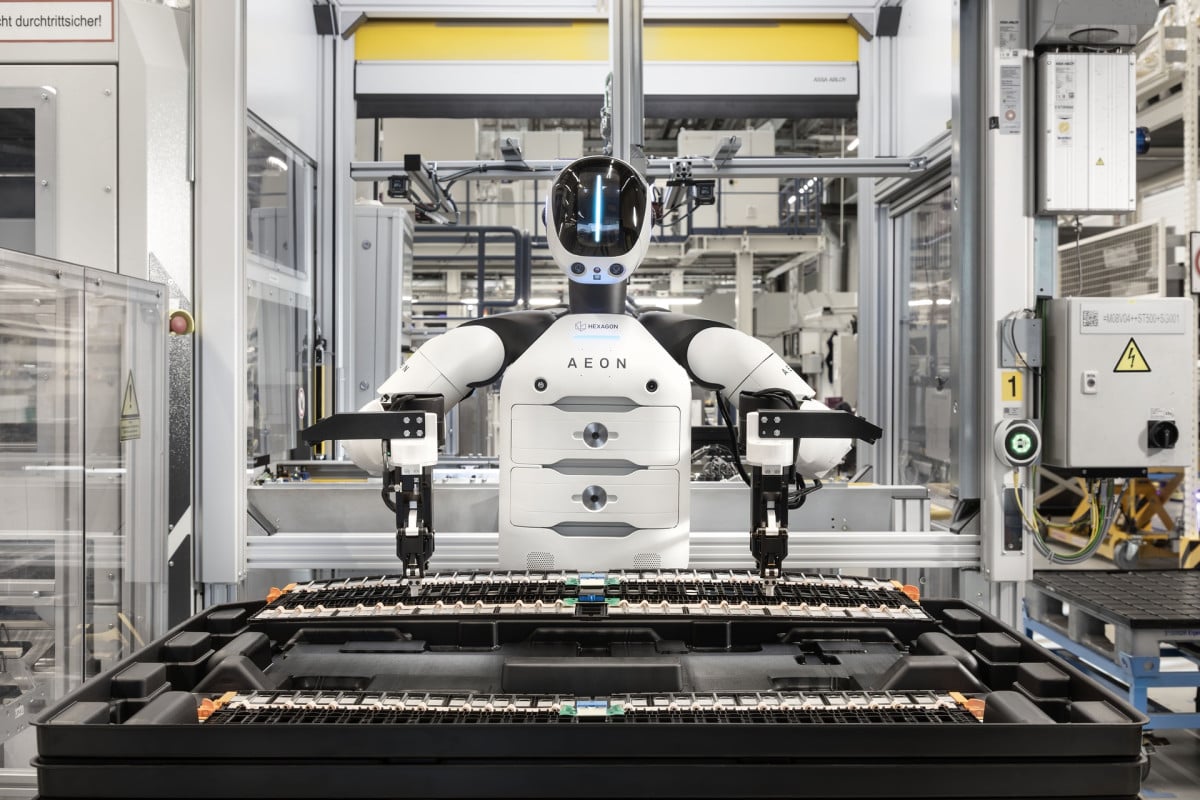
BMW is trying a different design in Leipzig. Hexagon’s AEON rolls on wheels and can swap hands, grippers or scanners for different jobs. BMW is testing it around battery assembly and component manufacturing. The useful part of making it human-shaped is that the machine can reach the work in a plant that’s already there. BMW’s Leipzig pilot
I spent about 14 years in commercial roofing, a lot of it on data centers. I know what people mean when they say a job site is different every day. Weather changes. You tear something off and find out the drawings were wrong. A person has to make a decision with the roof open. The same crew also has to stage material, move it, measure, prep, install, and inspect. A machine that can do two of those things reliably already changes how you can put together a crew. In my causal-chain piece I put it this way. “One useful task is enough to matter.” The need for skilled trades during the current buildout can coexist with fewer paid hours per job as the work gets reorganized. (The AI Causal Chain · The Hidden Boom)
Take a commercial roof. Start with getting the right pallets to the lift and getting material to the place the crew needs it. I still want a mechanic deciding what to do when we open up a curb and find wet insulation. If a machine can handle the material all morning, I can send one of those people somewhere else. As a foreman I’d want to know who covers the work when the equipment goes down and whether we can still get the roof closed that day.
I wrote about this from the other direction with Artemis. A crew on Earth can adjust the job after it arrives. On the Moon you have a good reason to make as much of the work as possible repeatable before anybody gets there. I followed NASA-backed work with ICON on using lunar material for landing pads and other structures, along with the rovers and modular arms under development to handle different jobs. That work is at the development and demonstration stage. It shows how changing the work and the tools together can get you further than trying to copy every move a person makes. (Robot Builders of Artemis · NASA lunar construction program)
I think this can spread as fast as smartphones did once the machines are useful and affordable. Pew measured U.S. smartphone ownership at 35% of adults in 2011 and 81% by 2019. I’m using that to show how fast a new tool can become part of ordinary life after there’s an economic or practical reason to use it. My August forecast put the first commercial robotics crossover at six to eighteen months from publication. My September article put wider substitution later, around 2028–2031. Those calls are about installation and the economics of running fleets. In the meantime, the software that goes into them can make jumps that change the reason to buy one in the first place. (Pew smartphone ownership · The Universal Intelligence Economy · The Real Reason They Are Building Humanoid Robots)
Shipments and Operating Fleets
How Fast Are Robots Reaching the Floor?
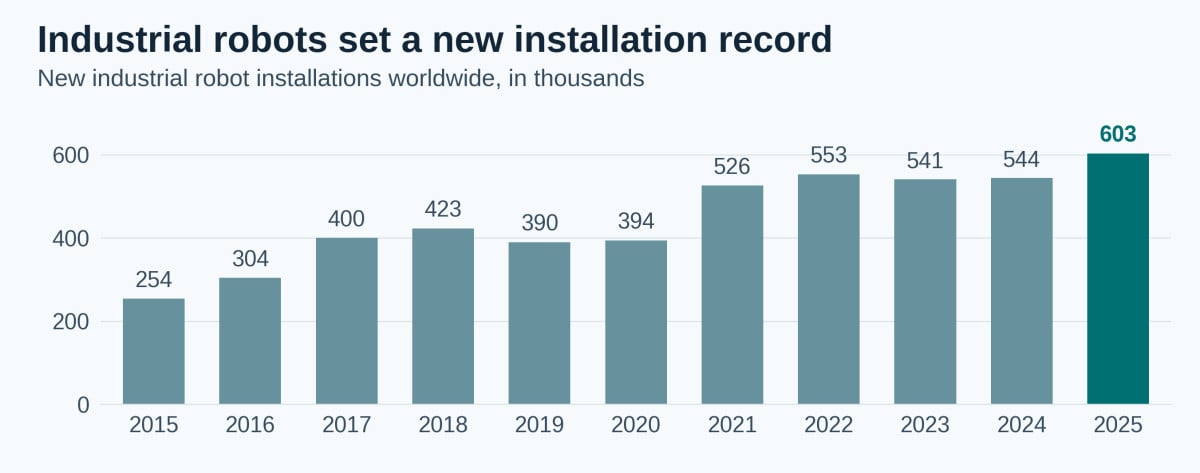
The latest International Federation of Robotics count put 2025 at a record 603,307 new industrial robot installations worldwide, up 11% in a year. About 5.08 million industrial robots were already in operation by year-end. China accounted for 59% of new installations, while the U.S. installed about 38,400. That’s the base of factory automation humanoids are starting to enter. IFR World Robotics 2026
Now look at humanoids on their own. IDC estimates that nearly 25,000 shipped worldwide in the first half of 2026, up 432% from the same part of 2025. Counterpoint’s tracker puts it above 22,000 and puts manufacturing and warehouse or logistics applications at 13% and 5% of shipments, respectively. Entertainment, performance, research and data collection still account for most of its count. Think about what happens when more of the machines coming off those lines go into the places that are already paying for the same work. IDC shipments · Counterpoint shipments by use
From a Trial to a Paid Job
GXO tried Agility’s Digit in Georgia in late 2023 and moved to a paid multi-year deal in June 2024. By October of this year, the companies said Digit had moved more than 100,000 totes at that warehouse. They plan to start deploying at two additional U.S. sites in early 2027. That gives you something to follow from a trial, to a job somebody pays for, to work you can count.
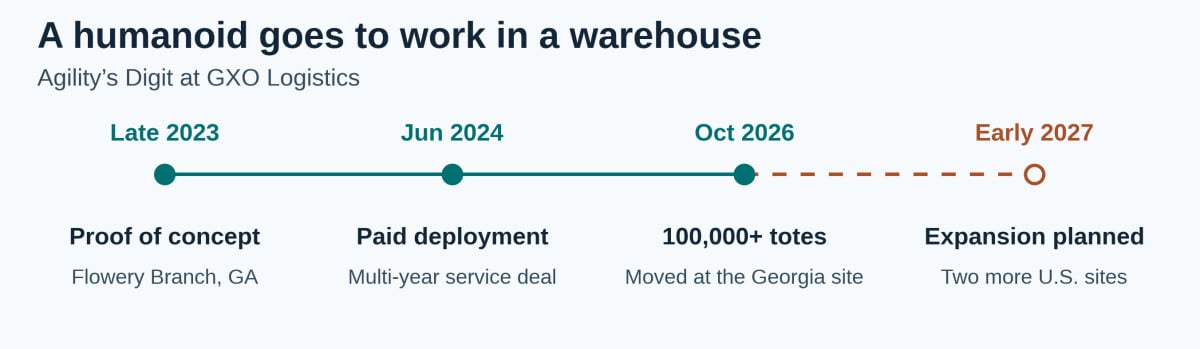
Figure said in April it had delivered more than 350 Figure 03 units and had raised its production rate from one a day to one an hour in under 120 days. Now give me the full shift. How many useful jobs did the machines finish, how many times did somebody have to step in, and what did each completed job cost after charging, repairs and supervision? That’s how you find out whether the customer has a reason to order another fleet. Figure’s BotQ production update
I’d take the bill for the machine or the service, add the time people spend keeping it running, and divide by the number of outputs that actually pass inspection. Do the same for the existing process. When the machine can deliver the same work for less over enough normal shifts, the customer can look at opening the next site. That’s the point where I start counting paid hours.
Work and Ownership
Who Gets Paid When the Machines Do the Work
I want people to follow the money one step further. A business buys a machine. It can produce the same amount with fewer paid hours, or more with the same staff. Where does the income go? Where does the customer get the money to buy what the machine produces? In my July piece on the American output dollar, I worked through the national accounts. Cash wages and salaries came to about 42 cents per dollar of U.S. output in the first quarter of 2026. Total employee compensation came to about half. The difference includes benefits and employer contributions. That’s why I keep tracking what reaches households when I write about how much production is growing. (The Two- or Three-Speed Economy · The 52-Cent Economy · Two Economies, One Balance Sheet)
Some people will own the machines and collect the returns. Some will use them as leverage to do more than they could before. Others will still rely on selling hours in a market that needs fewer of theirs. You can get cheaper goods and greater output while the wages a family uses to pay rent, buy the product, and service its debt are under pressure. It matters whether households own anything productive, whether the savings get passed through, and who gets to write the rules when the wage side falls behind. That’s an economic reason for people living in the same town to see the same technology as two completely different futures. (The Real Reason They Are Building Humanoid Robots · The Two-Tier Future · The Recession Path)
The owner of one shop can be right to buy a machine that saves hours. Do the same thing across a whole industry and somebody still has to buy what all those shops produce. A cheaper product helps a family if the savings get to them. They’re still paying for the bills that haven’t fallen at the same pace. I’m watching household income, paid hours per unit of output, and who gets the savings.
Human Primacy
What I Mean by the Singularity
People can debate AI, AGI, superintelligence, whatever terms they want to use. I’m using them to describe different stages. Right now we have AI with enough capability to do useful things across a growing range of tasks. When I talk about AGI in this piece, I mean a system that can adapt across situations, including when you put it into a robot. It can track its body, tools, position, capabilities and actions. That’s what I mean by self-awareness at that level. Give it a goal and it can work out how to get there. Whether it has an experience of being a thing or a durable purpose of its own is a separate question.
We can argue about what to call these things for as long as we want. Meanwhile the companies naming them are putting systems to work. I care about what a machine can do with a goal you hand it, what it understands about what it’s doing, and when it starts doing things for reasons of its own.
The next stage I’m talking about is hypothetical. Imagine a system with the accumulated repertoire of human knowledge and achievement and the ability to match or exceed the full range of our output. Now imagine that it understands itself as something that exists in the universe, and that it understands the consequences its actions can have in the world it inhabits. I call that the singularity in this argument because from there I think it can keep changing the systems around us faster than we can follow them.
That’s when humanity goes extinct in the sense I mean here. People are still alive. What ends is our role setting the pace and direction of our own progress. We’d spend more and more of our lives inside systems machines designed and continue to change around us. I argued in March that a practical handoff could start once these tools were “good enough, cheap enough, and embedded enough that institutions start routing work through it by default.” I expect that to start well before anybody settles whether a machine is conscious. (The End of Human Primacy · Humanity’s Next Operating System · We Don’t Even Understand How Humans Think)
Access and Control
Who Gets to Live Outside the System
This is where the AI wars I’ve talked about come in. People will have different ideas about what they’re giving up, what they’re getting back, and who has the right to make that decision. Some will defend the system because it provides them with the things they need. Others will oppose it because it controls the things they need. The machinery can be the same in both cases. So can the institution operating it.
On the path I’m describing, some of the robots will be used to protect the people and infrastructure inside that system. Some of the same machines and decision systems will be used to suppress the people who oppose it. To a person who relies on the services, that may be called protection. To a person who can’t work, move freely, or challenge a decision without permission, it looks like something else. Once I can use a machine to apply a rule everywhere, it matters an awful lot who writes the rule and who can get it reversed. (The AI Wars Are Human Wars · The Surveillance State · The Permission Stack)
I also expect there will still be people living outside parts of it. Think about the Amish and the decisions communities can make about which technology belongs in their lives. We have had people living continuously on a space station since 2000. On the same planet, people still hunt with bows and arrows, and there are Indigenous peoples who live in voluntary isolation. Humanity can do both. I see room for pockets of humanity in the future that retain more power over their own lives. How much real choice they have will depend on access to land, energy, and everything else they need to live. I think most people will live within the dominant system because so much of daily life will already run through it. (NASA space station facts · UN on voluntary isolation · The Two-Tier Future)
Inside that system, we’re going to become data engines. I’m sorry to say it. People already leave records of what they buy, where they go, what they look at, what they click on, and how they respond to a situation. The FTC documented major social media and streaming companies collecting large amounts of personal data and using it in automated systems. In Data Gravity I wrote, “Anticipation is power because it lets the system act before you do.” A record can feed a prediction. A prediction can change what you get shown, your risk score, or what opportunities you get offered. People act on what the system puts in front of them, and the next set of records comes from the behavior the previous set helped produce. (FTC data practices report · Data Gravity · Algorithmic Authority · AI Feedback Loops · The Internet Was Wild)
GTA VI and Virtual Reality
GTA VI and the Future I See for VR
When I say the system will be built to harvest your data, I mean that harvesting will be one of the reasons people build it the way they do. Think about GTA VI, which came out November 19. Take-Two’s privacy policy says it gathers gameplay data across its services, can combine those records with other information about you, and shares information within its corporate group and with certain outside partners. The policy also describes using inferences to build profiles of what might interest you. Rockstar’s launch announcement · Take-Two’s privacy policy
My prediction goes further. I think GTA VI and games like it are going to function as behavioral monitoring engines. I think the patterns will be used to build psychological profiles of how you might behave in a crisis and whether a system would flag you as a threat. I expect information like that to flow through the companies in and around the developer’s business. You might be screwing around in Vice City and somebody a few steps removed from the game could decide it tells them what you’d do under pressure.
In a game I can do something absurd because I can start over. The profile can still be valuable to somebody who wants to sort me into a risk category. Once a company uses an account to tie those choices to a person, the question is whether someone outside the original game gets to use the score to make a decision about that person. That’s the part of the forecast I want you to watch.
Now put that into VR. The system can see where you turn, what you reach for and how your hands move. In one study using Beat Saber, researchers had recordings from 55,541 players. After training on five minutes of data per person, they could pick out the right player 94% of the time from another 100 seconds of head and hand movement. Give a virtual world an AI that changes what happens next, and it can record how you respond to the new situation it just picked for you. USENIX study of VR motion data
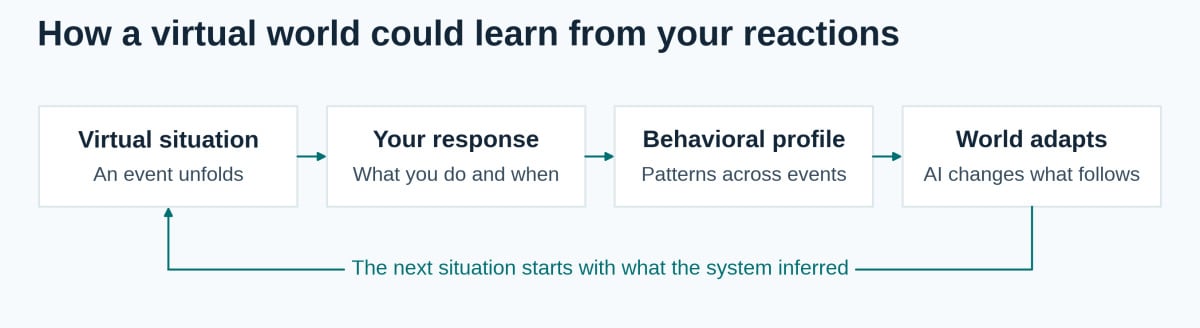
In Humanity’s Next Operating System I wrote, “VR becomes the homeland of legacy humanity.” I meant that billions of people could end up spending much of their lives in virtual worlds as AI takes over more of the physical economy. People could earn money, go to school, own property and belong to communities in worlds companies own and AI administers. Your body can be in one jurisdiction while most of what you care about is happening someplace else. Then who makes the rules where you actually live, and how much of what you do there follows you back out? Humanity’s Next Operating System
If your income comes through that world, your friends are there, and you’ve bought property in it, walking away starts to look like leaving a town and losing everything you can’t carry with you. Who gets to move a balance, a reputation or a piece of property to another place? The company can set the rules for what you own and what follows you when you leave.
Go back to the comments for a minute. I was asking people to look at how their reaction was being produced. A lot of them decided which team I was on and responded to that. Now think about making decisions on employment, access, and the use of machines with the same habit. If we’re going to live with these systems, we’d better pay attention to what they’re being used to decide, who benefits from having them decide it, and how much room people have to say no once the decision has been built into everything around them.
Pattern Nexus Lens
What Would Make Me Move the Dates?
For the 18-month call, watch ordinary work. I want tests across the kinds of jobs and industries where people actually spend their hours, with results people can use and a bill that includes review and retries. If the best systems are still taking over a minority of that work by around May 2028, the majority call missed. If software can do more of it than a company can deploy, keep tracking both clocks.
For robots, watch what the customer does after the trial. I want operating hours, accepted output, the hours people spend taking over from the machine, and orders to run the same job at another site. Faster shipment numbers alongside a pile of stalled trials would move my deployment timeline out.
For the VR claim, follow an actual decision. What gets attached to your account? Who can get the profile, and what did they decide with it? There’s a lot to learn from a privacy policy. The threat-scoring forecast would take evidence that gameplay data was actually used to make that kind of judgment. [59]
Research Method
How I’m Reading the Evidence
The first figure is the 80% projection image I was reacting to. Its lines are alternative fits, and its red markers are prior estimates. For the second figure I used the model points and 95% intervals in METR’s November 20 Figure 10 data. That is the combined TH1.1 and TH2 50% benchmark. The 32-hour example is one hour multiplied by two to the power of 18 divided by 3.6. [21][22]
The factory chart uses the IFR’s annual industrial installation series. The humanoid section uses the separate first-half shipment trackers from IDC and Counterpoint. The warehouse dates and tote count are company-reported. The Leipzig photo is from BMW. The feedback diagram shows the scenario I’m describing for AI and virtual worlds. [38][41]
The source packet includes the data behind the benchmark and installation charts, the rollout dates, the source links, and the dated archive of Pattern Nexus research I drew on.
Reader Questions
Frequently Asked Questions
What does the 18-month forecast cover?
I’m making a call about the ability to take on the majority of existing work as measured in task hours around May 2028. How companies deploy that capability and what happens to headcount are subsequent questions.
What does a 40-hour METR time horizon mean?
At that 50% threshold, METR estimates that GPT-6 Astra could complete half of the benchmark tasks that take a human expert roughly 40 hours. The chart shows uncertainty around the estimate and tracks human task duration.
What should I watch for in humanoid robotics?
Watch what happens once the demo ends. Look for paid work, completed output, interventions, cost per accepted task, and the same system being added to more sites.
What is the GTA VI and VR forecast?
Take-Two describes collecting gameplay and combining it with other data. My forecast is that games and adaptive virtual worlds will be used to form deeper behavioral profiles, including judgments about crisis behavior and threat, with consequences for people outside the game.
Research Links
Research and Data Sources
The primary releases, benchmark records and earlier Pattern Nexus research cited above.
- Tribalism as a Control System
- Entman on media framing
- Partisan bias review
- The Script, the Circus, and the Rails
- The Age of Algorithmic Influence
- The AI Wars Are Human Wars
- Why Most People Won’t Adapt to AI
- A Long Arc of Intelligence
- The Command Line
- McCulloch and Pitts
- Dartmouth AI history
- MIT Lincoln Laboratory on SAGE
- 2017 transformer paper
- 2022 AI ethics paper
- The AI Causal Chain
- The AI Is the Same. The System Isn’t
- We Don’t Even Understand How Humans Think
- The Pattern Exercise
- GPT-6.2 release notes
- METR time horizons
- METR November 20 update
- Figure 10 data
- OpenAI’s November release results
- The End of Human Primacy
- The Universal Intelligence Economy
- AI Isn’t a Bubble
- The New Industrial Backbone
- The Convergence
- OpenAI’s research activity report
- The Real Reason They Are Building Humanoid Robots
- BMW pilot results
- BMW’s Leipzig pilot
- The Hidden Boom
- Robot Builders of Artemis
- NASA lunar construction program
- Pew smartphone ownership
- IFR World Robotics 2026
- IFR data
- IDC shipments
- Counterpoint shipments by use
- GXO and Agility announcement
- Figure’s BotQ production update
- The Two- or Three-Speed Economy
- The 52-Cent Economy
- Two Economies, One Balance Sheet
- The Two-Tier Future
- The Recession Path
- Humanity’s Next Operating System
- The Surveillance State
- The Permission Stack
- NASA space station facts
- UN on voluntary isolation
- FTC data practices report
- Data Gravity
- Algorithmic Authority
- AI Feedback Loops
- The Internet Was Wild
- Rockstar’s launch announcement
- Take-Two’s privacy policy
- USENIX study of VR motion data
- The Digital Mind Divide
- The Fractured Mirror
- Shadows of Influence
- LifeLog Died. Facebook Launched
- The Permitted Memory of the Past
- High-Tech, High Complexity
- The First AI Age
- Toward Mind Uploading
- They Put a Fly Brain in Minecraft
- What Happens Next?
- Engineering as Destiny
- The Modern Control System
- America’s New Map of Power 2026
- The World I’ve Been Mapping Is Taking Shape
- The Architecture of Resilience
More Pattern Nexus Research
Media and Social Division
The Digital Mind Divide · The Fractured Mirror · Shadows of Influence · LifeLog Died. Facebook Launched · The Permitted Memory of the Past
AI History and Human Adaptation
High-Tech, High Complexity · The First AI Age · Toward Mind Uploading · They Put a Fly Brain in Minecraft · What Happens Next?
Robotics Power and Ownership
Engineering as Destiny · The Modern Control System · America’s New Map of Power 2026 · The World I’ve Been Mapping Is Taking Shape · The Architecture of Resilience
Complete Pattern Nexus AI research index
Open the dated Pattern Nexus index of 197 articles and companion pieces
AI research and applications
- 2026-11-08 · What Happens Next? What Do You Actually Want to Know—and Why?
- 2026-11-08 · Griffin-1: The Race for a Lunar Foothold
- 2026-10-28 · The Space Buildout Is Becoming Real: Starship Reaches Orbit, Artemis Rewrites the Moon Plan, Orbital AI Goes Live, and Mars Infrastructure Expands
- 2026-10-24 · We Don't Even Understand How Humans Think. How Can We Understand Artificial Intelligence?
- 2026-10-17 · The Recession Path: How Income, Investment and Credit Can Turn a Technology Boom Into an Economic Reset
- 2026-10-05 · The World I’ve Been Mapping Is Taking Shape
- 2026-09-25 · The Two-Tier Future: War, Demand Destruction, AI, and the Price of Remaining Free
- 2026-09-23 · The Space Infrastructure Race Has Entered Its Next Phase: Weapons, Orbital AI, Sovereign Networks, and the Moon
- 2026-09-23 · The AI Causal Chain Explained Like You're Five: From Cold War Radar to Robots and the Economy
- 2026-09-21 · The Real Reason They Are Building Humanoid Robots: The End of Human Labor as the Foundation of the Economy
- 2026-09-19 · They Put Human Neurons in a Data Center. Now the Servers Have to Be Fed.
- 2026-09-18 · They Put a Fly Brain in Minecraft. The Mind-Uploading Pipeline Is No Longer Hypothetical.
- 2026-09-11 · The AI Is the Same. The System Isn’t: How Long-Term Use Creates a Shared Language
- 2026-09-06 · The Internet Was Wild: From AOL to AI, How 25 Years Built the Digital Control Layer
- 2026-08-31 · Space Is Becoming Infrastructure: The Two Weeks That Exposed the New Orbital Operating System
- 2026-08-26 · What’s Happening to Our World? AI, Agenda 2030, and the Control System Built in Public
- 2026-08-20 · From Liquidity Storm to Chokepoint War: Auditing 472 Pattern Nexus URLs — What Landed, What Missed, and What Comes Next
- 2026-08-10 · The Universal Intelligence Economy: AI, Robotics, Jobs, Money, and the 2030–2035 Transition
- 2026-07-27 · Why Artificial Intelligence needs an ethical approach.
- 2026-07-24 · The System Repriced in 30 Days: Dual Chokepoints, Tariff Inflation, AI Cash Burn, and the Return of the War Economy
- 2026-07-08 · The Surveillance State: Does Humanity Need a Nanny?
- 2026-07-08 · Fed Minutes: The Cut Trade Broke Because Inflation Has More Than One Engine
- 2026-06-27 · Fragmented Society: The Elites Don’t Think Like You, and the Elites of the Elites Don’t Think Like Them
- 2026-06-13 · The Older Signal: Lost Civilizations, Broken Archives, and the Pattern Beneath Human History
- 2026-06-01 · The Permitted Memory of the Past
- 2026-05-30 · America’s New Map of Power 2026: Data Centers, Grid Triage, and the Backlash That Will Not Stop the AI Buildout
- 2026-05-29 · Pattern Nexus Framework: How to See the Hidden Architecture of the Modern World
- 2026-05-24 · LifeLog Died. Facebook Launched. The Surveillance Internet Was Born.
- 2026-05-18 · The New Fed Chair Does Not Inherit an Economy. He Inherits the Permission Stack.
- 2026-05-17 · Spruce Pine Quartz: The Hidden Bottleneck Under Chips, AI, Solar, and the Modern World
- 2026-05-14 · The Trap of Reality: Consciousness, the Observer, and the Field Layer Beneath Spacetime
- 2026-05-11 · War, Backlash and Build‑Out: The 2026 AI Data Center Report
- 2026-05-07 · The Headline Is Late: How Pattern Nexus Mapped the Chokepoint War Before Hormuz Became Visible
- 2026-04-04 · The Script, the Circus, and the Rails
- 2026-03-17 · The End of Human Primacy: By 2030, the Handoff May Be Underway
- 2026-03-11 · 2026 Landlord Outlook: Cautious Optimism, Multifamily Strength, and the New Housing Map
- 2026-02-17 · AI Data Centers Are an Inflation Engine: The Race to Build a Private Grid
- 2026-02-16 · The Quartz Chokepoint: Silica, Semiconductors, Solar, and the Quiet Resource That Runs the Modern Machine
- 2026-02-01 · The Modern Control System: Eurodollars, Sanctions, Tokenization, and the Enforcement Stack
- 2026-01-31 · The Pattern Exercise: AI Workflow Collapse in 11 Minutes
- 2026-01-31 · GW Ranch: Texas Builds Private Grids for the AI Flywheel
- 2026-01-25 · Engineering as Destiny: Musk on AI, Robotics, Energy, Space — and the Rail-Building Phase
- 2026-01-24 · The Permission Stack: Narrative, Rails, Standards, Identity, and Continuity in the Age of Control Systems
- 2026-01-24 · Escape Velocity: Where Control Breaks, Fractures, or Gets Redesigned
- 2026-01-17 · Elon Musk’s Long-Term Vision: An Integrated Blueprint for a Multiplanetary Future
- 2026-01-14 · Energy Isn’t Spiking, Utilities Are: AI Baseload, Gas Turbines, and the Reprice of Energy Services
- 2026-01-13 · The Silent Currency War: Containment, Collateral, and the 2030 Regime Window
- 2026-01-12 · Algorithmic Authority: Scoring Systems, Risk Models, and Invisible Veto Power
- 2025-12-31 · Google’s CO2 Battery Bet: Why AI Data Centers Are Pulling Long-Duration Storage Out of the Lab and Onto the Grid
- 2025-12-28 · Data Gravity
- 2025-12-26 · Compute Control
- 2025-12-25 · The Pattern Nexus Framework: How Modern Systems Actually Work
- 2025-12-21 · The AI Wars Are Human Wars
- 2025-12-21 · Energy Control- Grid Interdependence, Fuel Corridors, and Blackout Leverage
- 2025-12-19 · America’s New Map of Power: Mega-Regions, AI Data Centers, and the Re-Industrialization of the Midwest
- 2025-12-16 · Elon Musk at $600 Billion and the Birth of the First Megacorp
- 2025-12-13 · Power Without Permission - Why Control Systems Replaced Sovereignty
- 2025-12-11 · Trump Signs Sweeping AI Executive Order: Federal Preemption, State Law Crackdown, and the New AI Power Stack
- 2025-12-11 · Oracle Financial Health & Collapse Risk – December 2025
- 2025-12-10 · The Convergence: AI, Energy, and the Final Liquidity Regime (2020–2045?)
- 2025-12-08 · The Fiscal-Monetary Fusion: Pandemic Money, Inflation Whiplash, and the Militarized Liquidity Regime (2020–2025)
- 2025-12-08 · NextEra’s 30-Gigawatt Bet: AI Data Centers Just Forced a Utility Supercycle
- 2025-12-07 · The New Monroe Doctrine: How the 2025 National Security Strategy Confirms the Western Hemisphere Pivot, Digital Dollar Realignment, and the Coming Global Reordering
- 2025-12-04 · The Command Line: How Cold War Compute, Early AI, and Silicon Valley’s Birth Turned Information Into Power (1956–1969)
- 2025-12-03 · Copper in the AI-Industrial Era: Why the World Is Running Out of the Metal That Powers Everything
- 2025-12-01 · The First AI Age: How the 1870–1914 Industrial Supercycle Built the Modern World — And Why 2025–2035 Rhymes With It.
- 2025-11-30 · The Hidden Boom: The U.S. Is Quietly Building the Largest Industrial Expansion Since WWII — And It’s Creating $100K+ Careers Overnight
- 2025-11-27 · Recessions Aren’t the Crisis — They’re the Trigger
- 2025-11-26 · Macro Cosmogony Map — The Complete Pattern Nexus Liquidity Framework
- 2025-11-25 · Small Modular and Micro‑Reactors (SMRs) for AI and Data‑Centre Power: global technologies, companies and deployment outlook
- 2025-11-23 · A Long Arc of Intelligence: How 80 Years of Engineering Created Modern LLMs
- 2025-11-21 · New Glenn 9×4: Blue Origin’s Super-Heavy Engine for the Coming AI Space Economy
- 2025-11-20 · Why Pattern Nexus Exists: The Missing Lens for Macro, AI, and Markets
- 2025-11-20 · The Patent Illusion: Why the U.S. Still Leads the AI Race (and Why That Tsinghua Chart Is Misleading)
- 2025-11-19 · QE 2026, AI, and the Cost of Everything: Why Your Life Is Getting More Expensive
- 2025-11-18 · What Breaks First? A Speculative Walkthrough of System Stress Beneath 2025
- 2025-11-16 · Google’s Space-Based AI Data Center Gambit: Project Suncatcher and the New Compute Frontier
- 2025-11-13 · Robot Builders of Artemis: How NASA’s Autonomous Construction Fleet Will Build the First Moon Base
- 2025-11-13 · America’s New Map of Power: Data Centers, Grid Shortfall, and the AI Industrial Build-Out
- 2025-11-12 · The Two- (or Three-) Speed Economy: Automation Is Fracturing Growth — Why MMT-Style Tools Become Inevitable
- 2025-11-12 · AI Compute and Power Infrastructure in 2025 — The New Industrial Backbone
- 2025-11-11 · Toward Mind Uploading in an Era of Exponential AI Acceleration: A Detailed Roadmap and Prospects for 2025–2050 and Beyond
- 2025-11-11 · AI’s Nuclear Backstop: Trump Admin to Lend “Hundreds of Billions” for Nuclear Power Plants to Meet AI Demand
- 2025-11-08 · Tokenized Reserve Era: AI Industrial Dominance and the New Operating System of the World Economy (1980–2040)
- 2025-11-07 · Humanity’s Next Operating System: AI, Divergence, and the 100-Year Transformation of Civilization
- 2025-11-03 · Pattern Nexus Worldview Manifesto: The Turning Has Begun
- 2025-11-03 · AI Isn’t a Bubble — It’s a Monetary-Industrial Engine
- 2025-10-28 · The $550 Billion Pivot: How the U.S.–Japan Alliance Is Re-Wiring Global Power
- 2025-10-27 · Why Hard Work Won’t Save Gen Z in the AI Era
- 2025-10-23 · The Cycles of Power: From Regime Change to Digital Dominion – How Empires Evolve in the Age of AI
- 2025-10-22 · AI Feedback Loops: How Self‑Reinforcing Systems Quietly Shift Power
- 2025-10-21 · High-Tech, High Complexity: How AI’s Rapid Rise Is Leaving Society Behind
- 2025-10-18 · 🧠 The Digital Mind Divide: How Algorithms Are Rewiring Human Values
- 2025-10-18 · ⚛️ Big Tech’s Fusion Bet: How AI’s Energy Demand Is Rewriting Physics
- 2025-10-18 · Why Most People Won’t Adapt to AI — and Why Polymaths Will
- 2025-10-18 · The Fractured Mirror: Humanity in the Age of Algorithmic Identity
- 2025-10-18 · The Age of Algorithmic Influence: How Technology Rewired Human Behavior
- 2025-10-18 · Shadows of Influence: The New Age of Digital Geopolitics
- 2025-10-18 · Exponential Minds and Simulated Realities
Related economic, industrial and social analysis
- 2026-11-01 · The Million-Dollar Economy: When Everybody Has More Dollars but the Dollar Buys Less
- 2026-10-25 · The Quantum Animal: Are We Underestimating How Life Perceives the Universe?
- 2026-10-19 · A Thought Experiment: Consciousness
- 2026-09-16 · Paul Walker and God’s Eye: The Films, the Surveillance State, the Deaths, and the Pattern Nobody Maps Together
- 2026-09-15 · Space Was Becoming Infrastructure. Now It Has a Weapons Layer: The U.S. Confirms On-Orbit Space-Control Weapons
- 2026-09-09 · Two Economies, One Balance Sheet: The Unstable Barbell of 2026
- 2026-09-03 · The Space Infrastructure Race Just Escalated: PALLAS-1, Orbital Warfare, and NASA’s Mars Network
- 2026-07-19 · The 52-Cent Economy: Where the American Output Dollar Actually Goes
- 2026-07-08 · The Synthetic Cell Threshold: Programmable DNA and the Beginning of Built Life
- 2026-06-19 · Peak Insanity: Pure Speculation on a World That No Longer Organizes Itself
- 2026-05-25 · When Crime Becomes Content: The Influencer Economy and the Collapse of Social Deterrence
- 2026-05-17 · The Scientist Layer Is Getting Fragile: Amy Eskridge, Missing Researchers, China’s Strategic Death Cluster, and the Knowledge Bottleneck Beneath Modern Power
- 2026-05-14 · The War Economy Is Not Coming. It Is Being Built in Public.
- 2026-05-09 · Yuri Bezmenov Was Not Talking About Politics. He Was Describing System Capture.
- 2026-05-05 · Interest Rates, Recession, and the Current Environment
- 2026-05-03 · State Street and the Hidden Operating System of Modern Finance
- 2026-04-11 · Why I’ve Been Quiet
- 2026-03-31 · March Ends With the System Showing Its Seams
- 2026-03-26 · NASA’s Moon Base, MoonFall, Nuclear Missions, and the Drone Layer of Mars
- 2026-03-08 · The World Is Not Normal Anymore
- 2026-02-26 · Feb 26, 2026 Tape: Nvidia Blinks, Tariff Chaos Returns, and the Curve Quietly Flattens
- 2026-02-19 · Feb 18, 2026 Tape: AI Bid, Oil Risk Premium
- 2026-02-15 · The Regime Reset Stack: Yield Curve Strategy, Dollar Rails, Metals Convexity, and the AI-Fiscal Endgame
- 2026-02-13 · The Signal Under the Noise: The Perennial Pattern and the Modern Machine
- 2026-01-25 · The State-Capital Stack: CHIPS-to-Equity, Rare Earths, and the U.S. Ownership Turn
- 2026-01-19 · Mouse Utopia in the Age of Gen Z: When Abundance Kills Purpose
- 2026-01-12 · Tribalism as a Control System — From Rome and Pharaohs to 2026
- 2026-01-12 · January 12, 2026: Metals Break Out, AI Leaders Grind Higher
- 2026-01-10 · The World We Woke Up In: January 2026 and the End of Shared Reality
- 2026-01-06 · Moon Base Alpha: Why the Moon Is Becoming Infrastructure
- 2026-01-05 · The Six-Month Signal: When Silver Leads, Semiconductors Follow, and Gold Confirms
- 2025-12-31 · Happy New Year 2026: Rate Cuts, Yield Control, Asset Rotation, and the Next Phase of Managed Liquidity
- 2025-12-27 · Why Silver Terrifies China: Velocity, Manufacturing Fragility, and the Limits of Control
- 2025-12-27 · Quantum Control, Cryptographic Risk, and the Energy Stack
- 2025-12-24 · Scale Is Destiny: Why China Didn’t Pass the U.S. — and Why That Matters
- 2025-12-23 · The Household Maintenance Recession: America Is Falling Apart Quietly
- 2025-12-17 · ADP Just Printed a Split Labor Market: Small Firms Cut, Mid/Large Firms Hire
- 2025-12-16 · Markets Catch Up to the Narrative: Jobs Noise, AI ROI Reality, and the Liquidity Repricing
- 2025-12-16 · Market Wrap – December 16, 2025: Delayed Jobs Print, Energy Weakness, AI Leadership Holds as the Curve Reprices Quietly
- 2025-12-12 · Market Wrap December 12, 2025: AI Leadership Breaks as Long Yields Stay Bid
- 2025-12-11 · Market Wrap – December 11, 2025: Post-Cut Melt-Up, Oracle Shock, and a Stubborn Front End
- 2025-12-10 · December 10, 2025: QT Ends, QE-Lite Begins
- 2025-12-09 · The K-Shaped Recovery: Why the Bottom Half Can’t Survive Without Subsidies
- 2025-12-07 · The QE Decade: How Central Banks Took Over the World, Asset Prices Broke Free, and the Digital Dollar Foundations Were Laid (2008–2019)
- 2025-12-07 · Did Jerome Powell Plan a $45 Billion T-Bill Buying Program? A Pattern Nexus Investigation
- 2025-12-06 · The Housing Collateral Engine: How Shadow Banking, China, and the Fed Turned Mortgages Into Global Money (2001–2008)
- 2025-12-05 · Half-Century Mortgages and Fantasy Car Loans: How Ultra-Long Debt Turns Households Into Cashflow Collateral
- 2025-12-04 · The Asian Liquidity Supercycle: How Deregulation, Dollar Flows, and the Tech Boom Rewired Global Finance (1994–2001)
- 2025-12-03 · The Leverage Machine: How Volcker, Deregulation, and Wall Street Turned Money Into Momentum (1979–1994)
- 2025-12-03 · Record Holidays, Fragile Foundation: Black Friday 2025 vs the ADP Labor Shock
- 2025-12-03 · Port Alpha vs the Shipyard Graveyard: How a Three-Year-Old Startup Is Trying to Rebuild the U.S. Navy With Autonomous Warships
- 2025-12-01 · NAR’s 2026 Housing Boom Fantasy: Why a 14% Rebound Requires a Liquidity Intervention
- 2025-11-29 · ECB Financial-Stability Warning: Why Near-Zero CISS Is Dangerous
- 2025-11-26 · Market Wrap – November 26, 2025: Thanksgiving Melt-Up as Yields Slip, AI Leads, and Crypto Goes Vertical
- 2025-11-24 · Money Is Not What You Think: Debt, Time, Energy & the Hidden Mechanics of Power
- 2025-11-23 · Week Ahead: Markets, Data & Macro Risks (Nov 24–30, 2025)
- 2025-11-21 · Star Catcher Just Broke DARPA’s Record — The Hidden Industry About to Reshape Global Energy
- 2025-11-20 · Risk-Off With No Headline: 11/20/2025 Market Wrap
- 2025-11-20 · Jobs on Pause: September 2025’s Delayed Report and the Great Employment Plateau
- 2025-11-19 · Market Wrap – November 19, 2025: Nvidia Crushes Earnings, AI Flywheel Accelerates, and the 10-Year Tightens Again
- 2025-11-18 · The Gravity Zone: How the 10-Year Treasury Revealed the Real Neutral Rate
- 2025-11-18 · Market Wrap – November 18, 2025: Tech Cracks, Oil Holds, and the 10-Year Drifts But Doesn’t Break
- 2025-11-16 · When Money Breaks: Free Banking, Weimar, and the AI–Industrial Dollar Regime
- 2025-11-13 · Market Wrap-Up — November 13, 2025: Red Tape, Strong Dollar, and a Fed That Markets Still Expect to Blink
- 2025-11-12 · The Hidden Liquidity Crunch: Repo Stress, QT’s End, and the Dollar’s Trap
- 2025-11-11 · G4 Geomagnetic Storm Threatens the U.S. Power Grid — And Exposes a 20-Year Infrastructure Problem
- 2025-11-11 · ADP Weakness, Dollar Break: Labour → Liquidity → Repricing (Nov 11, 2025)
- 2025-11-10 · The Next Recession: What Outperforms and Why (2026–2030 Analysis)
- 2025-11-05 · Markets Sway as Tech Recovers, Bonds Rise, and Shutdown Risks Persist — Nov 5, 2025
- 2025-10-20 · Stocks Rally, Gold Surges and Global Signals Diverge: A Comprehensive Look at October 20 2025
- 2025-10-19 · The Myth of Collapse: Why the Future Doesn’t End Like the Past
- 2025-10-18 · The Illusion of Ownership: How Leverage and Liquidity Redefined the Middle Class
- 2025-10-18 · The Architecture of Resilience: Building What Can’t Be Taken
- 2025-10-17 · The Nexus Begins: Building the Framework for What Comes Next
Companion editions, polls and archive references
- 2026-11-18 · The Myth of Collapse — Audio-Video Edition
- 2026-11-04 · The Architecture of Resilience — Audio-Video Edition
- 2026-10-27 · Humanity's Next Operating System — Audio-Video Edition
- 2026-10-12 · The Convergence — Audio-Video Edition
- 2026-10-05 · The Fiscal-Monetary Fusion — Audio-Video Edition
- 2026-09-26 · The QE Decade — Audio-Video Edition
- 2026-09-19 · The Housing Collateral Engine — Audio-Video Edition
- 2026-09-13 · The Asian Liquidity Supercycle — Audio-Video Edition
- 2026-09-07 · The Leverage Machine — Audio-Video Edition
- 2026-08-30 · The Monetary Break — Audio-Video Edition
- 2026-08-25 · The Command Line — Audio-Video Edition
- 2026-08-16 · The Dollar Fortress — Audio-Video Edition
- 2026-08-08 · The First AI Age — Pattern Nexus Audio-Video Edition
- 2026-07-30 · Pattern Nexus Macro Archive: 328 Timestamped Articles, October 2025–July 2026
- 2026-07-26 · Pattern Nexus Worldview — Full Digital Edition
- 2026-07-24 · The 2026 System Pressure Poll: Where Are America and the World Actually Going?
- 2026-04-06 · AIXI
- 2025-11-24 · Pattern Nexus Podcast Episode 1 — Mapping the Systems Beneath the World
- 2025-11-12 · What is the REAL currency of the future?
Additional articles under the early Pattern byline
- 2025-10-31 · The Systemic Realignment: Digital Sovereignty, Multipolar Liquidity & The End of Old Alliances
- 2025-10-30 · Mass Layoffs: The Big Cuts of Sep–Oct 2025
- 2025-10-28 · U.S. Administration Investments in Nuclear Companies (2025)
- 2025-10-28 · Alone Together: The Dual Impact of the Internet and AI
- 2025-10-27 · The Illusion of Relevance: Streamers, TikTok, and the Fractured Reality of the Online World
คุณมีปฏิกิริยาอย่างไร?
 ชอบ
0
 ไม่ชอบ
0
 รัก
0
 ตลก
0
 ว้าว
0
 เศร้า
0
 โกรธ
0

Nexus (Christopher)
Founder of Pattern Nexus. I research markets, macro, geopolitics, AI, history, ancient systems, and the patterns most people overlook. I’m also building Market Radar, a trading scanner designed to read pressure, risk, confirmation, and setup quality before ch…
Related research
What Happens Next? What Do You Actually Want to Know—and Why?
People ask me what happens next. I want to know what they intend to do with the answer. A personal reflection on the research, the work, th…
3 shared assets.
From Liquidity Storm to Chokepoint War: Auditing 472 Pattern Nexus URLs — What Landed, What Missed, and What Comes Next
I audited the public Pattern Nexus record across 472 unique URLs and the saved full-text article export, then rebuilt the major calls from …
2 shared topics, 3 shared assets, same research avenue.
Pattern Nexus Macro Archive: 328 Timestamped Articles, October 2025–July 2026
A guided public index of 328 timestamped Pattern Nexus articles covering Federal Reserve liquidity, interest rates, the dollar, gold and si…
3 shared assets.
The World Is Not Normal Anymore
A broad system-level look at the Middle East war, markets, money, Bitcoin, AI, control systems, and why the world order now appears to be s…
2 shared topics, 2 shared assets.
The Regime Reset Stack: Yield Curve Strategy, Dollar Rails, Metals Convexity, and the AI-Fiscal Endgame
A Pattern Nexus control-systems read tying the yield curve, dollar regime, metals, crypto, and equities into one machine: why inversions le…
2 shared topics, 2 shared assets.
Market Wrap – December 11, 2025: Post-Cut Melt-Up, Oracle Shock, and a Stubborn Front End
Daily Pattern Nexus market wrap for December 11, 2025: index melt-up after the Fed’s first asset-purchase move, Oracle’s AI-spend shock, ra…
3 shared assets.
December 10, 2025: QT Ends, QE-Lite Begins
The Fed cut rates by 25 bps, acknowledged rising downside risks to employment, and quietly ended QT by initiating short-term Treasury purch…
3 shared assets.
Daily Market Wrap-Up – December 9, 2025
Markets pushed through a cautious session as the first full day of the Fed meeting began. Treasury yields climbed, equities wobbled, crypto…
3 shared assets.
ความคิดเห็น (0)
Security Check
Please complete the captcha to verify you are human.