

What Happens Next? What Do You Actually Want to Know—and Why?
People ask me what happens next. I want to know what they intend to do with the answer. A personal reflection on the research, the work, the systems we live inside, and the lives we are trying to bui…
- When you ask me what happens next, I want to know what you intend to do with the answer.
- My forecasts, revisions, business experience, and research all belong to the same effort: understand how the world works and make better decisions inside it.
- Money, wealth, ownership, and access to cash are different things. I want people to understand how each affects their choices and their time.
- Energy, AI, financial infrastructure, weather, history, and institutional incentives meet in the circumstances of ordinary lives.
- This reflection connects 143 distinct Pattern Nexus articles and the book page. Follow the subject that affects your life, then examine the evidence for yourself.
People keep asking me, “What happens next?” My question back is, “What do you actually want to know — and why?”
The question
What do you mean when you ask me what comes next?
The process
Read the work. Challenge the assumptions. Examine the sources.
The purpose
Use what you understand to improve your own life and legacy.
What do you mean when you ask me what happens next?
People ask me, “What happens next? Where does this go from here? Where do you see this going? Where do you see that going?”
And I ask you: What do you mean?
That's my question to you. What do you actually want to know? And why?
Is it so you can project anger or blame? Is it so you can use the information to better your life? And I mean better your life in a positive way. Build something. Understand something. Give yourself more options. It doesn't all have to be about preparing for whatever terrible thing somebody says is coming.
Can you use the information to better your own legacy, your own life, your family, your children's lives? Can you leave them with a little more understanding and a little less dependence on somebody else explaining the world to them?
Or do you just want another thing to argue about?
I can give you an answer. You probably won't believe parts of it. But before we spend an hour arguing over the answer, I'd like to understand what you're trying to gain from the conversation.
That question has been underneath this website from the beginning. In The Nexus Begins, I described a place where economics, real estate, technology, and human behavior could be examined together. In Why Pattern Nexus Exists, I explained why covering each of those subjects in isolation kept leaving out the relationships I was trying to show people.
The Pattern Nexus framework is the larger picture. Money moves through institutions. Institutions depend on energy, infrastructure, rules, and human cooperation. People's behavior changes the way those institutions work. Technology changes the available choices. None of those things stops at the boundary of the category somebody put it in.
And the Worldview Manifesto puts a responsibility on the person reading: understanding something should change what you're capable of doing with it.
So if you're asking me what happens next, I want to know where you stand inside the question. Are you a worker worried about your job? A parent thinking about your children? A person trying to build a business? Somebody trying to understand why a growing account balance doesn't seem to buy a better life?
Those are real questions. We can do something with those.
I can give you a prediction. Then what?
I regularly make accurate predictions across a wide range of subjects. I have the articles where I said what I expected, and I have articles where I went back and examined what happened afterward. What I got right. What I got wrong. What hadn't resolved yet.
You don't have to assemble all of that from screenshots of Facebook comments. The 328-article macro archive preserves a dated path through the work. The later audit of 472 Pattern Nexus URLs separates the major calls into outcomes you can actually inspect. There are original arguments, updates, partial successes, misses, and open questions.
I'm rarely wrong when I've worked through a subject to the point where I'm ready to reach a conclusion. And this isn't supposed to be a bragging thing. It's because I try to have as much information as possible before I make that conclusion. When I get it wrong, I want to know which part I missed.
The audit records the early liquidity turn, the gold repricing, and the Venezuela and Iran escalation sequences among the major successful parts of the framework. Those weren't all the same subject. They were different systems with dependencies I was tracking before the outcome became the headline. The original dates and the later follow-ups are there together.
The audit includes a very clear example: my expectation that the 10-year Treasury yield would fall below 3% did not happen in the period being evaluated. That remains a miss. An eventual decline somewhere in the future would not retroactively fix the timing of the original call.
The gold and 10-year follow-up examines that problem directly. It separates the gold thesis from the rate path and asks what war-related pressure changed. My earlier work on fiscal dominance and a sticky term premium had already described reasons the long end might resist the Fed. I had to account for that tension inside my own framework.
And in the September Fed follow-up, I revisited both the immediate call and the assumptions about how much tightening policymakers would tolerate. That is part of the job. You don't get to publish a model of the world and then refuse to look at the parts the world didn't follow.
I am confident because I've done the work. I'm also constantly questioning the work. Those things happen together.
The broader argument in The Headline Is Late is about following a developing structure before it becomes an obvious headline. The World I've Been Mapping Is Taking Shape follows those connections into AI power, energy, settlement systems, robotics, and ownership. Read the earlier work beside the later developments. That's how you can decide whether the connection was there beforehand or whether somebody is explaining it after the fact.
But suppose you decide I got a particular call right. Okay. What did that do for you?
Did you understand a risk sooner? Did it change an assumption in your business? Did you stop treating one headline as the whole story? Or did you just add another person to the list of people you expect to tell you the future?
I would much rather you learn to see part of the process yourself.
I like finding out where I'm wrong
I know I can be wrong. I'm okay with being wrong. I like being wrong, because finding the mistake gives me something I didn't have before.
Usually, the part that bothers me is the information I failed to account for. I reached a conclusion with an assumption sitting underneath it, and that assumption was incomplete or incorrect. Then I get annoyed with myself for not recognizing the gap earlier.
I'm constantly questioning and thinking about my thinking. Where am I filling something in? What am I treating as established because it fits the rest of the picture? What information would change the conclusion?
That can turn into a whole lot of mumble jumble when I try to explain it out loud. There is a practical version of it, though, and you can see it in the research.
The LCI framework white paper put a liquidity model into equations and a method somebody could inspect. The plumbing update worked through data alignment and the inputs. The July reconstruction then narrowed the original claim: liquidity belonged in the explanation, but the earlier absolute wording went further than the tests justified.
A chart can look convincing because two things trend over time. A relationship can weaken when you change the sample, account for publication delays, or test a different period. If the relationship disappears when you ask a harder question, that is useful information. Putting more decimals on the original result won't fix it.
The same process appears in The Sun, Liquidity, and Financial Turning Points. The short-horizon tests failed. Changing the question to longer cycles produced other things worth investigating, but a different question requires its own test. Then the 375-year reconstruction confronted the amount of time covered by broad turning-point windows and the difficulty of comparing very different historical records.
I can remain interested in a possible relationship while refusing to call it a reliable forecasting clock. Interest is a reason to investigate. It isn't the result of the investigation.
That's also why you'll see me say “could,” “may,” or “under this scenario.” Sometimes I can identify pressure building without knowing which part of the system will give way first. Sometimes several outcomes remain possible because a decision hasn't been made yet.
I could remove all of that and write something more certain. It would be easier to read. It would also give you a worse understanding of what I actually know.
I see the system before I have the words for it
Most of the articles and creative work come from decades of research and pattern recognition. The thing that starts a particular article is often just a thought. A connection. A little candle going off in my mind, and then I want to find a way to represent it.
The information is already there. Getting it into a form another person can follow is the difficult part.
I've explained this more directly in We Don't Even Understand How Humans Think. How Can We Understand Artificial Intelligence? I don't think in sentences first. I think through spatial representations, systems, memories, movement, and possible outcomes. I can be holding relationships together that take a very long time to describe one paragraph at a time.
When I look at a building, I don't stop at the exterior. There are structural loads, water paths, wiring, ventilation, maintenance problems, and all the things that have to work together for it to function. A financial system gives me a similar problem: where does the flow enter, where does it go, what depends on it, and what happens if a connection fails?
Each system has its own rules. Tracing the dependencies gives me a way into it. Then I have to learn what actually governs the movement, where the weak points are, and what would happen if one part changed.
The AI Is the Same. The System Isn't describes part of the effort involved in translating that into language. A tool can help organize the expression, but it can also flatten the meaning. I have to keep correcting it when the polished sentence stops representing the thought.
Even the subjects that seem far away from economics belong to that effort to understand how things work. The Quantum Animal examines sensory abilities and forms of perception that don't fit inside ordinary human experience. A Thought Experiment: Consciousness asks how much of our explanation of reality comes from categories we invented. The Electrical Architecture of Life moves down into the energy transformations supporting a living body.
Those articles ask different kinds of questions. The biological mechanisms have evidence you can examine. The philosophical questions remain philosophical. Exponential Minds and Simulated Realities extends into speculative futures. I'm interested in exploring the possibilities, then finding where the evidence lets me go further.
I study across those boundaries because each subject can expose an assumption I didn't know I was making. I'm trying to enlarge the model, and then work out which parts of it can actually be tested.
I don't know what you already know
That is why I go long and deep and over-explain. I don't know your starting frame of reference.
If I say a change in collateral conditions can reach housing through the bond market, somebody already familiar with that system may follow immediately. Somebody else may be wondering what collateral even means, why a Treasury yield affects a mortgage, or why the Fed can't simply tell the whole market what rate to use.
I can explain all of those steps. But then somebody tells me the article is too long.
I regularly get called out for being over-technical, over-detailed, or over-complex. I'm trying to be cautious about it. I'm also trying to avoid handing you a sentence that sounds understandable while leaving out everything that would let you evaluate it.
Take A Long Arc of Intelligence. Following AI back through earlier computing, language models, and engineering changes the question from “Where did this chatbot come from?” to “What finally became possible when several long-running technologies met?” The AI Causal Chain explanation presents that history in more accessible language. It still takes time, because the history actually contains more than one step.
My original 2022 AI ethics paper is also in the archive. It's preserved as an earlier paper, with the limits of when it was written. You can compare the concerns about trust, bias, and accountability with the later work instead of assuming my interest in AI began when it became fashionable.
The reading effort matters even more when the subject is exciting. In the K2-18 b article, a possible atmospheric signal has to be separated from a declaration of life. In the Alba Mons hydrogen-chloride article, a gas detection, a proposed geological source, habitability, and organisms are different questions. The Mars-origin investigation explores possibilities without turning the possibility of transfer into proof that life on Earth came from Mars.
If I compress those steps into “They found life,” I've given you something easy to repeat and almost nothing useful to understand.
So yes, becoming knowledgeable requires reading. At some point you have to get past the clip, the headline, and the five-second explanation. Read what the source actually measured. Read the assumptions. Look at the data and the part that remains unresolved.
I use video and audio too. They're ways into the material. The audio-video edition of The Architecture of Resilience sits alongside the written work for that reason. But whatever format you start with, understanding still requires attention. No format does that part for you.
I built the business on a whim. I still had to make it work
I built a multi-million-dollar real estate business in about two years, almost on a whim. I built this website on a whim too.
That describes the moment I decided to build them. It doesn't describe everything required afterward.
The portfolio value isn't the amount of cash in my pocket. There are properties, debts, expenses, maintenance, people, and responsibilities. A business has to work through all of those things while you are also trying to improve it.
I've spent years working on physical buildings. I understand what it means when the roof leaks, when a repair takes longer than expected, or when a problem that looked small turns out to be buried inside something else. The paperwork can look clean while the building still has a problem. The spreadsheet doesn't repair it.
That's why DSCR Loans, Distressed Rentals, and Reality spends time on the things that can destroy the strategy. Financing is one part. Buying the right property, understanding the condition, keeping reserves, managing the work, and operating it afterward are also part of it.
And Building a Scalable Real Estate Portfolio treats real estate as an operating business. The cash-flow calculation has to survive vacancy, maintenance, insurance, taxes, debt service, and the work of managing people. A portfolio that grows faster than your ability to operate it can make you less free.
You can borrow money to buy an asset and still buy yourself a problem. You can also use knowledge, labor, and organization to improve something that somebody else couldn't make work. The difference isn't the slogan you use about debt. It's whether you understand what you're taking on.
The 2026 landlord outlook connects that practical work with changing conditions: financing costs, regional differences, operating pressure, and how owners adapt. A national headline doesn't tell you whether one particular property works at one particular purchase price with one particular loan.
For me, doing the physical work and studying the financial system are connected. The physical side teaches you where the assumptions break. The financial side helps explain why the same work can produce different results under different conditions.
That's the sort of knowledge I want people to gain from the website. You should be able to bring a better question to your own situation. You should be able to notice a cost somebody left out, a dependency nobody mentioned, or an opportunity that makes sense because you understand the work behind it.
Money, wealth, and the time you're trading away
Most people want money. Money lets you buy a coffee, pay the mortgage, make the car payment, and keep going.
When I talk about wealth, I'm talking about what sits behind the spending. What do you own? What can it produce? What obligations come with it? How much control does it give you over your time?
When you don't have wealth, you trade your time for money so you can survive. As you build resources that can support you, you can use money to buy some of that time back. That's the part I want people to understand.
Money Is Not What You Think approaches money through debt, time, energy, and institutional power. The Capital Ladder separates net worth, liquid capital, access to capital, and the ability to make that capital productive. Those are different measurements of a person's position.
Somebody can own substantial assets and keep relatively little money in an ordinary checking account. That doesn't mean wealth requires having no cash. It means the checking account alone doesn't tell you what resources they control. Likewise, a large account balance doesn't tell you how long a household could function without the next paycheck.
The Wealth-Engine Differential compares preservation with productive, leveraged ownership. Gold and a rental business don't give the owner the same set of responsibilities or possible returns. One price chart cannot explain cash flow, operating expenses, debt, and the value of having choices about when to sell.
Then The Illusion of Ownership asks how much freedom a nominally owned asset provides when continued possession depends on financing and rising costs. The Debt-Free Illusion challenges the idea that avoiding all debt and understanding debt are the same thing. Debt can support productive ownership, and it can destroy it. You still have to know what you're doing.
Debt Is Not Income explores why accessing an asset's value through borrowing differs from selling it. That difference doesn't erase the liability. Borrowed money has a cost, and the lender's conditions remain part of your life.
Someone gets a bonus and goes on vacation. You can do that. Or you could invest some of that money and potentially use the returns for future vacations. You could also lose it. The risk-reward calculation is the part I want you to be able to make, instead of treating every extra dollar as something that has to disappear immediately.
And I know that a person stuck in survival mode may not have room to take that risk. An emergency reserve can be the thing that keeps a repair from turning into a crisis. The point is to understand what each part of your money is doing.
The Million-Dollar Economy takes the question across generations. A bigger number can still represent fewer choices if the things you need become more expensive. I want to know what your money buys, how much of your life it costs to earn it, and whether that relationship is improving.
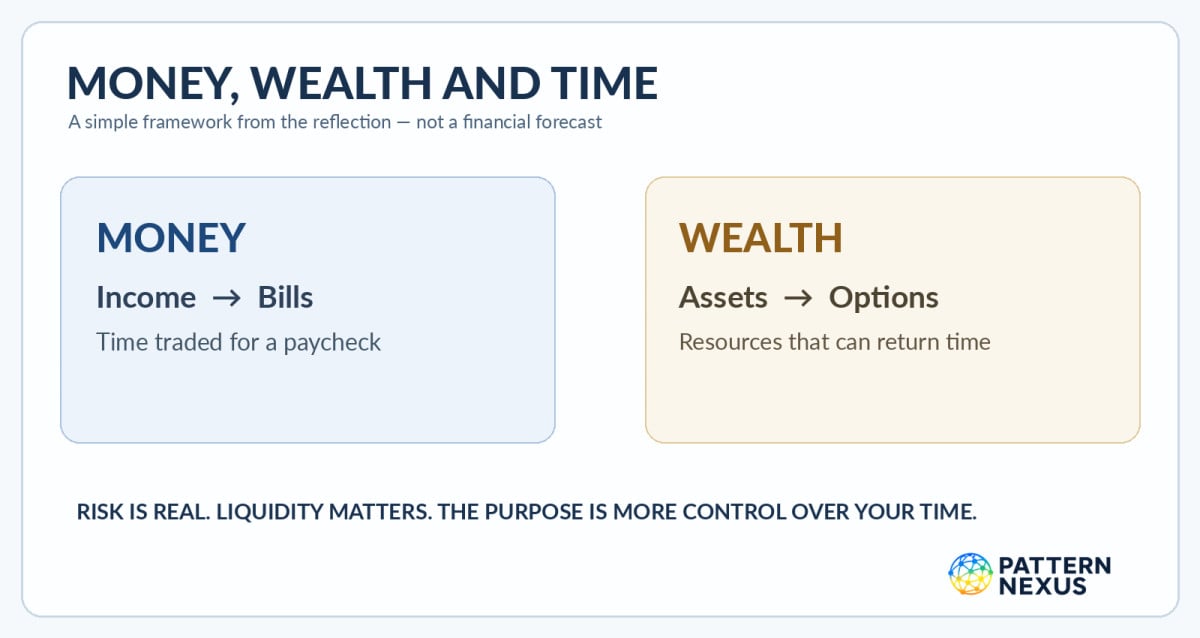
The objective is more control over your time. Risk, costs, and access to cash remain part of the calculation.
A higher house price doesn't tell me your life improved
This is where the money discussion meets the housing work.
A home can be worth more while its owner feels less secure. The insurance bill can rise. Taxes can rise. A major repair can arrive before the owner has the cash to pay for it. Selling may realize a gain but leave the family trying to buy another expensive home with more expensive financing.
That is part of the problem described in The Great Housing Plateau. The old expectation of moving smoothly from one step of life to the next runs into the way housing is financed and the cost of entering each new transaction.
The Coastal Housing Repricing Map follows regional pressures instead of pretending one national average describes every place. Housing in 2026: Prices Are High, but the Market Is Barely Moving examines why high prices and weak activity can coexist. The existing owner, new buyer, renter, and builder have different constraints, even in the same market.
An owner with a manageable fixed payment may be able to wait. A buyer has to qualify under today's terms. A builder holding finished inventory has carrying costs. The price at which somebody wants to sell is not automatically the price at which a transaction can happen.
That makes “Will housing go up?” an incomplete question. Where? Over what period? Measured in dollars, wages, gold, or monthly payments? Are you buying a place to live, evaluating a rental business, trying to refinance, or deciding whether you can afford to move?
The Household Maintenance Recession follows another part of the same problem: delaying work can preserve cash today while increasing the cost you face later. A household may appear to be keeping up because the deterioration hasn't reached the breaking point yet.
The Unrealized Gains Trap looks at the tension between assessed value and a real cash obligation. You can't pay every expense with the statement that your property is worth more. Something has to produce or release the cash, and doing that may create another cost.
So when I say wealth buys time, I don't mean you buy a building and time magically becomes free. I mean the objective is to create a structure that supports your life with enough margin to survive the things that go wrong.
That's a much more useful conversation than congratulating somebody on a bigger valuation while ignoring the bills attached to it.
The financial plumbing eventually reaches your kitchen table
People sometimes read a liquidity article and decide it has nothing to do with them. Repo. Reserves. Treasury cash. Reverse repo. It sounds like something that belongs to people in suits arguing over a Bloomberg terminal.
Then the same person asks why financing is expensive, why their mortgage quote didn't fall after a Fed announcement, or why asset prices moved before the economic news seemed to justify it.
Those questions are connected.
The early Calm Before the Liquidity Storm article and MBS repo analysis were attempts to follow funding conditions before the policy story became obvious. The Hidden Liquidity Crunch expanded that into the interaction between reserves, Treasury financing, the dollar, and the available backstops.
You don't have to memorize every abbreviation. Start with the transaction. Somebody needs funding. Somebody else has an acceptable asset, a balance sheet, or access to a facility. What price do they pay? How long does the funding last? What happens if the asset becomes harder to finance or the lender becomes less willing to provide the cash?
My bank-reserves explainer and quiz starts pushing readers below the ordinary headline description. Reserves are part of settlement inside the banking system. They are not simply household savings waiting to be handed to the next borrower. Balance sheets, funding costs, capital, collateral, regulation, and credit risk all matter.
The Reverse Repo Trap follows one part of that movement. The Short-End Liquidity Loop examines how bill issuance, Treasury cash management, spending, and reserve operations interact. Those operations have different purposes and different accounting effects. Calling all of them “printing” can hide the thing you're trying to understand.
The later Ample Reserves, Uneven Liquidity makes the question more precise again: the total amount in the system doesn't tell you whether the institution that needs funding can obtain it at the right time and price. Plenty in aggregate can coexist with friction in distribution.
The Liquidity-Gated Economy is my broader framework for thinking about access and flow. The 10-Year Decoupling follows why short-term policy relief may fail to produce the long-term borrowing costs people expect.
Now bring that back to a household or business. A loan matures. A buyer can't make the new payment work. A company delays an expansion. A contractor loses an expected job. A family puts off a repair.
I'm not claiming every one of those outcomes has a single monetary cause. I'm asking you to follow a channel that can reach all of them. Once you see the channel, you can start asking which other forces are helping it or pushing against it.
That's what the detail is for. Eventually, the financial plumbing reaches somebody's kitchen table.
Change the measuring stick and the story changes
The price of something is a relationship. We usually state that relationship in dollars and then forget to ask what happened to the dollar, the asset, or the person trying to buy it.
The original Hard Assets Follow Liquidity reconstruction tried to make that missing monetary context visible. As I explained earlier, the later research revised the strength of the claim. But the question remains useful: what are we measuring, and what else changed around the measurement?
Everything Bubble 3 looks at markets measured in gold. Gold Didn't Just Reprice—It Quietly Cut Housing in Half applies the same relative-value question to houses. A house can rise in dollars while falling in ounces of gold. That doesn't mean the homeowner received fewer dollars. It means the exchange relationship between two assets changed.
It also doesn't give you a law saying the ratio has to return to one old level on your preferred schedule. Gold and housing have different buyers, financing structures, carrying costs, and uses. A change of denominator can expose a question without supplying its answer.
The gold, liquidity, and governance-risk analysis follows some of the forces that can move the numerator and denominator differently. The $42 Illusion examines another layer: an accounting value, a market value, and the role an asset plays in a monetary system are not interchangeable measurements.
Then there is the difference between understanding a long-term role and understanding what can happen to a price next week. Silver Isn't Wrong—But the Risk Regime Has Shifted warned that vertical price behavior changes the risk. the subsequent silver update followed the leverage and liquidation mechanisms. A valid industrial use doesn't prevent an asset from becoming expensive, crowded, or vulnerable to forced selling.
The Bitcoin halving-cycle article connects issuance, miner economics, energy costs, liquidity, and a proposed reset path. The price level in that thesis is a forecast to evaluate. It isn't a number I can guarantee because the cycle looks familiar.
So “Where is gold going?” or “What happens to Bitcoin?” still brings me back to the beginning. What are you trying to understand? A price target? Purchasing power? A business model? A long-term allocation of resources? How much loss you could survive on the way to an outcome you believe in?
If you only want a number, you are leaving out most of the information that determines whether the number is useful to you.
The dollar is also a system you have to move through
The same problem shows up in arguments about whether the dollar is collapsing.
People can mean falling purchasing power, a lower exchange rate, reduced reserve use, a funding squeeze, or the disappearance of U.S. influence. Those are different claims. A person can be describing one of them while the other person is arguing about something else entirely.
In The Dollar Isn't Collapsing—It's Evolving, I examined the dollar as a network of liabilities, collateral, settlement, and global demand. Money as Software followed the ability to route, monitor, permit, or interrupt transactions. The number in an account matters, but so does the system through which you can use it.
The New Dollar Hierarchy then examined stablecoins, CBDCs, and tokenized money. My stablecoin Treasury-bid thesis and Synthetic Liquidity Engine articles followed how a digital instrument can connect back to conventional assets and financing relationships.
That means you have to look through the wrapper. Who issues it? What supports it? Who has a claim on what? How is it redeemed? Which institution controls access? Where can leverage appear? A new interface doesn't make those questions go away.
The GENIUS Act analysis examines the regulatory structure and reserve-demand argument. Stablecoins Are Becoming the Dollar's New Control Layer extends the discussion into distribution, compliance, and access. The idea is not that every digital dollar operates identically. It is that the institutional design changes what its users can do.
The articles on DTCC's tokenization framework and NYSE/ICE's proposed trading and settlement platform follow related changes in securities infrastructure. A proposal, a limited authorization, and a fully operating market are different stages. I want to know what has actually been built and which dependencies it carries forward.
the State Street investigation makes another useful separation: custody and administration are not the same as owning every asset being serviced. But providing the infrastructure for other people's assets can still create influence over how the market functions.
This connects directly to the wealth discussion. What you own is one question. Your ability to transfer it, finance it, redeem it, use it as collateral, or access it during stress is another.
You can argue about the future of money without looking at any of that. Plenty of people do. I don't see how you get a useful answer that way.
AI has to be built out of something
The AI discussion often begins and ends at the chat window. Somebody likes an answer. Somebody else finds a mistake. Then they decide whether the entire technology is useful or worthless.
Meanwhile, somebody has to build the physical system behind it.
The AI compute and power investigation follows the infrastructure. AI Isn't a Bubble—It's a Monetary-Industrial Engine develops my argument about capital moving into buildings, equipment, energy, and financing. You can dispute a company's valuation while still recognizing that physical construction is taking place. The usefulness of the infrastructure and the return earned by a particular investor are separate questions.
The private-grid article and GW Ranch investigation take the next step: access to electricity can govern how quickly computing capacity becomes usable. A chip order is not the same thing as an operating campus. A permitted power project is not the same thing as electricity already being delivered.
In America's New Map of Power, I examined where those constraints concentrate. The mega-regions and Midwest follow-up brings in land, water, logistics, existing infrastructure, and the regional consequences of industrial development.
That is how an AI article becomes a real-estate article. The location of a large industrial project affects construction demand, labor requirements, local services, land use, utilities, and potentially housing. The effect depends on the actual project and its stage. Announcing a giant number doesn't instantly create all the promised jobs or local wealth.
the copper investigation follows one of the material requirements. The Quartz Chokepoint and the Spruce Pine follow-up move farther upstream into the distinction between abundant raw material and a specific industrial grade that a manufacturing process needs.
You can have a shortage of a usable input without the planet running out of the element. Processing, purity, equipment, transport, and approved suppliers can be the bottleneck. That is why a map of deposits doesn't automatically tell you who can produce a finished technology.
Energy Isn't Spiking, Utilities Are separates prices that get bundled into the same everyday word. A household can hear that “energy is down” and still receive a higher utility bill. the small-reactor research follows technology options and development timelines, because a future reactor cannot solve a delivery problem before it exists.
Now we have gone from a chatbot to materials, manufacturing, electricity, construction, financing, geography, and a household's costs. That's not me wandering off topic. It's me trying to show you what the topic contains.
The subjects are connected through physical dependencies, financial relationships, institutions, and human choices. Editorial illustration.
A weather question can become a financing question
People sometimes wonder why the same website covers the polar vortex and the Treasury market.
The atmosphere doesn't need to care about the Treasury market for weather to affect the people financing an energy business. A physical event can travel through several systems before it appears in a financial headline.
My climate-circulation article laid out a broad systems view. The later polar-vortex work made particular parts of the question measurable. The September 1 early-organization report separated the geometry I was seeing from the wind-speed measurement. The September 6 follow-up examined whether the structure and the conventional metrics continued to develop. The September record update compared subsequent observations with the earlier work.
That sequence matters to me. I was looking at the structure early. You can read what I was looking at before the later coverage and compare it with what the measurements eventually showed.
But there is still work between seeing something unusual in the stratosphere and telling somebody what will happen in their yard. The Polar Vortex Test separates wind strength, geometry, circulation, historical comparisons, and regional cold delivery. Its simple seasonal models did not show dependable improvement over the baseline. That result belongs in the article too.
The October stretching update and November record-forecast comparison continue that separation between analyzed observations, model forecasts, and surface outcomes. A wind reversal on a forecast chart isn't an observed reversal. An observed upper-level event isn't a guarantee of a particular snowstorm in northern Illinois.
I want people to understand the early signal and the conditions still required for the next step. Otherwise, the interesting part of the research gets reduced to a claim I didn't actually make.
Then A Winter Energy Shock Could Become a Margin Call follows a different consequence. A producer can hedge future output and still need cash along the way if the financial contract requires payment before the higher physical-sale receipts arrive. The hedge and the financing calendar have to be examined together.
So the chain can run from weather into energy demand, delivered prices, a company's cash requirements, and its access to financing. There are conditions at every step. There are also places where the chain can weaken or stop.
If you ask me whether the world is connected, that's a concrete example. I don't have to claim the atmosphere is responding to the stock market. I have to show how people and institutions respond to the atmosphere.
A war doesn't stay inside the country on the map
Geopolitics gets flattened in a similar way. A leader says something. People decide whether they like the leader. Then the entire discussion becomes an argument about the person.
I want to know what has moved, what can be sustained, what routes are exposed, what decisions remain available, and what those decisions would require.
The Venezuela sequence starts with the October 2025 escalation analysis, then follows the Caribbean force buildup, the airspace warning, and the December flashpoint updates. The later Operation Venezuela report records the January event and separates reporting, operational claims, legal questions, and what remained unknown.
That is a sequence you can inspect. It isn't a claim that I knew every detail of an operation. The useful work was recognizing how the available options were changing and documenting the signals before the outcome.
The Iran research followed a related process. The January 12 decision-window article examined a reported briefing on military and other options. The January 14 follow-up tracked embassy posture, airspace, basing, communications, and potential retaliation. the February 28 escalation report and the subsequent day-by-day reconstruction then followed events as the situation developed.
You can be right that a decision window is opening without knowing which option will be selected or exactly when. That is why I keep the language attached to the evidence available at that point in the sequence.
Once physical disruption begins, the consequences don't all arrive at once. The Clock Starts at Hormuz examines that delay. A tanker already at sea, an inventory held near a refinery, a contract awaiting delivery, and a household buying fuel are exposed on different schedules.
The Oil Inventory War Machine asks how much of the apparent buffer is usable where it is needed. A global total doesn't tell you which grade is available, who controls it, which facility can process it, or how long it takes to arrive. The world can experience a serious local shortage while substantial stocks remain somewhere else.
The Fertilizer Strait extends the chain into agriculture. Disruption to inputs can affect purchasing decisions and planting before it appears in a harvest. High aggregate food production doesn't ensure that every importer or household can afford what it needs. Timing, location, currencies, and distribution remain part of the system.
The Oil War Is Becoming a Global Economic War investigation follows these relationships through energy, trade, inflation, demand, and financing. The Peace Premium examines how expectations of reduced conflict can travel through markets too. De-escalation also has to reach actual operations, enforcement, shipping, and supply.
Then the question comes back to your life. Does your business depend on delivered fuel? Are your customers cutting other spending because essential costs rose? Does a financing decision depend on rates falling at a particular time? Does the place you live rely on infrastructure with little spare capacity?
I can't answer every one of those questions by saying “war is bad” or “the market will recover.” I have to follow the connections and the delays.
And I don't need to invent secret coordination to do that. Two pressures can reinforce each other through ordinary contracts, physical constraints, and incentives. If I propose a deeper causal relationship, I still have to establish the steps.
History is part of the machinery we're still living inside
This is also why I spend time on history. The institutions around you didn't appear fully formed last week. They carry decisions, compromises, incentives, and dependencies inherited from earlier periods.
In WWII Was a Resource War Built on Credit, I followed financing, industrial inputs, sanctions, and access to resources. From Pearl Harbor to Petrodollar carries the investigation through surrender decisions, the postwar order, and the relationship between energy and financial power.
Those mechanisms tell you more about the conditions under which decisions were made. If you only learn the public justification, you can miss the material requirements that made a policy possible or made a position impossible to sustain. The financing, supplies, industrial capacity, and available alternatives belong in the explanation too.
The longer historical series follows a similar method across technology and money. The First AI Age uses the industrial expansion of 1870–1914 as a comparison for the present: new infrastructure, energy, productive capacity, financing, and the struggle over who benefits. The comparison doesn't require pretending nineteenth-century machinery was a modern language model.
The Dollar Fortress follows the postwar monetary arrangements. The Command Line brings in Cold War computing and the institutions behind the growth of information technology. Those histories overlap. Industrial capacity, public funding, military demand, private businesses, and financial arrangements developed together.
Then The Monetary Break follows changes to the dollar system; The Leverage Machine examines the expansion of financial leverage; and The Asian Liquidity Supercycle follows cross-border capital, debt, technology, and crisis. The institutional structure changes, but dependence on funding and access keeps reappearing.
The Housing Collateral Engine brings the chain back into mortgages and the global financial system. The QE Decade follows the response after the crisis. The Fiscal-Monetary Fusion examines the pandemic-era interaction between public spending, monetary policy, supply conditions, and the subsequent adjustment.
By the time you reach The Convergence, the subjects that looked unrelated at the beginning are sharing infrastructure, financing, and constraints. AI needs energy and capital. Governments need functioning debt markets. Households need income. Institutions want stability while pursuing objectives that can create new instability.
That is how I use history. I want to know what was built, why it was built that way, and which parts of it are still shaping the choices available now.
Repeating an old outcome isn't inevitable. Repeating a dependency can make a similar class of problem possible. The work is figuring out what carried forward and what changed.
The people shaping the system don't have to think like you
People use the word “elites” as if it describes a different kind of human being.
They're people. They have incentives, fears, ambitions, assumptions, and limits too. Some have far more resources and access than you. Some understand psychology and the human condition well enough to use that understanding against you. Their advantage doesn't require you to admire them.
It does help them if you never examine the mechanism.
Fragmented Society explores how different positions in the world can produce very different assumptions about what matters. A person trying to make rent and a person allocating capital across continents are not making decisions on the same scale or time horizon. If you imagine everyone is approaching the problem from your position, you can misunderstand what they're willing to do.
Tribalism as a Control System follows the use of identity, loyalty, spectacle, rewards, and exclusion. Those mechanisms can make a person defend a group even when the group's actions work against that person's stated interests.
Then technology makes the feedback faster. The Age of Algorithmic Influence examines what happens when attention can be measured and monetized. The Fractured Mirror and The Digital Mind Divide explore how repeated exposure and machine-selected information can shape the reality a person thinks everybody else is seeing.
Now bring that back to the comments under an article. Somebody sees a word associated with the wrong political camp, a reference to AI, or a conclusion they dislike. They respond to the category before they examine the argument.
That is exactly the kind of reaction an attention-driven system can reward. The person gets the feeling of defending something. The platform gets activity. Very little understanding has to occur for the interaction to be useful to either of them in the short term.
I disagree with people all the time. What frustrates me is the point where someone stops evaluating a claim because accepting any part of it would feel like betraying an identity. Then we aren't even discussing the information anymore.
What's Happening to Our World? follows the convergence of public policy, digital systems, sensors, identity, and institutional incentives. The documents are part of the evidence. So is what was actually implemented. A proposal printed in a document and a completed system operating exactly as proposed are different things.
You can criticize a real mechanism much more effectively when you understand it. Otherwise, you can spend your entire life being angry at a blurry idea while the specific rule affecting you goes unexamined.
Read the rules they wrote
I'm careful with my language because I want the argument to survive contact with the evidence.
I use institutional papers, their documents, their rules, and their own words. If I say an institution has a particular power, I want to be able to show you where it comes from. If I am interpreting the implications, I want that interpretation to remain visible as an interpretation.
Algorithmic Authority examines decisions made through scoring, eligibility, and risk models. A person doesn't always experience power as somebody ordering them to do something. They may experience it as a higher price, a rejected application, a restricted account, or a decision they can't get explained.
The Compliance Stack follows how requirements can condition access. Standards as Weapons asks who gains and who loses when compatibility and participation depend on a particular standard. A rule can serve a legitimate purpose and still impose costs or concentrate influence. You have to examine the implementation.
The Permission Stack connects those layers: identity, standards, information, financing, and access. The Modern Control System follows the relationship between financial networks and the ability to allow or deny participation across borders.
If you understand that structure, you can ask practical questions. Who makes the decision? What evidence do they use? Can it be challenged? Is there an alternative route? What happens when the decision is wrong? Does the system preserve a way to correct itself?
That's what I mean when I talk about using the system and its institutions to your advantage. Learn the financing rules before you sign. Learn the requirements before you build. Learn where a decision can be appealed. Use the source document when somebody gives you an explanation that doesn't match it.
There is more leverage in understanding a specific rule than in repeatedly announcing that the whole world is rigged.
And criticism should lead somewhere. The 90-Day State is my attempt to think through a different governance structure, including the risk that the qualification process or permanent bureaucracy could capture it. It is a proposal with failure conditions. I don't get to assume my own design is immune to the problems I identify in other people's systems.
If I invent a claim because it makes the article more dramatic, I give somebody an easy way to attack the work. Then we spend the conversation arguing about the invented part while the documented mechanism disappears underneath it.
I would rather make the argument carefully enough that you can take it apart, examine it, and decide whether it holds.
What happens when your time is no longer the scarce thing?
The money-and-wealth question becomes harder when technology changes what your time can earn.
I know what hard work is. I've done physical work for years. I manage things, repair things, learn things, and figure out how to make things function. I'm not dismissing effort when I say effort alone doesn't determine the reward.
The system determines what somebody will pay for that effort. Technology can change the available supply of a task, the time required to perform it, and the ownership of the resulting output.
Why Hard Work Won't Save Gen Z in the AI Era challenges the idea that telling people to work harder is a complete response to that change. Why Most People Won't Adapt to AI—and Why Polymaths Will develops my view that the ability to learn across fields and direct tools matters more as execution becomes easier.
The tool still needs a useful objective. Somebody has to recognize an error, know which constraint matters, and understand what a finished result is supposed to accomplish. Producing more material doesn't automatically mean producing more value.
The Pattern Exercise follows the compression of a workflow. The humanoid-robotics investigation extends the question into physical labor and machine ownership. The economic consequences depend on reliability, cost, deployment, supervision, maintenance, and what work the machines can actually perform. A demonstration doesn't instantly become an entire automated economy.
But you can examine the direction of the incentives before the transition is complete. If a machine can produce for longer, at a lower total cost, the owner has a reason to deploy it. The person selling the displaced task has a reason to worry. Those positions exist inside the same productivity story.
The End of Human Primacy explores a possible future in which the range of machine capabilities expands much further. Its horizon remains a scenario. The practical question today is what happens to bargaining power as more tasks become reproducible through systems owned by somebody else.
The Two- or Three-Speed Economy and The K-Shaped Recovery investigate the distribution problem. Growing output and a better life for every household are not interchangeable outcomes. People need some way to participate in the income, ownership, or public provision supported by that output.
The Recession Path connects income, consumption, investment, and credit. A technology boom can create real productive capacity while leaving a vulnerability if the expected customers cannot sustain the spending on which the financing depends.
That is why I keep bringing this back to your children and your legacy. What are you teaching them to understand? Only how to follow a procedure? Or how to learn, question, build, repair, adapt, and recognize where the rules are changing?
I can't promise that learning those things removes every disadvantage. I do believe it gives a person more ways to respond than waiting for somebody else to explain why the old plan stopped working.
Yes, I use AI. Read the work
The complaints about AI are exhausting. They're annoying. I know how to filter them. I can ignore them, delete them, or decide not to engage. That doesn't make the underlying pattern less frustrating.
Somebody sees a long article, notices AI somewhere in the production process, and thinks they've evaluated the research.
What did you evaluate? The source? The calculation? The chronology? The conclusion? Or did you decide the tool was enough to dismiss everything attached to it?
The writing process itself is something I've already discussed in The AI Is the Same. The System Isn't. I have to translate what I'm thinking into language. I use tools to help research, organize, analyze, code, and communicate. I also have to correct those tools when they lose the meaning or produce something that doesn't hold up.
A confident sentence from a model isn't evidence. Neither is a confident sentence from a human. The source still has to say what the article claims it says. The data still has to support the calculation. The reasoning still has to get from one step to the next.
I am also a data scientist. I can work with datasets, test relationships, and present the results. I want you to be able to examine the inputs and method rather than depend on whether you like the presentation.
I've been concerned with the ethics and accountability of these systems since the 2022 paper. Using the technology doesn't require pretending its failures disappeared. It requires enough understanding to recognize where it can help and where the output needs to be checked or rejected.
If there's a mistake in an article, show me the mistake. That's useful. If the link doesn't support a sentence, point to the sentence. If the model uses a bad assumption, identify the assumption. That gives us something to improve.
But calling a detailed, sourced investigation “clickbait” without reading it doesn't tell me what is wrong with the investigation. It tells me the conversation never reached the work.
And I don't want AI to turn my own thoughts into generic language either. If I dictate something personal and get back a smooth explanation that sounds like everybody else, the tool has failed the job. I want help expressing what I'm saying. I don't want the meaning replaced with whatever sounds most conventional.
Information should be accessible. Producing it still takes work
I don't think information should be gatekept. I think people should be able to understand the systems they live inside without needing a research department, an institutional account, or somebody else's permission to ask a serious question.
There are entire research firms, hedge funds, and teams of analysts paid to study many of the subjects I work through in public. I'm trying to aggregate information, connect it, and make it useful to people who don't have those resources.
Most of this work has cost me money. The website costs hundreds of dollars to operate. The research, charts, coding, maintenance, and time answering people have costs too. A post being free to read doesn't make it free to produce.
I'm not doing this because I need to extract a few dollars from you. I want the work to exist, and I want people to be able to use it. I also want it to last. The Support Pattern Nexus article explains how public research, memberships, books, and other support fit together. Some reports and features are paid. The public archive remains a substantial part of what I'm building.
I don't want to pretend those costs disappear, or that charging for part of the work means the purpose of the whole thing is deception. A durable project needs a way to keep functioning.
The Pattern Nexus Worldview book puts the broader framework into one sequence: money and wealth, monetary systems, assets, energy, compute, chokepoints, society, and what comes next. I recommend it because it connects material that can otherwise feel scattered across hundreds of articles.
I've put a lifetime of studying and connecting things into that framework. On a physical copy, my share is roughly fifteen dollars by my estimate; production and other costs account for much of what the reader pays. I didn't write it because I thought each sale would somehow compensate me for all the years behind it.
You can also spend a very long time reading the public work without buying anything. Follow the links in this article. Read the earlier argument. Check the source document. Compare it with the update.
You are all stakeholders in this world. In the broad sense I was getting at when I said “shareholders,” you have something at stake in how it functions—even if you don't own a single share of a company. Your time, your work, your family, and your future are inside it.
I'd like you to have a better understanding of what you're participating in.
The point of building wealth was supposed to be a life
I can spend thousands of words connecting money, technology, energy, institutions, and war. Eventually I want to bring it back to something human.
What are you trying to build with the time you have?
When I ask about your legacy, I don't just mean the amount in an account after you're gone. I mean what you understood, what you made possible, what you taught somebody, and what still works because you took the time to build it properly.
Echoes of the Builder follows that idea beyond ownership and reputation. A useful thing can outlast the person who made it. The work can become part of somebody else's starting point.
The Weight of Time asks whether what we build can continue. A business that depends on one person remembering everything has a different kind of durability from one whose processes can be understood and carried forward. The same is true of knowledge. If the reasoning only exists in my head, other people can't inspect it, adapt it, or improve it.
That's one reason I write so much of it down.
The Architecture of Resilience connects building with the ability to recover when conditions change. The corresponding audio-video edition develops the transfer of that process: how people learn from failure, reduce dependencies, and preserve the ability to rebuild.
You can lose a favorable market. You can lose a customer, a platform, a financing source, or a way of doing things that used to work. Knowing how to diagnose the problem and construct another path is valuable in a way an impressive-looking number doesn't fully capture.
But I don't think life should become an endless contest to optimize every minute either. The Value of Stillness examines what happens when constant reaction crowds out thought. If the purpose of wealth is to buy time, there ought to be something worthwhile you want to do with that time.
The pressure behind Why I've Been Quiet is part of that conversation too. Covering several systems at once, trying to express them accurately, and answering people takes attention. Having more information available doesn't automatically create more capacity to absorb it.
I don't want somebody to read this and decide the answer is to panic harder, work without stopping, or spend every day watching a chart. I want the knowledge to give you more room to make choices.
Build something that works. Understand enough to maintain it. Teach somebody how it works. Leave them with a method they can use when the circumstances are different from yours.
That's a legacy I can understand.
I don't need you to think like me
The framework for how modern systems work runs through all of this, but I don't want you to inherit it as another fixed opinion you're supposed to defend.
I don't want you to think like me. I don't want you to agree with me.
I want you to become a critical thinker. That's all.
Question what I say. Question what the institutions say. Question what your preferred commentator says. And question your own starting assumptions with the same energy you bring to everybody else's.
When you disagree, find the part you disagree with. Is the data wrong? Is the relationship weaker than I think? Did I leave out a constraint? Am I treating a possible outcome as more likely than the evidence warrants? Those are conversations worth having.
There are more than a hundred linked pieces of my work throughout this reflection because the subjects I mentioned are starting points. Each one opens into a deeper investigation. You don't have to read them all today. Start with the question that affects your life, and follow it until you understand more than the headline.
Then do something useful with what you learn. Make a better decision. Build something. Improve a process. Help somebody understand a problem. Give your children a better starting point. Preserve enough time to have a life with the people you care about.
If you ask me what happens next, I'll do my best to answer.
But I'm still going to ask you: What do you actually want to know? And why?
Article overview
People ask me what happens next. I want to know what they intend to do with the answer. A personal reflection on the research, the work, the systems we live inside, and the lives we are trying to build.
Qual é a sua reação?
 Curtir
0
 Não gostei
0
 Amor
0
 Engraçado
0
 Uau
0
 Triste
0
 Bravo
0

Nexus (Christopher)
Founder of Pattern Nexus. I research markets, macro, geopolitics, AI, history, ancient systems, and the patterns most people overlook. I’m also building Market Radar, a trading scanner designed to read pressure, risk, confirmation, and setup quality before ch…
Related research

We Are Going to Fight Each Other Over AI
I showed how people on both sides react to an edited clip. Now apply the same test to AI, the humanoid robots going into workplaces, and th…
3 shared assets.
Everything Bubble 3 — Markets Priced in Gold Reveal
Pricing markets in gold through October 29, 2026 exposes the dispersion beneath nominal records, near-record leverage, high-rate reserve su…
3 shared assets.
From Liquidity Storm to Chokepoint War: Auditing 472 Pattern Nexus URLs — What Landed, What Missed, and What Comes Next
I audited the public Pattern Nexus record across 472 unique URLs and the saved full-text article export, then rebuilt the major calls from …
3 shared assets.
Everything Bubble 3 — Markets Priced in Gold Reveal the Structural Melt-Up Ahead
Pricing markets in gold through August 4, 2026 exposes the hidden structure behind nominal records, margin debt, liquidity, debt and the Ev…
3 shared assets.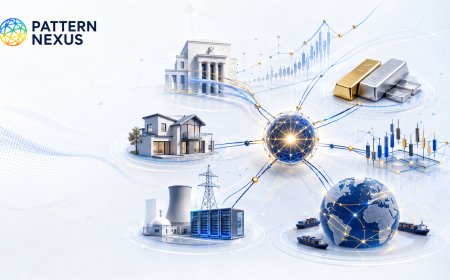
Pattern Nexus Macro Archive: 328 Timestamped Articles, October 2025–July 2026
A guided public index of 328 timestamped Pattern Nexus articles covering Federal Reserve liquidity, interest rates, the dollar, gold and si…
4 shared assets.
The World Is Not Normal Anymore
A broad system-level look at the Middle East war, markets, money, Bitcoin, AI, control systems, and why the world order now appears to be s…
1 shared topic, 3 shared assets.
Mar 5, 2026 Market Wrap (8:40 PM): VIX Won’t Relax, Gold Leads, and the Hormuz “Control Valve” Stays Partially Closed
Indexes tried to hold together, but the hedges kept talking: VIX stayed bid, gold/silver stayed firm, and the Gulf shipping/insurance layer…
3 shared assets.
The Regime Reset Stack: Yield Curve Strategy, Dollar Rails, Metals Convexity, and the AI-Fiscal Endgame
A Pattern Nexus control-systems read tying the yield curve, dollar regime, metals, crypto, and equities into one machine: why inversions le…
1 shared topic, 3 shared assets.
Comentários (0)
Security Check
Please complete the captcha to verify you are human.